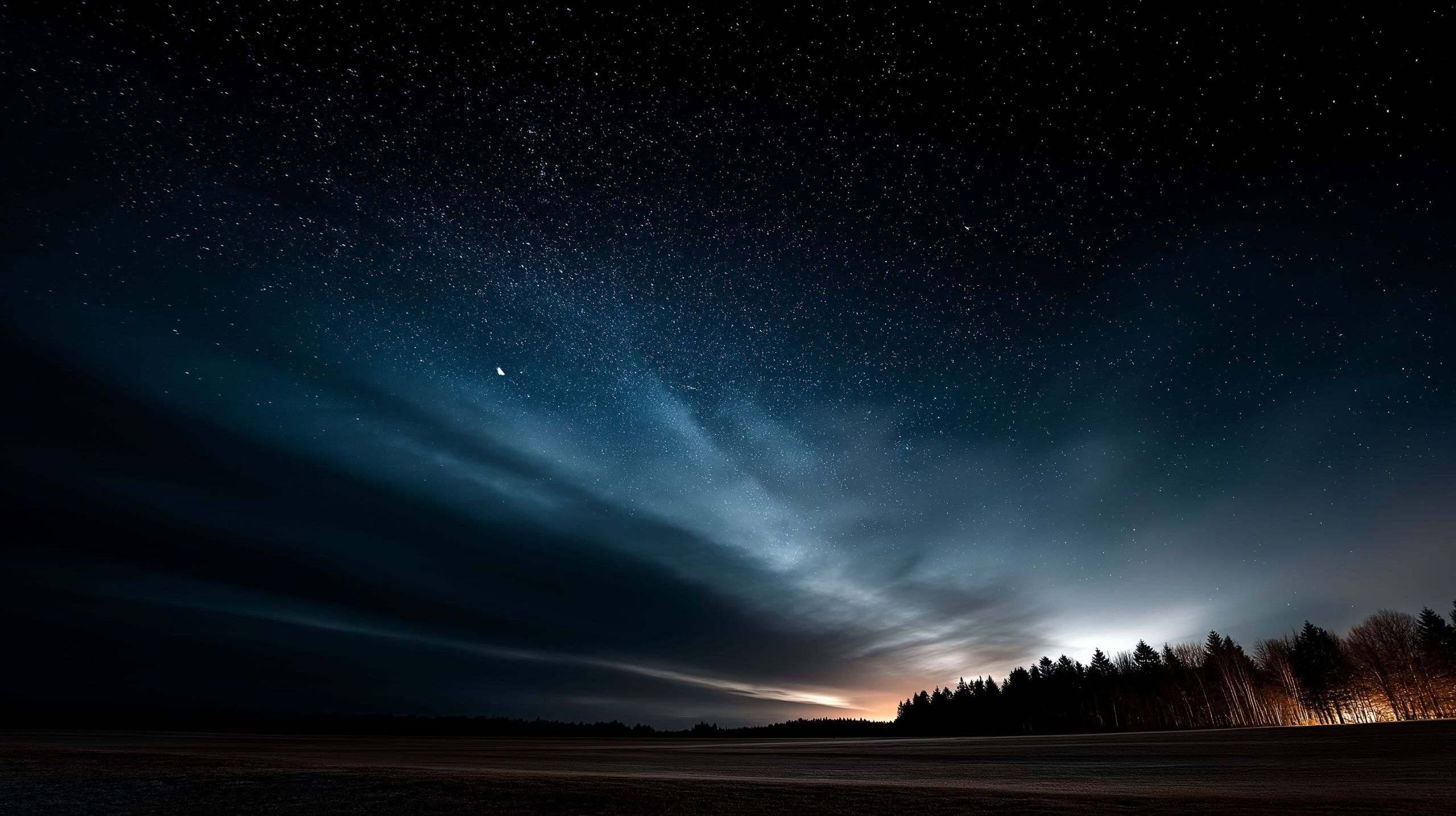
If you’ve been waiting for a truly dark December evening to step outside and let your eyes drink in the stars, tonight is one of the best opportunities of the month. The Moon is in a very thin waning crescent phase, sliding toward a late-week new moon—meaning the night sky is largely free of moonlight. Time and Date+1
And the timing couldn’t be better: bright Jupiter is commanding the night, Saturn is still holding its place after sunset, and the annual meteor-shower baton pass is underway, with the Geminids fading out and the Ursids ramping up toward next week. Planetary Society+2Live Science+2
Below is a detailed, practical guide to what to see in the night sky today—plus a round-up of the major astronomy and space headlines dated December 17, 2025, so your stargazing comes with context.
Tonight’s sky in one minute
Here’s the fast version of what matters most tonight:
- Moon: a slim waning crescent (only a few percent illuminated), setting relatively early and leaving a darker sky for evening observing. Time and Date+1
- Best darkness: from late evening through pre-dawn, with a brand-new Moon arriving late on Dec. 19 in U.S. time zones (Dec. 20 in UTC). Time and Date+1
- Planets: Jupiter dominates the night; Saturn shines in the west in early evening; Mercury is the morning “bonus planet” low near the sunrise glow. Planetary Society+2EarthSky+2
- Meteor showers: the Geminids are in their final hours, while the Ursids are beginning their climb toward a Dec. 22 peak. Live Science+2Space+2
Moon phase today and why tonight is a dark-sky sweet spot
On December 17, the Moon is a waning crescent, hovering at only a small fraction of illumination—great news if you’re trying to see faint stars, the Milky Way structure, or subtle meteor streaks. A representative real-time lunar readout shows the Moon at about 6% illumination today, with the next new moon arriving Dec. 19 in U.S. local time. Time and Date
EarthSky’s December sky guide pins the moment of new moon at 1:43 UTC on December 20, 2025 (which corresponds to the evening of Dec. 19 in North American time zones). EarthSky
A quiet lunar milestone happens today: apogee
Today also features a behind-the-scenes Moon event that matters more than it sounds: the Moon reaches apogee—its farthest point from Earth—at 6 UTC on Dec. 17, at a distance of 252,476 miles (406,322 km). EarthSky
While apogee doesn’t create a dramatic visual change for most casual observers, it’s part of why this week’s lunar cycle is especially friendly to stargazing: less bright moonlight, earlier moonset, and longer stretches of truly dark sky.
Visible planets tonight: Jupiter rules, Saturn lingers, Mercury shines at dawn
If you’re searching for the “headline planet” of the night sky today, it’s Jupiter—bright enough to look almost unreal on a clear night.
Jupiter: the bright beacon of December evenings
The Planetary Society’s December skywatching guide notes that very bright Jupiter rises in the east in the evening and dominates the sky through the night. Planetary Society
EarthSky adds that Jupiter remains visible through dawn and is heading toward opposition on January 10, 2026, when it will be at its biggest and brightest for the season. EarthSky
How to enjoy Jupiter tonight
- With naked eyes: look for the brightest “star” in the evening sky.
- With binoculars: you can often spot the four Galilean moons as tiny points near Jupiter.
- With a small telescope: Jupiter’s cloud bands become obvious, especially when the air is steady.
Saturn: the steady golden planet in the west after sunset
Saturn remains the “early evening planet,” glowing with a calmer, yellowish light. The Planetary Society describes Saturn high in the early evening west this month. Planetary Society
A location-based night-sky listing (New York example) notes Saturn can be visible for hours after sunset, generally setting before midnight. Time and Date
Mercury: catch it before sunrise, and today it has company
Mercury is notoriously elusive—but December 2025 is one of its more cooperative windows, especially in the Northern Hemisphere.
EarthSky highlights that on the morning of Dec. 17, the thin crescent Moon lies near Mercury, with the bright star Zubenelgenubi nearby—an easy-to-love “mini grouping” if you have a clear horizon about 40 minutes before sunrise. EarthSky
The Planetary Society also points out Mercury is visible low in the pre-dawn during the first half of the month, peaking around its greatest elongation window. Planetary Society
Venus and Mars: mostly out of the game right now
If you’re wondering why you can’t find Venus or Mars easily, it’s not you.
- EarthSky notes Venus is nearly behind the Sun and reaches superior conjunction in early January, returning to better visibility later. EarthSky
- A location-based sky report indicates Mars is extremely close to the Sun and can be difficult or impossible to observe. Time and Date
Uranus and Neptune: binocular challenges for patient observers
If you have binoculars or a telescope and want a “treasure hunt,” you can go beyond the naked-eye planets:
- Uranus can be visible after sunset and through much of the night, but typically requires binoculars. Time and Date
- Neptune is faint and also generally needs binoculars or a telescope, visible after sunset in early night hours depending on location. Time and Date
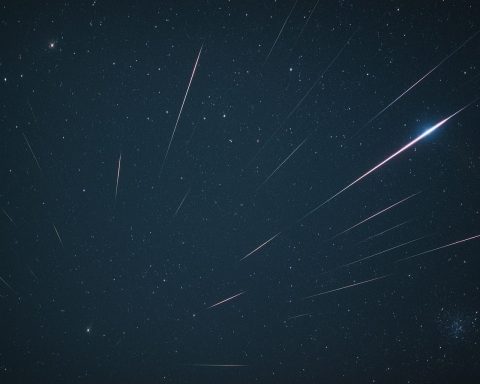
Meteor showers tonight: the Geminids fade out as the Ursids warm up
Geminids: last call today
The Geminid meteor shower—often called the year’s best—peaked a few nights ago, but tonight is still relevant because it’s effectively the final day of activity.
A Live Science report states the Geminids are active through Dec. 17, though rates drop quickly after the peak. Live Science
NASA’s December skywatching guide confirms the peak was Dec. 13–14, with meteors appearing near Jupiter’s part of the sky. NASA Science
How to watch tonight:
If you’re going out specifically for meteors, the best approach is simple: find the darkest place you can, give your eyes time to adjust, and watch a wide patch of sky rather than staring at one point.
Ursids: the underdog shower is starting now
The Ursids are not usually a meteor “fireworks show,” but they have one huge advantage this year: dark skies near new moon.
- The American Meteor Society lists Ursid activity from Dec. 13–24 with a sharp maximum on Dec. 22, predicting peak timing near 10:00 UT and noting the Moon won’t interfere much. American Meteor Society
- The International Meteor Organization gives a slightly narrower activity window of Dec. 17–26, also peaking Dec. 22 around 10:00 UT. International Meteor Organization
- Space.com summarizes the Ursids as active into late December and emphasizes that the best viewing is typically late evening Dec. 21 through dawn, with dark skies in 2025 thanks to the new moon timing. Space
Tonight’s takeaway: if you see a few meteors, you could be catching the Geminids’ final flickers and the Ursids’ opening act in the same night.
What constellations to look for tonight: classic December skies
December nights are long, crisp (in many regions), and packed with famous star patterns.
A helpful way to think about December stargazing is: planets for the “wow,” constellations for the “wander.”
Orion and the winter sky lineup
Orion becomes increasingly prominent in the evening as December progresses, and it anchors a region full of bright stars and easy-to-spot shapes. The Planetary Society specifically mentions Jupiter shining near the Winter Hexagon region of bright stars, a useful mental map when you’re learning the sky. Planetary Society
A quick planet-finding tip that always works
BBC Sky at Night Magazine reminds observers that visible planets stay close to the ecliptic, the line the Sun follows across the sky—so if a bright object is far from that path, it’s probably a star, not a planet. Sky at Night Magazine
Space and astronomy news from December 17, 2025
If you’re publishing on Google News and Discover, context matters: readers aren’t only looking up—they’re also following the story of how we explore and understand what’s up there. Here are the key space and astronomy headlines dated December 17, 2025, and why they matter.
Europe’s Ariane 6 launches Galileo satellites
Arianespace announced that on December 17, 2025, an Ariane 6 rocket successfully placed two Galileo satellites into orbit for ESA, supporting Europe’s navigation satellite system. The launch occurred at 5:01 a.m. UTC, and the satellites were inserted into medium Earth orbit at roughly 22,922 km altitude. Newsroom Arianespace
Why it matters: Galileo underpins positioning and timing services used by billions of devices—one of the most “everyday” ways space infrastructure touches life on Earth. Newsroom Arianespace
A sharper look at a fast-spinning supermassive black hole
The Center for Astrophysics | Harvard & Smithsonian released news from December 17, 2025 reporting what it calls the sharpest-ever X-ray spectrum of an iconic active galaxy, using a set of telescopes including XRISM (a JAXA/NASA mission). The report describes isolating features like a broadened iron emission line used to probe the environment near a rapidly spinning supermassive black hole. Center for Astrophysics
Why it matters: “Black hole spin” sounds abstract, but it’s a key clue to how black holes grow and how they interact with surrounding matter over cosmic time. Center for Astrophysics
A “superkilonova” candidate: a cosmic blast that may have happened in two steps
Scientific American reported on December 17, 2025 that astronomers may have identified a never-before-seen kind of cosmic explosion—a possible “superkilonova”—that could combine a supernova and a kilonova-like event. The article describes a scenario where a collapsing massive star could form two neutron stars that later merge, producing a second explosive signal. Scientific American
Why it matters: If confirmed, this would expand the known “zoo” of cosmic explosions and deepen the link between gravitational-wave detections and traditional telescope astronomy. Scientific American
A double-tailed exoplanet spotted by JWST
EarthSky published a December 17 report on WASP-121 b, described as an “ultra-hot Jupiter” about 880 light-yearsaway, showing two helium tails extending more than halfway around its orbit—an unusual structure that researchers are still working to explain. EarthSky
Why it matters: This kind of atmospheric escape is one of the ways planets can transform over time—potentially shrinking from gas giants into smaller worlds. EarthSky
Interstellar comet 3I/ATLAS: the daily feed ahead of its close approach
Space.com published a live update page dated December 17, 2025 tracking interstellar comet 3I/ATLAS ahead of its Dec. 19 close approach to Earth, noting it will pass at roughly 168 million miles (270 million km). Space+1
NASA’s comet overview page reiterates the object is interstellar (a hyperbolic orbit), is only the third known interstellar visitor discovered, and will remain far away—about 1.8 astronomical units at its closest to Earth. NASA Science
Why it matters for skywatchers: Even if you won’t spot it easily without gear, the comet is a rare “right now” story—an object from another star system passing through our neighborhood, with professional and amateur astronomers watching closely. Space+1
Practical stargazing checklist for tonight
To get the most out of the night sky today—whether you’re casual or committed—use this quick setup:
- Give your eyes 20–30 minutes to adapt to darkness (avoid bright phone screens). Sky at Night Magazine+1
- Start with Jupiter as your anchor, then work outward to Saturn and star patterns. Planetary Society+1
- If you want meteors: dress warmer than you think you need, recline, and watch broadly rather than hunting one constellation. Live Science+1
- If you want Mercury at dawn: find a clear eastern horizon and look about 40 minutes before sunrise. EarthSky+1
Bottom line for December 17, 2025
Tonight’s night sky is a rare blend of dark conditions and bright, easy targets—ideal for everyone from first-time stargazers to experienced observers. The Moon is thin, Jupiter is bold, Saturn is still visible early, and meteors remain possible as one shower winds down and another quietly starts to build. American Meteor Society+3Time and Date+3Pl…
If you’d like, tell me your city (or latitude/hemisphere), and I’ll tailor this into a tighter “exact times and directions” version for your location—still in article format and still Discover-friendly.