
NEW YORK, August 9, 2026, 15:07 EDT
- Nu ended Friday trading at $13.84, a decrease of 3.42% over the week and 17.32% lower since the start of the year.
- The company is scheduled to report its second-quarter results after Thursday’s market close. An initial projection puts revenue at $5.3858 billion with EPS at $0.1984.
- The main measure is risk-adjusted earnings, following a 33% rise in loan-loss provisions during the first quarter.
Nu Holdings faces a tougher challenge than customer gains as it prepares to report on Thursday. U.S. markets will be shut on Sunday. Investors are looking for evidence that increased lending continues to generate sufficient returns after factoring in anticipated losses.
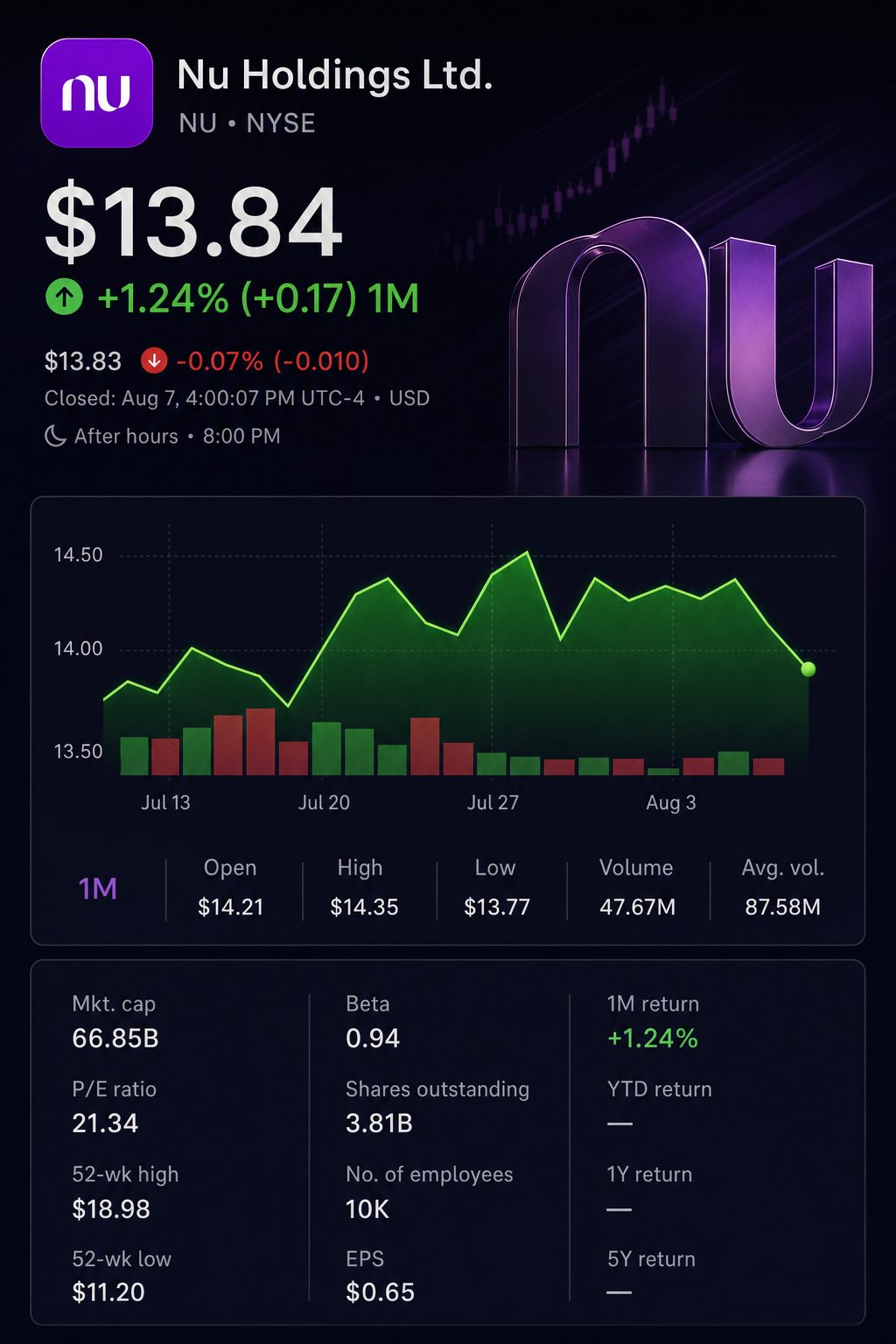
The stock closed Friday at $13.84, having declined 3.42% across five sessions and 17.32% so far this year. Last week, Nu was positioned between regional fintech firms and major Brazilian banks.
| Company | Friday close | Five-day change | 2026 change |
|---|---|---|---|
| Nu Holdings Ltd. NYSE:NU | $13.84 | -3.42% | -17.32% |
| StoneCo Ltd. NASDAQ:STNE | $10.60 | -6.81% | -28.33% |
| MercadoLibre Inc. NASDAQ:MELI | $1,820.69 | -3.05% | -9.61% |
| Itaú Unibanco Holding SA preferred BVMF:ITUB4 | R$40.75 | -4.99% | +3.87% |
| Banco Bradesco SA preferred BVMF:BBDC4 | R$17.31 | -6.08% | -4.84% |
Nu’s balance sheet offers clearer evidence. In the first quarter, credit expanded 40% year-on-year, while deposits rose 22%. This resulted in an 18 percentage point difference, causing the loan-to-deposit ratio to climb by 9.8 percentage points compared to a year earlier.
The trade-off became evident soon. Credit-loss reserves climbed 33% from the prior quarter, as the portfolio expanded by 7%. The risk-adjusted net interest margin dropped 100 basis points to stand at 9.5%.
| Credit-conversion measure | Q4 2025 | Q1 2026 | Change or investor reading |
|---|---|---|---|
| Credit portfolio | $32.7 billion | $37.2 billion | Up 7% from previous quarter; up 40% from a year earlier |
| Deposits | $41.9 billion | $42.4 billion | 22% higher year on year; credit growth outpaced deposits |
| Loan-to-deposit ratio | 49.1% | 58.3% | Increase of 9.2 percentage points |
| Credit-loss allowances | — | $1.79 billion | Rose 33% from prior quarter |
| Risk-adjusted NIM | 10.5% | 9.5% | Drop of 1.0 percentage point |
| NPL ratio, 15–90 days | 4.1% | 5.0% | Higher by 0.9 percentage point |
| NPL ratio, 90-plus days | 6.6% | 6.5% | Down 0.1 percentage point |
Thursday will serve as a test for credit conversion. Simply surpassing revenue expectations might not be enough. Nu reports that early-stage delinquencies typically reach their high point in the first quarter. The current seasonal decline is significant.
Nu plans to publish its results following the close on August 13, with a conference call slated for 6 p.m. EDT. Early MarketBeat consensus projects revenue at $5.3858 billion and EPS at $0.1984.
| Reporting period or estimate | Revenue | EPS | Status |
|---|---|---|---|
| Q2 2025 official result | $3.6685 billion | $0.1300 diluted | Reported; accounting profit and loss |
| Q1 2026 official result | $5.3155 billion | $0.1776 diluted | Reported; managerial revenue basis |
| Q2 2026 MarketBeat consensus | $5.3858 billion | $0.1984 | Early consensus |
The revenue numbers cannot be directly compared. Nu began presenting its managerial profit-and-loss results starting with the fourth quarter of 2025. For the first quarter, managerial revenue posted was $5.3155 billion, while revenue under its accounting approach was $4.968 billion.
Based on the managerial headline, the forecast suggests sequential revenue growth of just 1.3%. Earnings per share are expected to increase by 11.7% quarter-on-quarter and by 52.6% versus the previous year. This increases the focus on asset quality.
The benchmark for delinquency is established. During the second quarter of last year, 15–90-day NPLs stood at 4.4%, while loans overdue by more than 90 days recorded a ratio of 6.6%. For the first quarter of 2026, the figures came in at 5.0% and 6.5%, respectively.
Chief Executive David Vélez said Nu’s AI-driven credit models enabled the company to expand credit limits “with resilience, not just speed.” The delinquency numbers due Thursday will put that assertion to the test. Nu International
Mexico offers a potential counterbalance. The unit achieved break-even in the first quarter, surpassing 15 million clients. Greater input from this market might ease potential strain on Brazil’s post-loss spread.
Analysts are split in their views. Out of 22 analysts polled, the consensus is a Buy recommendation with an average price target of $17.98, indicating potential upside close to 30%. However, projections span from $10 to $22.
| Date | Firm and analyst | Recommendation action | Current rating | Target | Versus $13.84 |
|---|---|---|---|---|---|
| July 7 | JPMorgan Chase & Co. NYSE:JPM, Yuri Fernandes | Target increased | Overweight | $20 | +44.5% |
| June 26 | Needham & Co., Kyle Peterson | Started coverage | Buy | $17 | +22.8% |
| June 15 | Citigroup Inc. NYSE:C, Gustavo Schroden | Rating lowered | Neutral | $13 | -6.1% |
| June 3 | Susquehanna, James Friedman | Rating lowered | Neutral | $13 | -6.1% |
| June 2 | Bank of America Corp. NYSE:BAC, Mario Pierry | Rating lowered | Underperform | $10 | -27.7% |
| May 20 | UBS Group AG NYSE:UBS, Thiago Batista | Target cut | Buy | $17 | +22.8% |
The latest recommendation information is sourced from Benzinga. Upside and downside percentages are calculated using Friday’s close.
The dispute goes beyond concerns about credit risk. Rob Livingston took over as chief financial officer on July 13, with Guilherme Lago, the former CFO, staying on as an adviser until August 31. Bank of America set its $10 target after the leadership change was announced.
Risks: Accelerated growth in unsecured lending may result in increased delinquencies and higher allowances. Fluctuations in currency rates could affect growth measured in dollars. Spending in Mexico, Colombia and the United States might postpone realization of operating leverage.
A straightforward bullish outcome demands more than just accelerated revenue; early delinquencies must decline, late-stage defaults remain steady, and risk-adjusted NIM rebound. Absent those factors, Nu’s fast-paced loan expansion could become costly.
Related articles: NYSE:NU