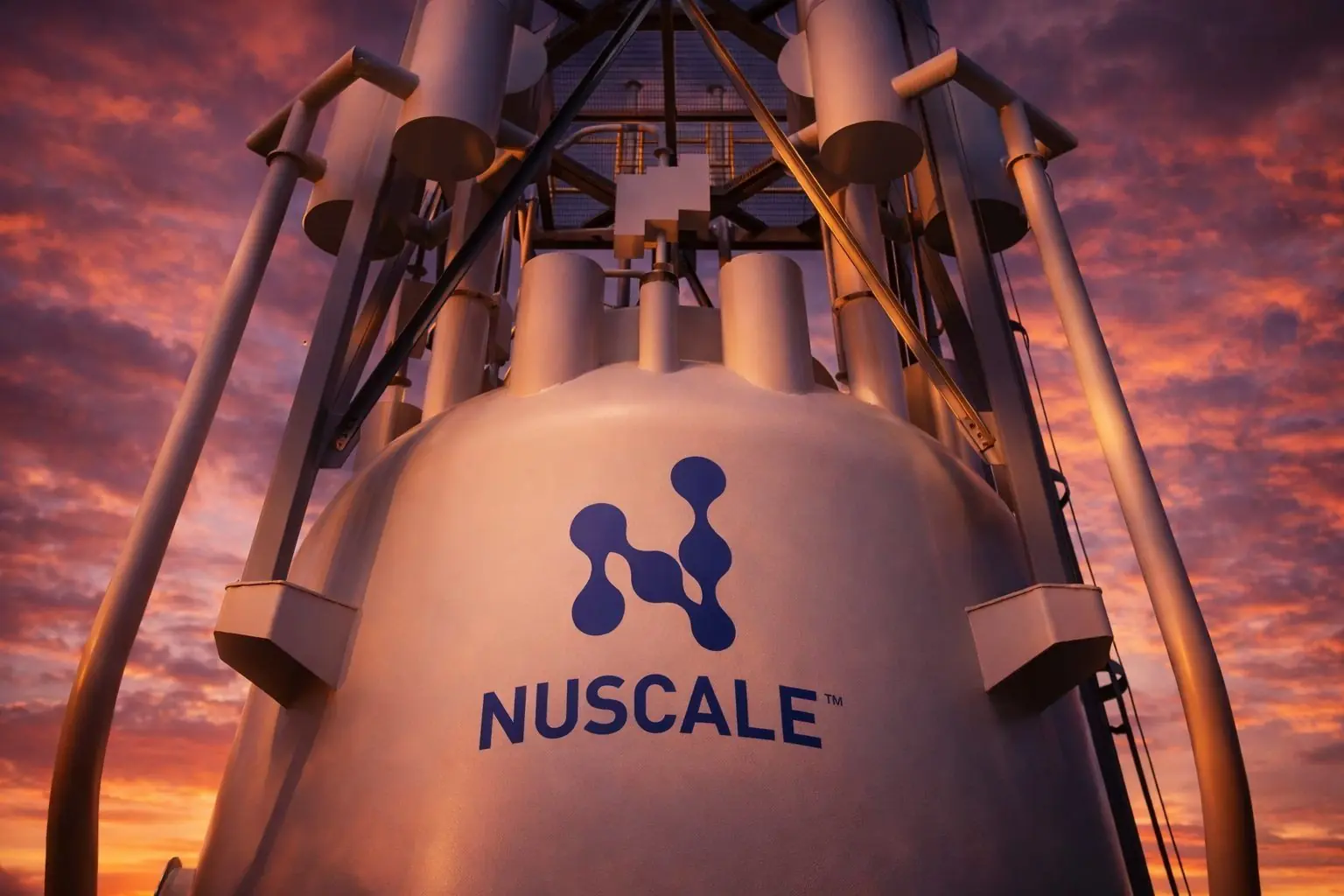
New York — As of 2:35 p.m. ET on Friday, December 26, 2025, NuScale Power Corporation (NYSE: SMR) shares are trading around $15.04, down about $1.05 (roughly 6.5%) on the day.
The drop is landing in a broader market that’s notably quiet after the Christmas holiday. Midday, the S&P 500 was slightly lower (down about 0.1%), with similarly modest moves in the Dow and Nasdaq—classic thin-liquidity conditions where high-volatility names can swing harder than usual. AP News
Today is also a normal, full trading session for U.S. equities (after the early close on Christmas Eve and the Christmas Day shutdown), so this is live price discovery—not a holiday-related market closure artifact. Reuters
SMR stock snapshot: volatility is the point, not the exception
NuScale has been one of the market’s most dramatic “nuclear renaissance” stories—capable of explosive rallies and equally violent reversals. Recent data shows a 52‑week trading range of roughly $11.08 to $57.42, underscoring just how momentum-driven sentiment in the SMR theme has become. Yahoo Finance
With shares now near the lower end of that range, investors are re-pricing the stock around a central question: How quickly can NuScale translate regulatory leadership into bankable, revenue-producing projects—without excessive dilution?
What’s driving NuScale’s debate right now: dilution math and shareholder “overhang”
1) Share authorization just doubled—by shareholder vote
A key recent catalyst: NuScale shareholders approved an amendment increasing authorized Class A shares from 332,000,000 to 662,000,000 at a December 16 special meeting (Form 8‑K filed December 17). SEC
This matters because NuScale’s own proxy materials highlighted how little headroom it had under the old authorization (a practical constraint for equity financing, employee plans, and other share-settled obligations). SEC
Market read-through: Authorization doesn’t guarantee immediate issuance—but it does remove a structural bottleneck. For a capital-intensive, pre-commercial company, that tends to raise dilution anxiety.
2) Fluor’s stake monetization: a defined timetable for selling pressure
NuScale and Fluor (its longtime partner and major holder) announced an agreement in November in which Fluor will convert remaining Class B units into Class A stock and then begin a “structured monetization”—with the expectation to complete monetization by the end of Q2 2026, subject to volume restrictions intended to reduce market disruption. NuScale Power
Importantly, the same agreement says Fluor would vote in favor of the authorized share increase and that the parties agreed to limitations on NuScale equity issuances through February 2026. NuScale Power
Investor takeaway: Even with volume limits, a large holder exiting over a defined window is a real technical overhang that traders tend to price in.
3) Activism spotlighted NuScale inside Fluor’s valuation
In October, Reuters reported that activist investor Starboard Value built a stake in Fluor and pushed the company to review its NuScale holding, with commentary noting how significant NuScale was relative to Fluor’s market cap at the time. Reuters
That storyline reinforced the market’s sense that NuScale’s cap table dynamics can move the stock—sometimes independently of reactor milestones.
The numbers under the hood: NuScale’s latest reported quarter and the ENTRA1 milestone impact
To understand why the stock can re-rate quickly, it helps to look at what NuScale actually is today financially: a commercialization-stage nuclear technology company, not a power producer.
From NuScale’s Q3 2025 10‑Q (quarter ended Sept. 30, 2025):
- Revenue: about $8.24 million for the quarter (vs. $0.48 million in Q3 2024) SEC
- Net loss: about $532.6 million for the quarter; loss per share about $1.85 SEC
- Cash and cash equivalents: about $407.6 million, plus $284.2 million in short-term investments (as of Sept. 30, 2025), and no debt SEC+1
The eye-popping loss was heavily influenced by a major commercialization arrangement tied to ENTRA1.
The ENTRA1 milestone contribution: why it mattered and why investors are still digesting it
NuScale disclosed that it recognized a one-time expense of about $495.0 million (“Milestone Contribution 1”) after ENTRA1 entered a non-binding agreement related to deploying 72 NuScale Power Modules as part of ENTRA1’s TVA initiative. SEC
The filing also notes:
- NuScale had paid about $148.5 million toward this contribution, with a remaining liability of about $346.5 million recorded. SEC
- Operating cash flow reflected that outflow, with disclosure tying increased cash used in operations to the ENTRA1 payment. SEC
Why the market cares: This structure links a potentially massive “headline opportunity” (72 modules) to real, near-term financial obligations—before the market sees binding offtake contracts or a traditional project-finance stack.
The TVA + ENTRA1 mega-program: huge numbers, incomplete visibility
NuScale and its strategic partner ENTRA1 have promoted what they describe as a landmark opportunity: up to 6 gigawatts of SMR capacity within TVA’s service territory. NuScale Power
A critical piece, though, comes from Utility Dive’s reporting on TVA’s announcement: the memorandum of understanding was described as confidential and did not include a project timeline or financial terms. Utility Dive
Utility Dive also noted the broader regulatory context: the NRC approved NuScale’s 77‑MW module and the company’s design for a 462‑MW plant in May 2025, strengthening NuScale’s “first mover” posture in U.S. SMR licensing. Utility Dive+1
Bottom line: The TVA/ENTRA1 story is a scale dream for bulls—but the market is demanding contract specificity (timelines, offtake, financing, supply chain) before it pays full “gigawatt optionality” prices again.
International catalyst watch: Romania’s RoPower project is still a live storyline
NuScale’s international visibility has been closely tied to Romania’s Doicești SMR effort.
Reuters reported in November that Romania was preparing for a preliminary investment decision in 2025 on an SMR plant at Doicești, working with NuScale, and targeting completion by 2029—with referenced U.S. government support packages (including EXIM and DFC financing support) in the broader project framing. Reuters
Separately, Nuclear Engineering International reported in December that RoPower tapped Studsvik for SMR core design and that a final investment decision is expected in 2026 for a plant using six 77 MWe NuScale modules. NEI Magazine
Investor lens: Romania remains one of the more concrete “first-of-a-kind” narratives for NuScale, but it’s still governed by multi-year decision gates.
Sector backdrop: Washington is funding SMRs—just not NuScale’s design (yet)
NuScale trades partly on sector sentiment, and U.S. policy headlines continue to move the space.
In early December, the U.S. Department of Energy announced selection of TVA and Holtec for up to $800 million in cost-shared funding to support early deployments of advanced light‑water SMRs in Tennessee and Michigan, with DOE framing the effort as supporting first deployments in the early 2030s. The Department of Energy’s Energy.gov+1
Even though this specific DOE selection centers on GE Vernova Hitachi’s BWRX‑300 (TVA) and Holtec’s design, it reinforces a market theme: federal willingness to de-risk SMRs as electricity demand rises (including from data centers and AI). The Department of Energy’s Energy.gov
Analyst forecasts and price targets: wide dispersion, and the trend lately has been downward revisions
Across major aggregators, the average 12‑month price target for SMR often shows up in the mid‑$30s, with high targets around $60 and lows in the high‑teens to ~$20—a spread that screams “uncertainty about timing.” MarketBeat+2TipRanks+2
Recent, specifically dated changes (illustrating how sentiment has shifted as the stock fell):
- B. Riley lowered its target to $24 from $38 while maintaining a Buy rating (TheFly via TipRanks). TipRanks
- Goldman Sachs lowered its target to $23 from $27 and kept a Neutral rating (TheFly via TipRanks). TipRanks
- UBS reiterated Neutral and cut to $20 from $38 (as summarized by Yahoo Finance). Yahoo Finance
- RBC Capital lowered to $32 from $35 and kept Sector Perform (TheFly via TipRanks). TipRanks
On the more bullish end of the spectrum, Cantor Fitzgerald initiated coverage with an Overweight rating in October (with third-party summaries placing a much higher target at the time). Nasdaq
And on the cautionary end, MarketWatch reported that Bank of America analyst Dimple Gosai warned that nuclear startups’ share surges were being driven by “unrealistic expectations” around deployment and future earnings, and that she downgraded NuScale to Underperform with a reduced price target. MarketWatch
How to read this: When a stock drops this far, target prices can look like huge “upside.” But the real variable is time—delays can destroy present value even if the long-run story stays intact.
What investors should know into the close and before the next session
Because the market is open right now (and trading is thin), the practical investor checklist is less about predicting today’s next tick and more about tracking the catalysts that actually move the underwriting:
Watch 1: Capital strategy signals.
The authorized share increase is now approved, and NuScale has historically used at-the-market programs to raise cash (the Q3 10‑Q details ATM activity and share issuance mechanics). Any indication of near-term issuance—or restraint—can move the stock sharply. SEC+1
Watch 2: Fluor selling dynamics.
Fluor expects to monetize through Q2 2026 under a structured approach; that’s a long window where blocks, hedges, or secondary-style flows can influence price action. NuScale Power
Watch 3: ENTRA1 milestone timing and contract quality.
The market is likely to reward binding offtake/PPAs, equipment purchase agreements, and financing clarity—because the milestone structure has already shown it can impact GAAP results and cash movement well before reactors are delivered. SEC
Watch 4: Romania decision gates.
Reuters’ and industry reporting put Romania’s project on a path with near-term decision points and a longer construction horizon. Updates here can meaningfully change investor confidence in “first deployment” narratives. Reuters+1
Watch 5: Don’t ignore holiday liquidity effects.
Today’s post-Christmas session has been described as quiet with light volume across the market; that environment can amplify moves in high-beta thematic stocks like SMR. AP News
If you’re reading this after the closing bell: the next regular U.S. equity session after Friday is Monday, December 29, 2025, and traders will be watching whether SMR’s holiday-week volatility resolves into stabilization—or continues to unwind.