
New York, April 26, 2026, 07:39 EDT
- Intel jumped 23.6% Friday—its biggest single-session gain since 1987—dragging CPUs back into the AI-stock conversation.
- AMD surged 13.9% after Intel’s results sent a strong demand signal for server CPUs. Nvidia, meanwhile, ended the day just shy of its 52-week high.
- Wall Street’s take is divided. Nvidia’s average price target points to more room to run, but after the rally, AMD and Intel are both trading above what analysts, on average, had set for them.
Intel’s surprise earnings pulled investors into a more crowded AI trade. The usual Nvidia-or-bust mindset is shifting: AMD and Intel are suddenly in focus, as attention swings from graphics chips to the CPUs powering data-center workloads.
The shift matters now because AI spending is pushing further into inference—the process of running trained models—and into what’s known as agentic AI, where software acts more independently and needs less direction. GPUs, or graphics processing units, still run the show in both AI training and much of inference, but now CPUs, or central processing units, are being promoted as a larger piece of the puzzle.
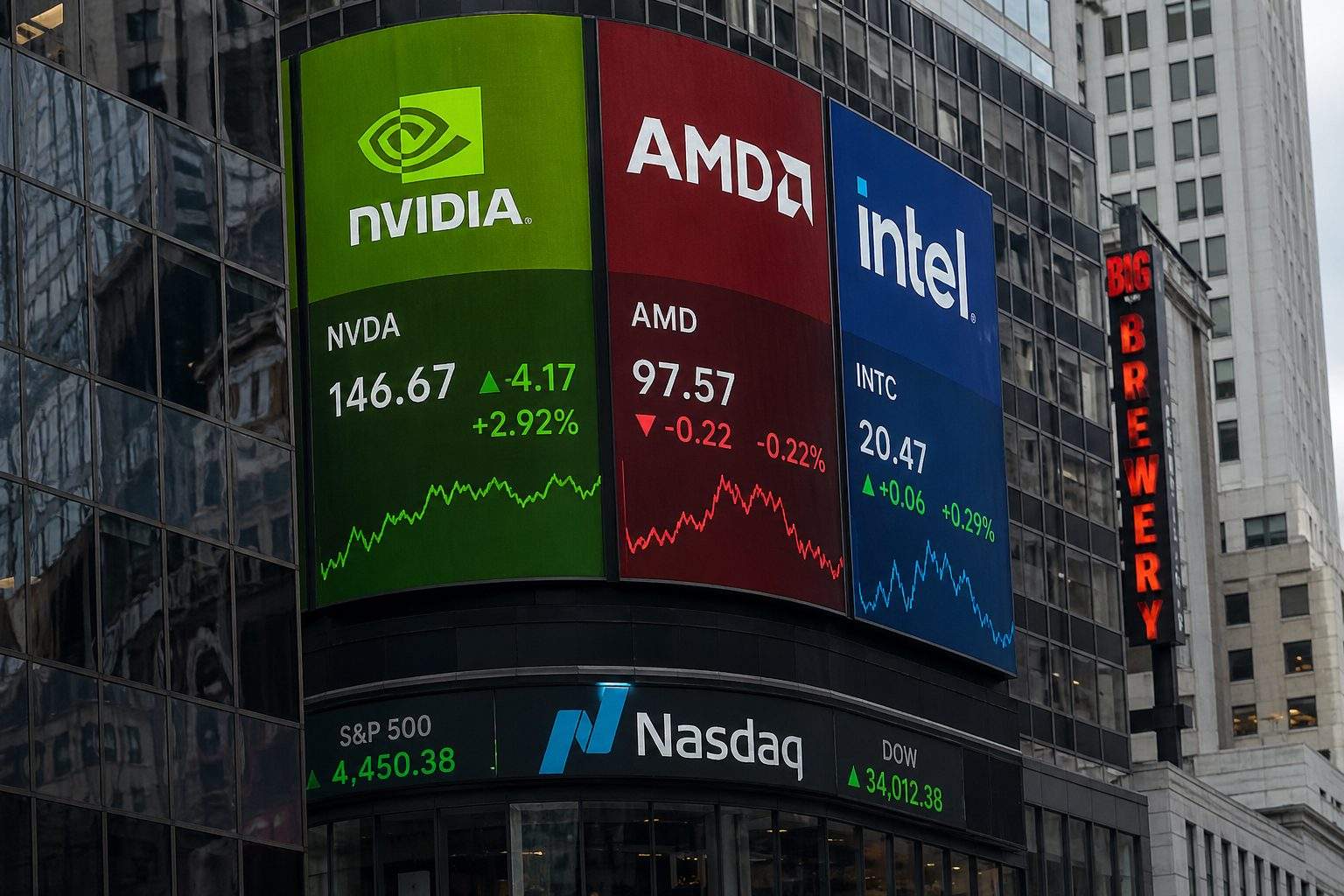
Intel wrapped up Friday at $82.54, notching a 23.6% gain. AMD settled at $347.81, climbing 13.9%. Nvidia landed at $208.27, up 4.3%, just shy of its $212.19 52-week high. No mistaking the momentum on the tape.
Intel projected second-quarter revenue between $13.8 billion and $14.8 billion, topping the $13.07 billion analysts polled by LSEG had anticipated, Reuters reported. First-quarter revenue landed at $13.6 billion, a 7% gain over last year, with adjusted earnings of 29 cents per share.
Intel CEO Lip-Bu Tan pushed back on doubts, calling the rebound in CPU demand “not just our wishful thinking.” CFO David Zinsner pointed to “unprecedented demand for silicon.” Still, Intel reported a GAAP net loss of $3.7 billion, weighed down by restructuring charges — meaning the quarter came with caveats. Even so, that result shifted the narrative. Reuters
Intel’s outlook has turned divisive rather than optimistic. According to StockAnalysis, 31 analysts now lean Hold, and their average price target sits at $61.23—under Friday’s finish. Still, a few price targets ticked up on Friday: UBS lifted its view to $83, TD Cowen to $75, Morgan Stanley to $73, and KeyBanc jumped to $110.
AMD found itself swept up in the action, with DA Davidson’s Gil Luria bumping the stock to Buy from Neutral and hiking his price target to $375—up sharply from $220. Luria pointed to a “structural increase in CPU demand” and sees “meaningful upside” for AMD’s numbers heading into the company’s May 5 earnings. The firm added that CPUs are “reinserting” themselves into the AI landscape as workloads shift past GPUs. Investing.com
That’s an aggressive prediction, though it’s not the typical view. According to StockAnalysis, AMD holds a Strong Buy consensus, with the average price target at $267.97 and the high end reaching $375. Put simply: after Friday’s surge, AMD’s shares are already trading above what Wall Street, on average, expects—despite analysts remaining largely bullish on the name.
Nvidia sets the pace. Shares ended Friday at $208.27, backed by a Strong Buy consensus. StockAnalysis lists an average price target of $266.24—though the high runs up to $360. Looking ahead, its next event is May 20, when first-quarter fiscal 2027 numbers are due.
Nvidia’s scale remains the key story. The chipmaker posted fiscal Q4 revenue of $68.1 billion, a jump of 73% from last year. Data-center sales hit $62.3 billion. CEO Jensen Huang declared that the “agentic AI inflection point has arrived.” Looking ahead, Nvidia projected first-quarter fiscal 2027 revenue around $78 billion, give or take 2%. NVIDIA Newsroom
Friday’s action may have gotten ahead of itself, particularly when it comes to Intel and AMD. Intel still faces the challenge of delivering chips without running into bottlenecks, keeping its prices intact, and making sure its foundry bet actually delivers steady profits. Michael Schulman, partner at Cerity Partners, told Reuters the company’s long-term strategy is still a “high-stakes gamble” as it tries to turn itself into a serious foundry competitor by 2030. Reuters
AMD faces the spotlight on May 5, with first-quarter earnings due out after the bell. Investors want to know if Intel’s robust CPU numbers reflect a broader market trend or something unique to Intel alone. What AMD says about server CPUs, AI accelerators, and its margins could carry extra weight this time.
The market’s already made its move. Nvidia remains the dominant AI-chip play and boasts the strongest analyst-upside setup of the group. Intel, though, brings the newest catalyst. That leaves AMD in the middle—a fresh bullish target, but its stock trades well above the average analyst call.
Related articles: NASDAQ:NVDA