
NEW YORK, August 5, 2026, 08:05 EDT — U.S. premarket.
- Palantir ended Tuesday at $162.66, rising 29.45%, then slipped 0.26% in premarket trade.
- Approximately 90% of the revenue growth for the quarter came from U.S. customers.
- Following the rally, the market value is about 48 times the projected 2026 revenue.
Shares of Palantir Technologies Inc. NASDAQ:PLTR dipped slightly ahead of Wednesday’s market open, though the bulk of Tuesday’s 29.45% rally remained. Volume hit 175 million shares, about four times higher than the stock’s recent average.
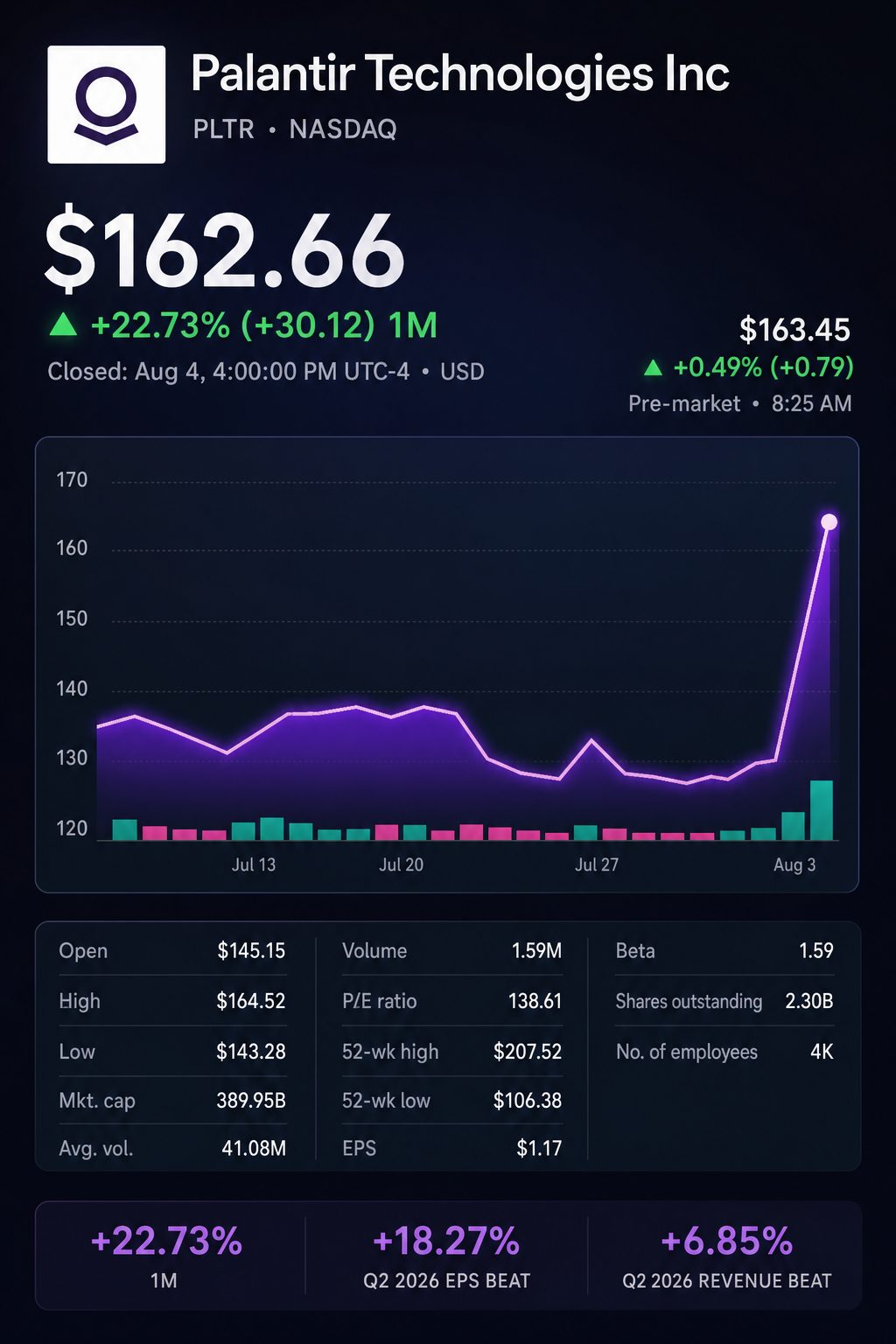
The surge reflected a rare mix of expanding growth and profitability, as revenue climbed 93% and the GAAP operating margin hit 47%. However, the growth was largely concentrated, with approximately 90% of the annual revenue gain attributable to U.S. clients.
Revenue for the second quarter totaled $1.935 billion, surpassing the LSEG consensus by roughly 7.5%. Adjusted earnings exceeded estimates as well, and management increased the midpoint of its yearly revenue outlook by close to $500 million.
| Metric | Reported or new | Comparison | Difference |
|---|---|---|---|
| Q2 revenue | $1.935 billion | $1.80 billion consensus | +7.5% |
| Adjusted EPS | $0.41 | $0.35 consensus | +17.1% |
| Adjusted operating margin | 62% | 46% in the same period last year | +16 percentage points |
| 2026 revenue midpoint | $8.154 billion | $7.656 billion previous guidance | +6.5% |
Figures are based on company data and approximate LSEG projections.
The beat was robust. GAAP operating income totaled $912 million, and net income topped $1.06 billion. Palantir reported operating cash flow of $1.216 billion and adjusted free cash flow of $1.220 billion.
Additional explanation is needed for the adjusted results. Palantir did not include $265 million in stock-based compensation and $17 million in associated payroll taxes. The company reported a GAAP margin of 47%, up from 27% in the prior year.
Nearly all of the momentum came from domestic demand. U.S. commercial revenue soared by 149% to reach $764 million. Revenue from the U.S. government increased 90% to $809 million. Combined, these segments accounted for 81% of sales for the quarter.
| Geography | Q2 revenue | Year-on-year growth | Share of Q2 sales | Approx. share of revenue increase |
|---|---|---|---|---|
| United States | $1.573 billion | 115% | 81.3% | 90.3% |
| International* | $362 million | Roughly 33% | 18.7% | 9.7% |
| Total | $1.935 billion | 93% | 100% | 100% |
International revenue represents total revenue minus U.S. revenue. Growth contribution figures are preliminary and based on rounded data for each segment.
The U.S. accounted for approximately 73% of sales in the previous year. That portion has since increased to over 81%. Although overseas revenue expanded by about a third, it contributed only around a tenth to the additional sales.
Deal flow points to sustained momentum at home. Palantir secured 220 contracts each valued at $1 million or more. Total contract value for U.S. commercial operations jumped 153% to $2.132 billion, and remaining deal value increased 124% to $6.238 billion.
These figures do not represent assured revenue. Palantir bases its calculations on the expectation that customers will exercise their options and that contracts will stay active. According to the company, the majority of contracts include clauses allowing for termination, including for convenience.
Chief Executive Alex Karp stated, “Demand for AI sovereignty has now been unleashed.” Palantir claims its software enables clients to use AI while maintaining authority over their data, models and decision-making processes. Securities and Exchange Commission
According to Emarketer analyst Jacob Bourne, Palantir stands as the “clearest counterexample” to arguments that enterprise AI is unable to progress past pilot stages. Deutsche Bank AG NYSE:DB analyst Brad Zelnick described Palantir as “operating several steps ahead of the rest of software.” Reuters
The cost of that operating leadership is steep. At Tuesday’s close, Palantir’s valuation stood near $390 billion—equivalent to 47.8 times the median of projected 2026 revenue guidance and 84.8 times forecasted adjusted free cash flow.
| Post-rally metric | Figure |
|---|---|
| Tuesday’s closing price | $162.66 |
| Change in one day | +29.45% |
| Total market capitalisation | $389.95 billion |
| Market value compared to 2026 revenue midpoint | 47.8 times |
| Market value compared to midpoint of adjusted free cash flow | 84.8 times |
| Trailing price-to-earnings ratio | 139.0 times |
| 2026 return to date | -8.5% |
Initial valuation multiples are based on the market value from Tuesday and the midpoint of the company’s guidance.
Jefferies Financial Group Inc. NYSE:JEF analysts adopted a cautious stance, expressing a preference for Microsoft Corp. NASDAQ:MSFT, Amazon.com Inc. NASDAQ:AMZN and Snowflake Inc. NYSE:SNOW. According to Jefferies, Palantir’s current valuation offers limited margin for any deceleration in growth or potential issues with execution.
An initial estimate suggests another significant obstacle. Combining first-half revenue, third-quarter guidance midpoint and the full-year outlook indicates fourth-quarter sales could reach approximately $2.424 billion. Achieving this would mean sequential growth of roughly 12%. This figure is not official company guidance.
Risks are still evident. Palantir has become more dependent on the U.S. market, as growth abroad lags significantly. Not all contract values are guaranteed to translate into revenue. Stock-based compensation climbed 66% over the previous year.
The premarket halt illustrates the shift in expectations. Investors have stopped doubting present demand and are now challenging whether U.S. hypergrowth can last sufficiently to justify almost 48 times forecast sales.
Related articles: NASDAQ:PLTR