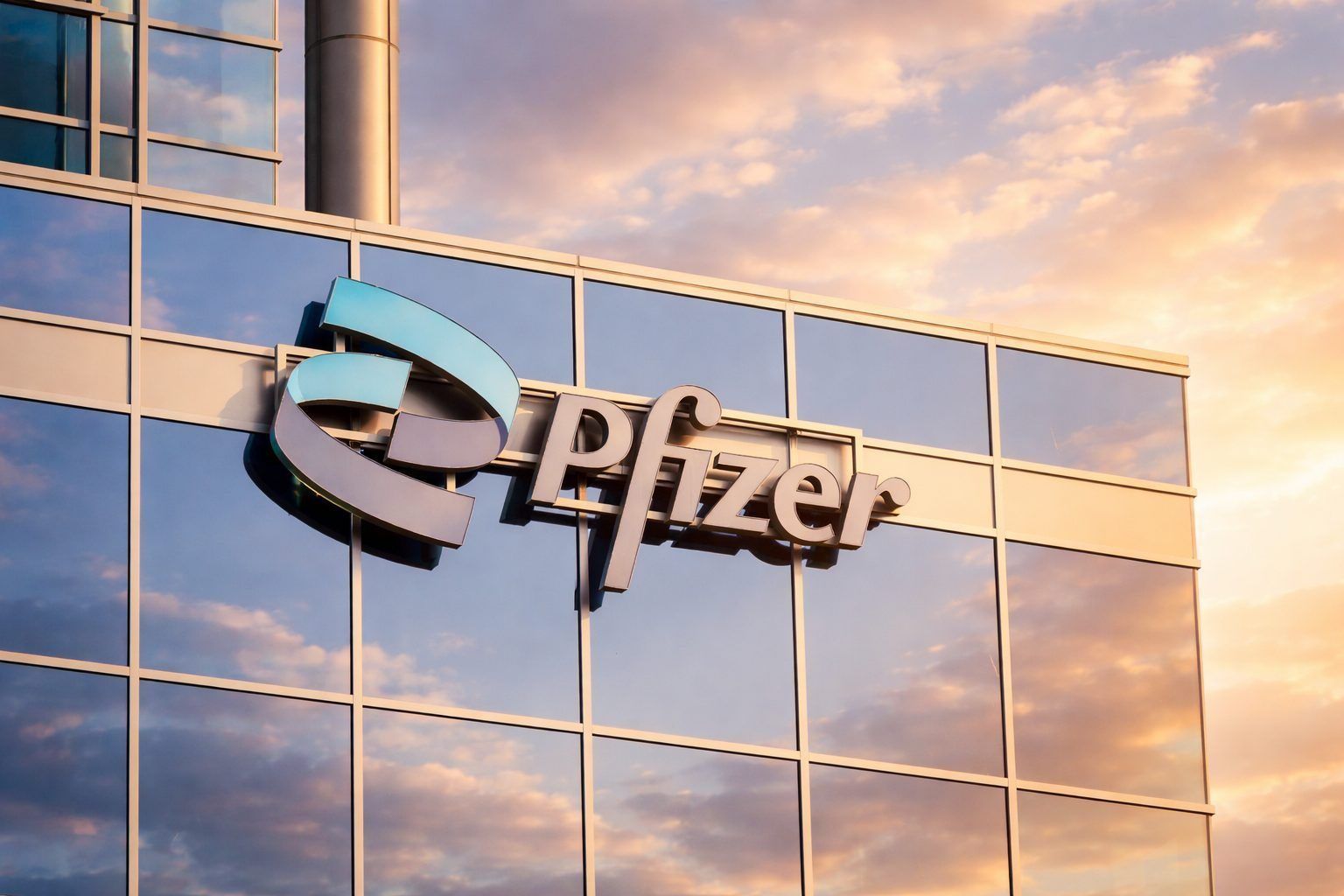
Pfizer Inc. stock (NYSE: PFE) is back in the spotlight on Wednesday, December 17, 2025, as investors digest the drugmaker’s newly issued 2026 outlook, a revised 2025 revenue view, and a longer runway to sustained growth than some shareholders had hoped for. Shares were trading around the mid-$25 range today, following a sharp reaction to the guidance update earlier this week.
The big question now: is Pfizer stock a high-yield value play that’s building a post-COVID, post-patent-cliff pipeline—or a “show me” story that will remain range-bound until revenue growth becomes visible?
Below is a full roundup of the most important Pfizer stock news, forecasts, and analyses available as of 17.12.2025.
What’s moving Pfizer stock on Dec. 17, 2025
Pfizer’s latest trading action is being driven primarily by management’s forward guidance for 2026 and the updated 2025 revenue expectation. In an SEC filing dated December 16, Pfizer forecast:
- 2026 revenue:$59.5 billion to $62.5 billion
- 2026 adjusted diluted EPS:$2.80 to $3.00
- 2025 revenue: revised to ~$62.0 billion (from the prior $61.0–$64.0B range)
- 2025 adjusted diluted EPS:reaffirmed at $3.00 to $3.15 SEC
The market’s initial reaction was negative: Pfizer shares slid sharply after the guidance release, with Reuters reporting a drop of about 5% in the immediate aftermath. Reuters+1
The core message in Pfizer’s 2026 forecast: headwinds are still in control—growth is later
1) COVID products continue to fade
Pfizer explicitly baked in another step down for its COVID-19 portfolio. The company’s guidance table shows COVID-19 product revenue expected at about ~$6.5B in 2025 and ~$5.0B in 2026, implying roughly a $1.5B year-over-year decline. SEC
That aligns with broader investor expectations that post-pandemic demand has become more seasonal and harder to forecast—especially for antiviral usage tied to infection waves.
2) Loss of exclusivity is a near-term drag
Pfizer also highlighted an additional ~$1.5B negative revenue impact tied to products facing loss of exclusivity (LOE) in 2026. SEC
In other words, even if the underlying “core” business is stable, Pfizer is still working through a period where legacy revenue streams are shrinking.
3) Core business growth exists—but it’s modest
To Pfizer’s credit, management emphasized that the company expects ~4% operational revenue growth at the midpoint when excluding COVID and LOE products. SEC+1
That’s an important nuance for long-term bulls: Pfizer is arguing that the engine underneath the headline declines is moving in the right direction—just not fast enough yet to offset the runoff above it.
Profit outlook: EPS below Street expectations, plus a higher tax rate
One key reason the guidance landed heavily is that Pfizer’s 2026 adjusted EPS range of $2.80–$3.00 came in below the Wall Street consensus around $3.05 cited by Reuters. Reuters
The guidance also reflects:
- Higher adjusted effective tax rate: ~15% in 2026 vs ~11% in 2025 (per Pfizer’s guidance table) SEC
- Continued investment needs, including pipeline development and integration of acquired assets SEC+1
And notably for capital-return investors: Pfizer’s filing states the EPS guidance assumes no share repurchases in 2025 or 2026. SEC
Timeline reality check: Pfizer signals the “real” growth inflection is post-2028
A major theme across coverage is that Pfizer is increasingly transparent about the timing of its rebound.
In commentary cited by Fierce Pharma from Pfizer’s guidance call, CFO Dave Denton described a tougher 2027–2028 period for LOE impacts (with those headwinds accelerating), and indicated the company does not expect to see growth until 2029. Fierce Pharma
That “later in the decade” framing is showing up repeatedly in investor analysis today—and it’s a major reason Pfizer stock can look optically cheap while still frustrating shareholders looking for nearer-term catalysts.
Cost cutting and restructuring: defending margins while funding R&D
Pfizer is continuing to pursue multi-year cost reductions to help bridge the gap between declining legacy revenue and future pipeline growth.
- Reuters reported Pfizer is pursuing over $7 billion in cost savings through 2027, and that it has already exceeded certain 2025 cost-reduction goals. Reuters
- Separately, Reuters also reported Pfizer plans job cuts in Switzerland—reducing headcount there significantly—as part of its broader cost reduction effort. Reuters
- Fierce Pharma, citing management commentary, reported Pfizer expects about $7.2B in total combined net cost savings, with most of the savings expected by the end of 2026. Fierce Pharma
At the same time, Pfizer’s guidance shows R&D spending rising in 2026 (to $10.5B–$11.5B) as it invests in programs tied to newer deals and acquisitions. SEC+1
Investor takeaway: Pfizer is trying to “cut and invest” simultaneously—tightening the cost base while still spending heavily enough to build the next wave of products.
Analyst forecasts and price targets: cautious optimism, but a clear demand for proof
Today’s headline analyst action
On December 17, Investing.com reported BMO maintained an Outperform stance and kept a $30 price target, framing Pfizer’s outlook as conservative. Investing.com
Where consensus sits right now
Aggregated analyst data continues to cluster around a “Hold” posture with targets in the high-$20s:
- Stock Analysis shows a consensus “Hold” rating and an average price target of $27.91, with targets ranging from $24 to $35 (based on its tracked analyst set). StockAnalysis
That framing matches the tone in broader coverage: plenty of analysts see valuation support, but many are reluctant to turn decisively bullish until revenue growth is closer and the LOE period is largely behind the company.
Why analysts are split
Several themes keep resurfacing:
- Guidance looks conservative to some, especially if costs come in lower or COVID declines stabilize. MarketWatch+1
- But acquisitions and licensing deals can pressure near-term EPS, even if they improve the long-term product portfolio. Investors+1
Pfizer dividend: still a centerpiece of the PFE bull case
For income-focused investors, Pfizer’s dividend remains one of the clearest reasons to own the stock during a low-growth period.
Pfizer’s board declared a quarterly dividend of $0.43 per share, payable March 6, 2026, to shareholders of record on January 23, 2026. Pfizer+1
That translates to an annualized payout of $1.72 per share, and data trackers put the yield in the high-6% range at current prices. StockAnalysis
Pfizer also described this as its 349th consecutive quarterly dividend in its announcement—an eye-catching streak for dividend reliability-focused investors. Pfizer
Dividend watchpoint: Several market data sources show Pfizer’s payout ratio is elevated (near ~100% by some calculations), which means dividend sustainability is closely tied to earnings stabilization and management’s ability to execute cost savings and portfolio transition. StockAnalysis+1
Pipeline and deal flow: where Pfizer is placing its next bets
While the next 12–24 months may be about managing decline, Pfizer is actively building (and buying) its longer-term growth engine. Key developments investors are talking about today include:
1) Oncology: Tukysa data in first-line maintenance therapy
Pfizer announced that adding TUKYSA (tucatinib) to first-line maintenance therapy in HER2+ metastatic colorectal cancer extended median progression-free survival by 8.6 months, with results published in the Journal of Clinical Oncology. Pfizer+1
Clinical wins like this matter for Pfizer’s credibility post-Seagen: the company needs oncology to become a durable growth pillar.
2) Immunology: Adaptive Biotechnologies partnership up to $890M
Reuters reported that Adaptive Biotechnologies signed two non-exclusive agreements with Pfizer focused on rheumatoid arthritis and broader immune-related research, with Adaptive eligible to receive up to $890 million in upfront and milestone-based payments tied to research, development, and sales progress. Reuters
The structure signals Pfizer’s interest in using advanced immune profiling and data assets to accelerate target discovery—especially as AI-driven drug discovery becomes more central across big pharma.
3) Obesity: building a pathway back into GLP-1s
Pfizer continues to rebuild its obesity strategy through business development.
- Reuters reported Pfizer signed an exclusive licensing agreement with YaoPharma (a Fosun unit) for an early-stage GLP-1 agonist weight-management candidate, including $150M upfront and up to $1.94B in milestones, plus royalties if approved. Reuters
- Pfizer also recently announced its acquisition of Metsera (obesity-focused), structured as $65.60 per share in cash plus a contingent value right, for a deal valued up to about $10B including the CVR. Pfizer+1
Wall Street’s push-and-pull here is clear: investors want Pfizer in obesity (a massive market), but they also worry about execution risk, cost, and how long it takes for these bets to pay off.
4) PD-1 x VEGF: a major external R&D investment
Pfizer’s 2026 guidance explicitly references development focus on PF-08634404, a PD-1 x VEGF bispecific antibody in-licensed from 3SBio. Pfizer disclosed $1.25B upfront plus a $100M equity investment, with further milestones possible. Pfizer+1
This is the kind of “big swing” R&D spending that can define Pfizer’s post-2028 competitive position—while also weighing on near-term profitability.
Policy and pricing backdrop: Pfizer’s tariff and Medicaid pricing agreement still matters
Another factor investors are keeping in mind is U.S. pricing policy risk.
Reuters reported Pfizer reached a deal with the Trump administration to lower prescription drug prices in Medicaid in exchange for tariff relief, including a three-year grace period tied to potential pharmaceutical tariffs. Reuters
Pfizer’s own statement on the agreement highlighted the three-year grace period and referenced additional U.S. investment commitments, including $70B dedicated to U.S. research, development, and capital projects over the next few years. Pfizer
For Pfizer stock, this backdrop cuts both ways:
- Reduced tariff uncertainty can support valuations.
- Pricing concessions (even limited in scope) add another layer of margin scrutiny—especially during a period when revenue is already under pressure.
What to watch next for Pfizer stock
Here are the near-term catalysts and checkpoints investors are likely to focus on after Dec. 17:
- Execution vs. 2026 guidance: Can Pfizer hit revenue and EPS while increasing R&D and maintaining margins? SEC+1
- COVID seasonality: Do Comirnaty and Paxlovid behave in line with assumptions (and infection trends)? SEC+1
- Cost program progress: Any evidence the cost realignment program is landing earlier and more materially than expected. Reuters+1
- Pipeline readouts and regulatory updates: especially oncology and immunology programs, where Pfizer is trying to prove it can generate organic growth. Pfizer+1
- Dividend sustainability optics: Investors will watch payout ratios and free cash flow commentary closely as the company prioritizes investment and manages leverage. StockAnalysis+1
- Next earnings timing: Market calendars currently point to early February 2026 for the next earnings event window (company confirmation may vary). Yahoo Finance
Bottom line: is Pfizer stock a buy after the guidance reset?
As of Dec. 17, 2025, Pfizer stock is effectively pricing in a long transition period: shrinking COVID revenue, an approaching patent/LOE wave, and heavier investment spending to seed growth later in the decade. SEC+2Fierce Pharma+2
The bull case centers on:
- A dividend yield that remains compelling,
- Cost cuts that protect margins,
- And a pipeline plus deal-driven portfolio (oncology, obesity, immunology) that can re-accelerate growth post-2028.
The bear (or cautious) case is that:
- The timing of that growth is still distant,
- Near-term EPS is pressured by investment and deal costs,
- And policy/pricing uncertainty could keep valuations muted.
Either way, Pfizer has clearly set the market’s expectations: 2026 is a build-and-bridge year—not a breakout year. SEC+1