
NEW YORK, August 4, 2026, 13:04 EDT — U.S. cash markets have opened.
- The stated purchase price is 5.8 times Thorne’s early forecast for sales in 2026.
- Thorne is expected to contribute approximately 0.75% to P&G’s yearly total revenue.
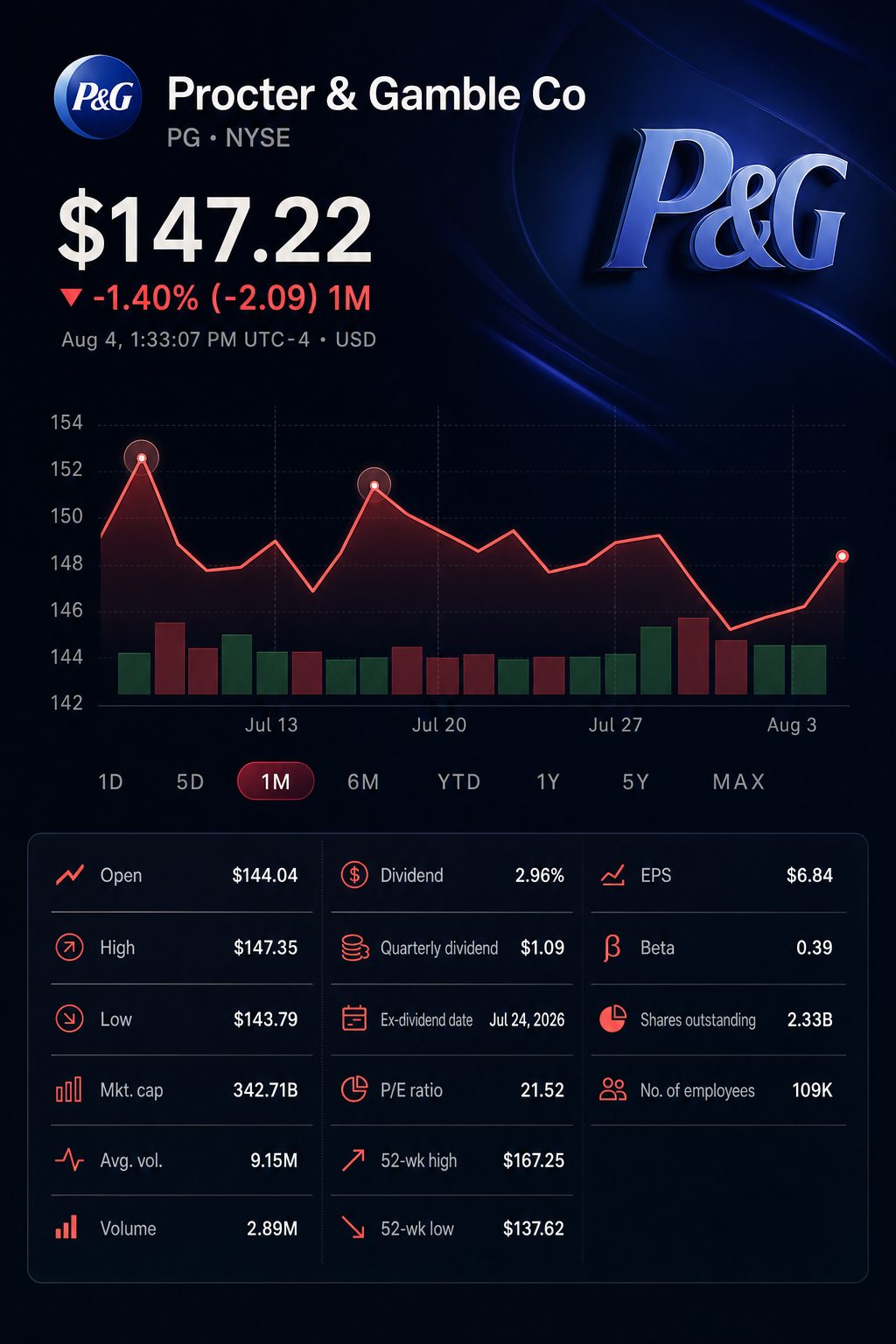
- P&G stock rose 1.29% to $146.84, underperforming the overall market.
Procter & Gamble plans to buy premium supplement producer Thorne for $3.8 billion, Chief Executive Shailesh Jejurikar told CNBC. The deal, pending regulatory clearance, is slated to close later in 2026.
The benchmark for investors is valuation rather than rapid expansion. The disclosed price represents approximately 5.8 times Thorne’s projected sales for 2026. However, those sales would contribute under 1% to P&G’s total group revenue.
This puts the spotlight on sustained growth. Thorne’s projected sales are seen rising from $290 million in 2023 to approximately $650 million in 2026, reflecting an implied yearly growth rate near 31%.
P&G reported weaker growth, with net sales increasing by 3% in fiscal 2026 and organic sales up by just 1%. The company projects organic sales growth between 1% and 3% for fiscal 2027, according to management.
The valuation bridge illustrates the extent to which anticipated future growth is reflected in the current price.
| Deal measure | Value | Investor implication |
|---|---|---|
| Disclosed deal value | $3.80 billion | Main offer amount |
| Thorne projected 2026 sales | $650 million | Early projection |
| Implied sales multiple | 5.85 times | Continued rapid expansion required |
| L Catterton’s deal value 2023 | $680 million | Previous reference value |
| Multiple based on headline sum since 2023 | 5.59 times | Prior to structural revisions |
| Total valuation growth | $3.12 billion | Approximately 459% |
The figures are based on disclosed deal values and Thorne’s initial sales projection. Adjustments for debt, cash, fresh capital or payouts have not been made.
L Catterton’s headline valuation climbed by about $3.12 billion in less than three years, marking a 5.6-fold increase. The equity return is not straightforward, as the two transaction structures may not be identical.
The purchase is considered small relative to P&G’s overall operational size.
| Scale comparison | P&G base | Thorne or deal value | Ratio |
|---|---|---|---|
| Group sales, fiscal 2026 | $87.03 billion | $650 million sales | 0.75% |
| Health Care sales, fiscal 2026 | $12.46 billion | $650 million sales | 5.22% |
| Operating cash flow, fiscal 2026 | $19.56 billion | $3.80 billion deal | 19.43% |
| Market capitalization now | $341.93 billion | $3.80 billion deal | 1.11% |
Thorne’s revenue figures are provisional. P&G’s market capitalization is based on trading as of 12:48 EDT.
P&G reported $19.6 billion in operating cash flow for fiscal 2026, indicating strong cash reserves. The company distributed over $15 billion via dividends and share repurchases.
The more difficult challenge is generating a satisfactory return. Thorne would make up around 5.2% of P&G’s Health Care revenue at the outset. Its growth will need to compensate for the steep entry valuation.
The operational contrast is pronounced.
| Growth measure | Latest reported or estimated rate |
|---|---|
| Thorne, 2023 to 2026E sales CAGR forecast | 30.9% |
| P&G projected net sales growth for fiscal 2026 | 3% |
| P&G projected organic sales growth for fiscal 2026 | 1% |
| P&G Health Care expected net sales growth for fiscal 2026 | 4% |
| P&G Health Care organic growth in the fourth quarter | -1% |
Thorne’s percentage is based on disclosed projections. P&G results come from the company’s own reporting.
The rationale behind the strategy lies in the growth disparity. P&G’s Health Care division recorded a 4% increase in reported growth over the year. Yet, organic sales in the fourth quarter declined by 1%, with softness in oral care outweighing improvements in personal health.
Thorne provides P&G with an elevated, practitioner-focused channel to reach customers. Its offerings include creatine, prenatal vitamins, hormone supplements, and a variety of wellness products. P&G’s portfolio already features brands such as New Chapter, Metamucil, and Align.
P&G’s Health Care head Paul Gama stated that the combination may help broaden Thorne’s market presence. Jejurikar described the valuation as “in line with the industry benchmarks we’ve seen.” The initial statement did not specify any margin or synergy goals. Procter & Gamble
Rising competition is fueling haste. Unilever NYSE:UL acquired the supplements label Grüns earlier this year. According to Rachel Wolff at eMarketer, P&G’s decision is “a clear indicator of where consumer demand is currently strongest.” Reuters
The market responded positively, though without a definitive move.
| Security | Price | Session change |
|---|---|---|
| Procter & Gamble | $146.84 | up 1.29% |
| SPDR S&P 500 ETF Trust NYSEARCA:SPY | $770.02 | rising 1.63% |
| Unilever | $64.01 | advancing 0.33% |
| Haleon NYSE:HLN | $9.70 | down 1.02% |
Prices were captured at approximately 12:48–12:49 EDT, within standard U.S. trading hours.
P&G trailed the major market benchmark by roughly 0.34 percentage point, which restricts the level of deal optimism that can be drawn from a single session.
The agreement has the potential to enhance P&G’s growth profile, though it does not significantly alter overall group sales. Success relies on Thorne maintaining its premium status. Broader P&G distribution should generate growth while preserving trust among practitioners.
Risks: Thorne faces potential slower growth as competition increases in the supplements market. Integration efforts might weaken its premium brand image. Uncertainties remain around regulatory approval, product claims, financing specifics, and the undisclosed effects on earnings.



![US Stock Market Today 08/25/2026 [UPDATE: 02:14 EDT] [Sandisk Jumps as QQQ Clears $710 Overnight]](https://ts2.tech/wp-content/uploads/2026/08/US-market-dashboard-2026-08-25-0208-480x384.jpg "US Stock Market Today 08/25/2026 [UPDATE: 02:14 EDT] [Sandisk Jumps as QQQ Clears $710 Overnight]")