Qualcomm (NASDAQ:QCOM) Shares Fall as Handset Weakness Challenges Expansion Strategy

Qualcomm (NASDAQ:QCOM) Shares Fall as Handset Weakness Challenges Expansion Strategy

NEW YORK, July 29, 2026, 16:59 EDT – Qualcomm stock declined as soft demand in the handset segment highlighted the company’s efforts to broaden its business beyond smartphones.

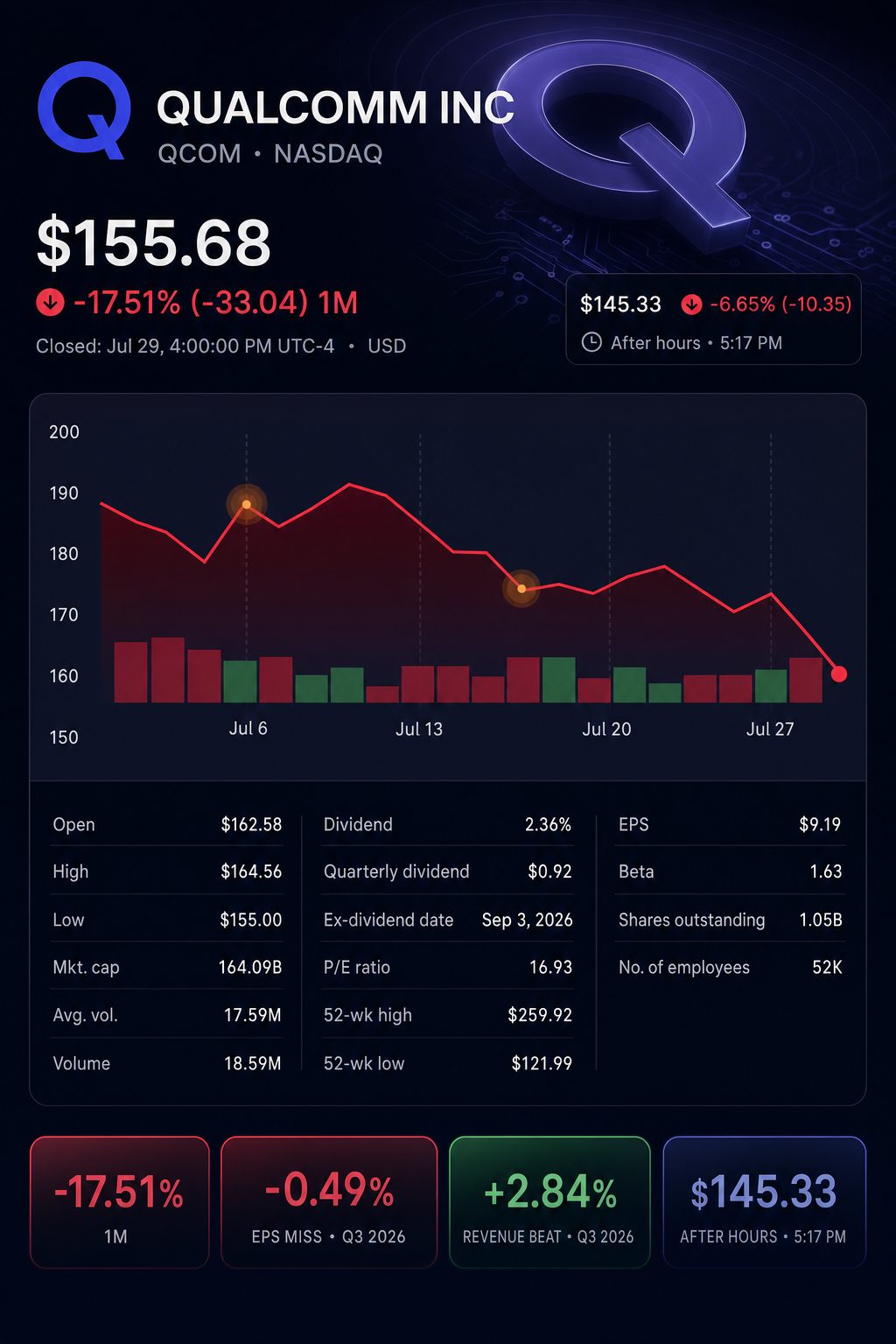
  • The stock finished the session down 4.4% at $155.68 and declined almost 5% after markets closed.
  • Qualcomm has been chosen by BMW (ETR:BMW) as the primary provider of processors for cockpit features and automated driving systems.
  • Growth in Automotive and IoT segments helped counterbalance around 61% of the handset revenue drop for the quarter.

U.S. markets have finished for the day. Qualcomm shares finished down 4.4%, and slid close to 5% in after-hours trade as cautious profit guidance overshadowed two recent diversification gains.
BMW has selected Qualcomm as its primary compute-silicon supplier for upcoming vehicle platforms. The deal includes digital cockpit technology and advanced driver-assistance systems for the coming decade.

Qualcomm has finalised its purchase of Modular, a company specialising in AI software infrastructure. Modular’s platform supports and accelerates AI workloads over multiple types of computing architectures.

Qualcomm’s quarterly segment figures already show the investor test. Gains in automotive and IoT segments made up $753 million of the $1.24 billion drop in handset revenue, covering around 61% of the shortfall.

QCT revenue streamQ3 FY2026 revenueYear-on-yearShare of QCTDollar change
Handsets$5.086 billiondown 20%59.8%decrease of $1.242 billion
Automotive$1.588 billionup 61%18.7%increase of $604 million
Internet of Things$1.830 billionup 9%21.5%increase of $149 million
Total QCT$8.504 billiondown 5%100%decrease of $489 million

Qualcomm’s figures form the basis for all share and dollar changes shown.

The composition shifted significantly. Automotive and IoT accounted for 40.2% of QCT revenue, increasing from 29.6% the previous year. Handsets remained at 59.8%.

Automotive revenue surged 61% to reach $1.59 billion, while IoT increased 9% to $1.83 billion. However, overall QCT revenue declined by 5%.

BMW’s deal includes Snapdragon Cockpit and Snapdragon Ride chips, in addition to AI accelerators and model projects launching in the coming decade. No financial details were shared.

Qualcomm’s automotive head Nakul Duggal said BMW’s decision showed its trust in Qualcomm’s plans. He stated the partnership allows the firms to “define the future of mobility.” Qualcomm

Stock chart for NASDAQ:QCOM

Qualcomm’s purchase of Modular delivers a software component that supports its edge-to-cloud approach. The Mojo, MAX and Modular Cloud offerings will remain distinct brands and products.

At its announcement in June, the all-stock deal carried a valuation of $3.92 billion. Under the terms, Qualcomm may issue as many as 19.2 million shares.

The actions focus on markets where Nvidia and Mobileye Global compete. Qualcomm is providing BMW with a more comprehensive vehicle-computing platform, and Modular is supplying AI software that works across different hardware.

Short-term profit continues to be a limiting factor. Revenue for the fiscal third quarter declined by 4% to $9.95 billion. Adjusted earnings were $2.21 per share, missing the LSEG consensus estimate by two cents.

Qualcomm projects fourth-quarter adjusted earnings in the range of $2.05 to $2.25 per share, with the midpoint of $2.15 roughly 9% under analysts’ forecast of $2.36. Expected revenue is set between $9.7 billion and $10.5 billion, surrounding the consensus estimate of $10.02 billion.

Handset revenue dropped by 20% to $5.09 billion. Revenue linked to Apple products is projected to decrease more quickly than previously anticipated. Chief Executive Cristiano Amon stated, “We kind of replaced Apple with the data center.” Reuters

Qualcomm’s forward-looking company goal aims to reach $40 billion in non-handset revenue by fiscal 2029. The company projects that non-handset revenue will grow by over 60% in fiscal 2027. These projections are reliant on achieving targets in automotive, IoT, and data-centre divisions.

Risks: Rising costs for wafers, packaging and memory could weigh on margins ahead of the impact from planned price hikes. BMW did not reveal any contract value, modular integration has yet to be proven, and reliance on handset customers remains significant.

TS2 TECH • EXTENDED COVERAGE

Further analysis

What caused QCOM to decline steeply following its earnings report?

Qualcomm (QCOM) ended the July 29 session at $155.68, losing 4.42% ahead of its earnings report. The S&P 500 dropped 1.52%, adding to the overall market pressure. At about 5:00 p.m. ET, QCOM shares changed hands at $148.84 in after-hours trading, down 4.39% further. That left the stock approximately 8.6% lower than its close on Tuesday. The post-market slide followed weak profit forecasts and increased costs. MarketWatch

Did Qualcomm exceed or fall short of fiscal third-quarter forecasts?

Revenue totaled $9.95 billion, marking a 4% decrease compared with the same quarter last year. The figure surpassed FactSet’s forecast of about $9.69 billion by approximately $260 million. Adjusted EPS was $2.21, slightly trailing estimates which were around $2.23–$2.24. GAAP net income declined 25% from the prior year period, to roughly $2.0 billion. Quarterly results were mixed. Qualcomm Investor Relations

How soft was Qualcomm’s guidance for the fourth quarter?

Qualcomm projected fourth-quarter revenue in a range of $9.7 billion to $10.5 billion, with the midpoint of $10.1 billion aligning with analyst expectations, which were near $10.07 billion. The company provided adjusted EPS guidance of $2.05 to $2.25 per share. The $2.15 midpoint fell about 9% below consensus estimates of around $2.36–$2.38. Margins were the main factor behind the shortfall. MarketScreener

Is the handset downturn a short-term issue or a lasting trend?

Handset revenue for the third quarter fell 20% from the previous year to $5.09 billion. The company pointed to high memory costs, slower Android production, and softer demand for high-end devices. While Chinese customer revenue could have reached its lowest point, a rebound has yet to be demonstrated. Qualcomm projects its share of components in future Apple iPhones will remain below 20%, increasing reliance on stronger Android demand. Reuters

Are automotive, IoT, and data centers able to compensate for weak smartphone demand?

Revenue from automotive and IoT combined increased 28% compared to the previous year. Automotive has reported double-digit yearly growth for 23 straight quarters. Qualcomm is aiming for $10 billion in automotive revenue and over $14 billion from IoT by the end of fiscal 2029. It also projects more than $15 billion from data centers. These are substantial figures, though they remain targets rather than secured results. Barron’s

Is QCOM undervalued following the recent decline?

Qualcomm reported adjusted EPS of $8.36 for its first three fiscal quarters. Including the $2.15 midpoint from guidance brings the estimated total to approximately $10.51 for fiscal 2026. With shares at $148.84, QCOM is valued at close to 14.2 times that adjusted earnings estimate. The $3.68 dividend on an annualized basis provides a yield of around 2.5% at the current share price. The stock appears reasonably priced, assuming that fiscal 2027 earnings remain steady.

What are analysts currently indicating with their price targets?

Reported averages differ significantly by service, with figures spanning about $208 to $223. The current published range of low-to-high targets extends from $100 to $300 per share. Public displays a Hold consensus from 23 analysts covering the stock. Many available analyst ratings were set prior to the most recent quarter and reduced profit outlook. These projections are considered outdated until analysts update their assumptions. Benzinga

What is a plausible price prediction for QCOM over the next 6–12 months?

My baseline scenario estimates QCOM trading between $155 and $175 per share, with adjusted EPS of about $10.70 to $10.90, assigned a multiple of 14.5–16.0 times earnings. In a downside scenario, shares could fall to $120–$135 if handset sales soften and margins worsen. On the upside, QCOM could rise to $190–$210 should data-center demand show material growth. Margins in Q4, Android sales, impact from Apple, and performance in data centers are all key factors. These are scenario projections, not formal Wall Street estimates. Reuters

Michał Rogucki is a senior markets reporter at TS2.tech, specializing in stocks, technology and macroeconomic developments. A graduate of Humboldt University of Berlin, he previously worked in investment research and market analysis before transitioning to financial journalism. He covers the trends and events that matter most to investors worldwide.

AI PORTFOLIO

Top Stock Picks

Today’s highest-ranked model selections.

#1 BUY IN STAGES

AerCap

NYSE: AER 95 / 100
#2 BUY ON WEAKNESS

Xylem

NYSE: XYL 93 / 100
#3 ACCUMULATE

General Dynamics

NYSE: GD 91 / 100
#4 BUY WITH LIMITS

Visa

NYSE: V 88 / 100
#5 TACTICAL BUY

IDEX

NYSE: IEX 85 / 100
View full portfolio
Editorial model selection. Not personalised advice.
Robinhood second-quarter results: Growth in prediction markets scrutinized amid profitability challenge
Previous Story

Robinhood (NASDAQ:HOOD) Slides as Prediction Markets Surpass Crypto

Wall Street Slips as Fed, Oil Impact Raises Challenges for AI Investments
Next Story

Wall Street Slips as Fed, Oil Impact Raises Challenges for AI Investments