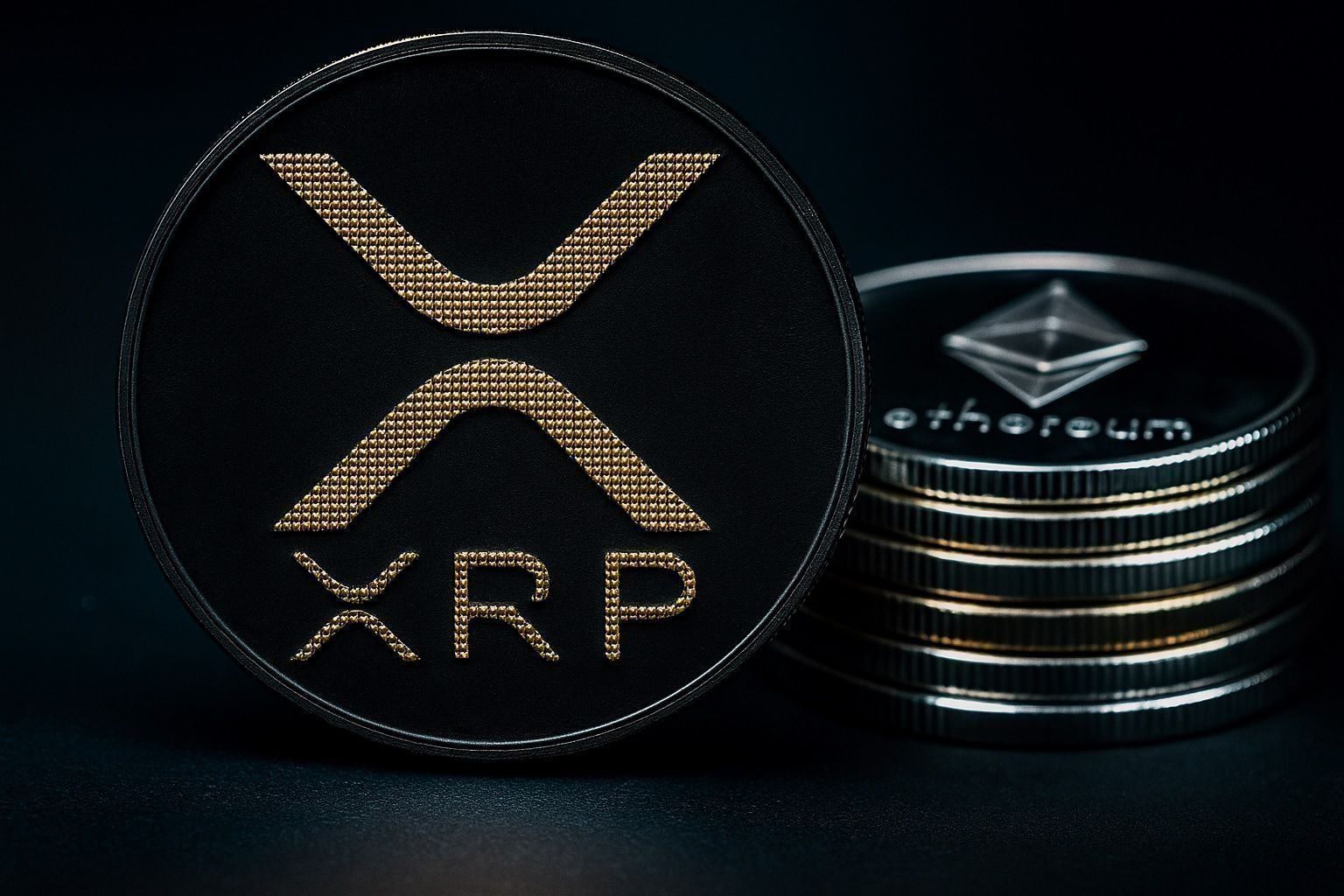
The XRP ecosystem is in one of its most hectic news cycles in years.
On 6 December 2025, fresh headlines ranged from a bold 5‑digit XRP price thesis to a $1 billion milestone for Ripple’s RLUSD stablecoin, new ETF‑driven supply‑shock narratives, and deeper integration with regulated U.S. markets.
At the same time, Ripple is appearing on stage with Mastercard, expanding into corporate treasury via a $1 billion acquisition, and backing a global brand campaign that tells institutions: “It’s happening.”
Here’s how all of these threads connect – and what they really mean for XRP, RLUSD and the future of global payments.
1. The 5‑Digit XRP Price Thesis: SWIFT, DTCC, Gold and CBDCs
A recent article syndicated from TheCryptoBasic spotlighted XRP community figure KING VALEX, who floated a headline‑grabbing forecast: XRP between $10,000 and $50,000 per coin in a far‑future scenario. CoinStats
According to the piece, his argument hinges on one core idea:
If XRP becomes the neutral settlement asset underpinning most major financial rails – from SWIFT and DTCC to tokenized gold and CBDCs – then its limited supply would need a dramatically higher price to provide enough liquidity.
To understand why some people even consider numbers that high, it helps to look at the size of the systems he references:
- SWIFT’s messaging network is estimated to facilitate around $5–7.5 trillion in value per day, or roughly $150 trillion annually in payments. LeRemitt+1
- DTCC processed $3.7 quadrillion in securities transactions in 2024 alone. DTCC
If – and this is a massive “if” – XRP were to sit at the center of even a large slice of that activity, the argument is that each token would need to be worth a lot more to grease the wheels of such huge flows.
Why this is still highly speculative
However, turning that intuition into a $10k–$50k price tag requires a long list of assumptions:
- That most cross‑border payments and securities settlements consolidate onto a single public chain.
- That institutions choose XRP specifically, rather than a mix of stablecoins, tokenized bank money, and other networks.
- That regulators worldwide are comfortable with a single volatile asset acting as the main settlement layer.
- That XRP’s velocity (how often each coin turns over) doesn’t increase enough to reduce the required price.
Mainstream research desks and institutional analysts are not modeling five‑digit XRP. Most price work around today’s market still lives in the low‑single‑digit to low‑double‑digit range, and even bullish outlets frame $10k+ numbers as extreme best‑case scenarios rather than a base case.
So the 5‑digit thesis is newsworthy because it captures the mood of a very optimistic corner of the XRP community – but it should be read as speculation, not a forecast.
2. Ripple Joins Mastercard on Stage: “What’s Next for Payments?”
While community pundits imagine extreme future valuations, Ripple’s executives are busy talking about something more tangible: payment rails.
At Binance Blockchain Week, Ripple’s Managing Director for the Middle East & Africa, Reece Merrick, appeared on a panel titled “What’s Next for Payments?” alongside Christian Rau, SVP Digital Assets & Blockchain at Mastercard, and Nikola Plecas, VP of Payments at TON. TradingView
Key themes from the discussion:
- From mobile to digital assets. Rau compared today’s crypto and stablecoin moment to mobile payments 10 years ago: once “new,” now table stakes. He argued that digital assets are quickly becoming a standard building block for the next generation of financial services. TradingView
- Digital‑asset strategy as ‘table stakes’. Merrick noted that, in conversations with banks and institutions, having a digital‑asset strategy is now considered essential rather than optional. TradingView
- Role of XRP and RLUSD. Merrick pointed to XRP and Ripple USD (RLUSD) on the XRP Ledger as core tools for moving value across borders quickly and cheaply, aligning with comments Ripple CEO Brad Garlinghouse has made about the growing acceptance of stablecoins. TradingView+1
This panel wasn’t just talk. It sits on top of a concrete pilot that quietly rewires how some card payments settle behind the scenes.
3. Inside the Mastercard–Ripple RLUSD Settlement Pilot
In November, Ripple announced that it is working with Mastercard, WebBank and Gemini on a pilot using RLUSD, Ripple’s dollar‑backed stablecoin, for credit card settlement on the XRP Ledger (XRPL). Unchained+2PYMNTS.com+2
How the pilot works
Detailed reporting from Unchained, PYMNTS and CCN outlines the structure:
- Consumers still pay in dollars, and merchants still receive dollars through Mastercard’s network.
- Behind the scenes, interbank positions between Mastercard’s partners and WebBank (issuer of the Gemini credit card) are settled using RLUSD on XRPL, compressing multi‑day clearing cycles into seconds. Unchained+2PYMNTS.com+2
- The pilot is fully institutional and permissioned – existing Mastercard rules and compliance frameworks remain in place; what changes is the settlement rail, not the user experience. CCN.com
Mastercard’s digital commercialization head has framed this as part of a “regulated, open‑loop stablecoin payments” strategy: bringing stablecoins into the financial mainstream, as long as consumer protections and regulatory compliance are front and center. PYMNTS.com
This is a very different narrative from speculative price targets. Here, Ripple is trying to prove that public blockchains can handle boring, high‑volume fiat settlement without users ever needing to think about wallets or gas fees.
4. RLUSD Hits $1 Billion and What That Means for XRP
On 6 December 2025, BlockchainReporter reported that RLUSD has reached a $1 billion market cap in under one year, with more than 1.3 billion tokens in circulation since its December 2024 launch. RLUSD is now ranked among the top 10 USD‑pegged stablecoins worldwide. blockchainreporter
A heavily regulated stablecoin
The same report highlights what differentiates RLUSD from many legacy stablecoins:
- Issued by Standard Custody & Trust Company, a Ripple subsidiary regulated by the New York Department of Financial Services (NYDFS). blockchainreporter
- Backed 1:1 by U.S. dollars, short‑term Treasuries and cash equivalents held in a custody account.
- Designed for institutional use and built with a “compliance‑first” mindset.
Ethereum + XRPL, but XRP still sits underneath
RLUSD is live on both Ethereum and XRPL, with roughly 80–85% of activity currently on Ethereum and the rest on the XRP Ledger. blockchainreporter+1
That split actually matters for XRP because:
- Every transaction on XRPL, including those involving RLUSD, pays a tiny fee in XRP that is permanently destroyed, slightly reducing XRP’s total supply over time. blockchainreporter+1
- As RLUSD usage grows for remittances, card settlement, on‑chain FX and tokenization, XRPL fee volume – and therefore XRP burn – could increase.
In other words, RLUSD gives institutions a stable, dollar‑denominated asset while still plugging them into XRP’s underlying settlement and fee structure.
5. XRP Deepens Its Role in Regulated Markets: Collateral and Corporate Treasury
5.1 XRP accepted as collateral on a CFTC‑regulated U.S. exchange
Another piece of 6 December 2025 news: a Times Tabloid report explains how XRP has just been placed into a new category in the U.S. derivatives market. Times Tabloid
Key points:
- Bitnomial, a CFTC‑regulated derivatives clearing organization, has become the first in the U.S. to accept stablecoins (RLUSD) as collateral – and has added XRP itself as margin collateral. Times Tabloid
- Traders can now use XRP directly for leverage, futures, options and perpetuals, without converting back and forth into fiat.
- Commentators on the Good Evening Crypto show argued that posting XRP as collateral effectively locks tokens out of circulation, potentially tightening supply and supporting the case for a future supply shock if demand continues to rise. Times Tabloid
This move also symbolically places XRP alongside Bitcoin and gold in the collateral conversation, at least within this particular exchange’s risk framework. Times Tabloid
5.2 Ripple’s $1B GTreasury acquisition and the corporate liquidity stack
On 5 December (updated 6 December), Coinpaper reported that Ripple has completed its $1 billion acquisition of GTreasury, a long‑established treasury‑management firm. Coinpaper
According to that report:
- GTreasury serves 800+ corporations in 160 countries, connects to around 13,000 financial institutions and processes roughly $12.5 trillion in payments per year, estimated as ~15% of global cross‑border flows. Coinpaper
- Integrating GTreasury’s software directly into Ripple’s digital‑asset stack lets corporates tap on‑demand blockchain liquidity while still working inside the treasury dashboards and banking pipes they already know.
- The acquisition completes a 2025 build‑out that included prior purchases in custody, prime brokerage and corporate treasury services, positioning Ripple as a full‑stack provider for institutional digital‑asset workflows. Coinpaper
In plain terms: Ripple isn’t just chasing banks; it’s trying to become the middleware layer for how large companies manage liquidity, FX and settlements.
6. The Marketing Layer: “It’s Happening, with Ripple”
On the creative side, LBBOnline recently featured Ripple’s new campaign film, “Ripple – It’s Happening.” Little Black Book
LBB describes the film as:
- A global campaign capturing a moment when finance, technology and innovation converge.
- A portrayal of how blockchain is driving change “from banking and bonds to currency and markets,” framed as a transformation that is already underway rather than a distant future. Little Black Book
The timing is deliberate. While institutional pilots, regulatory milestones and acquisitions may sound abstruse, the campaign translates that story into something simple and visual: the existing financial world morphing into something more programmable and interconnected – with Ripple positioned as one of the brands orchestrating that shift.
For Google Discover and mainstream audiences, this kind of storytelling is often how complex infrastructure moves – RLUSD pilots, ETF flows, collateral arrangements – become emotionally legible.
7. XRP Price, ETFs and Today’s Market Mood (6 December 2025)
All of this news is landing in a market that looks… tired.
7.1 XRP around $2 as technicals flash caution
Coinpaper notes XRP trading near $2.07, down about 4% on the day and roughly 7–8% over the week, and still well below its yearly peak around $3.60. Coinpaper
Two technical‑focused pieces published today add nuance:
- CryptoPotato, using ChatGPT‑driven scenarios, says the $2.00 level is key support. A clean break below could open room toward $1.90, while the “bull case” envisions a move up to around $2.25 if ETF inflows re‑accelerate and the wider market catches a relief rally. CryptoPotato
- U.Today’s Bollinger Bands analysis warns that repeated failures to reclaim the mid‑band around $2.10–$2.12 keep the structure tilted toward a sub‑$2 range, unless buyers step in with conviction. U.Today
In short, price action is choppy, with short‑term pressure even as long‑term infrastructure headlines are overwhelmingly positive.
7.2 ETFs, supply‑shock talk and “the public won’t understand”
XRP’s first pure U.S. spot ETF, Canary Capital’s XRPC, has been a major catalyst for new narratives:
- XRPC posted record day‑one trading volume and quickly accumulated hundreds of millions of dollars in AUM, outpacing several Solana and other altcoin ETFs and even lighting up Times Square in a high‑profile campaign. MEXC+1
- CryptoBasic’s new piece “Here’s How High XRP Price Could Go if $1T Is Added to XRP Market Cap” models hypothetical price levels if ETF demand and institutional inflows eventually added $1 trillion to XRP’s market capitalization – another strongly speculative scenario, but one that shows how ETF advocates think about upside. PRESSBEE+1
- A separate CryptoBasic‑syndicated commentary from researcher Ripple Bull Winkle argues that XRP ETFs will quietly absorb “millions of XRP” over time, and that the public “won’t understand what just happened to XRP until it’s too late” – again pointing to a possible future supply shock if demand outpaces the liquid float. CoinStats+1
These ETF‑driven arguments echo the older “digital gold” story from Bitcoin: fixed supply + rising institutional demand = upward pressure over time. But, as always, the path from narrative to realized price is messy and non‑linear.
8. How the Pieces Fit Together
Taken together, today’s XRP and Ripple news paints a layered picture:
- Narrative layer: Pundits and researchers are increasingly talking about supply shocks, trillion‑dollar market‑cap jumps and five‑digit price tags. These stories travel quickly on social media and attract speculative capital, but they rest on strong assumptions.
- Infrastructure layer: At the same time – and arguably more importantly – Ripple is:
- Piloting stablecoin settlement with Mastercard, WebBank and Gemini. Unchained+1
- Growing RLUSD into a $1B+, highly regulated stablecoin that lives on both Ethereum and XRPL. blockchainreporter
- Acquiring GTreasury and building a full institutional stack for treasury, custody and liquidity. Coinpaper
- Helping XRP step into roles as collateral on a CFTC‑regulated exchange. Times Tabloid
- Brand & perception layer: Campaigns like “It’s Happening, with Ripple” and the high‑visibility launch of Canary’s XRPC ETF in Times Square push the story that XRP is no longer just a speculative token, but a piece of mainstream financial plumbing. Little Black Book+1
Whether XRP ever justifies 5‑digit price predictions is unknowable. What is visible today is a steady shift from theory to implementation:
- Real banks and corporates experimenting with RLUSD settlement.
- Regulated ETFs and derivatives markets absorbing XRP exposure.
- A growing base of tokenized and real‑world use cases on XRPL.
For traders, that means price is increasingly influenced not only by crypto‑native cycles but by traditional finance adoption curves—how quickly banks, treasurers and regulators become comfortable with blockchain‑based rails.
9. Risk Reminder
Nothing in this article is financial advice. Crypto assets, including XRP and RLUSD, are high‑risk and volatile. Regulatory frameworks, market structure and technology can change quickly, and even the most promising pilots may never reach full production scale.
Anyone considering exposure to XRP, RLUSD or related products should:
- Do their own independent research.
- Understand jurisdiction‑specific regulations and tax rules.
- Be prepared for significant price swings and the possibility of losing their entire investment