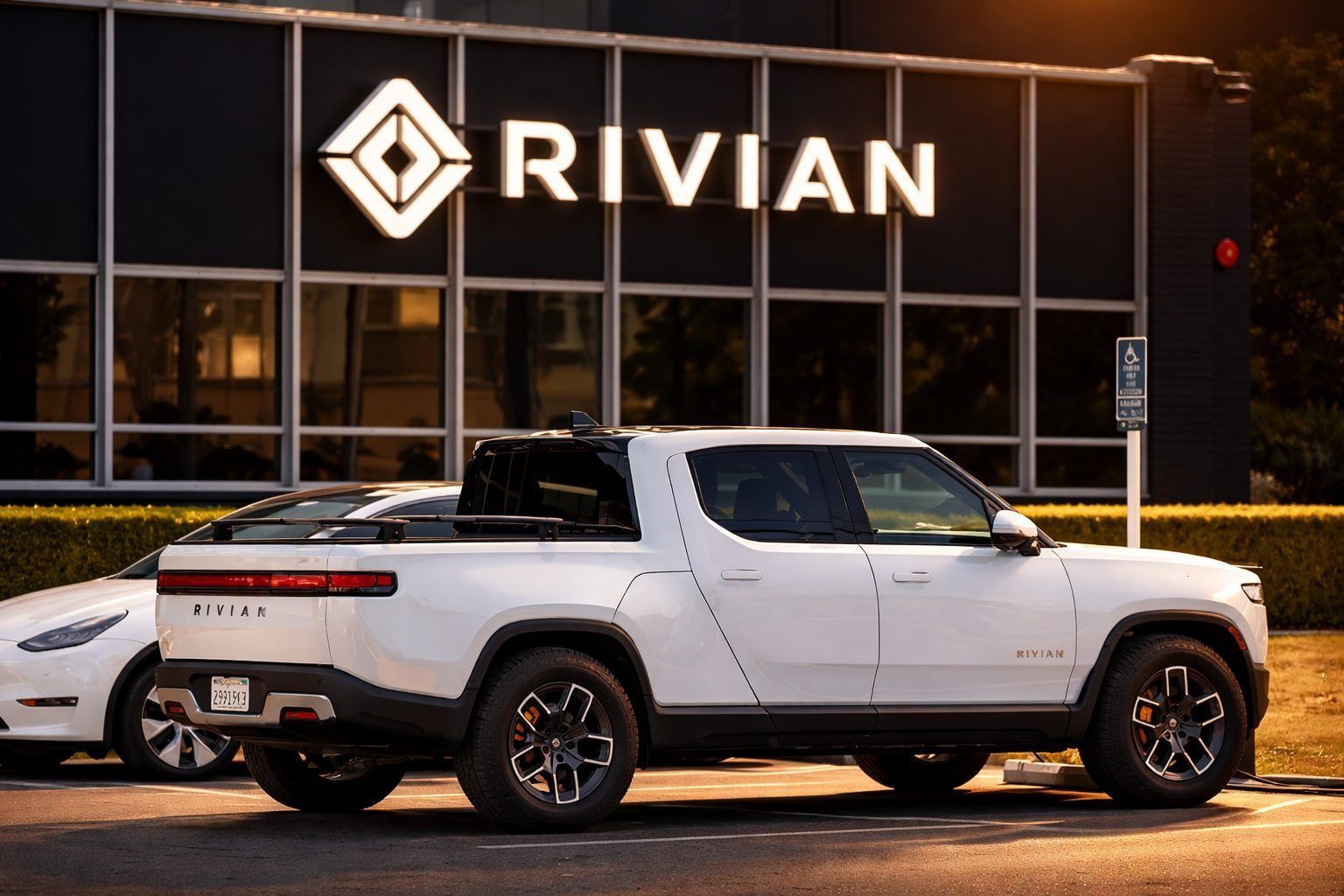
December 22, 2025 — Rivian Automotive, Inc. (NASDAQ: RIVN) is ending the year with a very different vibe than the one that dominated much of the post-IPO era: the stock is pushing to fresh highs, sentiment is swinging from “cash-burn problem” to “platform story,” and Wall Street is suddenly arguing about software subscriptions and AI chips instead of just vehicle deliveries.
On Monday, Rivian shares touched a new 52-week high of $22.68, capping a sharp recent run-up that some market trackers put at roughly 20% in the past week. Investing.com
So what’s actually moving Rivian stock right now—and what’s just narrative foam?
Below is a breakdown of the latest Rivian news as of 22.12.2025, the most-cited analyst forecasts, and the real catalysts (and risks) that could decide whether this rally has legs in 2026.
Why Rivian stock is running: the market is repricing Rivian as a “tech + platform” story
Rivian’s latest rally isn’t coming out of nowhere. It’s largely a response to a rapid sequence of developments in December that—together—tell investors: “Rivian wants recurring software revenue, not just one-time vehicle gross margin.”
1) Autonomy+ is now a real product with real pricing
Rivian is formally positioning Rivian Autonomy+ as a paid software layer. On Rivian’s autonomy page, the company says:
- Universal Hands-Free covers 3.5 million miles of roads in the U.S. and Canada (where lane markings are clear). Rivian
- Autonomy+ will be available in February 2026, priced at $49.99/month or $2,500 one-time, and deliveries include a 60-day trial. Rivian
That is exactly the kind of “SaaS-ification” investors like—because subscription revenue can eventually smooth the brutal cyclicality of car sales (in theory, at least).
2) Rivian’s autonomy push became the headline feature, not a side quest
At Rivian’s Autonomy & AI Day (Dec. 11), the company unveiled a custom autonomy chip and laid out its roadmap toward higher levels of automated driving—plus the paid Autonomy+ package. Reuters reported Rivian’s new chip is made with TSMC, supports processing from multiple sensors including lidar, and is part of a push away from reliance on suppliers like Nvidia. Reuters
In the EV market of late 2025—where “hardware is hard” and price competition is nasty—anything that hints at differentiation beyond range and 0–60 tends to get rewarded.
3) Analysts started moving targets higher—and the market followed
Rivian’s stock also got a classic “institutional narrative upgrade”: analysts argued that 2026 could be a turning point thanks to the upcoming R2 and software monetization.
- Investor’s Business Daily highlighted Wedbush’s Dan Ives calling 2026 an “inflection year” and lifting his price target to $25 after Rivian’s autonomy event and ahead of the R2 launch. Investors
- Barron’s reported Baird’s Ben Kallo upgraded Rivian to Buy and also raised the target to $25, explicitly tying the call to the R2 platform arriving in mid-2026. Barron’s
This matters because big price moves often require a “permission structure” for funds to buy—an upgrade cycle provides that.
The big 2026 bet: R2 is Rivian’s mass-market moment
If you want a single sentence summary of the bullish case, it’s this:
R2 is supposed to take Rivian from boutique EV maker to scaled manufacturer—while Autonomy+ turns the fleet into a software annuity.
A Zacks analysis published on Nasdaq framed R2 as a key catalyst and described it as a midsize SUV expected in the first half of 2026, with a starting price “around $45,000,” well below Rivian’s premium R1 lineup. Nasdaq
That price band matters. It’s where the market is deepest, where the Tesla Model Y has lived, and where “good enough” tends to outsell “best.”
But the R2 thesis is fragile in a very specific way: it doesn’t need to be perfect—it needs to be on time and manufacturable at scale without margin nightmares.
Current analyst forecasts for Rivian stock: upside targets vs. a still-cautious consensus
The headlines are bullish. The aggregate picture is… more complicated.
StockAnalysis (which compiles Wall Street analyst targets) shows that, as of Dec. 22:
- Rivian carries a consensus rating: “Hold”
- Average 12-month price target: $15.9
- Low target: $10 / High target: $25 StockAnalysis
That spread is a tell. Analysts are effectively admitting they’re forecasting two different companies:
- Rivian the car company (cash burn, execution risk, macro headwinds)
- Rivian the platform company (R2 scale + software + JV leverage)
Even within December’s updates, you can see the tug-of-war:
- Wedbush lifted a target from $16 → $25 (Dec. 19). StockAnalysis
- Baird upgraded Hold → Buy and raised $14 → $25 (Dec. 18). StockAnalysis
- Morgan Stanley, notably, moved the other direction with a Hold → Sell downgrade and a $12 target (Dec. 8). StockAnalysis
So yes: Rivian has bullish price targets again. But the Street as a whole is not unanimously buying the dream.
The Volkswagen–Rivian angle: a quiet catalyst with very loud implications
One of the most underappreciated drivers of Rivian’s “platform re-rating” is its deepening relationship with Volkswagen.
Volkswagen’s own November 12 press release says the Rivian–Volkswagen JV is:
- Developing a zonal architecture and software for future models
- Preparing VW/Audi/Scout reference vehicles for winter testing in Q1 2026
- Built up to more than 1,500 employees Volkswagen Group
Reuters went a step further the same day, reporting that Volkswagen said the JV tech could potentially extend beyond EVs into internal combustion vehicles in the future (while emphasizing near-term focus on BEVs). Reuters also noted VW’s plan for the ID.Every1 to debut the JV software/architecture in 2027. Reuters
From a stock perspective, the JV matters in two ways:
- Validation: VW is effectively saying Rivian’s architecture is serious enough to be a group-wide foundation.
- Leverage: If Rivian’s software DNA spreads into VW scale, Rivian’s “value per engineer” could rise dramatically—even if Rivian’s own vehicle volume remains modest.
It’s not guaranteed money. But it is credibility, and markets pay for that.
Fundamentals check: deliveries, guidance, and the cash burn reality
Hype can move a stock. Fundamentals decide whether it stays moved.
Deliveries: Rivian trimmed its 2025 outlook
In October, Reuters reported Rivian narrowed expected 2025 deliveries to 41,500–43,500 vehicles, citing an uncertain demand environment after U.S. EV tax-credit changes and broader industry gloom. Reuters
Whether that guidance ends up being conservative or painful will shape how investors interpret early 2026 momentum.
Cash burn: Rivian still has to finance the bridge to R2 scale
A Zacks analysis published on Nasdaq (Dec. 12) put Rivian’s cash balance at $7.1 billion at the end of Q3 2025, while also highlighting elevated capex guidance of $1.8–$1.9 billion and a 2025 delivery range of 41,500–43,500. Nasdaq
This is the part bulls and bears both agree on:
- R2 is expensive before it is profitable.
- Autonomy investment is expensive before it is monetized.
- Rivian has cash, but not infinite cash.
So a key 2026 question is not “Is Autonomy+ cool?” It’s “Does Rivian get to R2 scale without the market forcing ugly financing?”
Other Rivian headlines investors are weighing right now
Not everything is about autonomy.
Board change: Rose Marcario is stepping down
An SEC filing shows that Rose Marcario resigned from Rivian’s board effective January 1, 2026, with the board shrinking from eight to seven members. SEC
TechCrunch contextualized the timing as Rivian heads into a pivotal year with R2 and expanded automated-driving initiatives. TechCrunch
Recall: Rivian delivery vans
Reuters reported Rivian is recalling 34,824 electric delivery vehicles over a seat-belt issue, with the company also issuing an over-the-air update for misuse detection and planning inspections/replacements as needed. Reuters
CEO compensation: a Musk-style structure
Reuters also reported Rivian overhauled CEO RJ Scaringe’s pay package in a plan that could be worth up to $4.6 billion over a decade, tied to stock-price milestones and profit/cash-flow targets. Reuters
Individually, none of these necessarily changes the product roadmap—but together they influence investor confidence around governance, operational discipline, and risk.
The bull case vs. bear case for RIVN stock into 2026
The bull case (why investors are buying this rally)
- R2 expands Rivian into a far larger addressable market (lower price point, higher volume potential). Nasdaq
- Autonomy+ introduces clearer recurring revenue logic, with disclosed pricing and timing (Feb. 2026). Rivian
- The VW JV adds industrial-scale validation and potential long-term monetization leverage. Volkswagen Group+1
- Analysts are increasingly comfortable framing 2026 as a strategic turning point, with targets lifted to the mid-$20s by some firms. Barron’s+1
The bear case (why the consensus is still “Hold”)
- Rivian still faces execution risk: R2 timing, manufacturing ramp, cost targets, supplier stability.
- The company is still in a cash-burn phase, and the R2/autonomy push is capital intensive. Nasdaq
- EV demand has been sensitive to policy and incentives; Rivian itself pointed to tax-credit shifts and uncertainty when it narrowed delivery guidance. Reuters
- Autonomy is a “trust product.” A single high-profile safety event (or regulatory tightening) can stall adoption, subscriptions, and brand momentum.
In other words: the upside is real, but it’s not “free upside.”
What to watch next: the practical catalysts that could move Rivian stock after today
If you’re tracking Rivian stock beyond the headline pop to a 52-week high, these are the events that matter more than vibes:
- Adoption and performance of Universal Hands-Free as it expands to broader roads, plus consumer reception. Rivian
- Autonomy+ go-live execution (pricing is set; now it has to convert users in Feb. 2026). Rivian
- R2 manufacturing milestones and any signals about cost, margins, and launch timing. Nasdaq
- VW JV winter testing in Q1 2026 and any follow-on confirmation that the architecture is performing under harsh conditions. Volkswagen Group
- Any updates on cash runway and financing strategy as Rivian approaches the R2 ramp. Nasdaq
Rivian stock hitting a 52-week high on 22.12.2025 is the market’s way of saying: “We’re listening again.” The hard part now is keeping investors listening once the story collides with the physics of factories, margins, and time.