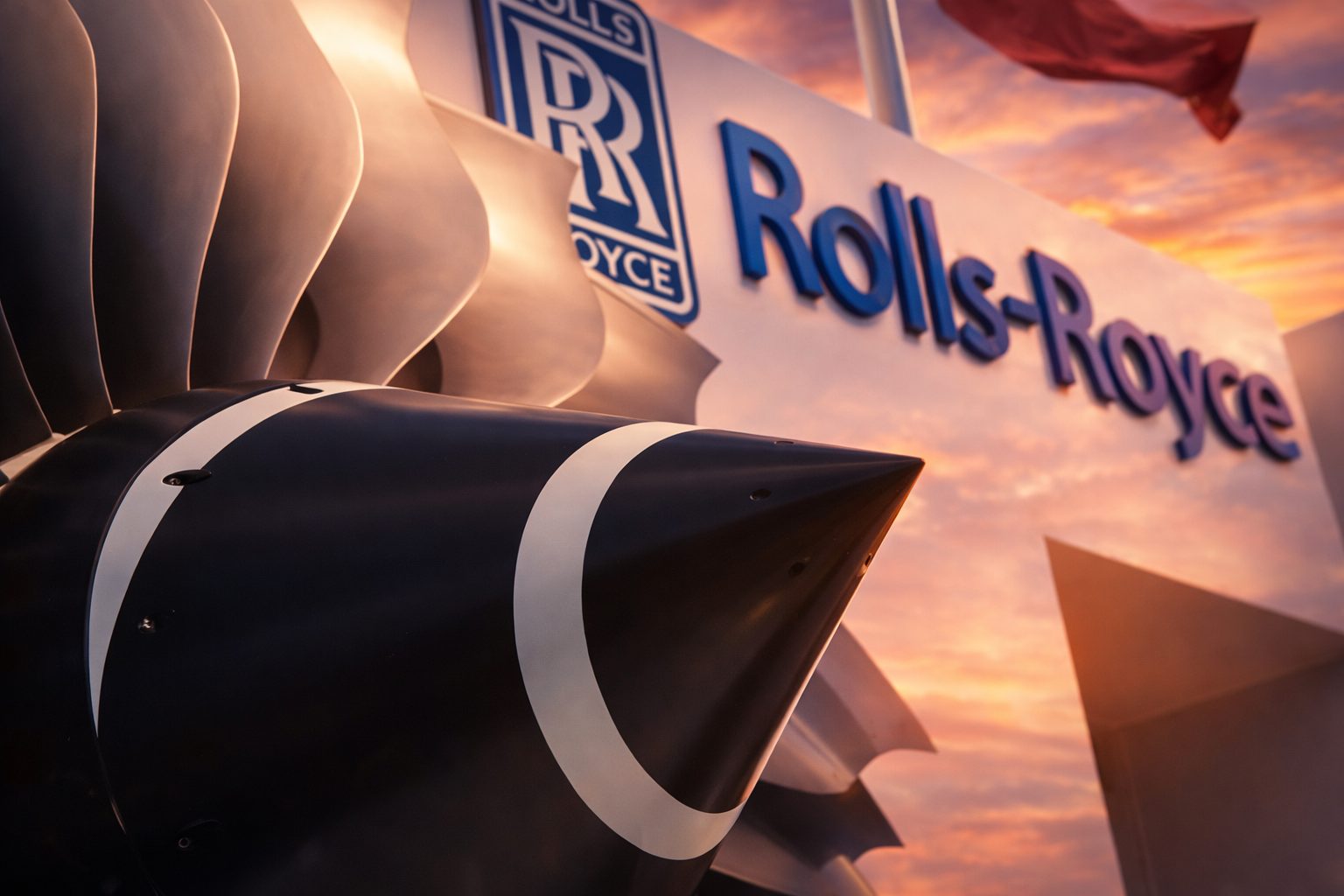
December 21, 2025 — Rolls-Royce Holdings plc shares (LSE: RR., ADR: RYCEY) are ending 2025 with momentum again, helped by a fresh capital return plan and a steady drip of operational and contract updates across Civil Aerospace, Defence and Power Systems. The stock closed at £11.70 (1,170p) on Friday, December 19, leaving it just a touch below its 52‑week high of £11.96 (set on September 29). MarketWatch+1
But the bigger story for investors isn’t “one more good week.” It’s whether Rolls‑Royce can convert its turnaround into something rarer: a durable, cash‑generating industrial compounder — while the market is already pricing in a lot of competence.
Below is the latest on the news, the company’s cash-return plans, and the most visible forecasts and analyst expectations shaping the RR.L narrative into 2026.
Rolls-Royce stock today: price, momentum, and what the market is signalling
Rolls‑Royce shares finished the last full trading week at £11.70, up 2.27% on December 19 in a session where the broader FTSE 100 also gained. MarketWatch
Zooming out, the stock’s positioning matters as much as the day-to-day moves: RR.L is trading close to the top of its recent range. One data provider lists a 52‑week range of £557 to £1,195 (in pence terms, 557p to 1,195p), with the stock around 1,170p. Investing.com
There’s also a plain-English interpretation of this setup:
- Near highs, good news has to stay good.
- Any “normal industrial wobble” (supply chain, shop-visit costs, airline capacity hiccups) can suddenly feel like a plot twist.
That’s why the next catalyst — full‑year results — is so central.
The headline catalyst: Rolls-Royce launches a £200m interim share buyback ahead of results
Rolls‑Royce announced it will begin an interim share buyback of up to £200 million, after completing its £1 billion share buyback programme for 2025 in November. The interim programme is scheduled to run from 2 January 2026 and is expected to complete no later than 24 February 2026, ahead of the expected release of FY2025 results on 26 February 2026. Rolls-Royce
Mechanically, Rolls‑Royce has a non‑discretionary agreement with UBS to execute the repurchases, with shares acquired and then cancelled, explicitly aiming to reduce share capital. Rolls-Royce
Two investor takeaways sit underneath the headline:
- Management is leaning into capital returns now that the balance sheet is stronger.
- Rolls‑Royce also made clear that the total amount of buybacks for 2026 is still subject to board review and will be communicated alongside the FY25 results. Rolls-Royce
So the buyback is both a vote of confidence and a teaser: the market will immediately start gaming what the February announcement could look like.
Defence momentum: MV‑75 FLRAA engine testing and a major Leopard 2 order
Rolls‑Royce begins AE 1107 engine testing for the U.S. Army’s MV‑75 FLRAA
On December 16, Rolls‑Royce said it has begun AE 1107 engine testing to support prototype delivery for the U.S. Army’s MV‑75 Future Long Range Assault Aircraft (FLRAA) programme. Each aircraft will use two AE 1107F engines, and testing is underway at Rolls‑Royce’s Indianapolis manufacturing campus, where the company says it has invested more than $1 billion in upgrades and test capability over the past decade. Rolls-Royce
Rolls‑Royce also framed the AE platform as “proven, low-risk,” noting more than 90 million flight hours across 16 commercial and military platforms for the AE engine family. Rolls-Royce
From a stock perspective, this kind of update is rarely about immediate revenue; it’s about reinforcing a theme: Defence programmes can be long-duration annuities if you stay embedded.
Rolls‑Royce to supply more than 300 Leopard 2 tank engines (delivery planned for 2026)
Earlier in December, Rolls‑Royce announced a major Power Systems defence order: tank manufacturer KNDS ordered more than 300 mtu MB 873 Ka‑501 engines to power new Leopard 2 battle tanks, with deliveries planned for 2026. Rolls‑Royce said the engines are intended for vehicles ordered by several European countries, including Germany, Lithuania, Sweden, the Netherlands and the Czech Republic. Rolls-Royce
The company also noted that “government business” contributed a quarter of the Power Systems division’s turnover last year, underlining how meaningful defence-linked demand has become inside that segment. Rolls-Royce
Power Systems and the “data centre economy”: sustainability disclosures and new projects
Rolls‑Royce’s Power Systems unit (mtu-branded engines and integrated power solutions) keeps popping up in 2025 coverage for one reason: the world is building energy-hungry infrastructure faster than grids can comfortably serve it.
First mtu emergency power generators for data centres with Environmental Product Declarations
On December 11, Rolls‑Royce said it delivered mtu emergency power generators with verified Environmental Product Declarations (EPDs) to a European data centre operator for the first time, positioning this as a transparency and sustainability milestone. The company said it worked with Sphera and published EPDs via the international system Environdec. Rolls-Royce
Rolls‑Royce also said its mtu gensets can be operated with sustainable fuels such as hydrotreated vegetable oil (HVO) and e‑fuels — and that, in combination with modern exhaust aftertreatment and sustainable fuels, emissions (including CO₂, NOx and particulates) can be reduced by over 90%. Rolls-Royce
This matters for stockholders because customers for “backup power” increasingly want to buy compliance and reporting along with hardware. EPDs are basically the nutrition label of industrial equipment — and increasingly, they’re not optional.
Power generators for Baleària’s electric ferries on a Spain–Morocco “green corridor”
On December 15, Rolls‑Royce said its Power Systems division will supply eight mtu emergency power generators for two fully electric fast ferries operated by Spanish shipping company Baleària. The vessels are expected to operate from 2027, covering the 18 nautical miles between Tarifa (Spain) and Tangier (Morocco) using electric power, described as the first “green corridor” between Europe and Africa. Rolls-Royce
Rolls‑Royce said the eight generators provide over 11,000 kW total output as backup for electric operation, including resilience if batteries can’t be charged as planned. Rolls-Royce
Again, this is less about one ferry route — more about the pattern: mtu is positioning itself as the reliability layer for electrification.
Civil Aerospace: flying hours, engine durability, and why “time on wing” is an investor obsession
Rolls‑Royce’s Civil Aerospace economics are famously tied to flying hours because aftermarket service revenue scales with utilisation — and because durability improvements can change the cost curve.
In its November 13 trading update (covering performance through October 31), Rolls‑Royce said Civil Aerospace demand remained strong, citing significant large engine orders in the second half of the year (including from IndiGo, Malaysia Airlines and Avolon). It also flagged growing demand for the Trent XWB‑97-powered Airbus A350F, including from customers in Greater China and Asia Pacific. Rolls-Royce
The key operating metric: large engine flying hours for the 10 months to October 31, 2025 grew 8% year-on-year to 109% of 2019 levels. Rolls-Royce
On durability, Rolls‑Royce said its upgraded Trent 1000 HPT blade (certified in June) “more than doubles” time on wing for that engine and is being fitted across new and existing engines in the MRO network. It also said the next phase of durability improvements for Trent 1000 and Trent 7000 remains on track for certification by end‑2025, with a further 30% time-on-wing increase expected. Rolls-Royce
Reuters has also highlighted how central these initiatives are to the profit algorithm, reporting earlier in 2025 that Rolls‑Royce makes money from engines’ flying hours and is targeting more than 80% improvement in time on wing for Trent engines by 2027. Reuters
What management is guiding for 2025: profit and free cash flow targets
Rolls‑Royce’s November trading update reiterated 2025 guidance of £3.1bn–£3.2bn in underlying operating profit and £3.0bn–£3.1bn in free cash flow, while also acknowledging continued supply chain challenges. Rolls-Royce
This 2025 guidance framework was previously raised during the half‑year results in July 2025. Reuters+1
The trading update also pointed to balance sheet strengthening and noted that credit rating agencies hold Rolls‑Royce at investment grade, including an upgrade to BBB+ by S&P Global in August, and that the company repaid a $1bn bond that matured in October. Rolls-Royce
Analyst forecasts: where revenue, earnings, cash flow and dividends are expected to land through 2028
Rolls‑Royce publishes a compiled analyst consensus (with clear caveats that it doesn’t endorse the estimates). The latest version on the company site was compiled from 13 analyst submissions collected in September 2025. Rolls-Royce
Here are the headline consensus numbers:
- FY2025: underlying revenue £19,552m, underlying EBIT £3,268m, free cash flow £3,177m, EPS 28.7p, DPS 9.3p Rolls-Royce
- FY2026: underlying revenue £21,516m, underlying EBIT £3,662m, free cash flow £3,572m, EPS 32.6p, DPS 11.2p Rolls-Royce
- FY2027: underlying revenue £23,378m, underlying EBIT £4,079m, free cash flow £4,175m, EPS 37.2p, DPS 12.8p Rolls-Royce
- FY2028: underlying revenue £25,357m, underlying EBIT £4,554m, free cash flow £4,636m, EPS 42.6p, DPS 14.7p Rolls-Royce
Two things jump out:
- Consensus expects meaningful growth in cash generation into 2027–2028.
- The implied dividend trajectory rises — but (importantly) dividends are still a smaller part of the story than free cash flow plus buybacks.
Analyst ratings and 12‑month price targets: “Buy” consensus, but not unlimited upside
One widely cited market consensus (18 analysts) lists Rolls‑Royce at a “Buy” consensus rating: 13 buy, 5 hold, 0 sell. The same snapshot shows an average 12‑month price target of about 1,215.9p, with a high estimate of 1,615p and a low estimate of 790p. Investing.com
If the stock is around 1,170p, that “average target” implies only modest upside — which is another way of saying: a lot of optimism is already in the price, and future upgrades may depend on execution that beats already-strong expectations.
Dividend reality check: payouts are back, but buybacks remain the louder signal
Rolls‑Royce’s dividend is no longer theoretical. The company’s shareholder payment history shows:
- Final dividend:£0.06 (6p) paid 16 June 2025
- Interim dividend:£0.045 (4.5p) paid 18 September 2025 Rolls-Royce
That’s a total of 10.5p paid across those two declared distributions — but the larger market narrative in 2025 has been the scale and persistence of buybacks (first £1bn completed, then the additional £200m interim programme). Rolls-Royce+1
Nuclear optionality: UK SMR progress, Siemens partnership — and IPO rumours denied
Rolls‑Royce’s Small Modular Reactor (SMR) business remains one of the most polarising parts of the equity story: bulls see “embedded call option,” bears see “capital needs and political risk.”
On the positive side, Reuters reported in February that Siemens Energy entered a partnership expected to make it the exclusive supplier of conventional technology (steam turbines, generators and auxiliary systems) for future Rolls‑Royce SMRs, with the agreement expected to be finalised by end‑2025. Reuters also referenced SMR output of up to 470 MW per unit. Reuters
In the UK, Rolls‑Royce SMR was selected as preferred bidder for a UK SMR programme earlier in 2025, according to reporting that described a plan aiming for generation by 2032 at the earliest and SMR units producing around 470 MW each. The Guardian
But the market also got a reminder that management is trying to control the narrative: Reuters reported in August that Rolls‑Royce denied a report suggesting it was exploring an IPO for its small nuclear reactor unit. Reuters
The bull case for Rolls-Royce stock into 2026
The optimistic thesis is not mystical; it’s operational:
- Aftermarket economics are improving as durability upgrades extend time on wing and reduce disruption costs, while utilisation stays high. Rolls-Royce+1
- Defence exposure is strengthening, and Europe’s rearmament cycle is still running hot enough to produce major engine orders. Rolls-Royce+1
- Power Systems is riding structural demand: data centres, electrification, and reliability upgrades create a long runway for mtu solutions. Rolls-Royce+2Rolls-Royce+2
- Capital returns are explicit and growing, with a completed £1bn buyback, a new £200m interim programme, and more guidance expected in February. Rolls-Royce
In the simplest framing: investors are paying for “a better Rolls‑Royce,” and the company is working hard to keep earning that label.
The bear case: valuation, cycle risk, and the awkward truth about expectations
When a stock is near highs, “risk” often means “the story isn’t wrong, it’s just priced like it can’t get worse.”
A few widely discussed pressure points:
- Valuation debate: some valuation models argue the stock is already pricing in a very rosy future. One Simply Wall St write‑up notes its DCF model put fair value nearer £10.01 while the share price was £11.70, implying overvaluation — even as another angle in the same piece cites a higher fair value estimate. Simply Wall St
- Cycle timing risk: an Interactive Investor summary of UBS research suggested that upside could extend into 2026, but warned the aftermarket cycle could turn as soon as 2026, with growth normalising later. Interactive Investor
- Execution and external shocks: supply chain constraints and tariffs were explicitly flagged as challenges in 2025 commentary — and those are the kinds of issues that don’t politely wait for quarterly reporting dates. Reuters+1
None of these automatically breaks the investment case. But they explain why RR.L can swing sharply on relatively small changes in guidance language.
Key dates and near-term catalysts to watch
Here’s what matters on the calendar from here:
- 2 January 2026: interim £200m share buyback scheduled to begin Rolls-Royce
- By 24 February 2026: interim buyback expected to complete no later than this date Rolls-Royce
- 26 February 2026: expected communication of FY2025 results (and likely the next major update on 2026 capital returns) Rolls-Royce+1
- End of 2025: Civil Aerospace durability certifications targeted for next-phase Trent 1000 and Trent 7000 improvements Rolls-Royce
Bottom line: Rolls-Royce stock has catalysts — but it’s no longer a “cheap turnaround”
Rolls‑Royce is heading into 2026 with three tailwinds that markets love: capital returns, defence demand, and a strong aerospace aftermarket. The company’s recent news flow — from the £200m interim buyback to defence engine testing and Power Systems wins tied to data centres and electrification — fits neatly into that thesis. Rolls-Royce+3Rolls-Royce+3Rolls-Royce+3
At the same time, analyst price targets imply that a meaningful chunk of that optimism is already reflected in the share price. So the next leg higher likely depends less on “good news” and more on better-than-expected execution — especially when FY2025 results land at the end of February. Investing.com+1