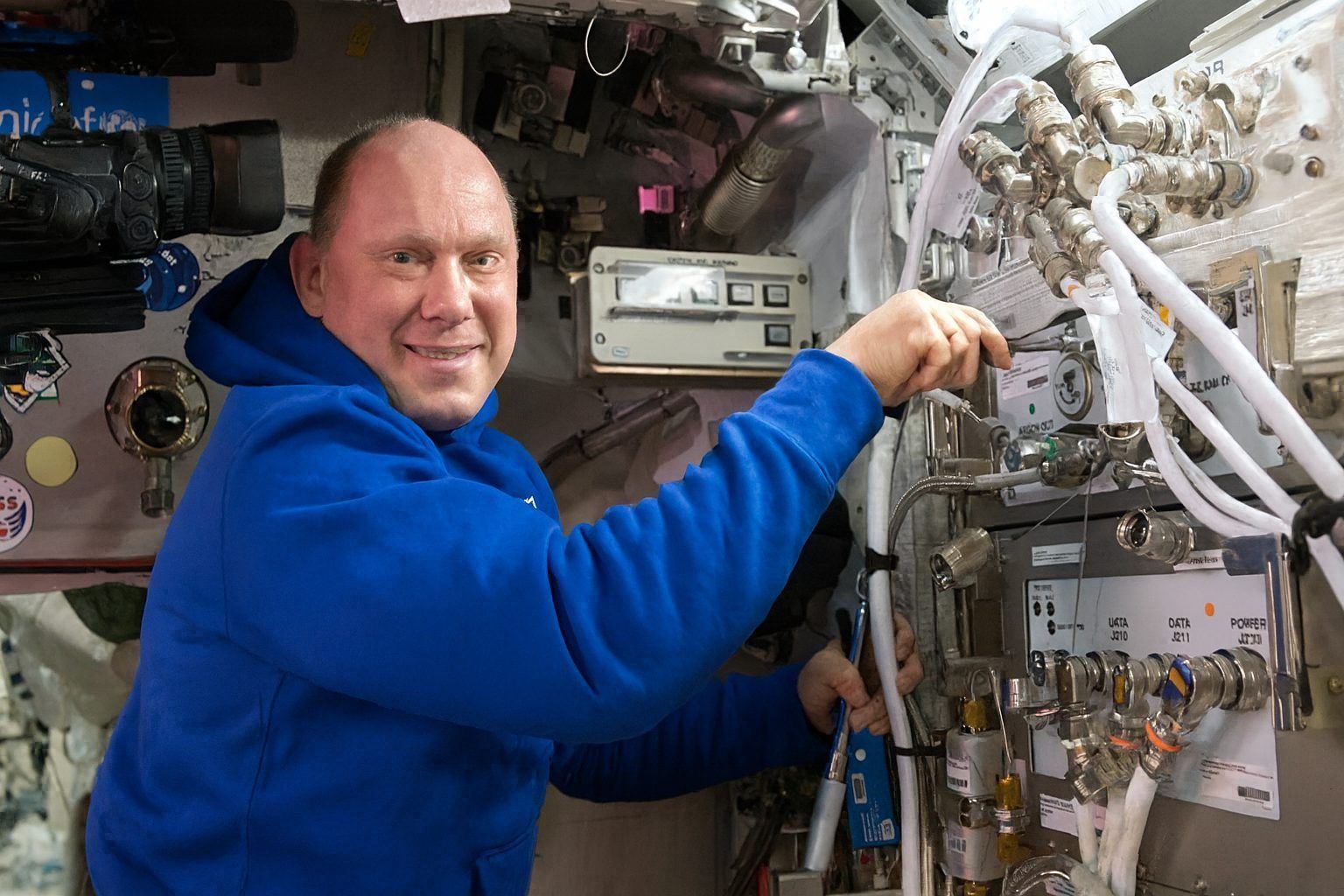
A high‑profile joint NASA–Roscosmos mission has been thrown into uncertainty after veteran Russian cosmonaut Oleg Artemyev was abruptly removed from SpaceX’s upcoming Crew‑12 flight to the International Space Station (ISS), following allegations that he mishandled confidential technical data at SpaceX’s training facilities in the United States. [1]
According to multiple outlets citing investigative reporting by The Insider, Artemyev is suspected of photographing restricted SpaceX documentation and hardware at the company’s Hawthorne, California site in late November 2025, an act that could amount to a violation of U.S. International Traffic in Arms Regulations (ITAR) – export‑control rules governing sensitive military‑related technologies. [2]
Russia’s state space agency Roscosmos has confirmed that Artemyev is being replaced on the Crew‑12 mission by fellow cosmonaut Andrey Fedyaev, but officially attributes the change only to his “transition to another job,” without mentioning any investigation. [3] NASA and SpaceX have so far declined public comment. [4]
The story broke on December 2–3, 2025, and has quickly become one of the day’s most closely watched security and space‑policy developments. [5]
Key facts at a glance
- Who was removed?
Oleg Artemyev, 54‑year‑old Russian cosmonaut, Hero of the Russian Federation, with three ISS missions and about 560 days in space. [6] - Which mission?
SpaceX Crew‑12, a NASA Commercial Crew Program flight to the ISS, currently slated no earlier than February 15, 2026, carrying up to four astronauts including one Roscosmos cosmonaut under a seat‑exchange agreement. [7] - Allegations:
Artemyev allegedly photographed SpaceX engines, documents, and other internal materials at the company’s Hawthorne training site and removed those images on his phone, potentially breaching ITAR export‑control rules. [8] - Official line vs media reports:
Roscosmos says the reassignment is due to a job change; independent media report an interagency U.S. investigation into a possible security breach. [9] - Replacement:
Roscosmos has named Andrey Fedyaev, who previously flew on SpaceX Crew‑6 in 2023, as the new Russian member of the Crew‑12 crew. [10]
What happened to Oleg Artemyev and Crew‑12?
The first public hints of trouble appeared in late November, when Russian space‑flight analyst Georgy Trishkin noted on Telegram that Artemyev’s name had quietly disappeared from the official Crew‑12 roster and been replaced by Fedyaev on the Yuri Gagarin Cosmonaut Training Center website. [11]
On December 2, 2025, investigative outlet The Insider published a detailed report stating that Artemyev had been removed from the mission “a few months before launch” following allegations that he had violated ITAR by photographing SpaceX documentation and “exporting” the information on his mobile phone. [12] Trishkin told the outlet that his sources confirmed a violation and said an interagency investigation had been launched in response. [13]
The same day, Roscosmos issued a brief statement confirming that Andrey Fedyaev had been added to the main Crew‑12 crew “instead of Oleg Artemyev,” but said only that the decision “was made in connection with [Artemyev’s] transfer to another job.” [14]
On December 3, The Moscow Times and other international outlets picked up the story, framing it as a security‑related removal from a SpaceX mission and highlighting the alleged mishandling of sensitive materials at SpaceX’s Hawthorne facility. [15] Space.com likewise reported that Artemyev was pulled from Crew‑12 “for violating U.S. national security regulations,” citing The Insider’s account of ITAR concerns. [16]
So far, neither NASA nor SpaceX has publicly explained the decision or confirmed details of the alleged breach, beyond standard acknowledgments of crew‑assignment changes. [17]
Who is Oleg Artemyev?
Artemyev is not a rookie flyer being quietly shuffled out of line; he’s one of Russia’s most experienced active cosmonauts.
According to official biographies and ISS flight records, Artemyev: [18]
- Was born December 28, 1970, in Riga (then part of the Soviet Union).
- Was selected as a cosmonaut in 2003 and has been part of the ISS program for two decades.
- Flew on three long‑duration missions to the ISS (Soyuz TMA‑12M, Soyuz MS‑08, Soyuz MS‑21), serving as both flight engineer and mission commander.
- Has logged about 560 days in space and performed eight spacewalks, totaling more than 53 hours of work outside the station.
- Since 2019, has also been a deputy in the Moscow City Duma representing the pro‑Kremlin United Russia party.
He is a recipient of the Hero of the Russian Federation title, one of the country’s highest honors. [19]
Because of this profile, the choice of Artemyev as Roscosmos’ representative on Crew‑12 made sense: he is one of the few cosmonauts with both deep ISS experience and high political standing in Moscow. That combination makes his sudden removal – and the suggestion of a security breach involving a U.S. commercial partner – especially sensitive.
What is Artemyev accused of doing at SpaceX?
Media accounts that emerged on December 2–3, based largely on The Insider, Trishkin’s Telegram posts, and the space‑focused channel “Yura, forgive me!”, outline broadly consistent allegations: [20]
- During training at SpaceX’s Hawthorne facility in California, Artemyev allegedly used his phone to photograph SpaceX engines and other internal materials, including technical documentation. [21]
- He then is said to have removed those images from the secure facility, effectively “carrying secret information out in his phone,” as several Russian‑language reports put it. [22]
- These actions reportedly constituted a violation of ITAR, the U.S. export‑control regime that restricts the transfer of sensitive defense‑related technology and data to foreign nationals from certain countries, including Russia. [23]
Trishkin has been quoted in multiple outlets as saying that removing someone from a mission just two and a half months before launch, without a clear explanation, is in itself a strong indicator that something serious occurred, and that in his view it is hard to imagine an experienced cosmonaut committing such a breach “unintentionally.” [24]
The Latvian‑based outlet Meduza adds another detail, reporting that at the time of publication, Artemyev had reportedly been “booted out of America”, according to one unnamed source – though that claim has not been independently confirmed by U.S. authorities. [25]
It is important to stress that, as of December 3, 2025, no public criminal charges have been announced in the United States, and all descriptions of the alleged breach come from unnamed sources cited by investigative and independent media. Roscosmos, NASA, and SpaceX have not provided a factual narrative of what happened inside the Hawthorne facility.
Roscosmos’ opaque explanation – and the role of Andrey Fedyaev
While Western and independent Russian‑language media describe a possible security incident involving ITAR‑controlled data, Roscosmos’ official messaging has been notably bland.
On December 2, the agency stated simply that Andrey Fedyaev had been included in the main Crew‑12 crew “instead of Oleg Artemyev”, and that the decision “was made in connection with Artemyev’s transition to other work.” [26] No details of that “other work” were provided, nor did the agency mention the Hawthorne allegations or any U.S. investigation.
Fedyaev is himself an experienced ISS flyer and a known quantity for NASA and SpaceX. He: [27]
- Flew as mission specialist on SpaceX Crew‑6 in 2023, spending almost six months on the ISS.
- Participated in operations using the European Robotic Arm and supported several spacewalks from the station.
- Became one of the first Russian cosmonauts to ride a commercial American spacecraft under the NASA–Roscosmos cross‑flight agreement.
From an operational standpoint, Fedyaev is a logical replacement: he is already familiar with Crew Dragon systems, NASA procedures, and SpaceX training environments, reducing the time needed to bring the new crew fully up to speed. [28]
But the way the replacement has been framed – blunt technical allegations in independent media, versus a vague “job change” in the official Russian line – underscores how politically sensitive the case has become.
Why ITAR and export‑control rules matter so much here
The reference to ITAR is not a minor bureaucratic detail; it goes to the heart of why Artemyev’s alleged actions are being treated as a potential national‑security issue in the United States.
ITAR (International Traffic in Arms Regulations): [29]
- Is a U.S. regulatory regime that controls the export of certain defense‑related technologies, technical data, and services.
- Lists Russia among the states subject to special restrictions under Section 126.1, making the transfer of covered information to Russian nationals tightly controlled. [30]
- Applies not only to hardware shipments but also to intangible technical data, including photos and documents that reveal design details of controlled systems.
SpaceX’s rocket engines, avionics, and certain Crew Dragon subsystems fall squarely into categories that U.S. officials have historically treated as ITAR‑sensitive, even when foreign partners are long‑standing allies. [31]
If a foreign crew member is found to have deliberately captured and removed detailed imagery or documentation of such hardware, U.S. agencies could interpret that as an unauthorized export of controlled technical data, triggering mandatory investigations and potential sanctions – regardless of whether the material was passed further on.
In this context, the reports of an interagency probe involving multiple U.S. authorities are unsurprising, even if the findings may never be made public. [32]
A blow to the U.S.–Russia ISS “seat‑swap” cooperation
Beyond the individual case, Artemyev’s removal lands at a delicate moment for U.S.–Russia cooperation in space.
Since 2022, NASA and Roscosmos have operated a no‑funds‑exchanged “seat‑swap” agreement:
- American astronauts fly to the ISS on Russian Soyuz spacecraft,
- Russian cosmonauts fly on SpaceX Crew Dragon missions,
- ensuring at least one U.S. and one Russian crew member are always on board the station to operate their respective segments. [33]
Crew‑12 is one of the missions covered by that arrangement. Meduza and other outlets note that it is explicitly part of the ongoing seat‑exchange program, making Artemyev’s removal more than just a personnel reshuffle – it touches the symbolic core of continued ISS cooperation amid intense geopolitical tensions. [34]
Compounding the timing, Russia’s Baikonur Cosmodrome – currently its only operational launch pad for crewed Soyuz missions – suffered damage in late November after a rocket launch to the ISS, raising the risk of delays to Russian crewed flights. [35]
Together, Baikonur’s problems and the Artemyev case highlight how fragile the human‑spaceflight partnership has become:
- If Soyuz launches are delayed due to ongoing repairs, Russia will rely even more on Crew Dragon seats to maintain a continuous cosmonaut presence on the ISS. [36]
- Now, one of those Dragon seats has become a flashpoint in a security controversy, raising questions about future Russian participation on U.S. commercial vehicles and the vetting of foreign crew in sensitive facilities.
At this stage, there is no indication that NASA plans to end the seat‑swap arrangement; previous public statements have emphasized that mixed crews are critical to “maintain the reliability of the ISS as a whole.” [37] But the Artemyev episode is likely to feed internal debates on risk, access rules, and how close technical cooperation with Roscosmos can safely remain.
What happens next for Crew‑12 – and for Artemyev?
For the mission
Current public schedules still list Crew‑12 as launching no earlier than February 15, 2026, on a Falcon 9 Block 5 rocket from Florida, carrying: [38]
- Up to two NASA astronauts (yet to be formally named),
- ESA astronaut Sophie Adenot,
- Roscosmos cosmonaut Andrey Fedyaev.
Specialist space‑tracking sites continue to show the mission as “NET Feb 15, 2026” with no sign – at least publicly – of a slip directly linked to the Artemyev situation. [39]
Because Fedyaev already has experience on Crew Dragon and the ISS, most experts expect training disruptions to be manageable, so long as there are no broader political repercussions.
For Artemyev
For Artemyev personally, the picture is murkier:
- Russian outlets note that he remains an elected member of the Moscow City Duma and has not been publicly stripped of his Hero of Russia title or other honors. [40]
- Roscosmos’ wording – “transition to another job” – suggests he may be reassigned within the space sector or to a political or educational role, but no such new position has been announced. [41]
- Meduza reports that at least one source claims he has been required to leave the United States following the Hawthorne incident, but this has not been confirmed by U.S. authorities or Roscosmos. [42]
Much will depend on the outcome – public or not – of the U.S. interagency investigation. If officials conclude that ITAR violations occurred but decide against criminal charges, the affair could remain largely administrative, affecting Artemyev’s international travel and flight status but not resulting in a courtroom drama.
If, however, the investigation points to deliberate technology transfer to third parties, the case could escalate into a full‑blown espionage controversy, with significant implications for both Artemyev and the broader NASA–Roscosmos relationship. At the moment, there is no public evidence of such a step, and media reports stop short of alleging that classified data was actually passed on.
Why this story matters
Even without criminal charges, the Artemyev–Crew‑12 case is significant for several reasons:
- Precedent‑setting:
It appears to be the first time a Russian cosmonaut has been removed from a U.S. commercial crew mission over alleged national‑security concerns, highlighting how sensitive private‑sector space technology has become in an era of geopolitical confrontation. [43] - Stress‑test for international cooperation:
The ISS partnership has already weathered sanctions, war, and political threats; this incident tests whether trust can survive when security agencies see partners’ astronauts as potential intelligence risks. [44] - Signal to future foreign crew members:
For all non‑U.S. astronauts training with SpaceX or other U.S. commercial providers, the message is clear: export‑control rules apply personally, and missteps – even if framed as “just photos” – can end careers and strain international relationships. - Impact on commercial space diplomacy:
As NASA increasingly relies on commercial vehicles like Crew Dragon and companies like Boeing and others vie for contracts, how these firms handle security incidents involving foreign crew members could influence future government decisions on access and partnership models. [45]
For now, Crew‑12 is still on the books, Fedyaev has taken Artemyev’s seat, and all sides are keeping official comments to a minimum. But the combination of alleged espionage‑adjacent behavior, export‑control rules, and a fragile U.S.–Russia partnership in orbit ensures that this story will remain under close scrutiny as the launch date approaches.

References
1. www.themoscowtimes.com, 2. theins.ru, 3. www.themoscowtimes.com, 4. www.space.com, 5. www.themoscowtimes.com, 6. www.svoboda.org, 7. www.themoscowtimes.com, 8. theins.ru, 9. theins.ru, 10. www.themoscowtimes.com, 11. theins.ru, 12. theins.ru, 13. theins.ru, 14. theins.ru, 15. www.themoscowtimes.com, 16. www.space.com, 17. www.space.com, 18. en.wikipedia.org, 19. www.svoboda.org, 20. theins.ru, 21. theins.ru, 22. news.zerkalo.io, 23. theins.ru, 24. theins.ru, 25. meduza.io, 26. theins.ru, 27. en.wikipedia.org, 28. en.wikipedia.org, 29. theins.ru, 30. t.me, 31. www.space.com, 32. theins.ru, 33. www.reuters.com, 34. meduza.io, 35. www.themoscowtimes.com, 36. www.themoscowtimes.com, 37. www.reuters.com, 38. en.wikipedia.org, 39. nextspaceflight.com, 40. www.svoboda.org, 41. theins.ru, 42. meduza.io, 43. www.space.com, 44. phys.org, 45. www.space.com