
NEW YORK, June 22, 2026, 6:03 a.m. ET
- Sandisk was indicated at $2,263.89 in premarket trading, up $79.14, or 3.62%, after closing the latest regular session at $2,184.75, up $225.95, or 11.54%.
- The move is a sector read-through, not a fresh Sandisk press release: Apple’s memory-cost warning is pulling NAND pricing power into the open.
- The overlooked math: SNDK screens at 75.95x trailing EPS, but at the premarket quote it is roughly 18.0x the annualized midpoint of Sandisk’s guided Q4 non-GAAP EPS, if that run-rate proves durable.
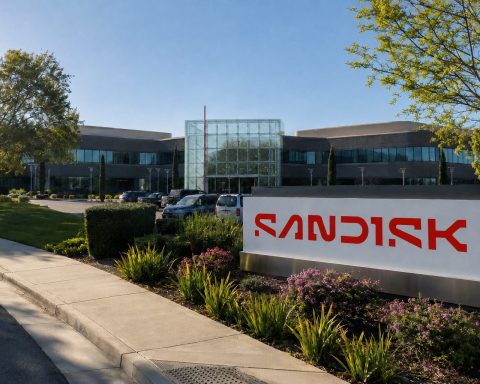
Sandisk Corporation NASDAQ:SNDK is moving again before Monday’s open: Google Finance showed the stock at $2,263.89 in premarket trading, up $79.14, or 3.62%, after the latest regular-session close of $2,184.75, up $225.95, or 11.54%. The immediate reason is not a new Sandisk announcement. It is Apple: CEO Tim Cook’s acknowledgement that memory-driven price increases are “unavoidable” has turned a supplier squeeze into visible pricing pressure at one of the world’s largest hardware buyers. Google
For Sandisk Corporation NASDAQ:SNDK, that distinction matters. Sandisk’s investor-relations feed listed its most recent company releases as the May investor-conference update, the May mini-tender rejection notice, and the April 30 quarterly results, while its latest SEC items were Form 4 and Form 144 filings in early June. In other words, Monday’s premarket bid is not being driven by a fresh company filing. It is memory-sector repricing.
Apple is the psychological catalyst because it is a buyer, not a seller. Business Insider, citing Cook’s Wall Street Journal interview, quoted him saying the pricing situation had become “unsustainable,” and Gene Munster said the “price hike conversation” was driving chip stocks higher. That is exactly the kind of buyer-side validation memory bulls wanted: confirmation that higher component costs are not staying hidden inside supplier slide decks. Business Insider
Sandisk’s own numbers explain why traders are chasing the read-through so aggressively. In its April quarter, the company reported $5.95 billion of revenue, up 97% sequentially, GAAP net income of $3.615 billion, and non-GAAP diluted EPS of $23.41. Datacenter revenue alone rose to $1.467 billion, up 233% sequentially, helped by higher pricing and demand for high-capacity storage. Chief Executive David Goeckeler called it a “fundamental inflection point” and said Sandisk was showing “structurally higher and more durable earnings power.” Sandisk Corporation
The information gain is the multiple compression hiding in plain sight. At $2,263.89, SNDK looks extreme on Google Finance’s trailing figures: $28.77 of EPS and a 75.95x P/E. But Sandisk guided Q4 non-GAAP EPS to $30 to $33; the midpoint, $31.50, annualizes to $126. On that run-rate, Monday’s premarket quote is roughly 18.0x annualized guided EPS. That does not make the stock cheap by itself. It reframes the question: is Q4 a cyclical peak, or the new earnings base? Google
TrendForce adds the supply-side bridge behind the trade. Its latest memory note said major suppliers are prioritizing HBM and advanced-layer 3D NAND, squeezing mature-node products, with cumulative first-half contract price increases of more than 100% for NOR Flash and SLC NAND. It also said no significant capacity expansion is expected in the second half, keeping supply-demand tight. That is why a consumer-hardware price comment can move a NAND-heavy name so sharply.
The street’s sharper read is that Apple did not create the memory squeeze; it exposed who has bargaining power. Investing.com cited Mizuho’s Jordan Klein saying memory costs are up 80% to 90% in 2026 since the end of 2025, and that investors may still “under-appreciate demand and pricing trends into ’27/’28.” For retail traders, that is the hook: SNDK is no longer just a post-spin storage stock. It is trading like a scarce-capacity proxy. Investing.com
One mechanical item is worth separating from the hype. Western Digital disclosed a June 11 exchange agreement to swap 1,038,681 Sandisk shares it held for Western Digital shares, with closing expected on June 22. Against Google Finance’s 148.09 million SNDK shares outstanding, that block is about 0.70% of the share count. It may matter at the margin for positioning, but it is too small to explain the move by itself.
The bear case is clean: if SNDK loses $2,029.00, the latest regular-session low, the Apple-driven breakout starts to look tired; if it slides back through the prior-week close of $1,980.10, momentum buyers may treat the move as failed rather than merely paused. Fundamentally, NAND is still a cyclical market, and Sandisk’s own filings flag exposure to pricing trends, demand swings, supply conditions, and manufacturing commitments. The asymmetry is obvious after a vertical move: pricing power is the bull thesis, but any sign of demand elasticity or contract-price fatigue would hit a stock now priced for durability.
The next hard catalyst is not Sandisk’s calendar. It is Micron’s fiscal Q3 report on June 24, where traders will listen for confirmation that memory pricing, AI storage demand, and customer pass-through are still tightening rather than peaking. If Micron validates the same cycle, Apple’s comment may look less like a one-day headline and more like the moment the memory trade went mainstream.
Related articles: NASDAQ:SNDK