Published: 12 November 2025
A powerful burst of space weather is sweeping across Earth today, disrupting radio communications, degrading GPS accuracy and setting the stage for another night of widespread aurora. The U.S. National Oceanic and Atmospheric Administration (NOAA) confirms G4 “severe” geomagnetic storm levels were reached early on Wednesday, while the European Space Agency (ESA) says a third coronal mass ejection (CME) could arrive late tonight or early Thursday—potentially prolonging disruptions. In the UK, the British Geological Survey (BGS) has upgraded its forecast to the highest intensity, warning this could be the biggest solar storm to affect Britain in more than two decades. NOAA Space Weather Prediction Center+2Euro…
What’s hitting Earth—and why experts call it a “cannibal” storm
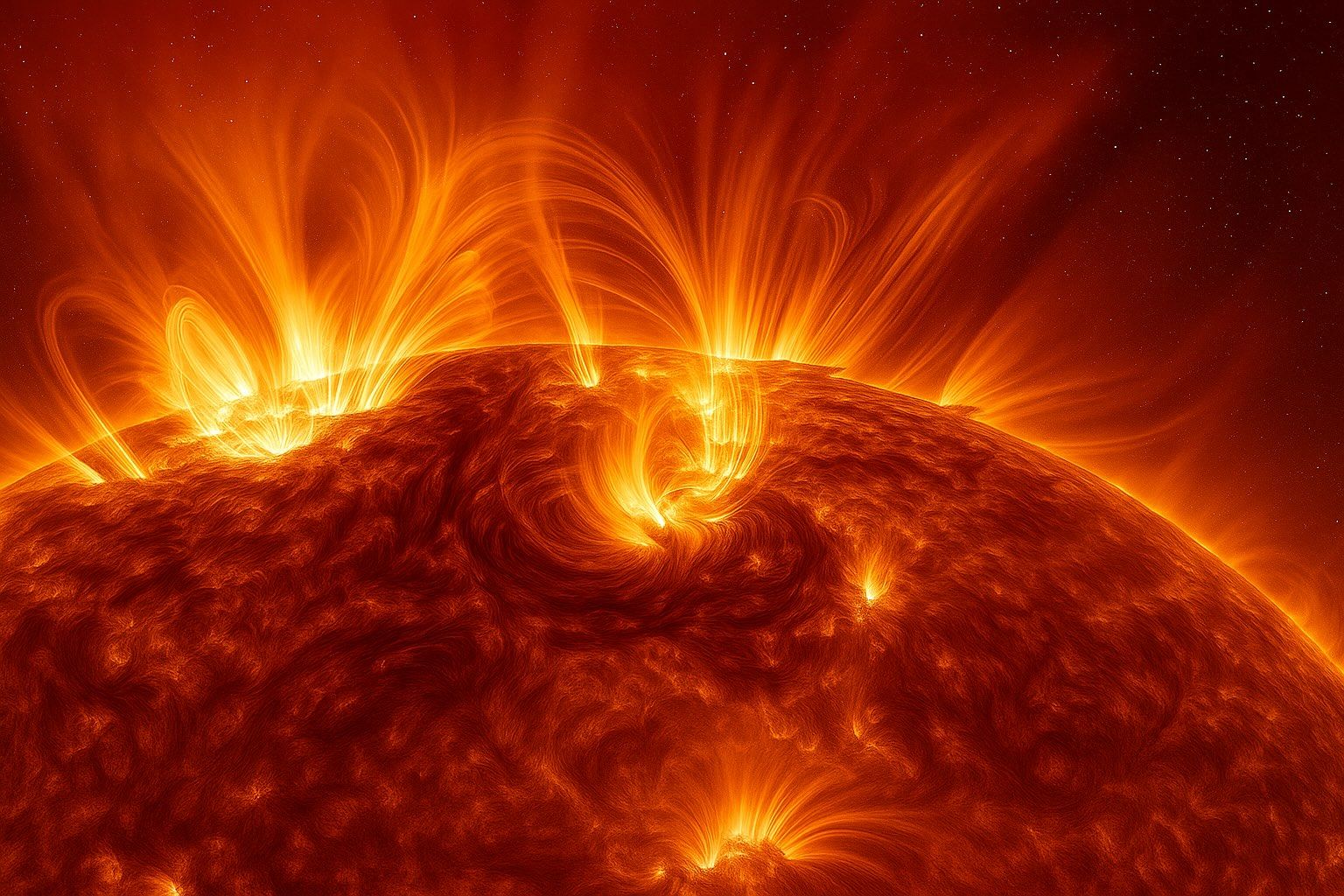
ESA reports that an X5.1-class solar flare erupted on 11 November at 10:04 UTC, followed by a fast-moving CME estimated at ~1,500 km/s. This outburst comes on the heels of earlier eruptions, and forecasters say today’s disturbance is being driven by multiple CMEs, with another likely to arrive late 12 November or early 13 November. When a faster CME plows into slower, earlier ejections, it can merge and intensify into a “cannibal” storm, amplifying impacts at Earth. European Space Agency
NOAA placed a G4 (Severe) watch for 12 November and confirmed G4 storm conditions at 01:20 UTC, noting that storming could persist through tonight as CME passage continues. That aligns with ESA’s scenario of three back‑to‑back space‑weather events and an extended period of elevated risk. Space Weather+2NOAA Space Weather Predicti…
UK on highest alert; record ground effects already logged
The BGS says the UK is braced for what “could be the largest solar storm in over two decades.” It has raised its geomagnetic forecast to the maximum, citing an ongoing event that has already disrupted communications and GPS and produced the biggest measured geoelectric field at ground level since BGS records began (2012). Conditions tonight could strengthen further if the incoming CME merges with the earlier ones—consistent with the “cannibal” scenario. British Geological Survey
Assuming clear, dark skies, aurora visibility is possible across Scotland, Northern Ireland and northern England, with a chance of sightings further south depending on cloud breaks, according to UK forecasters. Met Office
What’s happening globally
NOAA’s confirmation of G4 severe storming has already translated into widespread aurora across North America, with sightings reported unusually far south overnight and more displays possible tonight if activity persists. The Guardian+1
ESA emphasizes that while satellites, navigation (GNSS), and power grids face heightened risk during severe storms, there is no direct biological threat to people thanks to Earth’s magnetic field and atmosphere. Earlier solar flares also caused short‑wave radio disturbances on the sunlit side of Earth. European Space Agency
Spaceflight impact: NASA delays Blue Origin’s Mars mission
The space‑weather spike forced NASA to postpone today’s Blue Origin New Glenn launch carrying the ESCAPADE twin Mars probes. The agency and launch provider cited “highly elevated solar activity” and its potential effects on the spacecraft, with a new launch opportunity to be assessed when conditions improve. AP News
What disruptions to expect today
Navigation & timing (GPS/GNSS): Users may see reduced accuracy or intermittent outages, especially at high latitudes and during auroral activity. Aviation, agriculture, surveying and logistics operations are at risk of degraded precision. European Space Agency+1
Radio communications:HF (short‑wave) and some VHF/UHF links can experience blackouts or quality loss, particularly on the dayside during and after major flares, and in auroral zones during geomagnetic storms. European Space Agency
Satellites & spacecraft: Expect increased drag in low‑Earth orbit, sensor anomalies, and higher radiation exposure to electronics, prompting safe‑mode entries, orbit perturbations and operational work‑arounds by satellite operators. European Space Agency
Power grids: Rapidly changing geomagnetic fields can induce currents in long conductors. Grid operators monitor for voltage irregularities and transformer stress during severe storms; BGS notes record geoelectric ground conditions in this event. British Geological Survey
Aurora outlook (12 November)
- United Kingdom: Best chances in Scotland, Northern Ireland and northern England, with a chance farther south where cloud breaks allow. Urban light pollution will reduce visibility; head to dark, north‑facing horizons. Met Office
- North America: Another round of displays is possible tonight (local time) if storming remains strong, with reports already spanning much of the U.S. last night into this morning. The Guardian
For live visibility guidance, check NOAA’s Aurora Dashboard (Experimental) before heading out. NOAA Space Weather Prediction Center
Practical steps for today
- Time‑critical GPS tasks:Build in redundancy (dual‑frequency receivers, inertial backups) and verify positions against known landmarks or surveyed control points. European Space Agency
- Aviation & maritime ops: Expect HF/comm and GNSS degradation; follow operator bulletins and consider alternative procedures/routes as advised. European Space Agency
- Grid & infrastructure teams: Maintain elevated monitoring for geomagnetically induced currents (GICs) and voltage fluctuations; coordinate with national forecasting centers. British Geological Survey
- Public aurora viewing: Choose dark sites away from city lights, look north, allow 20–30 minutes for dark adaptation, and use tripods for low‑light photos. (Visibility depends on local cloud cover.) Met Office
What happens next
ESA says severe-level geomagnetic activity is likely to continue into the second half of the week. Forecasters are watching whether the incoming CME merges with earlier ones—a key factor determining how long elevated storm conditions last and how intense they remain. Forecasts can change quickly as new solar data arrives. European Space Agency
Key sources & official updates
- NOAA SWPC: G4 watch issued for 12 Nov; G4 storm confirmed at 01:20 UTC today. Space Weather+1
- ESA: X5.1 flare on 11 Nov; ~1,500 km/s CME; third CME expected late 12 Nov/early 13 Nov; severe impacts possible to satellites, power grids and GNSS, no direct biological risk. European Space Agency
- BGS (UK): Forecast raised to highest level; potential largest storm in 20+ years; record geoelectric field and confirmed tech disruptions. British Geological Survey
- NASA/Blue Origin:ESCAPADE Mars mission postponed due to elevated solar activity. AP News
This article will remain focused on developments from Wednesday, 12 November 2025. For operational decisions, consult your national space‑weather agency and official alerts.