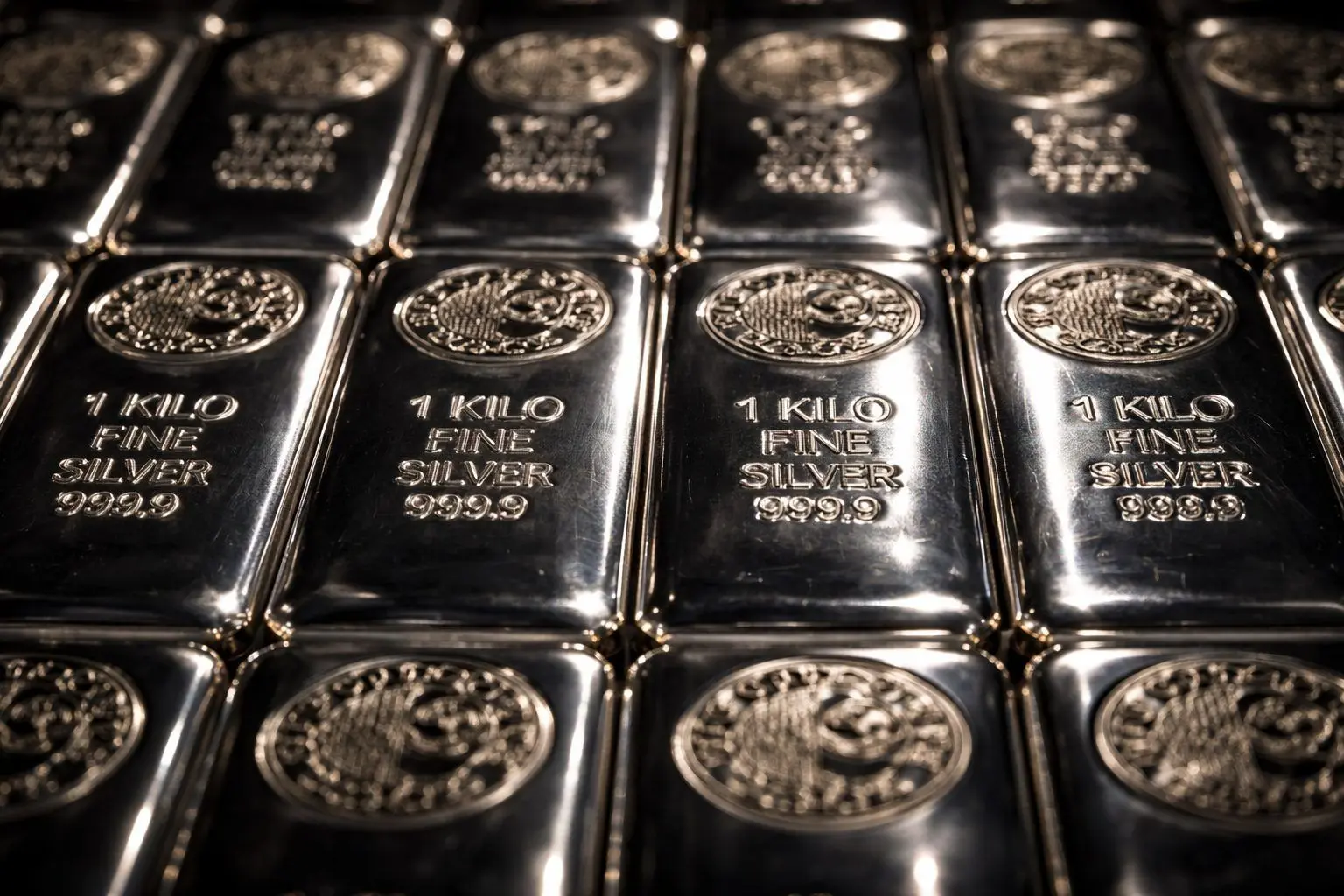
December 20, 2025 — Silver is ending 2025 with a bang. After surging to fresh all-time highs in the latest U.S. session, spot silver (XAG/USD) is holding around the mid-$67 range on Saturday, with live spot quotes near $67.40–$67.48 per ounce depending on the feed and timestamp. JM Bullion+1
That price zone caps an extraordinary year in which silver has outpaced nearly every major liquid asset class—and it keeps the spotlight fixed on one question heading into the new year: Is $70 silver the next stop, or is the market setting up for a volatility-driven reset?
Silver price snapshot: where XAG/USD stands on December 20
While weekend trading conditions differ from the most liquid weekday sessions, Saturday’s spot indications underscore how strong the momentum remains after Friday’s record-setting move.
Here’s the latest context:
- Friday, Dec. 19: Reuters reported spot silver jumped 2.6% to $67.14/oz, after hitting a record high of $67.45/oz in-session and finishing the week up 8.4%. Reuters
- Saturday, Dec. 20: Retail/live spot trackers showed silver around $67.40–$67.48/oz late morning U.S. time. JM Bullion+1
- 2025 performance: Reuters put silver’s year-to-date gain at roughly +132%, far ahead of gold’s rise in the same period. Reuters
Silver’s late-year acceleration is also showing up in the broader investment narrative, with market coverage increasingly treating the metal as both a macro hedge and a strategic industrial input as AI and electrification demand grows. Business Insider+1
What’s driving silver’s rally: the “perfect storm” narrative goes mainstream
In recent days, the dominant explanation across major market reporting has converged around a similar mix of catalysts:
1) Rate-cut expectations are re-pricing non-yielding metals
Silver—like gold—tends to benefit when investors anticipate lower policy rates and easier financial conditions.
Reuters pointed to U.S. macro data feeding that narrative, including cooler-than-expected inflation and a higher unemployment rate, reinforcing expectations that the Federal Reserve stays on an easing path. Reuters
In the same report, Reuters noted traders were pricing at least two 25-basis-point rate cuts in 2026, based on LSEG data. Reuters
2) Supply tightness isn’t a slogan—it’s becoming a pricing factor
Silver’s physical market is small enough that marginal changes in inventories and financing costs can matter a lot, fast.
- Reuters has emphasized silver’s persistent supply deficit and the role of “momentum buying” amplifying moves. Reuters
- Investopedia, citing a Deutsche Bank report, highlighted silver lease dynamics: the cost to lease silver rose to its highest since 2002, and Deutsche Bank described industrial-available supply as the tightest on record. Investopedia
Even when COMEX inventories look large on paper, analysts have warned that regional availability and deliverable liquidity can be a separate story—especially when flows and policy risks drive metal into specific hubs. Reuters+1
3) Industrial demand is no longer “background noise”—AI is pulling it forward
Silver is unique among precious metals because its investment identity coexists with heavy industrial usage.
Reuters has tied demand strength to AI data centers, solar cells, and electric vehicles. Reuters
Business Insider went further, arguing the AI build-out is turning silver into “another AI play,” citing commentary from Ed Yardeni and pointing to a report from The Silver Institute and Oxford Economics on rising silver demand tied to digitalization and AI adoption. Business Insider
The flows story: ETFs and retail participation are back in focus
Beyond macro and industrial demand, several reports highlight that investment flows are doing real work in this rally.
On Friday, Reuters quoted Blue Line Futures chief market strategist Phillip Streible saying silver ETF flows remain a dominant theme, alongside retail speculation. Reuters
Meanwhile, Investopedia reported Deutsche Bank expects ETF holdings to climb further—projecting silver held in ETFs could reach about 1.1 billion troy ounces by end-2026, surpassing a prior record. Investopedia
And in a separate 2026 outlook write-up carried by Nasdaq, Ole Hansen of Saxo Bank said (via an X post cited in the article) that inflows into silver-backed ETFs reached ~130 million ounces in 2025, lifting total holdings to roughly 844 million ounces (an ~18% increase). Nasdaq
Taken together, the flow picture reinforces a key point for 2026: even a small incremental shift in investor demand can overwhelm a tight physical balance—especially when the market is already trending.
Technical picture: $70 is the headline, but the risk is in the speed
By the numbers, the market has moved fast enough that even bulls are talking about consolidation.
A December 20 technical note from FXLeaders said silver has “a good chance” of reaching $70 before the New Year, pointing to strong demand conditions and momentum after the gold/silver ratio dropped below 65. FX Leaders
Other technical coverage has been framing the next steps in terms of whether silver can push through resistance cleanly—or whether overbought conditions trigger a shakeout:
- ActionForex (via Windsor Brokers) flagged $67.23 and $69.36 as upside targets (Fibonacci projections), with the psychological $70 barrier in focus, while warning that overbought readings could lead to consolidation or a limited correction. Action Forex
- The same analysis suggested dips “ideally” hold around $64.50–$65.00 to keep the bullish structure intact. Action Forex
A mainstream warning sign: “historic deviations”
Not all of the latest analysis is celebratory.
Barron’s cited Sundial Capital Research warning that silver (as tracked by the iShares Silver Trust) had stretched to “historic deviations” above key moving averages—conditions that in prior cycles (including 2011 and 2020) preceded sharp drops of 20%+. Barron’s
That doesn’t invalidate the bullish fundamentals—but it does underline silver’s reputation for violent swings in both directions.
Silver price forecast for 2026: wide range, sharper disagreement
As of December 20, 2025, forecasts and outlooks for 2026 are clustering into three broad camps:
Camp 1: The “$70+ is realistic” base case
This is the most common bullish-but-not-extreme view right now:
- Reuters quoted WisdomTree commodities strategist Nitesh Shah saying silver prices could rise to around $75/oz by end-2026, citing supportive conditions and inventory dynamics. Reuters
- A Nasdaq-hosted silver outlook article said this aligns with Citigroup’s view that silver could continue to outperform and reach upwards of $70 in 2026, particularly if industrial fundamentals remain supportive. Nasdaq
- A December 20 report in India, citing PL Capital’s outlook, said gold and silver are expected to retain momentum into 2026 amid strong demand (though it did not attach a specific USD target for silver). The Times of India
Camp 2: The cautious institutional view (silver lags gold)
The key dissenting institutional angle isn’t that silver collapses—it’s that silver underperforms after an exceptional year.
Reuters reported Morgan Stanley expects silver to lag gold, calling 2025 a likely peak deficit year and noting expectations for falling solar installations in 2026. Reuters
This is a reminder that a big part of the silver bull thesis is industrial momentum; if any major industrial driver softens, silver can re-price quickly.
Camp 3: Conservative forecasts that may look “behind the curve” after December’s surge
Some bank projections published earlier in the rally are now being re-evaluated against spot prices in the high-$60s:
Investopedia reported Deutsche Bank forecast silver would average about $55/oz in 2026, while also expecting stronger investor demand to crowd out industrial availability and lift ETF holdings. Investopedia
With spot already well above that level, readers should interpret such “average price” forecasts as scenarios that implicitly include volatility and pullbacks—not as a ceiling.
The fundamentals underneath: deficits, inventories, and the industrial bottleneck
A useful way to reconcile the forecast spread is to separate structural factors from cyclical factors:
- Structural: A Nasdaq-hosted 2026 outlook cited Metal Focus forecasting a fifth straight annual silver supply deficit in 2025 (63.4 million ounces), easing but still negative in 2026 (30.5 million ounces)—a setup that can keep physical tightness in play even if prices cool from extremes. Nasdaq
- Cyclical: Policy expectations (rates, USD direction), growth fears, and geopolitical risk can rapidly change demand for “hard assets,” which Reuters has also highlighted as a support for silver alongside gold. Reuters+1
This dual nature is why silver can look like a precious metal in one moment and a high-beta industrial commodity in the next.
What to watch next: the catalysts that could move silver after December 20
With silver already priced for a lot of good news, the next phase likely depends on whether the macro tailwinds and physical tightness persist into early 2026. Traders and longer-term investors are likely focused on:
- Fed expectations and U.S. data
Reuters cited softer inflation readings and a higher jobless rate as key inputs into easing expectations. Any re-acceleration in inflation—or a re-pricing of the cuts path—could hit silver quickly. Reuters - ETF flows and positioning
If ETF inflows continue, they can tighten the “available” pool of metal quickly, as several reports have underscored. Reuters+2Investopedia+2 - Industrial demand headlines (AI, electrification, solar)
Business Insider’s reporting tied the latest leg of the move to AI infrastructure demand and commentary from The Silver Institute/Oxford Economics, while Reuters also linked demand to AI data centers, solar, and EVs. Business Insider+1 - Policy and trade risk around the physical market
Reuters has already highlighted tariff concerns shaping flows and liquidity in 2025, and the Financial Times reported a policy review/tariff angle as part of the supply squeeze narrative. Reuters+1
Bottom line for December 20: silver is strong—and still fragile
Silver’s price action into December 20, 2025 reflects an unusual alignment: easier-rate expectations, tight physical conditions, and a powerful industrial narrative tied to AI and electrification. Reuters+2Reuters+2
But the same combination that can propel silver into the $70s can also produce fast air pockets if positioning gets crowded or macro expectations reverse—an issue raised in both mainstream commentary and technical warnings. Barron’s+1
For 2026, the center of gravity in forecasts is moving toward $70+ scenarios, with bullish calls extending toward $75 in some strategist outlooks—while large institutions still debate how sustainable the deficit and industrial impulse will be after an extraordinary 2025. Nasdaq+2Reuters+2