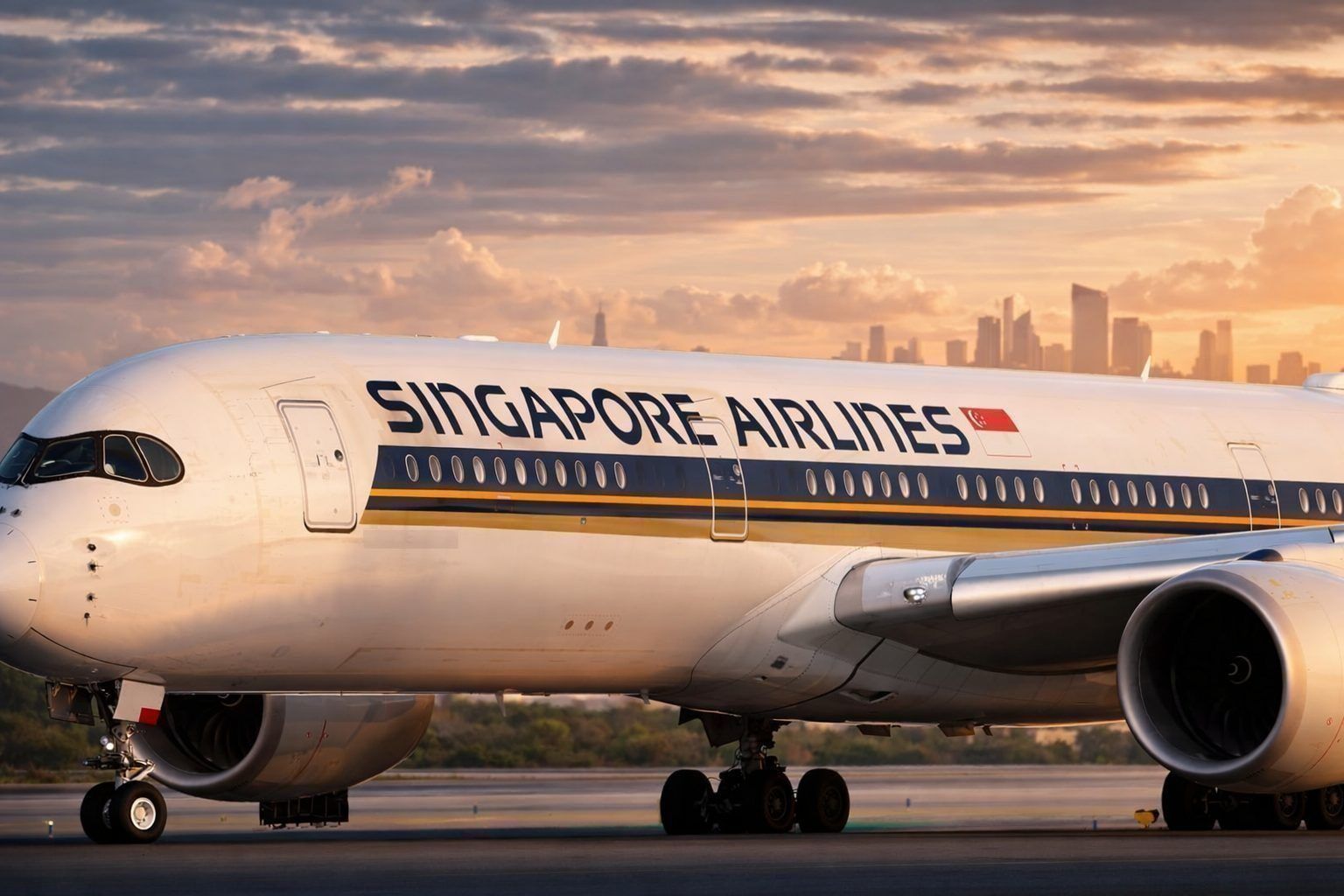
Singapore Airlines Ltd shares (SGX: C6L) traded around S$6.34 on 12 December 2025, hovering near the top of the day’s S$6.30–S$6.34 range and within a 52‑week range of S$5.90–S$7.63. At these levels, the stock implies a market value of roughly S$20.0 billion, with data providers showing a trailing P/E around 8.3 and a headline dividend yield around 5.5%. Google+1
The setup going into year-end is unusually “two-speed” for investors: strong passenger demand and shareholder returns are competing with earnings pressure tied to Air India losses, softer cargo, and rising non-fuel costs—all while the wider airline industry heads into 2026 with robust demand but still-thin margins.
Singapore Airlines share price today: key numbers and what they signal
As of Friday afternoon in Singapore, C6L was quoted at about S$6.34, with the prior close near S$6.28 and average daily volume around 5.25 million shares (30‑day average, per data providers). Google
On valuation, the market is effectively pricing Singapore Airlines as a cash-return story with cyclical risk:
- The stock sits closer to the middle-to-upper end of its one‑year trading band, suggesting investors are not in “panic mode” on earnings volatility. Google
- But the analyst consensus target prices cluster close to the current share price, implying limited “easy upside” unless fundamentals improve meaningfully (more on this below). SG Investors
What’s driving the stock narrative in December: dividends vs. earnings reality
1) Dividend focus: an 8‑cent interim payout and a 3‑year special dividend framework
A major pillar of investor attention is Singapore Airlines’ shareholder return plan.
For 1H FY2025/26, the company declared:
- Interim dividend:5 cents per share
- Interim special dividend:3 cents per share
with ex‑date 5 December 2025 and payment date 23 December 2025. Singapore Airlines+1
More importantly, SIA also outlined a broader capital return plan: a special dividend package of 10 cents per share annually over three financial years (about S$0.9 billion over the period, subject to shareholder approval where required). Singapore Airlines+1
Why it matters for the stock: dividends can support a valuation floor—especially in a market that often rewards Singapore blue chips for predictable distributions. But investors are also watching whether future payouts remain comfortable if earnings stay pressured.
2) Earnings pressure: net profit fell sharply, despite record revenue
Singapore Airlines’ latest major earnings update (announced 13 Nov 2025) showed the tension clearly:
- 1H FY2025/26 revenue:S$9.675 billion (record first-half revenue)
- 1H FY2025/26 operating profit:S$803 million
- 1H FY2025/26 net profit:S$239 million, down sharply year-on-year Singapore Airlines+1
Management pointed to a mix of drivers, including:
- Share of losses from associated companies (notably Air India)
- Lower interest income (including reduced cash balances and interest-rate effects)
- Higher non-fuel costs linked to capacity growth and inflationary pressure Singapore Airlines+1
Reuters also highlighted that the result missed consensus estimates and emphasized the scale of the year-on-year profit decline, attributing it to Air India losses, higher costs, and intensifying competition. Reuters
Demand check: October operating statistics show passengers holding up, cargo lagging
Operationally, the latest monthly data (October 2025) points to a still-resilient passenger environment:
- Group passenger traffic (RPK): +5.3% y/y
- Group passenger capacity (ASK): +3.7% y/y
- Group passenger load factor:87.3% (up 1.3 percentage points) Singapore Airlines+1
The SIA mainline and Scoot both posted strong load factors in the month (86.8% and 89.0%, respectively), with 3.58 million passengers carried across the group airlines (passenger) in October. Singapore Airlines+1
Cargo, however, remained a soft spot:
- Cargo carriage: -4.6% y/y, with cargo load factor down to 53.5% in October, and management noting softer demand across route regions amid global trade tensions. Singapore Airlines+1
Network expansion continues, particularly through Scoot, which launched services to Da Nang and Kota Bharu during the month. By end‑October, the group passenger network covered 130 destinations in 37 countries/territories (SIA: 78; Scoot: 75), while the cargo network comprised 134 destinations in 38 countries/territories. Singapore Airlines
Air India: the biggest swing factor for Singapore Airlines stock
If there’s one storyline investors keep circling, it’s this: Air India is both strategic and financially painful—right now.
Why Air India matters
Singapore Airlines owns 25.1% of Air India, and it began accounting for Air India’s performance following the integration of Vistara into Air India (a key reason the associate’s results matter more now than a year earlier). Reuters explicitly linked SIA’s profit decline to Air India losses and highlighted the drag from associated companies. Reuters
Singapore Airlines, for its part, has reiterated that its Air India stake fits a longer-term multi-hub strategy, and it has emphasized its commitment to work with Tata Sons on Air India’s transformation. Singapore Airlines+1
Fresh Air India developments this week
Two recent headlines are particularly relevant for SIA shareholders watching “associate risk”:
- Air India–Scoot interline partnership (11 Dec 2025)
Air India announced a new unilateral interline partnership with Scoot, enabling connectivity to over 60 destinations across Asia and Australasia, and describing access to Scoot’s network of over 70 destinations across 18 countries via Singapore. Air India+1
From an SIA Group perspective, this is a network and feed positive—it strengthens Singapore’s hub role and can help fill seats on Scoot sectors. The market will still want to see whether such commercial initiatives translate into better unit economics (yields) over time.
- Air India compliance scrutiny (10 Dec 2025)
Reuters reported Air India flagged internal compliance failures after an aircraft operated flights without a valid airworthiness review certificate, underscoring governance and operational risks while the airline is in transformation. For SIA investors, this type of headline matters because it can affect brand recovery timelines, regulatory oversight intensity, and turnaround costs—all of which can flow through associate losses. Reuters
Analyst forecasts and target prices: clustered near the current share price
A useful “street-level” read is that analysts are not wildly polarized on price—they’re clustered, but ratings differ.
According to compiled broker research snapshots, SIA target prices from four research institutions (within the past three months as of 12 Dec 2025) ranged from about S$6.03 to S$6.40, with a median around S$6.195 and an average around S$6.205—both implying low single-digit downside from around S$6.34. The same summary lists a mix of Hold and Sell/Reduce calls among major local brokerages. SG Investors
How to interpret this:
- The market seems to be treating SIA as “fairly priced” at current levels, unless earnings momentum improves or the Air India drag fades faster than expected.
- At the same time, the dividend framework can keep investors engaged even while earnings are choppy—so the stock can trade more like an “income-plus-cyclical” name than a pure growth story.
Industry backdrop for 2026: demand remains strong, but margins are thin
The wider airline industry outlook going into 2026 is supportive on demand, with a big caveat: margins are not expected to be huge.
IATA forecast airlines could deliver combined net profit of about $41 billion in 2026, with a net margin around 3.9% and profit per passenger around $7.90, while still facing aircraft availability constraints from supply chain and delivery delays. IATA+1
For Singapore Airlines, this macro picture suggests:
- Passenger demand can remain healthy (especially in Asia-Pacific),
- But competition and capacity can keep yields under pressure, meaning execution (cost control, product mix, and network discipline) becomes the differentiator.
Singapore policy watch: SAF levy arrives in 2026 and will show up on tickets
A concrete, Singapore-specific factor investors are starting to model is the Sustainable Aviation Fuel (SAF) Levy.
CAAS confirmed a SAF Levy will apply to tickets sold from 1 April 2026 for flights departing from 1 October 2026, with the levy shown as a distinct line item. Example economy-class charges cited by CAAS include S$1.00 to Bangkok, S$2.80 to Tokyo, S$6.40 to London, and S$10.40 to New York; premium cabin charges are set at four times economy for the same band. CAAS – CWP
What it could mean for Singapore Airlines stock:
- The levy is designed as a pass-through charge collected by airlines, so it’s not automatically a margin hit—but it can influence price sensitivity at the edges, especially on competitive routes.
- Because the levy starts with a 1% SAF uplift target for 2026 (with an ambition to rise to 3–5% by 2030, subject to global developments), the bigger long-term question is whether SAF costs compress margins or remain largely recoverable through fares and surcharges. CAAS – CWP
Other headline risk: fleet and supply chain constraints
Aircraft availability remains an industry-wide limiter—and Singapore Airlines has been addressing this in public commentary.
Reuters reported SIA’s CEO said the airline does not expect a major operational impact from Boeing’s 777‑9 delivery delay (now pushed to 2027), citing flexibility in fleet planning. Reuters
Bottom line for investors watching C6L in December 2025
Singapore Airlines stock enters the year-end stretch with a clear set of competing forces:
Supportive factors
- A visible near-term cash return: 8 cents per share payable 23 Dec 2025 and a three-year special dividend framework. Singapore Airlines+1
- Passenger demand that still looks healthy in the latest operating stats (October load factors remain high). Singapore Airlines+1
- A constructive 2026 industry demand outlook, even if margins stay slim. IATA+1
Key risks and uncertainties
- The Air India associate remains a material earnings swing factor, and operational/compliance headlines can add uncertainty to the turnaround timeline. Reuters+1
- Cargo softness tied to trade conditions and route shifts. Singapore Airlines
- Policy and cost pressures (including the upcoming SAF levy) and ongoing non-fuel inflation dynamics. CAAS – CWP+1
With analyst target prices broadly near the prevailing share price, the next leg for C6L will likely depend less on “headline demand” and more on whether yields stabilize, costs stay contained, and Air India’s losses show credible signs of narrowing.