NEW YORK, Dec. 28, 2025, 9:33 a.m. ET — Market closed
Singapore Exchange (SGX) heads into the final trading days of 2025 with a familiar year-end cocktail: thinner liquidity, elevated sensitivity to global rate expectations, and a steady drumbeat of positioning into the new year. With U.S. stock markets closed for the weekend, attention shifts to Asia’s Monday open—where Singapore investors will be balancing strong domestic manufacturing signals against a global macro backdrop that remains dominated by the Federal Reserve’s next move.
The Singapore market’s last session offered a snapshot of that tug-of-war. The benchmark Straits Times Index (STI) finished essentially unchanged on Friday, closing at 4,636.15, down 0.19 point, while the iEdge Singapore Next 50 Index edged up to 1,449.67. Broader market breadth was positive, with gainers outnumbering losers, and about S$667.8 million of securities traded—figures consistent with a market that is active, but not frantic, as the calendar winds down. The Business Times+1
Singapore stocks: flat tape, strong factory print
What kept Singapore equities from drifting into holiday indifference was the data. Singapore’s factory output jumped 14.3% year-on-year, driven by pharmaceuticals, even as the pace cooled from October’s revised 28.9% gain. The reading came in just below economists’ median forecast of 15% (per a Bloomberg poll cited in local coverage), reinforcing the idea that Singapore’s manufacturing engine still has torque—an important input for sentiment across industrials, logistics, and the broader earnings outlook for a trade-dependent economy. The Business Times+1
For global investors watching SGX from New York, that matters because Singapore’s equity market isn’t just a “local story.” The STI is heavily influenced by banks and large regional businesses, but macro momentum—especially a manufacturing upcycle—can change expectations around credit demand, fee income, and the durability of earnings into 2026.
Singapore Exchange Ltd (SGX:S68): where the exchange trades, too
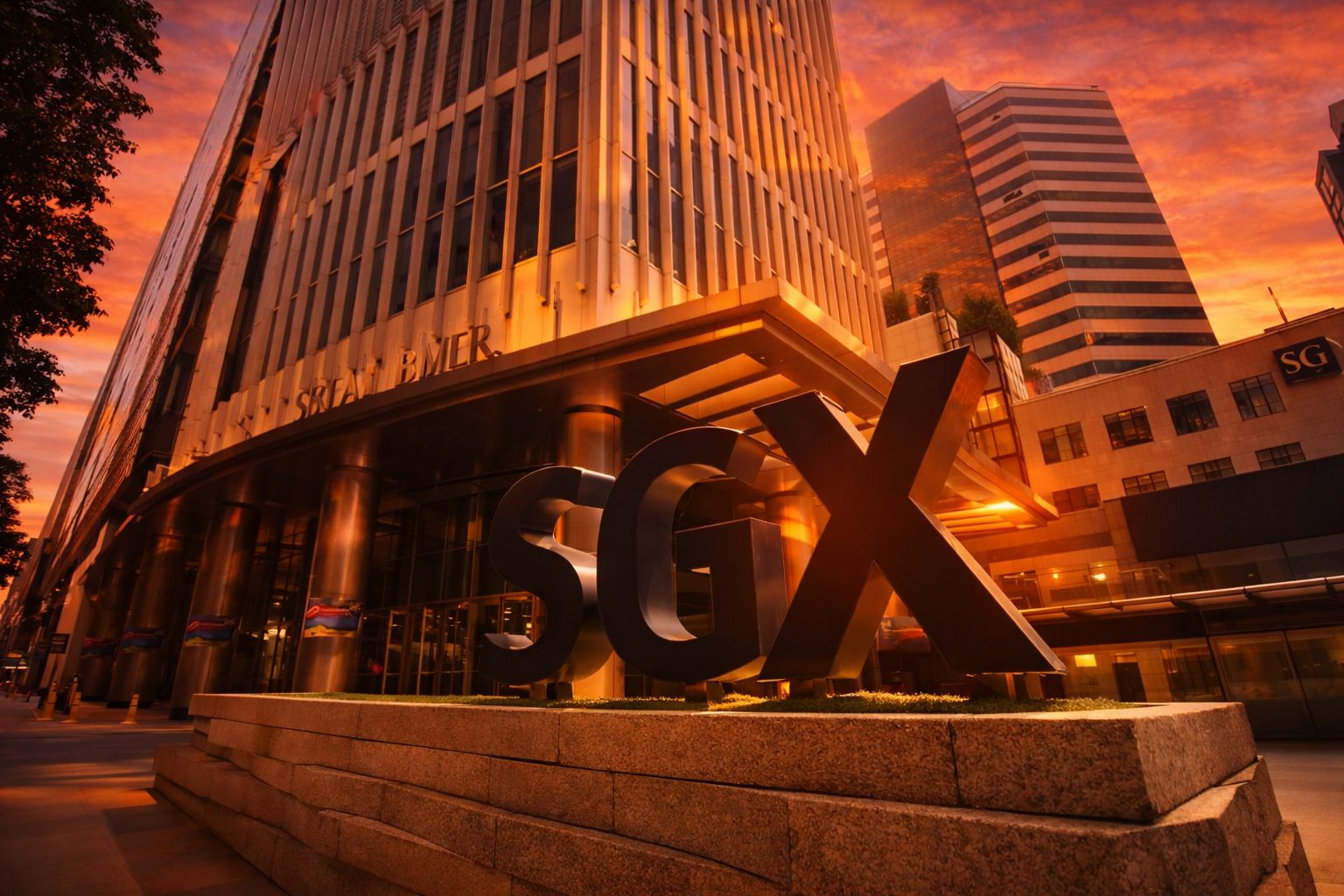
There’s also the meta-layer: Singapore Exchange Ltd, the listed operator of SGX (ticker S68), is itself a bellwether for market activity, sentiment, and listings appetite.
As of the last close (Friday, Dec. 26), SGX Ltd shares were quoted around S$17.13, down about 0.75% on the day, with reported trading volume near 706,600 shares in delayed market data. MarketWatch+1
Exchange operators tend to behave like “picks-and-shovels” plays on capital markets: they can benefit when volumes rise, volatility increases (boosting derivatives activity), and listing pipelines improve. But they can also be sensitive to lulls in risk appetite—especially around holidays, when investors step away and volumes thin out.
The global backdrop: record-ish highs, rate-cut math, and commodities fireworks
Friday’s global tone leaned risk-positive. Reuters reported U.S. stock indexes closing near record peaks in muted post-Christmas trading, while expectations around Federal Reserve rate cuts helped drive precious metals to fresh all-time highs; oil fell sharply on supply concerns and geopolitics. Reuters
That U.S. setup matters for SGX because it influences Monday’s Asia open through multiple channels at once: the direction of the dollar, global risk appetite, and sector rotation (which, in turn, can affect Singapore’s bank-heavy index and REIT positioning).
In a separate “week ahead” look, Reuters underscored how the final stretch of the year can be unusually jumpy: light volumes can exaggerate moves, and portfolio adjustments can create sharp, technical price action. Strategist Paul Nolte of Murphy & Sylvest Wealth Management told Reuters that “Momentum is certainly on the side of the bulls,” while Michael Reynolds of Glenmede flagged the potential importance of upcoming Fed minutes for interpreting the policy debate. Reuters also quoted Anthony Saglimbene of Ameriprise on rotation into more moderately valued areas as investors gain confidence the economy can stay on solid footing. Reuters
For Singapore investors, the message is straightforward: even if local fundamentals look stable, the marginal price-setter into year-end can be global flows—especially if U.S. rate expectations shift.
SGX’s own read on activity: “robust,” with derivatives and commodities in focus
The most recent official operating color from SGX Group points to a market that has stayed busy through the year. In its November activity update, SGX Group said Singapore stock market turnover rose 18% year-on-year to S$35.5 billion, with securities daily average value rising 24% year-on-year to S$1.8 billion. The exchange also highlighted that the STI gained 2.2% month-on-month in November, taking calendar-year-to-date gains to 19% and total returns to 25%, and noted the index hit a then-new high of 4,575.91 during the month. SGX Links
On the derivatives side, SGX pointed to continued attention on China and India exposure instruments, with open interest and volumes indicating strong institutional use cases, while commodities activity (including iron ore, freight, and petrochemical contracts) rose year-on-year. SGX Links
The key investor implication: heading into 2026, SGX isn’t only a “Singapore equities” story—it’s increasingly tied to cross-border hedging demand, Asia index risk management, and multi-asset participation. When volatility rises globally, that ecosystem can become a tailwind for an exchange operator.
Listings momentum: “strongest IPO pipeline in years,” CEO told Reuters
Listings remain the narrative investors keep trying to confirm with real deal flow. Earlier this year, Reuters reported SGX posted its highest annual earnings since its 2000 listing, and CEO Loh Boon Chye said more than 30 companies were actively preparing to go public—calling it the “strongest IPO pipeline in years.” Reuters also noted SGX’s comments around expanding Singapore Depository Receipts (SDRs) beyond current underlying markets. Reuters
Even though that Reuters reporting dates to August, it continues to frame how investors think about SGX into year-end: if the pipeline translates into completed listings, it can support fee income, market relevance, and secondary trading activity. If it doesn’t, investors may re-price expectations quickly—particularly when the stock is near highs and market optimism is already “in the air.”
What investors should know before the next session
Because both U.S. markets and Singapore’s cash equity market are closed today, the “next session” risk is less about reacting to fresh price moves and more about preparing for the first wave of liquidity when trading resumes.
1) Monday’s timing matters (especially for New York-based investors)
SGX’s Monday open happens well before the U.S. cash session begins. For investors operating on U.S. time, the practical reality is that Asia can move the narrative before New York gets a chance to trade.
2) Watch year-end liquidity and “small flows, big moves” dynamics
Reuters has highlighted how light volumes near year-end can amplify price swings. That effect can show up in SGX blue chips, Singapore REITs, and derivatives linked to regional benchmarks, even without a major headline catalyst. Reuters
3) Corporate and market-structure items: Mainboard transfer set for Dec. 29
One concrete SGX-specific development on the calendar: SGX announced that Ever Glory United Holdings Limited is scheduled to transfer from Catalist to the Mainboard, effective 9:00 a.m. on Dec. 29, 2025, with the company trading under its new Mainboard stock code from that time. SGX Links+1
For investors, such moves can matter for liquidity, eligibility in mandates, and potential index or institutional visibility over time—though the immediate market impact varies by company and positioning.
4) Macro watch: Singapore growth expectations vs. global rate expectations
Singapore’s domestic macro narrative has been improving. In the Monetary Authority of Singapore (MAS) survey coverage reported by The Straits Times, private-sector economists projected 4.1% growth for 2025 and 2.3% for 2026, citing a better outlook for exports, manufacturing, and finance among other sectors—while also flagging risks from trade tensions and potential spillovers if an AI-driven market bubble were to unwind. The Straits Times
Stack that against the U.S. macro narrative—where investors are fixated on the pace and timing of Fed cuts—and you get a simple framework: SGX traders are likely to price Singapore’s resilience, but they’ll take their cues from global discount rates.
5) Holiday schedule risk: shortened sessions and closures are approaching
Investors should also plan around end-of-year trading schedules. In the U.S., Investopedia reported that stock trading is expected to run a full day on New Year’s Eve (Dec. 31), while the bond market closes early, and both stock and bond markets are closed on Jan. 1, 2026. Investopedia
In Singapore, the SGX market calendar includes half-day trading on certain eves, and broker guidance commonly references a half-day close structure that ends with a shortened Trade-At-Close (TAC) window; DBS, for example, describes TAC running to 12:16 p.m. on half-day sessions (versus 5:16 p.m. on regular days). DBS Bank+2Singapore Exchange+2
Holiday mechanics matter more than they sound like they should: shorter sessions can compress liquidity, widen spreads, and make stop-driven moves more likely—especially in smaller names.
Bottom line: SGX enters the final week with steady fundamentals—and a macro-sensitive tape
Singapore’s latest market close showed stability in equities, backed by a surprisingly strong factory output print. The Business Times+1 The global mood remains broadly constructive with major U.S. indexes near record highs, but markets are still trading the Fed narrative and the volatility that comes with year-end positioning. Reuters+1
For SGX itself—both the exchange and the listed operator—investors are juggling two realities at once: (1) structural efforts to deepen listings and multi-asset participation, and (2) the near-term fact that liquidity and global rate expectations can dominate price action from one session to the next.