Updated: December 5, 2025
Key takeaways for Southwest Airlines (LUV) stock today
- LUV stock closed around $37.9 on December 5, 2025, up nearly 6% and just below a fresh 52‑week high near $38.MarketBeat
- Southwest cut its 2025 EBIT outlook to about $500 million from a prior $600–$800 million range, citing the 43‑day U.S. government shutdown and higher fuel prices.Stock Titan+1
- Despite the guidance cut, the airline is coming off record third‑quarter revenue and expects all‑time high revenue again in Q4 2025.Southwest Airlines Co.
- New partnerships with Condor and Philippine Airlines expand Southwest’s reach across the Atlantic and Pacific, reinforcing its long‑term growth story.Travel Agent Central+3Southwest Airlines C…
- Wall Street’s overall stance remains cautious: consensus ratings are “Hold” with average 12‑month price targets clustered in the mid‑$30s, slightly below today’s price.Benzinga+4MarketBeat+4TipRanks+4
Southwest Airlines stock today: strong rally after a weak outlook
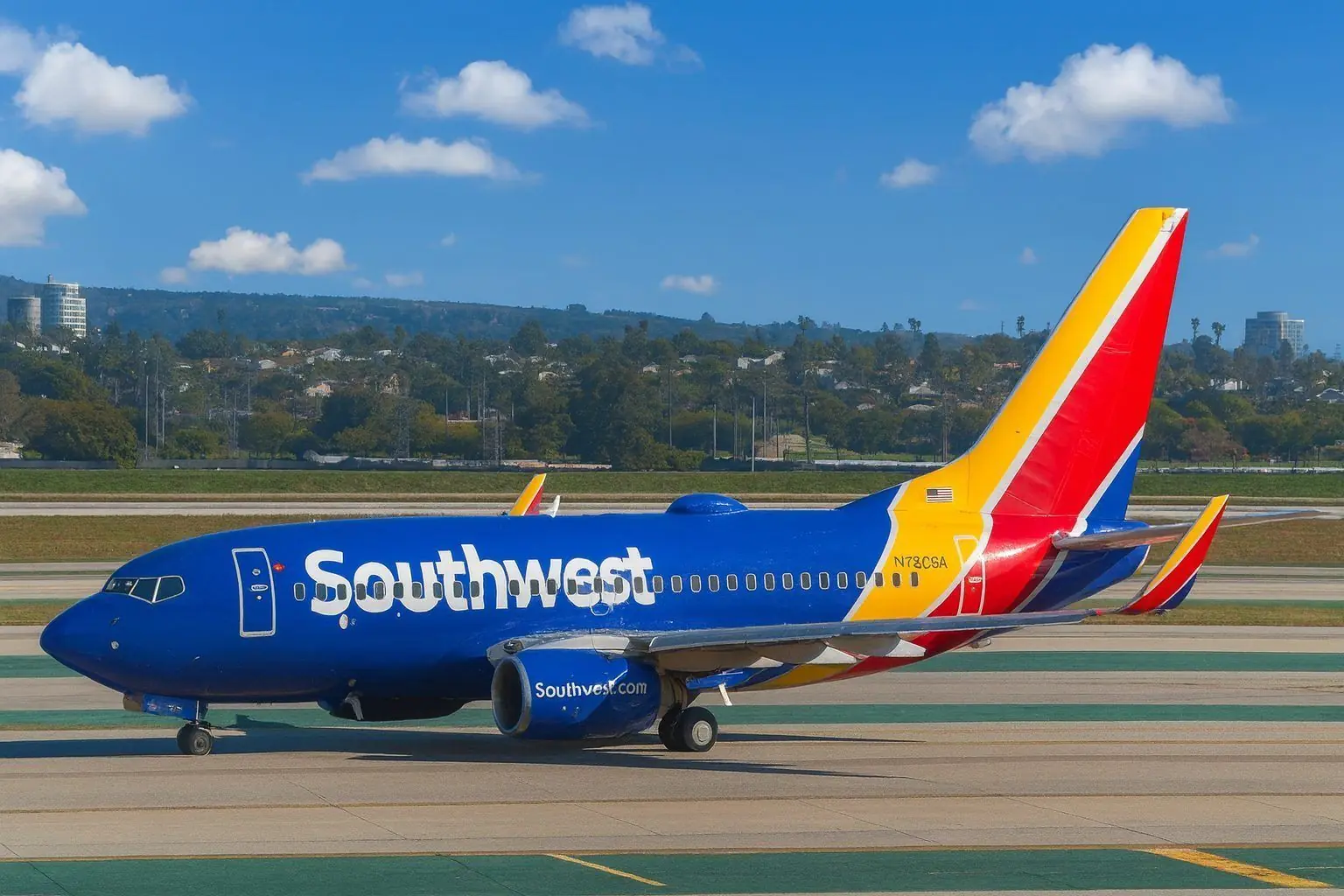
On Friday, December 5, 2025, Southwest Airlines Co. (NYSE: LUV) rallied hard despite issuing a weaker profit outlook.
- The stock closed regular trading at about $37.87, up roughly 5.8% on the day, and was trading just under $38 in late trading.MarketBeat
- Intraday, LUV touched a high above $38, placing it within cents of its 52‑week high around $37.97 and well above its 52‑week low near $23.80.Investing.com+1
At current levels, Southwest’s market capitalization is around $18.5–$18.7 billion.Stock Titan+1 Based on trailing 12‑month earnings of about $0.72 per share, the stock trades at roughly 50x trailing earnings, a rich multiple that reflects depressed recent profitability and expectations for a multi‑year earnings recovery rather than current results.Fintel+1
The rally is particularly notable because it came on the same day Southwest lowered its 2025 profit guidance, suggesting investors may be looking through near‑term turbulence toward improving demand, transformation initiatives, and new partnership‑driven growth.
Why Southwest cut its 2025 profit outlook
Before the market opened on December 5, Southwest filed an 8‑K with the SEC updating its full‑year 2025 guidance.Stock Titan
New EBIT guidance
- Southwest now expects 2025 EBIT (earnings before interest and taxes, excluding special items) of approximately $500 million.
- Previously, the company had guided to $600–$800 million for the same measure.Stock Titan+1
What’s driving the downgrade?
According to the filing and subsequent media coverage, the downgrade is driven by two main factors:Stock Titan+2Reuters+2
- A 43‑day U.S. government shutdown
- The shutdown, the longest in U.S. history, disrupted air travel nationwide.Reuters+1
- The Federal Aviation Administration ordered flight reductions at 40 major airports, forcing airlines, including Southwest, to trim schedules.Reuters+1
- Southwest reported a temporary decline in bookings during the shutdown, which directly pressured revenue.Stock Titan+1
- Higher fuel prices
- The company cited rising fuel costs as another key reason EBIT expectations had to come down.Stock Titan+1
Importantly, Southwest emphasized that bookings have since returned to prior expectations once the shutdown ended, indicating the demand hit was sharp but not lasting.Stock Titan+1
Market reaction: bad news, good setup?
Reuters reported that shares were initially down about 2.3% in premarket trading on the guidance cut.Reuters But as the day progressed, the stock reversed higher, ending with a strong gain near the top of its 52‑week range.MarketBeat+1
A GuruFocus note framed the move as “Southwest Airlines (LUV) Stock Rises Despite Lowered 2025 Profit Forecast,” underscoring that investors appear willing to accept near‑term margin pressure in exchange for improving demand and a cleaner outlook heading into 2026.GuruFocus
Under the hood: record revenue and tight margins
Southwest’s guidance update comes shortly after a solid third‑quarter 2025 earnings report that highlighted both progress and challenges.Southwest Airlines Co.
Q3 2025 by the numbers
According to the company’s October 22 earnings release:Southwest Airlines Co.
- Passenger revenue:
- A third‑quarter record of $6.3 billion, up about 1% year‑over‑year.
- Total operating revenue:
- Also a third‑quarter record at $6.9 billion, up roughly 1.1% from a year ago.
- Unit revenue:
- RASM (revenue per available seat mile) rose 0.4% on capacity up 0.8%, beating the midpoint of prior guidance.
- Costs:
- Operating expenses were $6.9 billion, up 1.2% year‑over‑year.
- CASM‑X (unit cost ex‑fuel, profit sharing, and special items) increased 2.5%, but still came in better than guidance, reflecting ongoing cost discipline.
- Profitability and balance sheet:
- Southwest ended the quarter with about $3.0 billion in cash and short‑term investments plus a fully available $1.5 billion revolving credit facility.
- Leverage was around 2.1x adjusted debt to adjusted EBITDAR, comfortably within the company’s target range of 1.0x–2.5x.
- The airline returned $439 million to shareholders in the quarter via $189 million in dividends and $250 million of share repurchases.
While margins remain thin relative to pre‑pandemic and pre‑meltdown norms, Q3 showed that unit revenues and costs are moving in the right direction, aided by:
- A positive inflection in demand beginning in early July.
- Improving corporate travel.
- Growth in loyalty revenue (up about 7%) and co‑brand credit card acquisitions (up double digits).Southwest Airlines Co.
Q4 outlook: record revenues despite shutdown drag
Even after the shutdown impact, Southwest still expects an all‑time quarterly revenue record in Q4 2025.Southwest Airlines Co.+1
- Q4 unit revenue is guided to be 1–3% higher year‑over‑year, with capacity up roughly 6%.
- That guidance explicitly factors in the shutdown impact and a 2‑point boost to capacity from delaying some seat‑removal retrofits into January 2026 (to keep more seats in the system during the holiday period).Southwest Airlines Co.
Taken together, Southwest is growing revenue and stabilizing costs, but profitability remains fragile, making the business sensitive to shocks like shutdowns, storms, or further fuel spikes.
Strategic expansion: Condor, Philippine Airlines, and a wider global footprint
Southwest’s investment case today isn’t just about domestic U.S. point‑to‑point flying. A key theme of late 2025 is partnership‑driven international expansion.
Interline partnership with Condor (Europe & beyond)
On December 2, Southwest announced a new partnership with Condor, the German leisure airline, to link Southwest’s U.S. network with Condor’s long‑haul routes.San Francisco Chronicle+3Southwest Airline…
Key elements:
- Starting January 19, 2026, customers will be able to book single‑ticket itineraries combining Southwest’s domestic flights with Condor’s nonstops to Frankfurt, via shared gateways in:
- Boston, Las Vegas, Los Angeles, Portland, San Francisco, and Seattle.
- Bags will transfer automatically between carriers and tickets will include through‑check protection for misconnects—features Southwest historically hasn’t offered on most international connections.San Francisco Chronicle+1
- Condor’s network from Frankfurt reaches nearly 70 destinations across Europe, Africa, Asia, and the Americas, opening a broad swath of new options for Southwest customers connecting via these hubs.San Francisco Chronicle+1
This is a meaningful strategic shift: Southwest remains a low‑cost domestic carrier at its core, but partnerships like Condor’s make it functionally more global for customers without taking on the complexity of running its own long‑haul fleet.
Partnership with Philippine Airlines (Pacific connectivity)
In November, Southwest also launched an interline partnership with Philippine Airlines (PAL).Southwest Airlines Co.+1
- The deal allows passengers to book single‑ticket itineraries that pair PAL’s long‑haul services (for example from Manila to U.S. West Coast and Hawaii) with Southwest connections in cities like Honolulu, Los Angeles, San Francisco and Seattle.Southwest Airlines Co.+1
- Dozens of new travel options across the Pacific are already available via Philippine Airlines and major online travel agencies.Southwest Airlines Co.+1
These partnerships build on other recent tie‑ups, such as EVA Air, and on Southwest’s Q3 announcement that it will start flying to additional domestic and leisure destinations like Knoxville, St. Maarten, Santa Rosa (Sonoma County), and Anchorage in 2026.Southwest Airlines Co.+1
The message to investors: Southwest is using partnerships and network tweaks—not alliances or full long‑haul operations—to expand its addressable market, a relatively asset‑light way to add growth levers.
Dividend, capital returns, and balance sheet strength
Despite volatile earnings, Southwest continues to pay and grow shareholder distributions, signaling confidence in its recovery plan.
187th consecutive quarterly dividend
On November 20, 2025, Southwest declared its 187th consecutive quarterly dividend:Stock Titan+1
- Dividend per share: $0.18
- Record date: December 26, 2025
- Payment date: January 16, 2026
At today’s share price around $37.85, that equates to an annualized dividend of $0.72 per share, or a yield of roughly 1.9–2.0%.Stock Titan+1
In addition to dividends, Southwest has been actively repurchasing shares, buying about $250 million in Q3 alone under its current $2.0 billion authorization.Southwest Airlines Co.
Liquidity and leverage
- Cash and short‑term investments: ~$3.0 billion at the end of Q3.
- Undrawn revolver: $1.5 billion.
- Leverage: ~2.1x adjusted debt to adjusted EBITDAR, within management’s 1.0x–2.5x target.Southwest Airlines Co.+1
That liquidity provides important downside protection in an industry where shocks (shutdowns, storms, fuel spikes) can quickly strain cash flows.
Wall Street’s view: cautious “Hold” with mid‑$30s price targets
Analysts generally see limited upside from current levels after the recent rally.
Consensus ratings
Across major data providers, Southwest is rated a “Hold”:
- MarketBeat:
- Consensus rating: Hold based on 18 analysts (4 Buy, 11 Hold, 3 Sell).
- Average 12‑month price target: $35.00, with a range of $24 to $42. That implies about 7.6% downside vs. the last quoted price near $37.87.MarketBeat
- TipRanks:
- Rating: Hold from 12 analysts (2 Buy, 8 Hold, 2 Sell).
- Average price target: $34.33, with a high of $42 and a low of $28—about 3.8% downside vs. the last price when their data was compiled.TipRanks
- Fintel:
- Average one‑year target: $33.90, based on a set of forecasts ranging from $19.19 to $48.30.Fintel
- Other aggregators (StockAnalysis, Benzinga’s compiled targets) also cluster in the low‑ to mid‑$30s, generally below where LUV is trading today.StockAnalysis+1
Fresh analyst actions
Recent rating and target moves help explain how sentiment is evolving:MarketBeat+1
- Citigroup initiated coverage on December 4 with a “Neutral” rating and a $38 price target, roughly in line with where the stock now trades.
- Jefferies recently raised its target to $34 from $33 while maintaining a Hold stance.
- Bernstein, UBS, JPMorgan and others have also fine‑tuned targets in the low‑ to mid‑$30s over the last few months, reflecting a view that much of the near‑term recovery is already priced in.
Earnings expectations: 2025–2026
According to a recent compilation of analyst estimates on Yahoo Finance:Yahoo Finance+1
- Full‑year 2025 EPS is estimated at roughly $1.07.
- 2026 EPS is projected to climb to around $2.62, as capacity grows, transformation initiatives mature, and temporary drags like the 2025 shutdown roll off.
At today’s price near $37.85, that implies:
- A 2025 forward P/E of ~35x, and
- A 2026 forward P/E of ~14x, assuming those estimates hold.
That profile—expensive on near‑term earnings, more reasonable on 2026 numbers—helps explain why analysts lean “Hold” rather than outright bullish or bearish.
(As always, these are consensus estimates and can change quickly as new data emerges.)
Institutional and insider activity: big funds step in
Recent filings show significant institutional repositioning in LUV:
- Arrowstreet Capital boosted its stake by more than 2,400% in Q2, to about 10.1 million shares, valued around $328 million.MarketBeat
- Shelton Capital Management increased its position by 46.7%, to approximately 385,000 shares (~$12.5 million).MarketBeat
- Icon Advisers grew its stake by over 240%, while Norges Bank and other funds also initiated sizable positions.MarketBeat
- Newer entrant Edgestream Partners L.P. disclosed a roughly $2.27 million position (almost 70,000 shares).MarketBeat
At the same time:
- Steward Partners and HSBC Holdings trimmed their holdings, showing that not all institutions are leaning the same way.MarketBeat+1
Overall, institutional ownership remains high—around 80–96% of shares, depending on the data source—while insiders own just over 1%.MarketBeat+2Stock Titan+2
Fintel data also points to short interest of about 7–7.3% of float, with days to cover around 7, indicating a meaningful but not extreme level of bearish positioning.Fintel+1
There has also been some insider selling, including a recent sale by a company vice president, which investors may watch but which is not unusual after share price strength.TradingView
Key risks for Southwest Airlines stock
Even with the recent rally and strategic progress, LUV carries several notable risks:
- Macro and policy shocks
- The 43‑day government shutdown showed how quickly political events can hit demand and operations, forcing guidance cuts. Future budget standoffs or policy disruptions could have similar effects.Reuters+1
- Fuel price volatility
- Higher fuel prices were a direct factor in the lowered 2025 EBIT outlook. If fuel remains elevated or spikes again, margins could be squeezed further.Stock Titan+1
- Cost inflation and labor contracts
- Labor agreements ratified in 2024 continue to put upward pressure on unit costs. Southwest is targeting $370 million in cost reductions, but success is not guaranteed.Southwest Airlines Co.
- Execution risk on transformation initiatives
- Projects like assigned seating, extra‑legroom retrofits, and revenue management upgrades must roll out smoothly to realize expected revenue and cost benefits. Any IT or operational issues could dent customer satisfaction or raise costs.Southwest Airlines Co.+1
- Dependence on Boeing
- Southwest relies heavily on the Boeing 737 family, including the 737‑8 and the planned MAX 7, for fleet growth and fuel efficiency. Certification delays, production problems, or safety concerns could affect capacity plans and capital spending.Southwest Airlines Co.+1
- Competition and pricing pressure
- Low‑cost rivals and the “Big 3” (Delta, United, American) all have strong networks and loyalty programs. Aggressive pricing or capacity moves could pressure Southwest’s unit revenues, especially on leisure‑heavy routes.
What to watch next
Investors tracking LUV over the coming months may want to keep an eye on:
- Q4 2025 results and early 2026 guidance
- Can Southwest deliver the record revenue it has promised for Q4 while containing unit costs?Southwest Airlines Co.+1
- Updated booking trends post‑shutdown
- Management says bookings are back to normal; future updates will confirm whether that holds during non‑holiday periods.Stock Titan+1
- Fuel prices and hedging strategy
- Any change to hedging, or big swings in oil prices, will flow directly into earnings.
- Partnership ramp‑up
- How quickly do customers adopt the Condor and Philippine Airlines partnerships, and do these deals drive measurable revenue uplift or loyalty gains?Travel Agent Central+3Southwest Airlines C…
- Regulatory and political environment
- With one shutdown now on the books as a major earnings event, the market may react more sharply to any future signs of budget gridlock.
LUV stock outlook: priced for a recovery, not for perfection
As of December 5, 2025, Southwest Airlines stock sits in an interesting place:
- Price: Near a 52‑week high and above most published one‑year price targets.MarketBeat+2Investing.com+2
- Fundamentals: Revenue is at record levels, costs are improving but still elevated, and 2025 EBIT guidance has just been cut to about $500 million.Southwest Airlines Co.+1
- Valuation: Rich on near‑term earnings (mid‑30s P/E on 2025 estimates) but more ordinary on 2026 numbers (mid‑teens P/E).Yahoo Finance+1
- Sentiment: Wall Street is lukewarm, leaning “Hold,” while a number of big funds have increased positions and short interest remains moderate.Stock Titan+3MarketBeat+3MarketBeat+3
In simple terms, the market is betting that Southwest’s transformation plan, stronger demand, and new partnerships will outweigh the drag from shutdowns, fuel, and inflationary costs over the next 12–24 months. Any disappointment on those fronts—or another macro shock—could put pressure on a stock that is already trading near the top of its recent range.
Conversely, if Southwest delivers on earnings growth toward the 2026 consensus, proves its partnerships can drive profitable traffic, and maintains balance sheet strength, there may still be room for longer‑term upside even if near‑term analyst targets look conservative.
Important note
This article is for informational and educational purposes only and does not constitute financial or investment advice, a recommendation to buy or sell any security, or a prediction of future performance. Always do your own research and consider consulting a qualified financial adviser before making investment decisions.