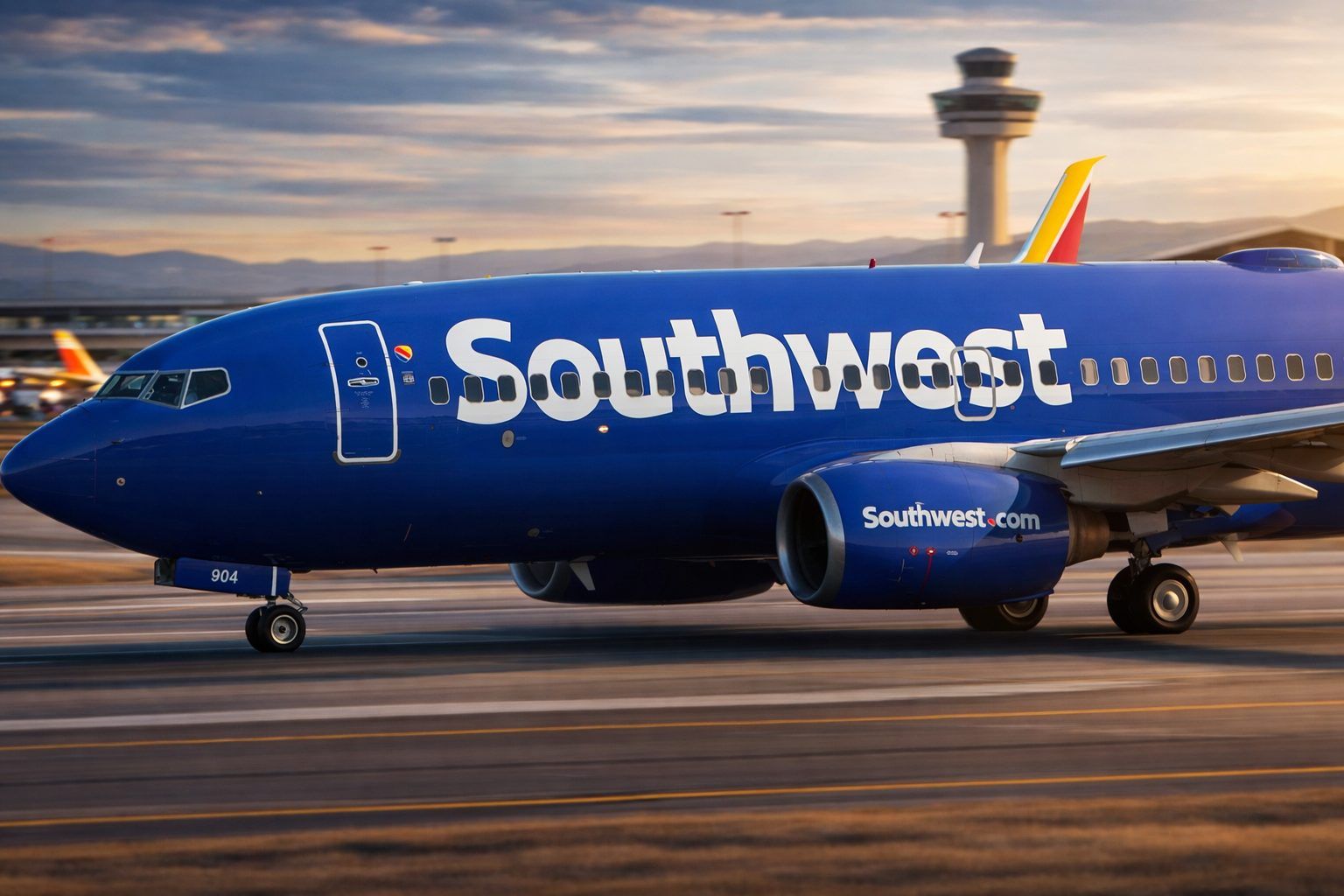
Southwest Airlines Co. stock is in the spotlight on Tuesday, Dec. 16, 2025, as shares push higher again—extending a sharp early-December rally that has re-rated the airline in the eyes of momentum traders and (increasingly) Wall Street analysts. In late morning trading, LUV was up roughly 2%–3% and hovering around the low-$40s. StockAnalysis+1
The immediate catalyst: Barclays upgraded Southwest to Overweight from Equalweight and lifted its price target to $56 from $34, a dramatic move that helped keep the stock bid even as broader markets softened. Investing.com+2Barchart.com+2
But the bigger story for investors isn’t just a one-day analyst call. It’s what that call represents: a growing belief that Southwest’s multi-year business-model reset—shifting from “one-size-fits-all” to a more segmented, revenue-maximizing approach—could finally close a long-discussed gap versus competitors in fares, premium upsells, and loyalty monetization. Investing.com+2CBS News+2
Southwest Airlines stock today: what’s moving LUV on Dec. 16, 2025
By late morning Tuesday, Southwest shares were trading around $42–$43, up about 2%–3% on the session. StockAnalysis+1
That strength comes on top of a notable run earlier this month. Based on recent price history, LUV rose from roughly the mid-$30s in early December to the low-$40s by mid-month, with several heavy-volume sessions during the climb. StockAnalysis
Market commentary Tuesday morning tied the move directly to the Barclays upgrade, listing Southwest among notable gainers even as stocks overall drifted lower on fresh economic data. Barchart.com
Barclays turns bullish: why the firm raised its target to $56
Barclays’ new stance is about more than near-term momentum. In a note summarized Tuesday, the firm pointed to Southwest’s ongoing commercial overhaul—moving away from a traditional, simplified pricing model toward more fare types and more ways to monetize the cabin (basic fares, assigned seating, extra-legroom products, and bag fees). Investing.com
Two points from that Barclays view matter for stock watchers:
- The competitive “fare gap” thesis. Barclays argued Southwest’s average passenger fares trailed competitors by 20%–30% through mid-2025, and that new merchandising could help close that gap as the strategy rolls out more fully. Investing.com
- Aggressive earnings expectations into 2026–2027. Barclays projected EPS rising sharply—citing estimates around $4.50 for 2026 and $6.10 for 2027—well above what the firm described as prevailing consensus expectations. Investing.com
In plain English: Barclays isn’t just saying “the stock can go up.” It’s saying Southwest could start looking like a structurally different airline—one that’s better at turning demand into revenue per passenger and margin per flight.
Analyst forecasts for Southwest Airlines stock: consensus is still cautious
Here’s the twist: even after the upgrade, overall Street consensus remains far less enthusiastic than Barclays.
MarketBeat’s compiled view on Dec. 16 shows:
- Consensus rating: Hold (with a mix of Buys, Holds, and Sells) MarketBeat+1
- Consensus 12-month price target: about $38.59 MarketBeat
- High target:$56 (now led by Barclays) MarketBeat+1
- Low target:$24 MarketBeat+1
That wide range is the market’s way of admitting uncertainty. Bulls see a successful transition to premium and segmented revenue. Bears see execution risk, cost pressures, and airline cyclicality—plus the possibility that investors are pricing the turnaround too early.
A quick tour of recent analyst positioning
Recent notes around Southwest (including in the days leading into Dec. 16) show analysts adjusting targets upward—but not always changing their ratings to outright “Buy”:
- UBS reiterated a Neutral stance with a $43 target while pointing to encouraging booking/yield signals into the assigned-seating transition. Investing.com South Africa
- Deutsche Bank raised its target to $48 and maintained a Buy rating, according to a MarketBeat summary. MarketBeat
- Morgan Stanley also moved its target to $48 and maintained an Overweight rating, per MarketBeat. MarketBeat
This pattern—targets rising faster than ratings—often shows up when analysts want to acknowledge improving fundamentals but still worry about timing, valuation, or macro risk.
The “new Southwest” strategy: why assigned seating and bundles are a big deal
Southwest’s brand was built on simplicity—open seating, fewer fees, and a customer-friendly reputation. In 2025, the company made the strategic decision to look more like the broader industry: more product tiers, more premium options, more à-la-carte revenue.
Recent reporting captures the scope of the shift:
- Southwest began charging for checked bags, with public-facing fees cited at $35 for the first bag and $45 for the second (with exceptions for some customers and fare types). CBS News
- Assigned seating is expected to begin in January 2026, with “fare bundles” combining seating, bags, and boarding options. CBS News+1
- The airline is retrofitting aircraft with extra-legroom sections; one report described roughly three additional inches in that product. CBS News
From a stock perspective, this shift is about one word: monetization. Airlines that can consistently sell premium seats, preferred seating, loyalty perks, and fee-based add-ons typically generate higher unit revenue—especially in a market where base fares are intensely competitive.
And Southwest’s leadership has suggested the bag-fee decision alone could become meaningful: one local report cited CEO Bob Jordan projecting the fees could generate about $1.5 billion in annual revenue (though actual results will depend on demand elasticity and competitive responses). Spectrum Local News
What UBS said investors should watch in the rollout
In a Dec. 15 note, UBS described what it called a “knife edge” improvement in yields in forward bookings tied to the January launch window for assigned seating and extra-legroom options—an early data point that supports the bull case that customers will pay up for better seat products. Investing.com South Africa
Operational and corporate headlines feeding the LUV narrative this month
The stock story is also being shaped by a string of company updates that connect directly to growth, operations, and execution.
Austin crew base expansion: jobs, training, and operational efficiency
Southwest said it plans to open a new crew base at Austin-Bergstrom International Airport in March 2026, initially staffed by hundreds of pilots and flight attendants and growing to about 2,000 employees by mid-2027, alongside a recurring flight-attendant training facility. Reuters
Investors tend to read this kind of expansion in two ways:
- as a sign Southwest is leaning into a high-growth U.S. region, and
- as a potential lever for operational reliability (crew positioning and training infrastructure can reduce disruptions over time).
International connectivity without flying long-haul: the Condor partnership
Southwest also announced a new partnership with German carrier Condor that enables same-ticket journeys connecting Southwest’s domestic network with Condor’s transatlantic flying via gateways including Boston, Las Vegas, Los Angeles, Portland, San Francisco, and Seattle. Service begins Jan. 19, 2026. Southwest Airlines Co.
This matters because it hints at a broader ambition: expanding relevance for customers traveling internationally, without Southwest itself taking on the economics and complexity of long-haul operations.
Lounges and premium loyalty: chasing the high-margin traveler
Another “premium pivot” signal: CEO Bob Jordan has discussed pursuing a network of airport lounges, reportedly in coordination with credit-card partner Chase, with at least one lounge approval already in Honolulu mentioned in local reporting. Fox 4 News
In airline economics, lounges aren’t just about amenities—they’re often about locking in loyalty and supporting higher-margin co-branded credit card products.
The risks investors can’t ignore: shutdown shocks, fuel costs, and Boeing timelines
Airline turnarounds don’t happen in a vacuum. Southwest’s recent stock strength comes despite real headwinds.
2025 outlook pressure: government shutdown and fuel costs
In early December, Southwest cut its 2025 EBIT outlook to about $500 million, down from a prior $600 million to $800 million range, citing lower revenue tied to a U.S. government shutdown and higher fuel prices. Reuters+1
That’s a reminder that even the best commercial strategy can be overwhelmed—temporarily—by macro disruption, operational constraints, and commodity volatility.
Fleet planning risk: Boeing 737 MAX 7 certification pushed out
Southwest is closely tied to Boeing’s 737 program. Reuters reported CEO Bob Jordan expects MAX 7 certification around August 2026, with Southwest aiming to start flying the aircraft in Q1 2027—and notably, the MAX 7 is not in Southwest’s current 2026 fleet plan. Reuters
For investors, delayed aircraft certification can translate into capacity constraints, higher costs, and less flexibility—especially if demand holds up and the airline can’t add seats as planned.
Regulatory and reputation overhang: the post-meltdown era
The U.S. Transportation Department’s decision to waive an $11 million remaining fine tied to Southwest’s December 2022 meltdown was framed as an incentive for airlines to invest in operational resiliency, citing Southwest’s over $1 billion operational investment since the disruption. Reuters
While the waiver reduces a specific financial penalty, it also keeps attention on reliability—an area where execution can influence both customer willingness to pay and long-term brand power.
What to watch next for LUV stock
With the stock near recent highs and analysts actively repricing their models, the next catalysts are likely to be data-driven:
- Evidence that customers pay up for assigned seating, extra legroom, and bundles once the January 2026 changes take effect CBS News+1
- Unit revenue and margin progression as merchandising ramps (the core of the Barclays thesis) Investing.com
- Updates on fuel costs and demand trends, given how quickly macro conditions forced a 2025 outlook reset Reuters
- Fleet and delivery/certification headlines, especially around Boeing’s MAX 7 timeline Reuters
- Earnings timing: many market calendars currently estimate a late-January 2026 report window, but dates vary by provider and the company has not confirmed a specific day on its IR calendar. MarketBeat+2Zacks+2
Bottom line
On Dec. 16, 2025, Southwest Airlines stock is being driven by a classic combination: momentum + narrative + analyst upgrades—with Barclays’ move to a $56 target as the day’s headline. Investing.com+2MarketBeat+2
The bull case is increasingly coherent: Southwest is rebuilding its revenue engine around the same playbook that has worked across the industry—premium seating, bundled offerings, fee-based ancillaries, partnerships, and loyalty monetization—while also investing in operations and staffing for reliability. Fox 4 News+3CBS News+3Reuters+3
The bear case remains equally real: airlines are cyclical, execution is hard, shocks happen (as the shutdown-driven EBIT cut showed), and fleet timelines can slip. Reuters+1
That tension—between a credible transformation and the industry’s built-in turbulence—is exactly why LUV’s analyst targets are so spread out right now. MarketBeat+1