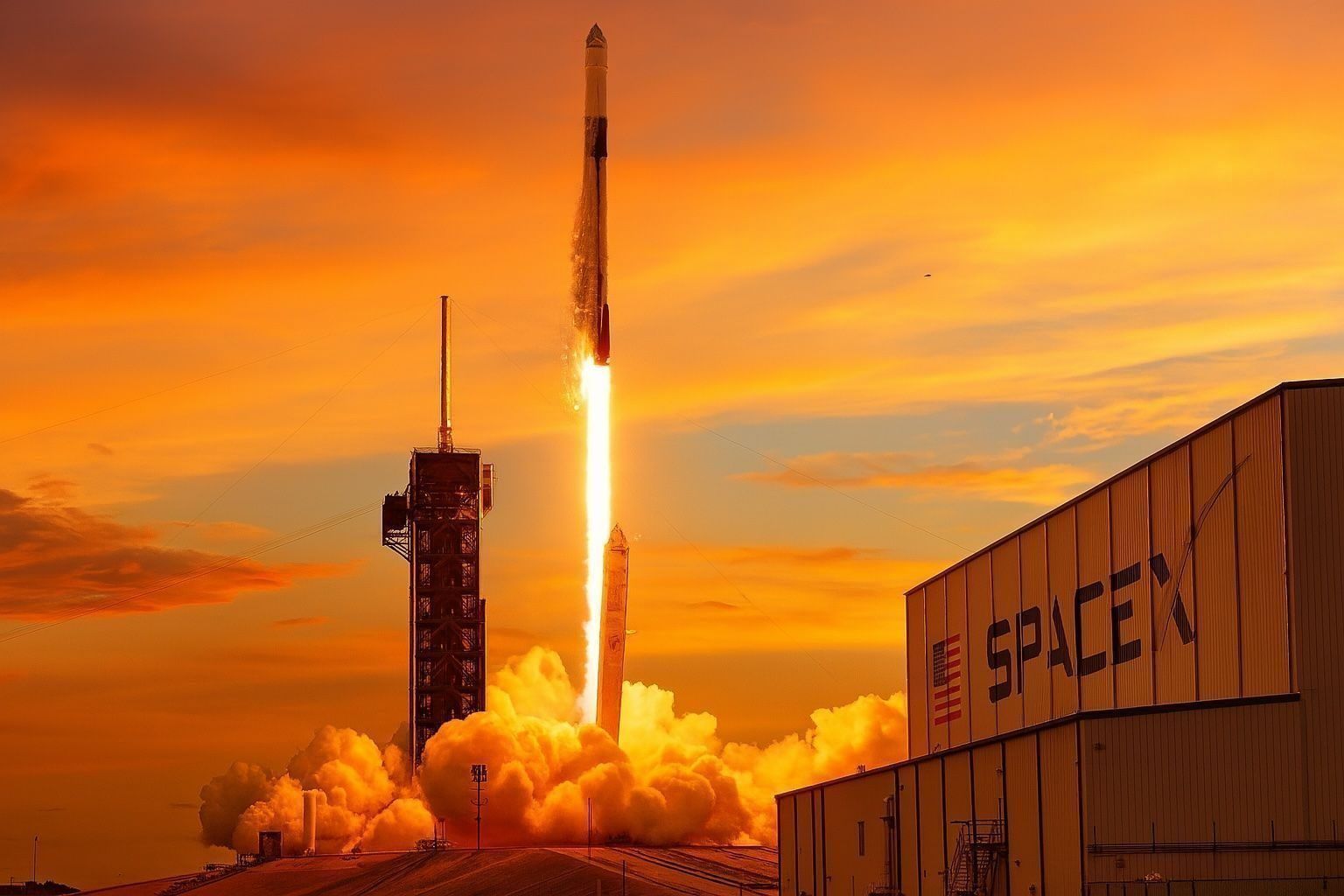
SpaceX is closing out 2025 in full sprint. On Tuesday, December 2, the company is preparing another Starlink launch from Florida, expanding its mega‑constellation while also securing approval for a new Starship launch pad on the U.S. East Coast. At the same time, the International Space Station is packed with visiting vehicles, including two SpaceX Dragon spacecraft, and policy decisions in Washington are putting the company’s future role in NASA’s exploration plans under fresh scrutiny. 1
Below is a detailed roundup of the key SpaceX developments relevant today, December 2, 2025.
Key SpaceX Headlines for December 2, 2025
- Starlink 6‑95: Falcon 9 is targeting a late‑afternoon Starlink launch from Cape Canaveral, carrying 29 satellites for SpaceX’s broadband network. 1
- New Starship Pad Approved in Florida: The U.S. Department of the Air Force has formally approved SpaceX’s plan to redevelop historic Space Launch Complex 37 (SLC‑37) for Starship flights from Cape Canaveral. 2
- Record Launch Cadence: By the start of December, SpaceX had already surpassed 150 Falcon 9 launches in 2025, with more than 100 missions dedicated to Starlink. 3
- ISS Docking Milestone: The International Space Station now has all eight docking ports occupied, with two SpaceX Dragon vehicles among the visiting spacecraft. 4
- Policy & NASA Leadership: The U.S. Senate is moving to fast‑track confirmation hearings for Jared Isaacman, a frequent SpaceX customer, as NASA administrator, amid debate over Starship’s schedule for the Artemis program. 5
Starlink 6‑95: Today’s Falcon 9 Launch from Cape Canaveral
The headline event for SpaceX today is Starlink Group 6‑95, a Falcon 9 mission scheduled to lift off from Space Launch Complex 40 (SLC‑40) at Cape Canaveral Space Force Station. The current target is 3:16 p.m. EST (20:16 UTC), with the rocket flying a southeasterly trajectory over the Atlantic. 1
According to launch coverage and tracking data:
- The mission will carry 29 Starlink v2 Mini satellites to low Earth orbit. 6
- The satellites are headed to the “Group 6” orbital shell, operating at roughly 530 km altitude with an inclination of about 43°, boosting capacity for lower‑latitude regions between roughly 43° north and south. 6
- The booster is Falcon 9 B1077, flying for the 25th time, after previously supporting high‑profile missions including Crew‑5, GPS III SV06 and CRS‑28. 1
- After stage separation, B1077 is expected to land on the droneship “A Shortfall of Gravitas” in the Atlantic. If successful, it would mark the 135th landing on that vessel and the 543rd overall booster landing for the Falcon family. 1
Spaceflight Now notes that this will be SpaceX’s 295th orbital launch from SLC‑40 and the 350th orbital launch overall from that pad, underscoring how central this site has become to the global launch market. 1
The local “Space Coast” launch calendar lists the mission as “Status: Go”, confirming that, as of today, the range and weather teams are still planning for an afternoon liftoff, though all launch times remain subject to change. 7
Weather-wise, the U.S. Space Force’s 45th Weather Squadron is calling for roughly a 70% chance of acceptable conditions at the opening of the window, improving to 80% later as a cold front pushes through. The main concerns are showers and isolated thunderstorms, with gusty winds in any stronger cells. 1
A Blistering Start to December: Back‑to‑Back Starlink Launches
Today’s Starlink 6‑95 launch comes on the heels of an early‑morning Starlink mission from Florida on December 1. In that mission, a Falcon 9 lifted off from Launch Complex 39A at NASA’s Kennedy Space Center at 2:44 a.m. ESTcarrying another 29 Starlink satellites (Group 6‑86) into orbit. 8
Key details from that flight:
- The booster B1095 completed its fourth mission, landing on the droneship “Just Read the Instructions” in the Atlantic. 8
- The launch added to a Starlink constellation that now numbers over 9,100 operational satellites in low Earth orbit, according to independent tracking. 8
- Spaceflight Now’s tracking shows that, before this predawn launch, Falcon 9 had already flown 152 times in 2025, with 110 of those missions dedicated to Starlink. 3
Taken together with the Vandenberg Starlink mission scheduled around the same period, SpaceX is effectively attempting three Starlink launches in roughly 48 hours across Florida and California — a pace that would have been unimaginable in the early days of orbital rockets. 6
Starship Gets a New Home in Florida: SLC‑37 Redevelopment Approved
Beyond today’s Falcon 9 launch, perhaps the most consequential SpaceX news for the long term is the approval to redevelop Space Launch Complex 37 at Cape Canaveral Space Force Station for Starship operations. 2
A “Record of Decision” signed by the U.S. Department of the Air Force on November 20, 2025 authorizes SpaceX to transform the historic pad — once home to Saturn I and Delta IV rockets — into a hub for Starship‑Super Heavy. The decision follows a full environmental review that weighed the option of no action against SpaceX’s redevelopment proposal. 2
According to the Air Force documentation and local reporting:
- The approval allows for up to 76 Starship launches and 152 landings per year from SLC‑37, once the Federal Aviation Administration (FAA) completes its own regulatory analysis. 2
- The Air Force cited national defense needs, rising commercial launch demand, and the need for more launch infrastructure as reasons to move forward with redevelopment. 2
- SpaceX has already stated on social media that construction has begun, and highlighted that Starship will eventually operate from three pads in Florida, positioning the system to support both U.S. national security missions and NASA’s Artemis lunar program. 2
When combined with Starship operations at Starbase in Texas and ongoing FAA efforts to update Starship’s launch license parameters, this Florida pad approval points to a future where high‑cadence Starship flights from both coastsbecome routine. 9
2025: SpaceX’s Record‑Setting Launch Cadence
If 2022 and 2023 were years of rapid growth for SpaceX, 2025 is the year of industrial‑scale launch operations.
Several independent trackers and analyses highlight the scale of what SpaceX is doing this year:
- A detailed launch tally compiled in early October counted 129 orbital missions in 2025 (125 Falcon 9, 4 Starship), all successful at that time. 10
- By late November, a SpaceX Starlink mission from Florida marked Falcon 9’s 150th flight of 2025. 11
- Yesterday’s Starlink 6‑86 launch was identified as Falcon 9’s 153rd flight of the year, with Starlink accounting for the majority of those missions. 8
- The Falcon 9 family as a whole has now flown more than 580 times since 2010, with an extraordinarily high success rate and hundreds of successful booster landings. 12
A recent investor‑focused analysis argues that this cadence has effectively made SpaceX responsible for roughly half of all orbital launches worldwide in 2025, and notes that Falcon 9’s demonstrated reliability — approaching ~99.8% mission success for the Block 5 variant — has pushed launch costs down while enabling business models such as Starlink’s direct‑to‑consumer broadband. 13
Whatever the exact final tally by year’s end, the trend is clear: SpaceX is launching at a pace that reshapes expectations for how often rockets can safely fly.
On Orbit: Two SpaceX Dragons Help Fill Every ISS Docking Port
SpaceX’s activity is not limited to the ground. On orbit, the International Space Station (ISS) just reached a major operational milestone: all eight docking ports are currently occupied, an unprecedented configuration. 4
According to NASA’s ISS blog, as of December 1, 2025 the orbiting laboratory is hosting: 14
- Two SpaceX Dragon spacecraft
- A cargo Dragon, supporting NASA’s Commercial Resupply Services.
- The Crew‑11 Dragon, ferrying astronauts as part of NASA’s Commercial Crew Program.
- Northrop Grumman’s Cygnus XL cargo ship, temporarily relocated and then reattached to free up docking space.
- JAXA’s HTV‑X1 cargo vehicle from Japan.
- Two Soyuz crew spacecraft and two Progress cargo vehicles from Roscosmos.
NASA notes that Cygnus will remain attached to the station until no earlier than March 2026, while a SpaceX cargo Dragon will depart later in December loaded with research samples and equipment for return to Earth. 15
The presence of two Dragons at once highlights how central SpaceX has become to both crewed and cargo logistics for the ISS — a critical piece of the company’s government‑services portfolio alongside its commercial business.
Partners and Markets Riding SpaceX’s Launch Infrastructure
SpaceX’s high launch cadence is also rippling through financial markets and partner ecosystems.
One example in the last 24 hours: SEALSQ Corp (ticker: LAES), a cybersecurity and post‑quantum technology company, saw its stock jump 6.94% after confirming that its latest WISeSat satellite was successfully launched aboard a SpaceX Falcon 9 Transporter‑16 rideshare mission. 16
According to the company’s announcement:
- The new satellite extends the WISeSat constellation, which provides encrypted, low‑power IoT connectivity for industrial and defense customers.
- SpaceX’s rideshare program allowed SEALSQ to deploy specialized secure‑communications hardware at relatively low cost, deepening its partnership with the launch provider. 16
This is just one example of how SpaceX’s availability and pricing are enabling a broad range of niche missions — from secure IoT networks and climate monitoring to experimental data centers and commercial space stations — to hitch rides to orbit.
Policy Watch: NASA Leadership, Artemis and Starship
SpaceX is also in the political spotlight today.
A Reuters report notes that the U.S. Senate Commerce Committee plans to hold a December 8 vote on President Donald Trump’s nomination of Jared Isaacman as NASA administrator. Isaacman is an e‑commerce billionaire and private astronaut who has flown two orbital missions with SpaceX, including the pioneering all‑civilian Inspiration4mission. 5
Key points from the report:
- Isaacman’s original nomination earlier in 2025 was withdrawn amid a public falling‑out between Trump and SpaceX CEO Elon Musk, but the White House has now renominated him. 5
- In the interim, Sean Duffy, a senior official from the Department of Transportation, has been serving as acting NASA chief. 5
- Duffy recently suggested that other companies should be invited to compete with SpaceX for NASA’s Artemis lunar landing contract, arguing that Starship’s schedule delays could threaten the agency’s timeline for returning humans to the Moon. 5
Today’s nomination maneuvering underscores how tightly NASA’s exploration roadmap is intertwined with Starship. While the new Starship pad at Cape Canaveral promises more operational flexibility for future Artemis lander missions, regulatory scrutiny and political decisions in Washington will heavily influence how quickly those capabilities come online.
What to Watch Next from SpaceX
Beyond today’s Starlink 6‑95 mission, SpaceX’s near‑term manifest shows more activity in the first week of December and beyond:
- Starlink Group 15‑10 from Vandenberg Space Force Base, California:
- Scheduled for late December 1 local time (Dec 2 in UTC), carrying 27 Starlink v2 Mini satellites into a high‑inclination orbit serving higher‑latitude regions. 6
- Starlink Group 11‑25 from Vandenberg:
- Planned for December 4, with 28 Starlink v2 Mini satellites targeting another shell optimized for mid‑latitude coverage. 6
- Starlink Group 6‑92 from Florida:
- A Falcon 9 Block 5 mission currently on the schedule for December 7 at 4:40 p.m., again launching 29 Starlink satellites from the Space Coast. 7
- Classified NROL‑77 mission:
- A Falcon 9 launch for the U.S. National Reconnaissance Office, tentatively slated for December 9 at 2:16 p.m. from Florida, highlighting SpaceX’s continuing role in U.S. national security missions. 7
All of these dates and times are, of course, subject to change based on weather, range availability and technical readiness — but they illustrate how dense SpaceX’s December schedule already is, even before Starship returns to flight.
Why Today’s SpaceX News Matters
Stepping back from the day‑to‑day launch count, the collection of SpaceX developments on December 2, 2025 paints a clear picture:
- Operationally, the Starlink 6‑95 mission is another brick in an enormous orbital infrastructure project that is redefining how broadband is delivered, especially in underserved regions. 6
- Strategically, Air Force approval of a Starship pad at SLC‑37 signals that U.S. military and civil space planners are betting on heavy‑lift, rapidly reusable systems becoming central to both national defense and lunar exploration. 2
- Economically, SpaceX’s very high launch cadence and reliability are enabling new business models — such as secure IoT constellations and affordable rideshares — that depend on frequent, predictable access to orbit. 16
- Politically, NASA leadership decisions and ongoing debate about Starship’s schedule will shape how quickly Artemis and related programs can move, and how dominant SpaceX remains in the U.S. government’s exploration architecture. 5
For now, all eyes are on Florida’s Space Coast, where another Falcon 9 is standing on the pad — and where the groundwork is being laid for much larger Starship rockets to follow.