Date: December 5, 2025
SpaceX is ending the first week of December with news on multiple fronts: a fresh Starlink launch from California, a major expansion of Starlink connectivity in South Korea, a new “Starlink Mobile” trademark that hints at full‑blown carrier ambitions, tense political and security stories around NASA and Russia, and a nine‑figure Bitcoin transaction from a SpaceX‑linked wallet.
Here’s a rundown of the most important SpaceX developments as of December 5, 2025, and what they mean for launch cadence, Starlink’s business model, and the company’s relationship with regulators and governments.
Starlink 11‑25: New batch of satellites from California’s central coast
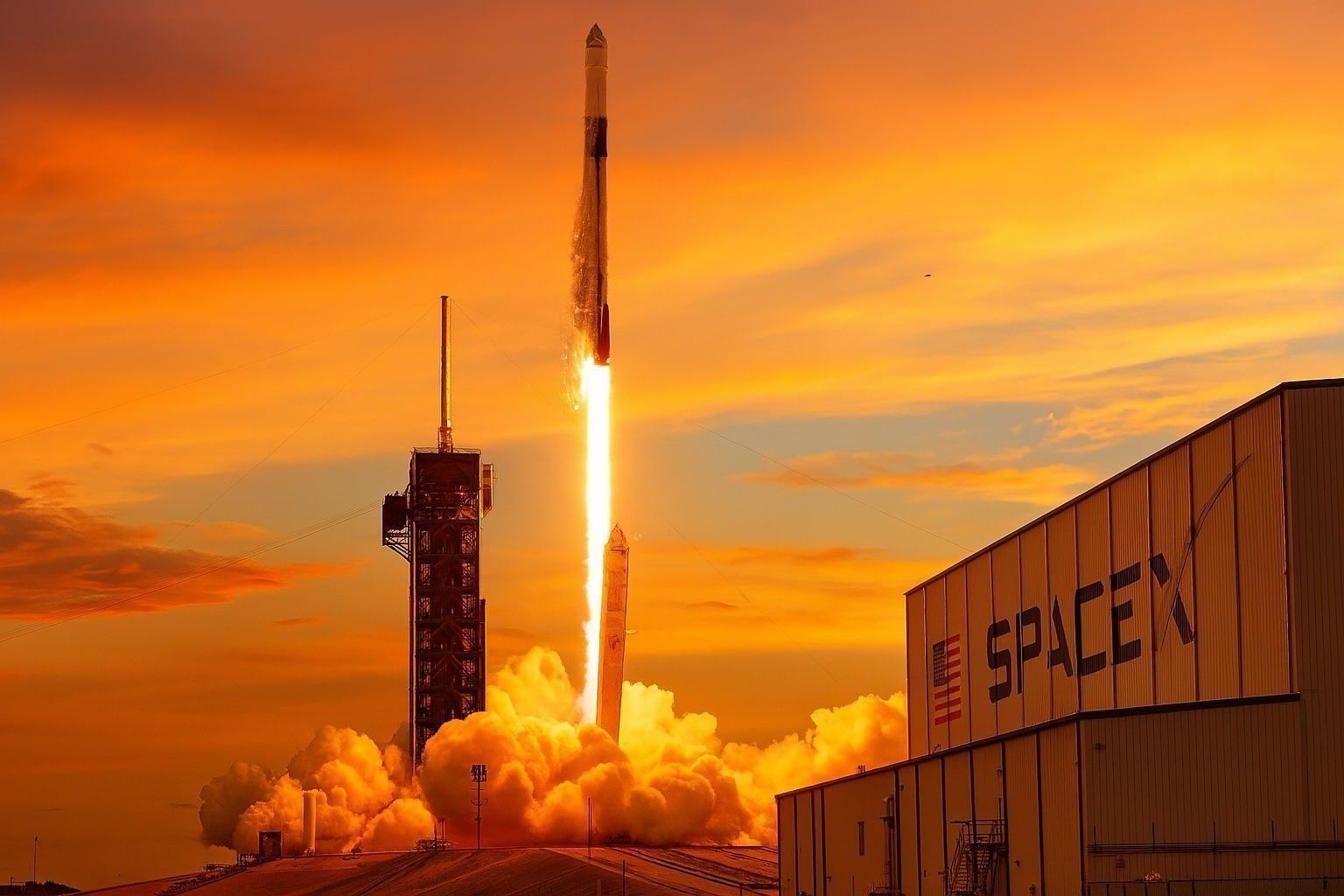
On December 4 (local time), SpaceX launched another batch of Starlink satellites from Vandenberg Space Force Baseon California’s central coast, with coverage and official photos published today.Space+1
- A Falcon 9 rocket carrying the Starlink Group 11‑25 mission lifted off from Space Launch Complex 4E at 12:42 p.m. PST (20:42 UTC).Space+1
- The rocket deployed 28 Starlink satellites to low Earth orbit, adding to SpaceX’s already massive broadband constellation.Space+1
- According to Space.com, it was the 156th Falcon 9 launch of 2025, underscoring how routine (and commercially crucial) Starlink launches have become for SpaceX.Space
- Vandenberg officials noted that this flight marked the 66th launch and test mission from Vandenberg Space Force Base in 2025, highlighting how central the West Coast range has become to commercial and national security operations.Vandenberg Space Force Base+1
The booster performed a successful downrange drone‑ship landing in the Pacific, continuing SpaceX’s streak of reusable‑rocket recoveries and holding down launch costs.Space
Why it matters
Every Starlink batch does more than just increase capacity:
- It deepens SpaceX’s competitive moat in satellite broadband; independent trackers now count over 9,000 Starlink satellites on orbit, out of more than 10,000 launched in the last six and a half years.Space+1
- The company’s launch cadence—well over 150 Falcon 9 missions this year—is unprecedented in aerospace and is the backbone that makes Starlink, Direct to Cell, and future services possible.Space+1
Starlink spreads across Korean skies, seas and skyscrapers
One of today’s biggest business stories for SpaceX comes from South Korea, where Starlink has officially launched service and immediately landed multiple high‑profile customers.The Korea Times+1
According to The Korea Times:
- Starlink service officially debuted in Korea this week, offering residential, business and roaming plans.
- Home internet plans are priced at about 64,000 KRW and 87,000 KRW per month (roughly $44–$60), with customers purchasing a hardware kit for 550,000 KRW (about $400+).The Korea Times
- Given Korea’s dense fiber and mobile networks, analysts expect business‑to‑business demand to dominate, especially in maritime and aviation, rather than mass consumer uptake.The Korea Times
Several major Korean firms have already signed on:The Korea Times+1
- SK Telink is supplying Starlink to shipping company Pan Ocean for connectivity at sea and plans broader industrial deployments (construction, disaster‑response networks).
- KT SAT will deliver Starlink to ship‑management firm KLCSM and Lotte Property & Development, which plans to use the service for resilience and disaster response at Lotte World Tower, one of the world’s tallest skyscrapers.
- On the aviation side, Hanjin Group’s five airlines—Korean Air, Asiana Airlines, Jin Air, Air Busan and Air Seoul—will equip their fleets with Starlink in‑flight Wi‑Fi, aiming to start service as early as the second half of 2026, with full rollout targeted by 2027.Advanced Television+1
Why it matters
South Korea is a test case for how Starlink can slot into markets that already have excellent terrestrial connectivity:
- The residential business is likely to remain niche, but maritime and aviation connectivity are high‑margin, high‑visibility markets where satellite internet can outperform ground networks.
- Korean Air’s decision to roll out Starlink fleet‑wide reinforces the service’s momentum after earlier deals with airlines like JSX, Hawaiian and others, and it positions Starlink as a premium in‑flight Wi‑Fi option on long‑haul routes in and out of Northeast Asia.Advanced Television+1
From satellites to smartphones: ‘Starlink Mobile’ and the 4G challenge
The clearest signal today that SpaceX wants to become more than a broadband provider came from a report that the company has filed a U.S. trademark for “Starlink Mobile” and a related mark, “Powered by Starlink.”International Business Times UK+1
According to IBTimes:
- The “Starlink Mobile” trademark application, filed with the U.S. Patent and Trademark Office, covers traditional mobile‑carrier categories like voice, text and data services.International Business Times UK
- SpaceX is also pursuing the “Powered by Starlink” mark for partners that might integrate Starlink‑backed connectivity into their own offerings.International Business Times UK
- The move sits atop recent regulatory approvals and spectrum deals (including an agreement with EchoStar) that would allow SpaceX to deploy up to 15,000 additional satellites to support a cellular‑grade network with performance in the 4G LTE range.International Business Times UK+1
On the technical side, SpaceX’s own Starlink Direct to Cell page frames the current state of play:
- The company now says it has 650+ Direct to Cell satellites in low Earth orbit, forming what it calls “the world’s largest and only Direct to Cell constellation” for data, voice, video and messaging to mobile dead zones.Starlink
- Starlink describes Direct to Cell as “the largest 4G coverage provider on Earth” by land area, using satellites equipped with eNodeB modems that behave like cell towers in space and interconnect via laser links with the broader Starlink network.Starlink
- Text messaging has been available since 2024, with data/IoT live in 2025, and voice service delivered via apps.Starlink
A separate UK broadband outlet reported that SpaceX has also hinted at launching its own satellite‑based 4G mobile service, a move that would put traditional mobile operators “on notice” by competing directly rather than only through partnerships.ISPreview+1
Why it matters
Up to now, SpaceX’s cellular ambitions have mostly run through partnerships with carriers like T‑Mobile (US), Rogers (Canada), KDDI (Japan), VMO2 (UK) and others, who treat Starlink as a roaming partner that fills coverage gaps.Starlink
The “Starlink Mobile” trademark suggests SpaceX may eventually:
- Offer branded mobile plans directly to consumers in some markets, rather than only wholesaling capacity to telcos.
- Use “Powered by Starlink” to label devices, vehicles or services that rely on Starlink connectivity in the background.
If enacted, this would move SpaceX into direct competition with incumbents like Verizon, AT&T and Vodafone—not just as a wholesale partner but as a rival carrier that happens to own the global infrastructure in orbit.
Broadband billions: SpaceX gets a small slice of BEAD funding
Another major thread today is regulatory and financial rather than technical.
A SpaceNews‑originated report, summarized by Space Launch Schedule, indicates that SpaceX and Amazon together are on track to receive only about 4% of nearly $20 billion that U.S. states have proposed for rural broadband buildouts under the federal BEAD (Broadband Equity, Access, and Deployment) program.Space Launch Schedule+1
Key points from that analysis:
- States’ final or near‑final BEAD proposals collectively allocate around $20 billion in federal funds.
- Satellite providers SpaceX (Starlink) and Amazon’s Project Kuiper are in line for about 4% of that total, covering roughly 21% of eligible locations, while the bulk of the money goes to fiber and fixed wireless projects.Space Launch Schedule+1
At the state level, the debate is already intense. A new Spotlight PA/WITF investigation published today focuses on Pennsylvania’s BEAD plan, which would spend nearly $20 million to bring satellite internet to more than 20,000 locations statewide.WITF+1
Under the proposal:
- Low‑Earth‑orbit satellite service from Amazon would cover 18,000+ locations, while SpaceX would serve around 4,800.WITF
- Critics argue that funding satellite service—which is already commercially available—may not be the best long‑term investment compared with fiber, given concerns about latency, reliability and long‑term capacity.WITF+1
- Supporters counter that satellite is often the only realistic option in mountainous, sparsely populated or heavily forested regions where fiber is prohibitively expensive.WITF+1
Why it matters
The BEAD allocations highlight a tension at the heart of Starlink’s business:
- Commercial demand for Starlink is strong in many rural areas, but public funding is still heavily skewed toward fiber, which policymakers see as more “future‑proof.”
- Even with “only” 4% of the BEAD pie, Starlink and Kuiper stand to receive hundreds of millions of dollars over a decade, but they are clearly not being treated as the primary solution for rural broadband.Space Launch Schedule+1
For SpaceX, that likely means relying more on direct consumer and enterprise demand—and on higher‑value services like maritime, aviation and Direct to Cell—rather than expecting BEAD to fund large chunks of its U.S. rural expansion.
Human spaceflight friction: a cosmonaut removed and political grilling in Washington
Russian cosmonaut removed from upcoming Crew Dragon mission
On December 3, The Moscow Times reported that veteran Russian cosmonaut Oleg Artemyev has been removed from a future SpaceX Crew Dragon mission (Crew‑12) after an alleged security breach at a SpaceX facility in Hawthorne, California.The Moscow Times+1
According to that reporting:
- Investigative outlet The Insider alleged that Artemyev photographed and removed restricted documents during training, reportedly including sensitive materials related to SpaceX engines and hardware governed by U.S. export‑control laws.The Moscow Times
- An interagency investigation was reportedly opened, and Russia’s space agency Roscosmos has since reassigned Artemyev, officially stating only that he was “transferred to another job.”The Moscow Times
- Artemyev is being replaced on the Crew‑12 mission—currently scheduled no earlier than February 15, 2026—by fellow cosmonaut Andrei Fedyayev, who previously flew on NASA’s Crew‑6 mission.The Moscow Times
- Neither NASA nor SpaceX has publicly commented on the incident.The Moscow Times
The reported breach underscores the sensitivity of U.S. export‑control and ITAR rules as SpaceX ships technology abroad and trains international partners. Even if future investigations clear Artemyev of any deliberate wrongdoing, the episode could complicate U.S.–Russia crew exchanges in the short term.
Senate presses NASA nominee on ties to Musk and SpaceX
In Washington, SpaceX is not officially on trial—but its influence definitely is.
At a Senate confirmation hearing this week, senators questioned Jared Isaacman, President Trump’s nominee to become NASA administrator, about his close business ties to SpaceX and to Elon Musk personally.Reuters+1
Two intertwined storylines emerged:
- Moon race urgency and reliance on SpaceX
- Isaacman argued that the U.S. must “beat China to the moon”, warning that losing the lunar race could shift geopolitical power.Reuters+1
- Lawmakers noted that SpaceX already holds around $15 billion in NASA contracts, including the Starship‑based lunar lander for Artemis missions, raising questions about how independent Isaacman could be from Musk’s company.Reuters+1
- “Was Elon Musk in the room where it happened?”
- Senator Ed Markey repeatedly pressed Isaacman on whether Musk was physically present when Donald Trump offered him the NASA job at Mar‑a‑Lago, echoing a viral question from an earlier hearing.Space+1
- Isaacman again declined to give a yes‑or‑no answer, saying only that “many people” were in the room. Markey suggested that Isaacman’s refusal implies Musk was present and that the public deserves clarity about SpaceX’s influence on NASA leadership.Reuters+1
Why it matters
For SpaceX, the immediate risk is not that existing contracts will be canceled; those are deeply embedded in NASA’s Artemis architecture and commercial crew and cargo programs. But:
- The more questions senators raise about Musk’s informal influence, the more likely NASA is to face new transparency requirements, conflict‑of‑interest rules or reporting obligations that indirectly constrain how closely it can align with SpaceX’s internal plans.Reuters+1
- Politically, the episode reinforces that SpaceX is no longer “just a contractor” but a central actor in U.S. space policy—and that scrutiny will follow accordingly.
SpaceX moves over $100 million in Bitcoin
On the financial side, on‑chain analysts tracked a large Bitcoin transaction linked to SpaceX early on December 5.
Crypto news outlet Finbold reports:Finbold
- A SpaceX‑tagged wallet transferred 1,083 BTC, worth about $99.8 million at the time of the transaction, to a new address.
- The move appears consistent with previous flows between SpaceX and Coinbase Prime custody, suggesting treasury rebalancing or consolidation rather than a full exit.Finbold
- Even after the transfer, on‑chain labels estimate that SpaceX still controls around 5,000 BTC, worth roughly $450+ million at current prices, placing it among the larger known corporate Bitcoin holders.Finbold
- SpaceX has not commented on the transaction or its broader Bitcoin strategy.Finbold
Why it matters
SpaceX’s Bitcoin activity is mostly a side note compared with rockets and satellites, but it tells us a few things:
- The company appears comfortable holding significant crypto assets on its balance sheet, in line with Elon Musk’s history of experimenting with digital currencies.
- Large treasury moves tend to happen when there is substantial price action—Bitcoin has been trading above $90,000 after a strong rebound—which may influence when corporate holders rebalance or hedge.Finbold
(As always, these observations are descriptive, not investment advice.)
Starship’s Florida future: Air Force greenlights SLC‑37
Quietly but importantly for SpaceX’s long‑term ambitions, the U.S. Air Force has approved SpaceX’s plan to convert Space Launch Complex 37 (SLC‑37) at Cape Canaveral Space Force Station into a Starship launch site.Space
According to Space.com:
- The Record of Decision, signed on November 20, concludes a lengthy environmental review and allows SpaceX to proceed with construction, subject to airspace and environmental mitigations.Space
- In the approved scenario, SLC‑37 could eventually host up to 76 Starship launches and 152 landings per year, turning Florida’s Space Coast into a true multi‑pad Starship hub alongside NASA’s historic Pad 39A.Space
- The review required measures to protect local wildlife, including species such as the Florida scrub‑jay and eastern indigo snake, highlighting the environmental stakes of scaling up super‑heavy launch operations.Space
Why it matters
Starship’s success is central to nearly everything SpaceX wants to do next: deep‑space missions, ultra‑cheap launches, massive next‑gen Starlink satellites, and possibly global mobile coverage. The Florida approval:
- Reduces SpaceX’s dependence on Starbase in South Texas by creating a second major Starship launch corridor.Space
- Signals that regulators are willing—if cautiously—to embrace airport‑like launch operations, a key part of SpaceX’s long‑term business model.
How today’s headlines fit together
Taken as a whole, the December 5 news cycle paints a picture of a company executing on multiple time horizons at once:
- Right now: Starlink launches like 11‑25 keep the constellation growing and cash flowing, while new airline and maritime deals in Korea turn Starlink into a global premium connectivity brand.Space+2The Korea Times+2
- Next few years: The “Starlink Mobile” trademark, Direct to Cell build‑out and BEAD‑era funding decisions hint at a world where SpaceX is both a wholesale partner and a full‑fledged global mobile carrier, but still fighting for recognition in public broadband policy.WITF+3International Business Times UK+3Sta…
- Strategic horizon: The Florida Starship pad approval, NASA’s political drama and the Crew Dragon security incident all remind us that SpaceX’s future remains intertwined with governments, regulations and geopolitics, not just engineering.Space+3Space+3The Moscow Times+3
- Financial backdrop: Large Bitcoin moves underscore SpaceX’s willingness to experiment not only in space but also in finance, while its sheer launch cadence and Starlink growth continue to fund the next leap.Finbold+1
If there’s a single theme tying today’s SpaceX news together, it’s integration: rockets, satellites, mobile networks, government contracts and financial strategy are increasingly parts of one tightly coupled system. Each new launch and regulatory decision doesn’t just move a rocket—it moves the entire ecosystem SpaceX is building around the planet.