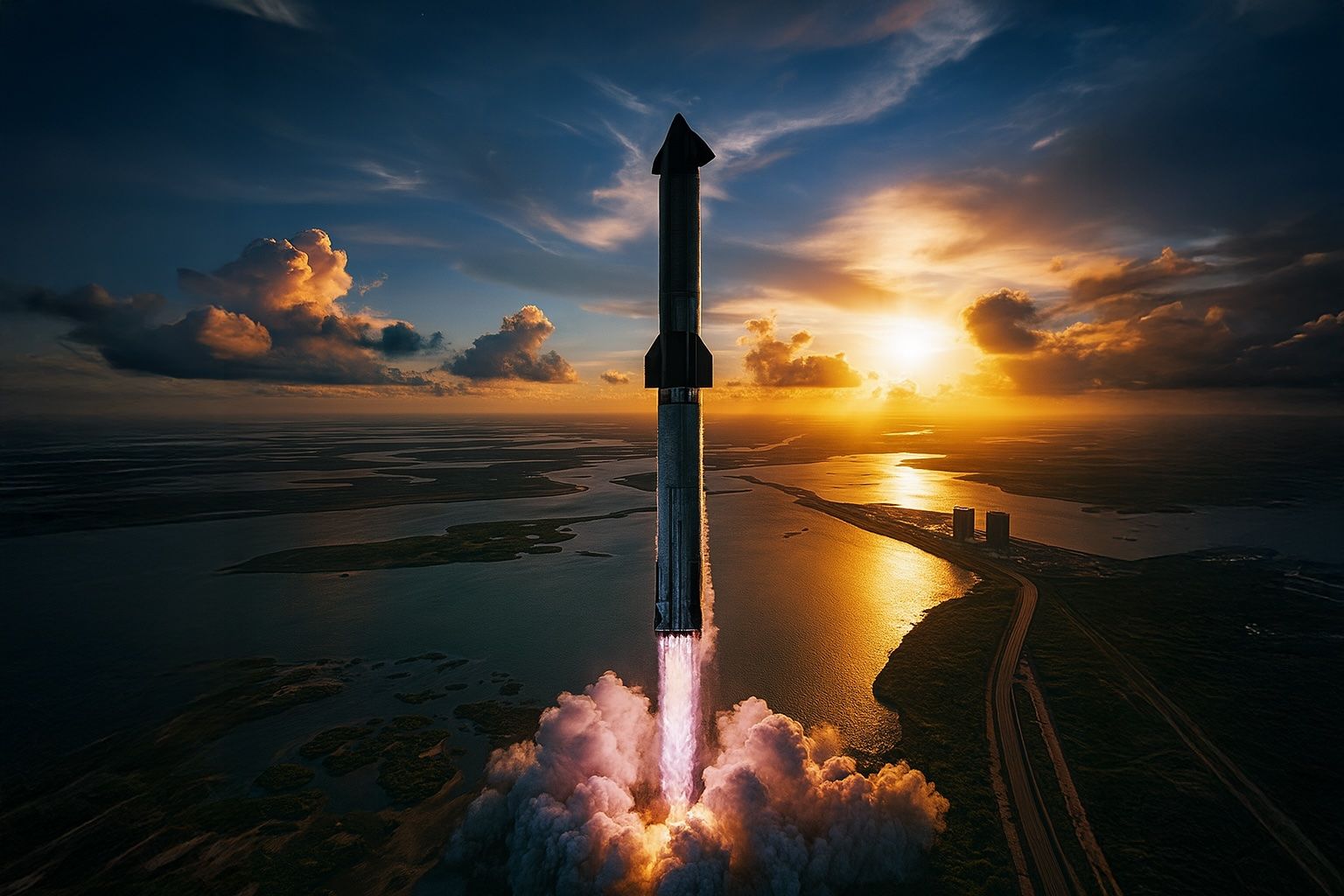
- Historic Flight: On Oct. 13, 2025 SpaceX launched its 11th Starship flight — the last test of the current “Block 2” (Version 2) Starship/Super Heavy vehiclespaceflightnow.comts2.tech. The 400-foot-tall rocket thundered off Pad A at Starbase, Texas at 6:23 p.m. CDT (2323 UTC) on a roughly hour-long suborbital mission.
- Clean Reentry and Landing: Both stages hit their marks. About 2.5 min after liftoff the Super Heavy booster (B15) separated and then performed a controlled splashdown in the Gulf of Mexico 11 minutes after launchspace.comwral.com. The Starship upper stage (Ship 38) arced over the Pacific and splashed down off Western Australia ~66 minutes post-launchspace.comwral.com. Both landings worked as planned, validating SpaceX’s recovery procedures.
- Mission Goals Met: Starship deployed eight mock Starlink satellites from its payload bay, reignited one of its Raptor engines in space, and tested new heat-shield tiles during reentryspaceflightnow.comspace.com. These objectives (payload deployment, re-light capability, and reentry survivability) mirror the goals of Flight 10 and demonstrate progress for future missions.
- Praise and Context: NASA and SpaceX celebrated the success. Acting NASA Chief Sean Duffy hailed the flight as “another major step toward landing Americans on the Moon’s south pole”wral.comreuters.com. SpaceX’s leadership was similarly bullish: CEO Elon Musk tweeted “Great work by the @SpaceX team” after splashdownspaceflightnow.com, and President Gwynne Shotwell called the next-generation Starship “the vehicle that could take humans to the Moon and Mars”reuters.com. SpaceX engineer Jake Berkowitz likewise proclaimed “Congrats to the whole SpaceX team – that was incredible!” and noted “we promised maximum excitement – and Starship delivered!”space.comspace.com.
- What’s Next: With Block 2 retired, SpaceX turns to Version 3 of Starship. Engineers will outfit the new prototype with orbital-refueling hardware (“docking adapters” and other upgrades) needed for crewed lunar/Mars missionsreuters.com. Meanwhile, NASA is counting on Starship as the crewed lander for its Artemis program (Artemis 3 is scheduled for 2027space.comreuters.com). SpaceX has a multi-billion-dollar Artemis contract, placing Starship at the center of a new Moon racespace.comreuters.com. Pad A will now be overhauled for Version 3 (with a new launch mount, flame trench and improved “chopstick” catcher)space.com, and a second pad (Pad 2) is being readied for upcoming flights.
The Final Starship V2 Test Flight
At 6:23 p.m. local time on Oct. 13, SpaceX lit the engines on Starship Flight 11. The vehicle — fully stacked and standing ~121 m (400 ft) tallspace.comts2.tech — roared off the Starbase launch tower under 33 ground-level Raptor engines, generating about 16 million pounds of thrust (over twice that of the Saturn V moon rocket)ts2.tech. The Super Heavy booster carried its upper-stage “Ship 38” clear of the pad in a plume of flame. The only anomaly during ascent was one Raptor failing to reignite during a planned boost-back burn; that engine later relit during the landing sequence as SpaceX had plannedspaceflightnow.com.
Roughly 2½ minutes into the flight, Super Heavy and Starship separated as intended. The booster flipped and began its descent back toward Earth. SpaceX ran a new landing burn sequence: it lit 13 engines initially, then throttled down to 5 for a fine control phase (a configuration planned for the next-generation booster)space.com. About 8½ minutes after liftoff, B15 completed a soft landing in the Gulf of Mexicospace.com. This marked SpaceX’s third successful Super Heavy recovery and only the second reuse of the same booster (B15 previously flew Flight 8)space.com. The flight tower’s catch-arms (“chopsticks”) were not used – unlike one of Flight 8’s catches – but the controlled splashdown met the recovery criteria.
Meanwhile, the upper stage (Ship 38) coasted on a long suborbital arc over the Pacific. About 19 minutes into flight, at roughly 119 km altitude, it opened its payload bay and released eight flat panels simulating Starlink satellitesspaceflightnow.comspace.com. This was Starship’s first intentional payload deployment (though suborbital) and the first time any Starship carried freight. After payload release, Ship 38 reignited one of its sea-level Raptors to demonstrate a de-orbit burn – a critical maneuver for future orbital flightsspaceflightnow.com.
During its fiery descent, the Starship tested its thermal protection. SpaceX engineers intentionally removed some of the heat-shield tiles over vulnerable areas to see how the vehicle would perform under extreme heatingspace.com. Ship 38 then executed a banking flop maneuver (like an airplane banking into a turn) to align itself for splashdown in the Indian Ocean. Approximately 66½ minutes after launch, Ship 38 fired a final braking burn and hit the water just off Western Australia, well within the target zonespace.comspace.com. High-definition video from a buoy shows the splashdown, a dramatic send-off for this Starship version.
SpaceX’s webcast commentators erupted in cheers. On camera, spaceport announcer Dan Huot pumped the crowd, shouting “Let ’em hear it, Starbase – what a day!”space.com. Later, propulsion lead Jake Berkowitz declared the outcome “incredible” and congratulated the teamspace.com. CEO Elon Musk – watching on ground for the first time – tweeted praise, and NASA officials called the test a major milestone.
Mission Achievements and Technical Highlights
This launch duplicated the profile of Flight 10 (Aug. 26) but introduced new twists for learning. All primary objectives were met. The eight dummy satellites were successfully deployed, and the booster and ship each survived reentry and splashdown. Notably, Ship 38 managed a Raptor relight in space and an intact re-entry despite missing tiles, proving the vehicle’s hardware and guidance are improvingspace.comreuters.com. These capabilities are essential for Starship’s future role: delivering cargo (and eventually crews) to orbit, the Moon, and beyond.
On the booster side, SpaceX is perfecting rapid reusability. Booster B15 had already flown once, and 24 of its 33 Raptors were flight-provenspace.com. During entry, it executed the hot-staging maneuver (both stages’ engines burning together) that SpaceX pioneered in Flight 10space.comts2.tech. In a first, SpaceX also tested an asymmetric landing burn by shutting down extra engines – and the booster still landed smoothlyts2.techspace.com.
Overall, the flight demonstrated Starship’s “secret sauce”: a two-stage fully reusable system designed for rapid turnaroundspace.com. Both Super Heavy and Starship were built of stainless steel for durability. SpaceX’s plan is to catch them with the launch tower’s robot arms, allowing fast inspections between flightsspace.com. So far Super Heavy has been caught three times in testing, and now this booster has shown it can even land safely at sea when needed. The dual success of Flights 10 and 11 — after a string of failures early in 2025 – validates SpaceX’s iterative strategy of test, failure, fix, and retestts2.techwral.com. Flight 10’s “stunning comeback” set the stagets2.tech, and Flight 11 has now proven the design ready to scale up.
NASA and Industry Impact
The success was immediately hailed by SpaceX and NASA leaders. “Another major step toward landing Americans on the Moon’s south pole,” NASA’s Acting Administrator Sean Duffy posted on X about the flightwral.comreuters.com. Starship is indeed the linchpin of NASA’s Artemis program: NASA awarded SpaceX a ~$3 billion contract for Starship to serve as the uncrewed and crewed lunar lander on Artemis 3 and 4space.comreuters.com. Artemis 3 (currently planned for 2027) aims to touch down in the Moon’s south pole – a mission Starship alone can accomplishspace.comreuters.com. Without Starship, NASA would lack the hardware to complete Artemis by the deadlinewral.comreuters.com.
SpaceX officials also noted the broader stakes. Gwynne Shotwell reminded audiences that Starship’s next design “is really the vehicle that could take humans to the Moon and Mars”reuters.com. Elon Musk himself has said he founded SpaceX “primarily to help our species set up shop on the Red Planet”space.com. Indeed, Starship is much bigger than any launch system today: at 123 m it dwarfs rivals like NASA’s SLS (98 m) and Blue Origin’s New Glenn (98 m)ts2.tech, and it can lift ~150 t to orbit fully reusablets2.tech (enough to send dozens of tons to Mars at once). If reliable, Starship could revolutionize space travel economics. It already dominates satellite deployment: SpaceX has launched a record 125 Falcon 9 missions in 2025 (70% for Starlink)ts2.tech, and its Starlink constellation now exceeds 8,500 satellitests2.tech. On the same launch site, crewed Dragon missions ferry astronauts to the ISS. Now the Starship program is earning its place.
Behind the scenes, SpaceX continues to prepare. Engineers plan to install upgrades for the next campaign: a new orbital launch mount, water-cooled trench, and beefed-up capture arms are being fitted on Pad Aspace.com. Pad 2 is nearing completion for future launches. In Florida, Starship facilities are rising at KSC LC-39A (ready by 2026) and plans for LC‑37 Cape Canaveral are in the worksts2.tech. The FAA has even overcome legal hurdles – a judge recently upheld SpaceX’s Texas launch site permitsts2.tech – smoothing the path for frequent Starship flights.
The Road Ahead: Starship V3 and Beyond
With Flight 11 in the books, SpaceX turns to Version 3 of Starship. This will be a slightly taller rocket (~124–125 m tallspace.com) with upgraded engines (42 Raptors instead of 39space.com) and built-in hardware for deep-space missions. Crucially, SpaceX is developing “tankers” of Starship that can dock and refuel each other in orbit, a complex dance of cryogenic propellant transferreuters.com. NASA insists on proving this refueling loop before Starship can carry crew on a lunar missionreuters.com. In fact, Musk says a Starship refueling test is targeted for next year. Shotwell expects the new “deep space” Starship to fly by late 2025 or early 2026reuters.comgbnews.com.
All this pressure is focused on the 2027 Moon landing timeline. Artemis 2 (2026) will fly around the Moon, but Artemis 3 in 2027 is to be a lunar landing – and Starship must perform the descent from lunar orbit. “Refueling is one of many remaining testing objectives required before the rocket carries humans to the lunar surface, which is scheduled for 2027,” Reuters notedreuters.com. In short, Flight 11’s success is a giant leap toward that goal. As Starship V2 passes the torch, SpaceX is on schedule to push the boundaries of spaceflight yet further – and, NASA hopes, bring us the first Moon landing of the 21st century.
Sources: Coverage of Flight 11 and Starship’s future by Spaceflight Nowspaceflightnow.comspaceflightnow.com, Space.comspace.comspace.com, Deutsche Welleamp.dw.com, Reutersreuters.comreuters.com, AP (via WRAL)wral.comwral.com, Sky Newsnews.sky.com, and TechStock² (ts2.tech)ts2.techts2.tech. These sources include official SpaceX statements, expert commentary, and NASA/industry analysis for comprehensive context.