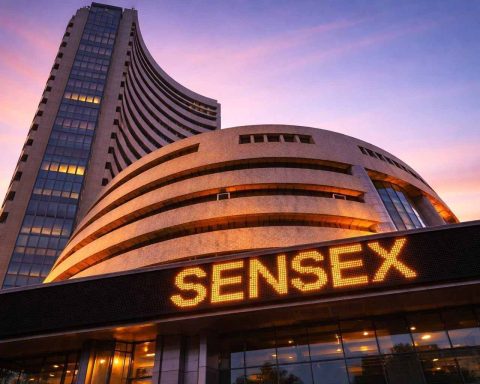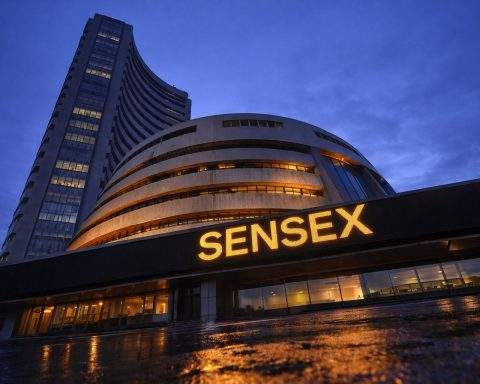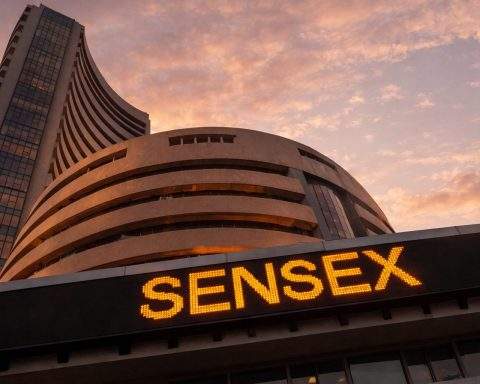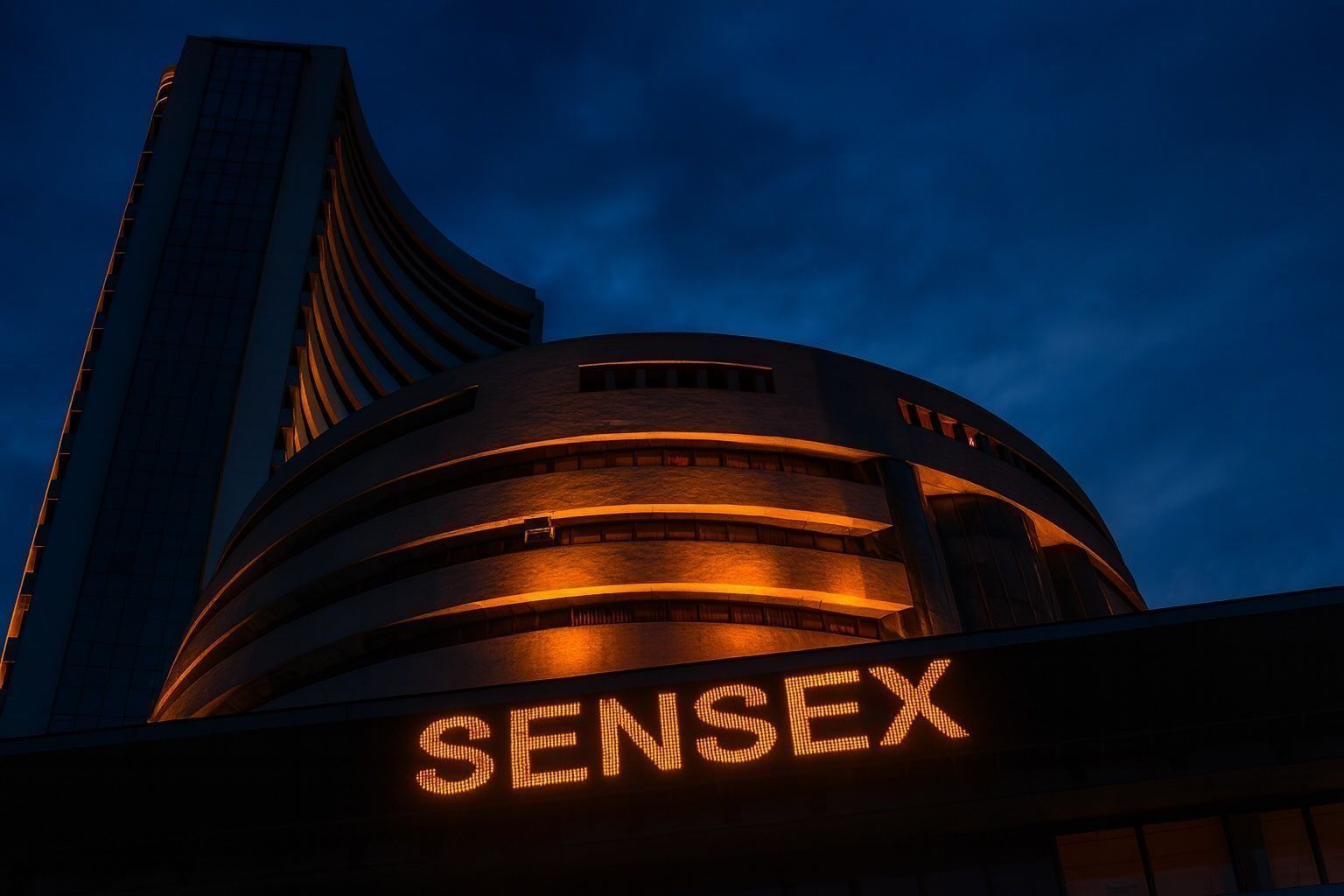
Indian stock markets ended slightly lower on Wednesday, 3 December 2025, as a record‑weak rupee, persistent foreign portfolio outflows and caution ahead of the Reserve Bank of India’s (RBI) Monetary Policy Committee (MPC) decision kept investors on the back foot. The benchmark indices closed almost flat, but the damage was deeper under the surface in mid- and small‑cap shares. The Economic Times+1
Sensex, Nifty Today: Flat Close Masks Broader Weakness
The headline indices moved in a narrow range through most of the session and finished with modest losses:
- The Sensex closed around 85,100, down about 31 points (‑0.04%).
- The Nifty 50 ended just below the 26,000 mark, near 25,986, down around 46 points (‑0.18%). The Economic Times+1
This was the fourth straight day of declines for both benchmarks. After touching record highs earlier this week—Sensex above 86,000 and Nifty beyond 26,200—the indices are now roughly 1.2–1.3% below their peaks, reflecting a mild but persistent bout of profit‑taking. The Economic Times+1
The broader market showed clearer signs of stress:
- Nifty Midcap 100: down about 1%
- Nifty Smallcap 100: down 0.7%
- BSE Midcap: off 0.95%
- BSE Smallcap: lower by 0.43% mint+1
According to BSE data, the total market capitalisation of BSE‑listed companies fell by roughly ₹2.76 lakh crore in a single session, slipping to around ₹469.7 lakh crore, underscoring that the wealth destruction was far larger than the almost-flat headline indices suggest. mint
Rupee at Record Low Near ₹90.2 per Dollar: The Dominant Headwind
The real story of the day sat in the currency market. The Indian rupee finally and decisively breached the ₹90-per-dollar mark, hitting fresh intraday lows in the ₹90.1–₹90.3 range and ending around ₹90.2 in the interbank market—its weakest level on record. The Economic Times+2mint+2
Several factors drove the move:
- US–India trade deal uncertainty: Multiple reports highlighted delays and uncertainty around a trade agreement with the United States, which has kept investors uneasy about future tariff and market-access dynamics. The Indian Express+1
- Persistent FPI equity outflows: Foreign portfolio investors (FPIs) have been net sellers in recent sessions; provisional data for Tuesday showed FPIs offloading around ₹3,642 crore, even as domestic institutional investors (DIIs) bought roughly ₹4,646 crore of equities. The Times of India+1
- Stronger US dollar & high import demand: A firm dollar, high oil import needs and demand from banks and corporates added to the downward pressure on the rupee. mint+1
Through 2025 the rupee has now fallen roughly 4.6–5.4% against the US dollar, placing it among — and by some measures at the very bottom of — Asia’s worst‑performing currencies this year, according to analyses from Indian and global outlets. NDTV Profit+3mint+3The Times of India+3
Analysts quoted by various publications point out that the RBI appears to have shifted from aggressively defending specific levels (previously near ₹88.8) to allowing a “slow and steady” depreciation, intervening mainly to avoid disorderly moves rather than to maintain a strict line in the sand. mint
For equity markets, a structurally weaker rupee has two conflicting effects:
- It hurts rupee returns for foreign investors and raises concerns about imported inflation and macro stability, pressuring banks and domestic cyclicals.
- It supports export‑heavy sectors, particularly IT and some manufacturing exporters, which partially explained the day’s sector rotation.
RBI MPC Meeting (3–5 December): Markets Split on Rate Cut vs Status Quo
The rupee’s slide is unfolding just as the RBI’s MPC meeting kicks off (3–5 December), with the policy outcome due on Friday, 5 December. The Economic Times+1
Key points on the policy backdrop:
- The repo rate currently stands at 5.5% after 100 basis points of cuts in the first half of 2025, followed by a pause since August. Moneycontrol
- A late‑November Reuters poll showed a narrow majority of economists expecting a 25 bps cut to 5.25% on December 5. Reuters+1
- However, Q2 FY26 GDP surprised on the upside at about 8.2%, with strong manufacturing and services growth, which has reduced pressure for aggressive easing and left the Street more divided on whether a cut will actually materialise this week. Moneycontrol
Analysts quoted by Moneycontrol outline the two key scenarios for equities: Moneycontrol
- RBI cuts by 25 bps
- Likely viewed as a pro‑growth signal.
- Could spur a short‑term rally in rate‑sensitive sectors — banks, NBFCs, autos, real estate and consumer durables — as borrowing costs ease and expectations of sustained credit growth strengthen.
- Might, however, add to rupee pressure unless accompanied by strong reassurance on inflation and external stability.
- RBI holds rates at 5.5% but sounds dovish
- Supports the rupee and may reassure bond markets.
- Could initially disappoint segments of the equity market that had priced in an imminent cut, but a clear roadmap for future easing might limit downside.
Economists also note that real rates are relatively high against very low inflation, giving RBI some room to ease; yet, the currency’s fragility and the importance of maintaining India’s macro “premium” in the eyes of foreign investors argue for caution. Moneycontrol
Sector Snapshot: IT and Private Banks Cushion the Fall
Despite the negative close, the market was far from uniform beneath the indices.
Biggest index losers
According to closing‑bell round‑ups and highlight pieces:
- On the Nifty 50, Max Healthcare led the losers with a fall of about 2.9%. BEL, Adani Enterprises and Tata Consumer also dropped more than 2% each, while Shriram Finance and Mahindra & Mahindra declined close to 1.8%. mint
- On the Sensex, major drags included Hindustan Unilever (HUL), BEL, Titan, Tata Motors (passenger vehicles), NTPC and SBI. The Economic Times
The common thread among many laggards: they are domestic‑facing or richly valued names where investors have locked in profits after the recent run‑up, or they are sensitive to currency weakness and policy uncertainty (such as financials and some consumption plays).
Top gainers
On the positive side:
- IT and metals showed relative strength. Wipro rose around 1.6%, Hindalco about 1.5%, while TCS, ICICI Bank and HDFC Bank gained around 1–1.4% each on the Nifty. mint
- On the Sensex, TCS, Infosys, Tech Mahindra and ICICI Bank were among the notable gainers. The Economic Times
The pattern fits the macro backdrop:
- Export‑oriented IT stocks benefit from a weaker rupee, which boosts rupee revenues on dollar billing.
- High‑quality private banks continue to draw interest thanks to improving credit growth and solid Q2 earnings, even as PSU banks and some NBFCs face pressure. The Economic Times+1
Market breadth & most‑active counters
Market breadth tilted in favour of declines, particularly in the mid‑ and small‑cap universe. Livemint’s market wrap noted that: mint
- Vodafone Idea was the most‑traded stock on the NSE, with over 117 crore shares changing hands.
- Three stocks — Hikal, OnMobile and Midwest Ltd — rallied 10–13%, while Indowind Energy RE, Adani Enterprises RE and Patel Retail dropped around 11–18%, underscoring the highly stock‑specific volatility outside the large‑cap benchmarks.
Rupee, FPI Flows and Global Cues: Why Dalal Street Is Cautious
Brokerages and strategists consistently pointed to a toxic short‑term mix:
- Rupee depreciation is making foreign investors nervous and encouraging further FPI selling, despite strong domestic fundamentals such as robust GDP growth and rising corporate earnings. The Economic Times+1
- A series of explainers this week have highlighted how India’s currency has turned into Asia’s worst performer in 2025, with trade‑war rhetoric, tariff threats and visa‑related issues adding to a stronger‑dollar backdrop. The Times of India+2NDTV Profit+2
- Globally, markets are marking time ahead of key central bank decisions, with upcoming US Federal Reserve and European Central Bank meetings and even a possible tweak in Bank of Japan policy keeping risk assets on edge. The Economic Times+1
Vinod Nair of Geojit Investments summed up the day by saying that Indian equities are “consolidating” as the rupee slides to fresh lows and FPI outflows continue, and that the RBI’s stance later this week will be “crucial, especially for banks,” given that the probability of aggressive rate cuts has receded after the strong GDP print. mint
Another widely cited strategist, V K Vijayakumar (also of Geojit), argued that:
- Large‑cap and quality mid‑cap stocks remain supported by fundamentals such as improving credit growth.
- However, small‑caps look overvalued as a segment, making them vulnerable in a phase of rupee weakness and foreign selling. The Times of India
IPO Corner: Meesho Steals the Primary‑Market Spotlight
Even as secondary markets cooled, the primary market remained busy and comparatively buoyant on 3 December.
Meesho IPO
- SoftBank‑backed e‑commerce platform Meesho opened its ₹5,421‑crore IPO for subscription, with a price band of ₹105–111 per share, implying a valuation of roughly ₹50,000 crore at the upper end. Moneycontrol+1
- By mid‑afternoon, the issue was fully subscribed on Day 1, with strong retail participation (over 3x subscribed), decent interest from non‑institutional investors, and a slower but building response from QIBs, according to live tallies from multiple platforms and the Economic Times live blog. The Economic Times+1
- Grey‑market premium (GMP) indications, while volatile, suggested a moderate listing upside, though analysts cautioned that valuations are not cheap for a still‑loss‑making platform. Moneycontrol+1
SME and broader IPO activity
- The Vidya Wires SME IPO also saw healthy traction, with early data showing overall subscription above 1x, led by retail investors (around 1.7–1.8x), even as institutional participation was still minimal on Day 1. The Economic Times
The ongoing pipeline of tech, consumer and financial listings, together with a steady calendar of SME offerings, underscores that primary‑market risk appetite remains intact, even as secondary‑market valuations consolidate.
Spotlight on BSE Ltd: Multi‑Bagger Under Pressure
One of the more closely watched stock‑specific narratives today involved BSE Ltd, which has been a spectacular multi‑bagger over the past few years.
Recent analysis of BSE’s share performance and fundamentals as of 3 December 2025 highlighted that: TS2 Tech+1
- Revenue is up ~44% year‑on‑year and profit up ~61%, driven by explosive growth in derivatives, SME listings, mutual fund platforms (StAR MF) and clearing operations.
- However, the stock now trades at 60‑plus times trailing earnings and over 20 times book, with a very low dividend yield, leaving little margin of safety if growth slows.
- Much of the Street’s concern centres on regulatory risk: SEBI’s decisions on weekly expiry rules and potential constraints on highly leveraged options strategies could materially impact derivatives turnover, which has become the main profit engine. TS2 Tech
With BSE and peers like CDSL featuring among the day’s notable losers in some market wrap‑ups, the stock is increasingly seen as a “crowded winner” vulnerable to bouts of profit‑taking whenever macro sentiment or derivatives volumes wobble. mint+1
Nifty, Sensex Technical Outlook: Range‑Bound with Key Levels in Play
Technical and derivatives analysts continue to see Indian indices in a tight, range‑bound setup:
- Nifty 50 derivatives data show aggressive call writing at the 26,100 strike and strong put open interest at 26,000, signalling a narrow trading band in the near term. mint
- Analysts peg major resistance around 26,325 on Nifty and crucial support near 25,840 (a recent swing low). Until Nifty breaks out above resistance, rallies are being used for profit‑booking; dips toward support are attracting selective buying interest. mint+1
- For the Sensex, 85,000 has emerged as an important short‑term pivot. Kotak Securities notes that sustained trade above 85,000 could set up a bounce toward 85,500–85,800, while a break below this zone opens the door to a deeper pullback toward 84,500 and below. mint
Given that Wednesday’s close left Nifty hovering just above support and Sensex barely above its key threshold, the next couple of sessions—shaped by rupee moves, FPI flows and the RBI verdict—are likely to decide whether this remains a sideways consolidation or evolves into a larger correction.
How Are Analysts Positioning for the Near Term?
Across broker commentaries on 3 December, a few common themes stand out:
- Short‑term caution, long‑term optimism
- The consensus is that India’s structural story—high growth, strong corporate balance sheets, steady domestic flows—remains intact, but near‑term currency risk and valuations warrant caution. mint+1
- Preference for quality large‑caps and select mid‑caps
- Strategists repeatedly recommend staying invested in high‑quality banks, IT leaders, and established industrial/consumption names, while being more careful with expensive small‑caps and speculative bets. The Times of India+1
- RBI as the immediate catalyst
- A 25 bps cut with balanced guidance is seen as the most market‑friendly outcome, but any sign that the RBI is comfortable with a much weaker rupee or is turning more cautious on growth could alter sector leadership quickly. Moneycontrol+1
- Watch the rupee and FPI tape as much as the index levels
- If the rupee stabilises near or below ₹90 and FPI selling moderates, markets could attempt another push toward recent highs.
- Continued currency weakness and large FPI outflows, however, would likely keep banks, financials and domestic cyclicals under pressure, even if IT and exporters remain resilient. mint+2The Economic Times+2
Bottom Line for 3 December 2025
- Indices: Sensex and Nifty slipped slightly for a fourth straight session, staying less than 2% below record highs but masking sharper pressure in broader markets. The Economic Times+2mint+2
- Currency: The rupee’s decisive break past ₹90/USD has become the central macro risk, fuelling FPI selling and weighing on sentiment. mint+2The Economic Times+2
- Sectors: IT and select private banks offered support, while PSU banks, metals and richly valued domestic names bore the brunt of profit‑taking. The Economic Times+2The Economic Times+2
- Primary market: The Meesho IPO’s strong Day‑1 subscription and ongoing SME activity underline that risk appetite is far from dead—just more selective. The Economic Times+2Moneycontrol+2
- Next triggers: All eyes now turn to Friday’s RBI decision, rupee levels around ₹90, and how FPIs respond to a market that is still near record highs but increasingly sensitive to macro shocks. The Economic Times+2Moneycontrol+2
As always, these developments are informational, not investment advice. Investors and traders should align any decisions with their own risk tolerance, time horizon and professional guidance.