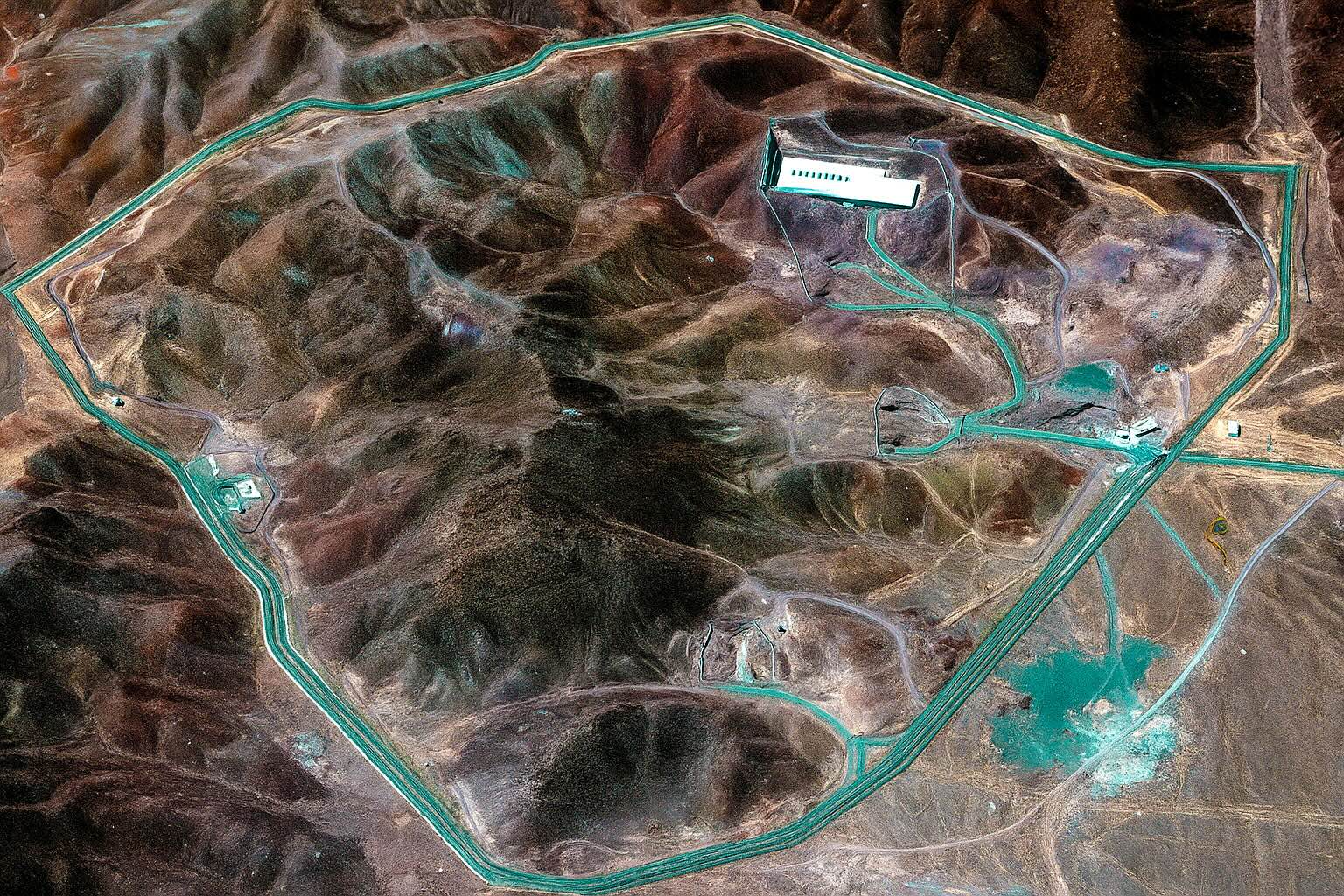

- On 21 June 2025, the U.S. strike package used B-2 launched GBU-57 bunker-busters and sea-launched Tomahawks to damage Natanz and Isfahan and cut external power to Fordow.
- Maxar Technologies and Planet imagery circulated minutes after President Trump’s confirmation, enabling open-source observers to map bomb craters, scorched roads, and collapsed roofs at Natanz and Isfahan.
- IAEA Director-General Rafael Grossi said the sudden loss of external power made it “very likely” the roughly 15,000 Natanz centrifuges were badly damaged or destroyed, based on satellite evidence.
- Fordow is buried 80–90 meters inside Mount Kuh-e-Daryacheh and was designed to withstand direct air attack, with power loss possibly wrecking its centrifuge halls.
- Natanz, home to about two-thirds of Iran’s installed centrifuges, had four above-ground halls completely collapsed by 15 June, with follow-up frames on 22 June showing heavy earth-moving.
- Isfahan’s Uranium Conversion Facility (UCF) and related buildings at the Isfahan Nuclear-Conversion and Fuel-Fabrication Center showed roof penetration and interior fire damage.
- Planet’s 3–5 m imagery captured Natanz within six hours of the strike, while Maxar’s WorldView-3 provided 0.31 m resolution imagery allowing counts of crater rims and collapsed columns.
- Independent analysts from CSIS, Bellingcat and ISIS cross-referenced optical data with Sentinel-1 radar and infrared feeds to produce publicly shared 3-D models within 24 hours.
- Analysts argued that Fordow’s underground core might remain intact, meaning diplomacy or repeated strikes could be required to render it unusable.
- The episode showed that commercial satellites can verify battlefield claims within hours, shaping the diplomatic narrative and revealing that even hardened nuclear sites are not invisible.
A wave of newly released commercial‐satellite photographs confirms that the 21 June 2025 U.S. strike package—which used B‑2‑launched GBU‑57 “bunker‑busters” and sea‑launched Tomahawks—badly damaged key above‑ground infrastructure at Iran’s Natanz and Isfahan complexes and cut external power to the otherwise deeply buried Fordow enrichment halls. Taken together with on‑the‑record assessments from the International Atomic Energy Agency (IAEA) and leading non‑proliferation analysts, the imagery suggests Iran’s centrifuge capacity has been set back by years, even if the subterranean core of the program survives. This report pieces together what happened, site by site, shows how satellite imagery made it possible to verify battlefield claims within hours, and explains the strategic stakes that now hang on what Iran, the United States and Israel do next.
1. Why the World First Learned About the Strikes From Space
Minutes after President Donald Trump confirmed U.S. involvement, high‑resolution photos from Maxar Technologies and Planet Labs were already circulating on social media and in international press wires, giving journalists—and the IAEA in Vienna—their first independent look at the battle damage before inspectors could get anywhere near the sites apnews.comreuters.com. Commercial satellites revisit central Iran several times a day; by stitching successive passes together, open‑source analysts mapped fresh bomb craters, scorched access roads and the collapse of multiple roofs at Natanz and Isfahan newsweek.comnewsweek.com. Rafael Grossi, the IAEA’s director‑general, later told the BBC that “with this sudden loss of external power, in great probability the centrifuges have been severely damaged if not destroyed altogether”—an opinion he said was reached only after “extensive use of satellite imagery” reuters.com.
2. Timeline of the 21 June Operation
| Local time (GMT + 3:30) | Confirmed Event | Evidence |
|---|---|---|
| 02:05 | First explosions at Fordow | Seismic sensors; Maxar infrared bloom apnews.com |
| 02:17 | B‑2 releases two GBU‑57s over Natanz | U.S. official to AP apnews.com |
| 02:24 | Thirty Tomahawks launched at Isfahan from submarines in the Gulf | Pentagon leak to Reuters reuters.com |
| 05:15 | Trump posts “We have completed our very successful attack…” | Social‑media capture; AP wire apnews.com |
| 11:00 | First Planet Labs 3 m imagery publicly available | Newsweek compilation newsweek.com |
| 18:30 | IAEA emergency Board of Governors briefing | Reuters live blog reuters.com |
3. The Three Facilities in Detail
3.1 Fordow Fuel Enrichment Plant
- Location & Design. Burrowed 80–90 m inside Mount Kuh‐e‑Daryacheh, Fordow was designed to withstand direct air attack csis.org.
- Strike Results. Imagery shows new access‑road scarring, fresh vehicle tracks, and a plume that experts interpret as evidence of a feeder‑cable tunnel collapse apnews.com. Grossi said “very limited if any damage” to the centrifuge halls themselves—but noted power‑loss may have wrecked the machines reuters.com.
- Expert View. David Albright of the Institute for Science and International Security (ISIS) cautions that “there’s no evidence the underground site was destroyed,” but adds that de‑powering alone could “freeze Fordow for months” reuters.com.
3.2 Natanz Enrichment Complex
- Significance. Home to roughly two‑thirds of Iran’s installed centrifuges reuters.com.
- Visible Damage. Maxar imagery from 15 June shows four totally collapsed above‑ground halls, carbonized debris fields and pockmarked terrain; follow‑up frames on 22 June reveal heavy earth‑moving as Iran races to clear rubble reuters.com.
- IAEA Assessment. Grossi told governors it is “very likely all the roughly 15,000 centrifuges operating at Natanz were badly damaged or destroyed” reuters.com.
3.3 Isfahan Nuclear‐Conversion and Fuel‑Fabrication Center
- What Was Hit. Four buildings, including the Uranium Conversion Facility (UCF) that turns yellowcake into UF₆, show roof penetration and interior fire damage reuters.com.
- Strategic Impact. Without UCF output, experts say Iran will struggle to feed fresh UF₆ into surviving centrifuges—a bottleneck that could extend any bomb‑breakout timeline by many months csis.org.
4. How Satellite Imagery Became the Decisive Forensic Tool
- Speed. Planet’s 3–5 m constellation passed over Natanz within six hours of the strike, beating even local cell‑phone uploads newsweek.com.
- Resolution. Maxar’s WorldView‑3 captured 0.31 m pixels, sharp enough to count individual crater rims and collapsed columns reuters.com.
- Independence. Because Iran bars inspectors and censors domestic media, the IAEA relies on “extensive satellite imagery” to confirm compliance or damage iaea.org.
- OSINT Ecosystem. Independent analysts at CSIS, Bellingcat and ISIS cross‑referenced optical data with Sentinel‑1 radar and infrared fire‑detect feeds, producing publicly shared 3‑D models within 24 hours isis-online.orgcsis.org.
5. What the Experts Say
- “Iran responds to attacks by hardening its facilities and expanding its program,” warns Kelsey Davenport of the Arms Control Association, arguing that strikes give Tehran political cover to enrich even higher reuters.com.
- Albright notes that while Natanz’s above‑ground pilot plant was “destroyed,” Fordow’s mountain cover still poses a military problem “that only diplomacy or repetitive strikes can solve” reuters.com.
- CSIS analyst Henry Rome points out that without Isfahan’s conversion line, “Iran’s stockpile of feed gas will shrink rapidly, complicating any dash to weapons‑grade” csis.org.
6. Iranian and International Reactions
- Iran’s Atomic Energy Organization vowed it “will not allow the development of its national industry to be stopped” reuters.com.
- Russia warned that any strike on the Bushehr power reactor could spark a “Chernobyl‑style disaster,” signalling Moscow’s red lines reuters.com.
- The U.N. Security Council met in emergency session; the U.K. endorsed the strikes, while China and Russia called them an “illegal use of force” thetimes.co.uk.
7. Legal and Strategic Stakes
| Question | Key Point | Source |
|---|---|---|
| Was the U.S. strike legal? | Washington argues collective self‑defence alongside Israel against an “imminent nuclear threat”; critics say Article 51 does not apply. | Guardian analysis theguardian.com |
| Did the attack end Iran’s bomb option? | Probably not: knowledge is portable and underground halls at Fordow appear intact. | Reuters explainer reuters.com |
| What risk of escalation? | Iran has already fired missiles into Israel; U.S. Central Command bases now on high alert. | AP chronology apnews.com |
8. Scenarios for the Next 12 Months
- Rapid Repair. Iran diverts resources to rebuild Natanz’s surface facilities and reroute power to Fordow. Timeframe: 9‑12 months; requires smuggling of replacement centrifuge parts.
- Negotiated Freeze. Strikes provide leverage for a “JCPOA 2.0” style cap at 3.67 % enrichment; would need U.S.–EU economic incentives.
- Cycle of Retaliation. Israel or the U.S. repeat attacks if reconstruction detected; Iran escalates via proxies and missile tests. Risk: regional war drawing in Gulf energy infrastructure.
9. Bottom Line
The 21 June raids demonstrated that even the world’s most hardened nuclear sites are not invisible in the age of commercial satellites. Within hours, open‑source imagery made battlefield claims transparent, empowered watchdogs, and shaped the diplomatic narrative. Whether the strikes ultimately slow Iran’s pathway to the bomb or accelerate it now depends less on physics than on politics—and on how many more devastating satellite pictures the world is willing to tolerate.


![US Stock Market Today 08/28/2026 [UPDATE: 01:00 EDT] [Marvell Pins Near Overnight Low as Analyst Targets Diverge]](https://ts2.tech/wp-content/uploads/2026/08/US-market-dashboard-2026-08-28-0058-480x384.jpg "US Stock Market Today 08/28/2026 [UPDATE: 01:00 EDT] [Marvell Pins Near Overnight Low as Analyst Targets Diverge]")