
- Current Price (Oct 21, 2025): ~$20.50, up ~5% on the day reuters.com. (Prev. close $19.51, open $20.07 reuters.com.)
- Year-to-Date: Stock has climbed sharply from a 52-week low around $5.38 to trade near its recent high ($22.44) marketbeat.com. It hit a new 12-month peak (~$20.25) in early October markets.financialcontent.com.
- Analyst Upgrades: On Oct. 21, Citigroup upgraded RUN from Neutral to Buy, raising its price target to $26 (implying ~27% upside) marketbeat.com. UBS, Goldman and others have also lifted targets to ~$21–26 recently marketbeat.com.
- Earnings Calendar: Sunrun will report Q3 2025 results after the close on Nov. 6, 2025 (call 1:30pm PT) investors.sunrun.com. Market expects robust subscription growth and the tail end of federal solar incentives to be key topics.
- Financial Highlights: Q2 2025 revenue was $569.3M (+9% YoY) with EPS $1.07, well above the $(0.18) consensus marketbeat.com. Over 940,000 subscribers (up 14% YoY) drive recurring revenue pv-tech.org. The company is debt-financing growth – it raised ~$510M via securitization in Q3, bringing Q3 non-recourse debt funding above $1.5B pv-tech.org pv-tech.org.
- Growth Strategy: Sunrun calls itself a “storage-first” company, attaching batteries on ~70% of new systems pv-tech.org. CEO Mary Powell notes Sunrun is now a major distributed power provider (“energy resilience” for homeowners) with 3+ GWh of dispatchable home battery capacity pv-tech.org.
- Expert Commentary: CEO Powell says Sunrun is “well positioned to continue to generate strong financial returns” under current U.S. policy pv-tech.org. CFO Danny Abajian highlights the $1.5B raised in Q3 financing to “fuel profitable growth” pv-tech.org. Analysts caution that the pending expiration of key solar tax credits (end-2025) creates uncertainty pv-tech.org benzinga.com.
- Industry Context: Federal policy is in flux. A June bill preserved some solar tax credits and sent Sunrun stock sharply higher reuters.com, but recent Trump administration rollbacks (cutting subsidies and canceling projects) have weighed on solar names ts2.tech. Experts warn of a possible “boom–bust” cycle if incentives vanish ts2.tech.
Stock Rallies on Upbeat Sentiment
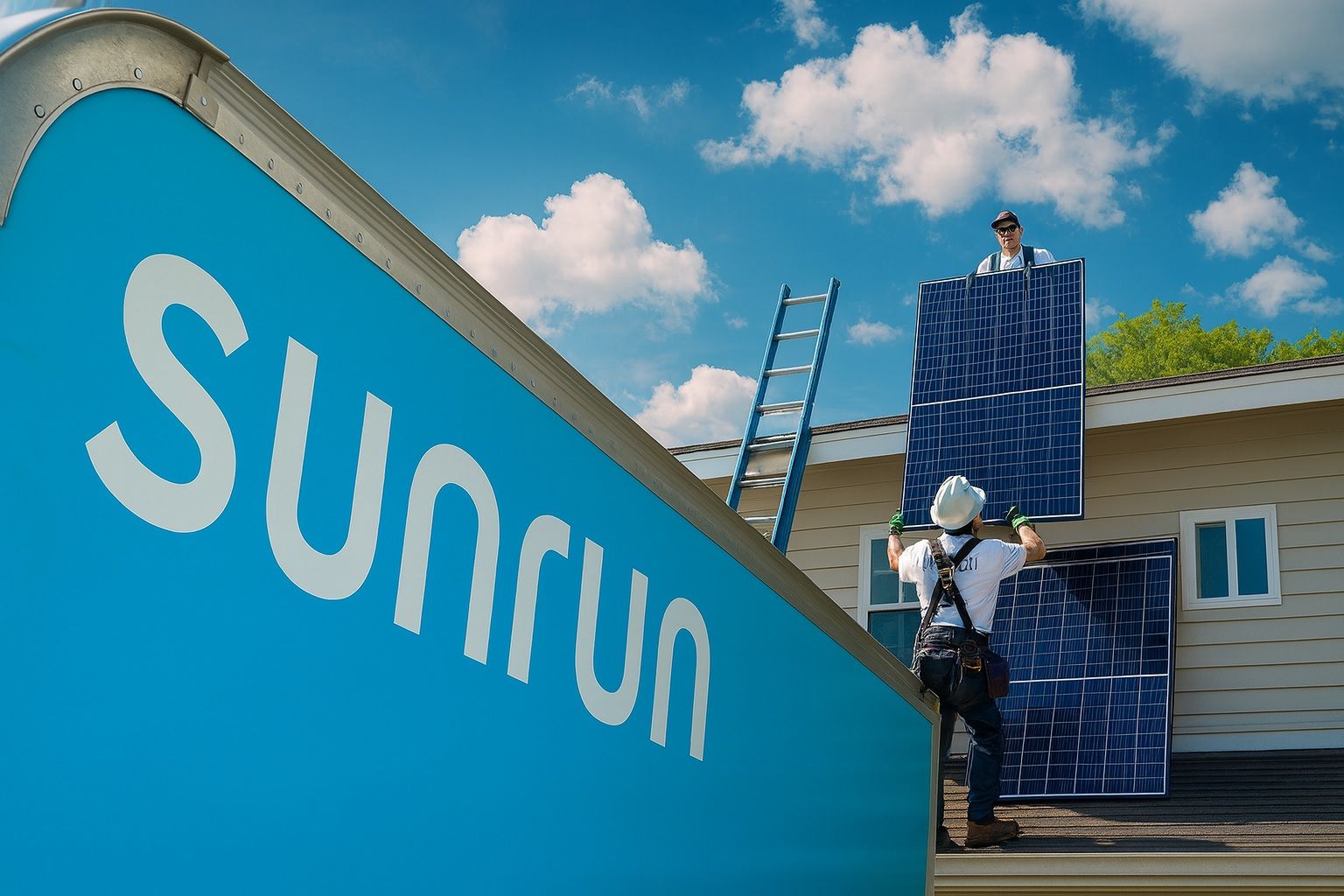
On Oct. 21, 2025, Sunrun (Nasdaq: RUN) traded around $20.50, up about 5% intraday reuters.com. This surge followed news that Wall Street’s Citigroup had upgraded Sunrun to “Buy” with a $26 price target marketbeat.com. The stock’s rally pushed it above the consensus 12-month analyst target (~$20) ts2.tech. In fact, RUN hit a new 12-month high (~$20.25) on Oct. 7 markets.financialcontent.com, as investors cheered its improving fundamentals and solar incentives.
Over the year, Sunrun has been on a tear. Earlier in 2025, the shares languished near multi-year lows (around $5.38), but rallied into the teens after a strong Q2 report in August markets.financialcontent.com and surged through the $20 mark in October markets.financialcontent.com. The 50- and 200-day moving averages are now near $17 and $11, respectively marketbeat.com, reflecting the recent uptrend. Volume has been robust (millions of shares traded), underscoring rising institutional interest.
Market momentum is also driven by analyst upgrades. In addition to Citigroup’s call on Oct. 21 marketbeat.com, research shops like Jefferies and Zacks have recently changed ratings on Sunrun from Hold to Buy or Strong Buy, lifting targets into the low-$20s marketbeat.com. The consensus forecast (MarketBeat) indicates a Moderate Buy rating and an average target around $18–20 marketbeat.com, suggesting room for upside.
Analyst Quote: “Sunrun has been upgraded from ‘neutral’ to ‘buy’ by Citigroup, which sees about a 27% potential upside” marketbeat.com. This upgrade reflects expectations that Sunrun’s subscriber growth and storage push will translate into stronger cash flow.
Strong Fundamentals: Growing Subscribers and Storage
Sunrun’s fundamentals have improved markedly. In Q2 2025 (released Aug 6), Sunrun reported $569 million in revenue (+9% year-over-year) and $1.07 EPS, far above the consensus loss estimate marketbeat.com. More than 28,800 new customers (up 15% YoY) signed up in Q2 pv-tech.org, bringing the total to nearly 940,000 (up 14% YoY) pv-tech.org. These long-term subscription contracts generate predictable recurring revenue.
Crucially, Sunrun’s “solar+storage” strategy is gaining traction. The company now equips ~70% of new solar customers with battery storage pv-tech.org, versus about 69% last quarter. That drove a 48% jump in storage capacity installations in Q2 versus a year earlier pv-tech.org. Sunrun’s CEO Mary Powell emphasizes the shift: “Sunrun is a storage-first company,” she said in the Q2 report pv-tech.org. This focus means each customer offers multiple revenue streams (solar plus grid services from the batteries).
Powell also highlights Sunrun’s role as a decentralized power producer. The company’s virtual power plants (VPPs) now involve 3 GWh of home batteries and ~8 GW of solar, enabling dispatch of stored power to the grid. “We have transformed the business to be a provider of energy resilience for homeowners, and a formidable independent power producer…with more than 3 GWh of dispatchable energy from our fleet of home batteries,” Powell said pv-tech.org. For example, in June 2025 Sunrun systems delivered up to 340 MW during California grid peaks, helping prevent outages.
CFO Quote: Danny Abajian, Sunrun’s CFO, underscores the capital strength: “Inclusive of this transaction…Sunrun will have raised more than US$1.5 billion in…non-recourse debt financings in Q3, and we look forward to continuing to utilize our diverse financing channels to fuel profitable growth,” he said about a recent $510M securitization deal pv-tech.org pv-tech.org.
Indeed, Sunrun’s aggressive financing is notable. In mid-September, it priced a $510 million securitization (two A-rated tranches of $260M and $250M) to fund leases and PPAs pv-tech.org. This was the fifth such deal in 2025, bringing total Q3 debt raises above $1.5B pv-tech.org. The proceeds help Sunrun expand its lease financing pool and grow without diluting equity.
Market Sentiment and Analyst Outlook
Investor sentiment is broadly positive but tempered by caution. Run’s current market cap (~$4.7B) and metrics (forward P/E ~16x, price/sales ~2.1) reflect both growth potential and still-negative net income (2024 net loss was $2.85B reuters.com). Analysts note Sunrun has “delivered impressive revenue growth in 2025” and could see lift from rising power demand (e.g. from AI data centers) benzinga.com. The AI trend is cited by Sunrun management as boosting interest – the company is positioning its grid services as a solution for electrification needs.
However, concerns linger over federal incentives. The 30% homeowner solar tax credit (Section 25D) is slated to end Dec 31, 2025, which could slow new solar installations next year pv-tech.org. Mary Powell acknowledges this: while the residential credit sunsets, Sunrun benefits mainly from the commercial credit (Section 48E) – 94% of Sunrun’s new customers are subscription-based and qualify for 48E (available through 2028 for solar, 2033 for storage) pv-tech.org. Powell is optimistic, saying Sunrun is “well positioned to continue to generate strong financial returns under the enacted legislation” pv-tech.org.
Street price targets reflect this mix of optimism and caution. Benzinga reports (Sept 2025) that the average 12-month target was ~$18.07, with a high of $38 and low of $6 benzinga.com. Recent upward revisions point to mid/high $20s. Citigroup’s new $26 target is one of the highest. Consensus ratings are around Hold to Moderate Buy.
Expert Insight: RBC Capital Markets analysts note that recent tax legislation has “mixed implications for solar-linked clean energy stocks” reuters.com. In the short run, many solar stocks rallied in June after tax credits for solar leasing were preserved reuters.com. But industry experts warn the mix of subsidies and regulatory moves could cause volatility. As one TS2 report put it, analysts caution that a “boom‑bust” cycle may emerge if incentives abruptly disappear ts2.tech.
Policy Headwinds: Tax Credits and Political Shifts
Solar policy in Washington is in flux, and Sunrun sits at the center of the debate. The Biden-era Inflation Reduction Act (2022) initially extended generous solar credits, but the current administration has accelerated their phase-out. In mid-2025 Congress moved up the sunset of federal solar tax credits (the so-called “One Big Beautiful Act”), which trimmed support faster than planned ts2.tech pv-tech.org. This created near-term uncertainty for rooftop solar demand.
Meanwhile, permitting changes have been dramatic. In October, the Trump administration abruptly canceled the massive Esmeralda 7 solar-plus-storage project in Nevada (6.2 GW) by rescinding its environmental review, part of a broader push to slow renewables on public lands ts2.tech ts2.tech. Renewable energy groups condemned the move. Kabir Green of NRDC called the project cancellation “unfettered obstruction” of clean energy ts2.tech, and SEIA warned it “will restrict America’s ability to produce homegrown clean energy” ts2.tech.
These policy headwinds have pressured some solar stocks. The TS2 report notes that U.S. solar shares “have faltered” amid subsidy rollbacks ts2.tech. However, other signs are positive: globally renewables investment is at record levels, and even insiders like Gina McCarthy (ex-White House climate czar) say many companies remain “committed to clean energy investments despite policy headwinds” ts2.tech.
For Sunrun in particular, the next few quarters will test the industry’s resilience. The company believes its business model – long-term subscriptions and integrated storage – provides insulation. Indeed, 85% of Sunrun customers lease rather than buy panels, so their effective cost remains subsidized through Section 48E for several years pv-tech.org. Sunrun has also diversified into EV charging and VPP partnerships.
Looking Ahead: Earnings and Future Outlook
With the strong Q2 performance behind it, Sunrun will provide an update on Nov 6, 2025 for Q3. Investors will watch guidance closely. On one hand, if Q3 shows continued subscriber growth and stable financing costs, it will reinforce confidence. On the other hand, we’ll likely hear more about preparing for the 2026 environment without major tax credits (many analysts in Benzinga’s bear case expect a 2026 slowdown if incentives fully drop benzinga.com).
Most analysts expect Sunrun to remain unprofitable for 2025 (est. EPS around –$0.43 marketbeat.com) but see improving cash flows. The company projects positive operating cash flow by late 2026 as contracts ramp and financing stabilizes. Citigroup and others imply share prices near mid-$20s by next year, assuming execution stays strong.
One forward-looking scenario: If Sunrun can continue scaling homes with storage and lock in long-term electricity contracts, it could start generating net profits in the coming years. Simply Wall Street’s analysis suggests targets of $2.9B revenue and $465M EPS by 2028 under a 10%+ growth pace benzinga.com (though such forecasts depend on policy and market demand).
Forward-Looking Analysis: Bloomberg and market models put Sunrun’s forward P/E in the mid-teens reuters.com marketbeat.com (based on 2026-27 estimates), reflecting a growth premium. TradingView analytics show price targets clustering around $19–25 for 2026 tradingview.com. Even the mean of analyst forecasts suggests roughly a 10–20% upside from current levels.
Investors will also eye valuation multiples: Sunrun’s price/sales is about 2.1 reuters.com marketbeat.com, modest for a high-growth company, and its debt/equity (~4.7:1) is high by manufacturing standards but typical for asset-intensive solar financing (most debt is non-recourse on leased systems). If 2026 growth holds up, rerating to higher multiples is possible – as has happened recently.
Conclusion
Sunrun’s stock is riding a wave of optimism on Oct. 21, 2025 – lifted by analyst upgrades, robust Q2 results, and signs of strong demand for solar+storage. At ~$20.50, shares trade near multi-year highs, reflecting confidence in the company’s strategy and the industry’s long-term prospects. However, investors remain watchful of the policy backdrop. The impending phase-out of tax incentives and a more hostile regulatory environment could challenge growth in 2026.
For now, Sunrun’s management and many analysts believe the company can weather the transition. As CEO Mary Powell put it, Sunrun is positioned to continue “strong financial returns” under the enacted policies pv-tech.org. With the Q3 earnings release on the horizon, the market will be looking for confirmation that Sunrun’s subscription model and “energy resilience” mission translate into sustainable growth.
Sources: Sunrun investor releases and earnings reports investors.sunrun.com pv-tech.org; Reuters, PV Tech, MarketBeat, TS2.Tech, and financial media coverage reuters.com marketbeat.com pv-tech.org reuters.com markets.financialcontent.com pv-tech.org ts2.tech.
Related articles: Renewable Energy