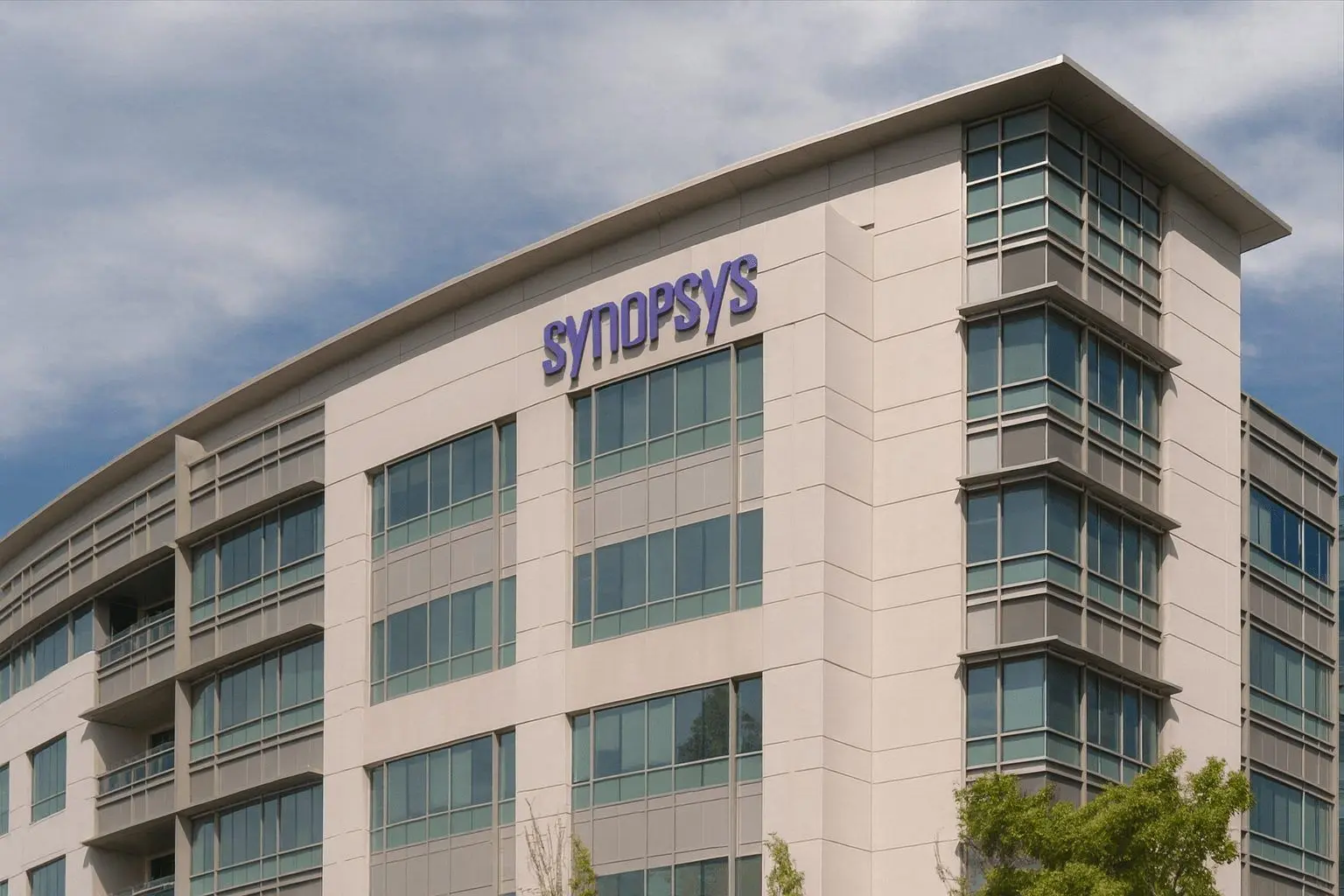
Synopsys, Inc. (NASDAQ: SNPS) has gone from a bruising late‑summer selloff to a high‑stakes recovery story driven by artificial intelligence, a $2 billion strategic investment from Nvidia, record revenue and a flurry of securities class‑action lawsuits.
As of 11 December 2025, Synopsys stock trades around the mid‑$460s–$470s, giving the company a market cap in the high‑$80 billion range.CompaniesMarketCap+1 That’s roughly 20% above its 21 November close near $388, but still well below its 52‑week high around $652 set in late July.Yahoo Finance+1
From 21 November onward, new lawsuits, restructuring plans and blockbuster partnerships have reshaped the Synopsys narrative. Here’s what investors need to know about the latest news, forecasts and analysis around SNPS stock.
Synopsys stock performance since November 21, 2025
On 21 November 2025, Synopsys shares closed at $388.36, capping a difficult stretch in which the stock traded about 40% below its summer peak after a September earnings shock and guidance reset.Yahoo Finance+1
Since then:
- By early December, SNPS rallied back into the mid‑$460s, helped by enthusiasm over Nvidia’s strategic stake and anticipation of Q4 results.Synopsys News Releases
- The stock remains roughly 30% below its 52‑week high near $651.73, underscoring how deep the autumn drawdown was.MarketWatch+1
- Market cap has recovered to roughly $87–89 billion, up from the low‑$70 billions seen in mid‑November.CompaniesMarketCap+2FinanceCharts+2
Daily performance pieces from MarketWatch show the stock oscillating sharply through November, underperforming on some weaker sessions but gradually clawing back losses as sentiment improved.MarketWatch+1
For investors, the key question is whether this rebound marks the start of a sustained uptrend or a relief rally inside a still‑fragile story.
Legal overhang: Securities class actions launched on November 21
The turning point date in your question—21 November 2025—matters for another reason: that’s when a major securities fraud class action announcement hit the tape.
What the lawsuits allege
On 21 November, law firm Kahn Swick & Foti (KSF) announced a class‑action lawsuit on behalf of investors who bought Synopsys shares between 4 December 2024 and 9 September 2025.PR Newswire The complaint centers on Synopsys’ Q3 FY2025 results, released on 9 September:
- Q3 revenue came in at $1.74 billion, missing the company’s own guidance range of $1.755–$1.785 billion.PR Newswire+2PR Newswire+2
- GAAP net income plunged to $242.5 million, down about 43% year on year, even though revenue still grew double digits.PR Newswire+1
- The Design IP segment—which provides high‑margin interface and foundation IP—accounted for roughly a quarter of sales but declined about 7.7% year on year and was guided to fall at least 5% for the full year.PR Newswire+2semisrael.com+2
According to the complaint, management failed to disclose material issues in the IP business and with at least one major foundry customer, as well as risks tied to U.S. export controls and China demand.PR Newswire+2Reuters+2
When those issues surfaced with the Q3 release, Synopsys stock collapsed by roughly 36% in a single day, dropping about $216 to close near $388 on 10 September—its worst trading day on record.PR Newswire+1
Multiple firms, one core case
KSF is far from alone. A string of law firms—including Hagens Berman, Bleichmar Fonti & Auld, The Schall Law Firm, the Law Offices of Frank R. Cruz, and others—have issued their own notices urging Synopsys investors to join similar or overlapping suits by 30 December 2025, all referencing the Q3 shortfall, IP weakness and share‑price plunge.Newsfile+4PR Newswire+4GlobeNewswire+4
Most of these actions reference a single underlying case, Kim v. Synopsys, Inc., et al., pending in the Northern District of California.PR Newswire
What it means for the stock:
- The legal overhang could linger for years and may ultimately result in settlements or judgments.
- For now, the main impact is headline risk and valuation pressure, particularly for investors sensitive to governance and disclosure practices.
- The lawsuits help explain why analyst price targets have been trimmed slightly even as long‑term growth forecasts remain robust.Yahoo Finance+1
Nvidia’s $2 billion strategic stake: A vote of confidence
If the lawsuits are the main negative development since late November, the clear positive catalyst is Synopsys’ deepening partnership with Nvidia.
On 1 December 2025, Nvidia and Synopsys unveiled an expanded, multi‑year strategic collaboration that spans:Synopsys News Releases+2Silicon UK+2
- Accelerating Synopsys’ EDA and simulation workloads on Nvidia CUDA and AI‑physics platforms
- Building agentic AI engineering workflows, integrating Synopsys’ AgentEngineer technology with Nvidia’s AI stack
- Developing sophisticated digital twins using Nvidia Omniverse and Cosmos for industries from semiconductors to automotive and aerospace
- Joint go‑to‑market initiatives to bring GPU‑accelerated engineering solutions to a broader base of customers
Crucially, Nvidia also invested $2 billion in Synopsys common stock at $414.79 per share, effectively anchoring a large, long‑term shareholder position.Synopsys News Releases+2Reuters+2
The deal arrived just as Synopsys was trying to stabilize investor confidence after the September selloff and the emergence of lawsuits. Simply Wall St, for example, described Nvidia’s stake as a catalyst that “reframes the story around the stock and its longer‑term growth potential,” noting a roughly 16% one‑month rebound in the share price into early December.Simply Wall St
Why this matters for SNPS:
- It validates Synopsys’ technology road map in AI‑driven design and simulation.
- It adds a powerful ally in navigating GPU‑accelerated workflows and cloud distribution.Synopsys News Releases+2Synopsys News Rele…
- It signals that one of the world’s most valuable AI companies sees Synopsys as strategically important infrastructure, not just another vendor.
For many institutional investors, the Nvidia tie‑up is now a central pillar of the bull case for Synopsys stock.
Q4 2025 earnings: Record revenue, mixed optics
On 10 December 2025, Synopsys reported fourth‑quarter and full‑year fiscal 2025 results that beat expectations and set new records.Investors+3Synopsys News Releases+3PR News…
Headline numbers
For Q4 FY2025:
- Revenue: $2.255 billion, up from $1.636 billion a year earlier (roughly 38–40% growth), and slightly above consensus estimates around $2.25 billion.Synopsys News Releases+2Reuters+2
- Non‑GAAP EPS: $2.90, above Wall Street’s ~$2.78 forecast but down from $3.40 in Q4 FY2024.Synopsys News Releases+2Investors+2
- GAAP EPS: $2.39, up from $1.79 a year ago.Synopsys News Releases
- Ansys contribution: about $667.7 million of Q4 revenue, reflecting the first full quarter with the simulation giant under Synopsys ownership.Synopsys News Releases+1
For full‑year FY2025:
- Revenue: $7.054 billion, up about 15% from $6.127 billion in FY2024—a new record for the company.Synopsys News Releases+2PR Newswire+2
- Non‑GAAP EPS: $12.91 vs. $13.20 a year ago (slight decline, reflecting acquisition, integration and export‑control impacts).Synopsys News Releases+1
- Backlog: Approximately $11.4 billion, giving strong multi‑year revenue visibility across EDA, IP and simulation.Synopsys News Releases+1
2026 outlook
Synopsys also issued FY2026 guidance:
- Revenue: $9.56–$9.66 billion (midpoint $9.61B), including about $2.9 billion of expected Ansys revenue and a ~$110 million hit from divested optical and RTL businesses.Investors+3Synopsys News Releases+3PR News…
- Non‑GAAP EPS: $14.32–$14.40, implying strong profit growth versus FY2025.Synopsys News Releases+2Investors+2
- Q1 FY2026: Revenue of $2.365–$2.415 billion and non‑GAAP EPS of $3.52–$3.58—roughly in line on earnings and slightly below consensus on sales.Synopsys News Releases+2Reuters+2
Initial after‑hours trading saw Synopsys shares spike about 5–6% on the beat, but they soon gave back those gains as broader tech sentiment soured following disappointing results from Oracle.Reuters+2Barron’s+2
Takeaway: The latest quarter confirmed that Synopsys is executing well operationally, but the market remains sensitive to valuation, macro tech volatility and lingering concerns about IP growth and China.
Job cuts and restructuring after the Ansys acquisition
Another key post‑November 21 development is Synopsys’ decision to trim about 10% of its workforce, or roughly 2,000 employees, following the completion of its roughly $35 billion Ansys acquisition.Reuters+2semisrael.com+2
According to a 12 November 2025 Reuters report, Synopsys:Reuters
- Plans to reallocate spending toward higher‑growth areas, including AI‑driven design tools and system‑level solutions
- Expects $300–$350 million in pretax restructuring charges, largely related to severance and site closures
- Intends to carry out most of the reductions in FY2026, with the plan substantially completed by the end of FY2027
- Continues to face slower demand in China due to export‑control disruptions and issues at a key foundry customer, even after some restrictions were eased in July 2025
The layoffs are part of a broader effort to integrate Ansys, streamline overlapping operations and protect margins as Synopsys leans into AI, multi‑die (chiplet) design and complex system simulation.Reuters+2Q4 Capital+2
For investors, the restructuring introduces execution risk in the near term (cultural integration, talent retention) but is intended to support higher long‑term profitability.
Strategic positioning: EDA, IP and AI‑native design
Behind the headlines, Synopsys still occupies a dominant strategic position in a highly concentrated industry.
EDA oligopoly and Ansys integration
- Synopsys, Cadence and Siemens EDA form an oligopoly controlling roughly 75–85% of global EDA revenue, with Synopsys holding about 31% market share as of 2024, just ahead of Cadence’s ~30% and Siemens’ ~13%.Market Reports World+2TrendForce+2
- Adding Ansys’ simulation portfolio gives Synopsys unmatched reach from chip design to multiphysics system modeling, with Q4 slides highlighting over 1,400 advanced‑node tape‑outs (16nm and below) and a full‑stack EDA solution integrated with AI.Synopsys+3Q4 Capital+3Investing.com+3
Given that EDA software is deeply embedded in customers’ workflows and faces high switching costs, this market structure tends to support resilient, recurring revenue—a key pillar for the bullish long‑term thesis.
AI‑powered design and agentic workflows
Synopsys has spent the past few years infusing its tools with AI and generative AI:
- The Synopsys.ai platform and its “copilot”-style capabilities aim to shrink design cycles from weeks to days by automating synthesis, verification and signoff tasks.Synopsys News Releases+2PR Newswire+2
- A September 2025 announcement detailed expanding AI features and introduced AgentEngineer, a multi‑agent system designed to autonomously handle increasingly complex steps in chip design flows, from step‑level actions to more autonomous decision‑making over time.Synopsys News Releases+1
- Nvidia’s partnership now ties these AI‑native flows directly to GPU‑accelerated compute, Omniverse digital twins and cloud deployment, creating a powerful moat at the intersection of EDA, simulation and AI infrastructure.Synopsys News Releases+2Reuters+2
This is central to why many analysts still view Synopsys as a mission‑critical supplier to the AI and high‑performance computing boom, even after the Q3 missteps.
Analyst sentiment and stock forecasts
Consensus rating and targets
According to aggregated Wall Street data compiled by Stockanalysis, 15 analysts currently cover Synopsys stock:StockAnalysis
- Consensus rating: “Strong Buy”
- Average 12‑month price target:$556.47, implying roughly 20% upside from recent prices in the mid‑$460s
- Range of targets: Low $425 to high $602
Several recent actions following the Q4 print and the Nvidia deal include:StockAnalysis+2GuruFocus+2
- KeyBanc lifting its target from $575 to $600 (Buy/Overweight)
- Needham maintaining a Strong Buy while raising its target from $550 to $580
- Rosenblatt reiterating a bullish stance around $560
- Aggregator data showing BofA Securities shifting from a more cautious stance to its most bullish category with a target lifted from $500 to $560
At the same time, a few firms have trimmed very aggressive targets (for example, Piper Sandler nudging a $630 target down to $602), reflecting a more sober view of risk after the September shock and legal developments.StockAnalysis
Fundamental forecasts
Consensus forecasts also imply rapid growth over the next two years:StockAnalysis+2Synopsys News Releases+2
- Revenue: Expected to jump from $7.05B in FY2025 to about $9.86B in FY2026 (nearly 40% growth, driven largely by full‑year Ansys consolidation), then to around $10.9B in FY2027.
- EPS: Projected to rise from roughly $8.05 (GAAP baseline) to about $14.39 in 2026 and $17.74 in 2027, indicating substantial operating leverage.
- Synopsys’ own FY2026 non‑GAAP EPS guidance of $14.32–$14.40 broadly aligns with those estimates.Synopsys News Releases+1
A narrative‑driven analysis from Simply Wall St pegs Synopsys’ “fair value” near $551 per share—about 15% above recent levels—based on long‑term cash‑flow and growth assumptions.Simply Wall St But that same analysis notes that much of the upside depends on sustained AI‑driven demand, smooth Ansys integration and a recovery in the IP segment.
Valuation: Growth premium with real risk
Multiples snapshot
Based on the latest results and share price:
- Using FY2025 non‑GAAP EPS of $12.91, Synopsys currently trades at roughly 36x trailing earnings.Synopsys News Releases+2FullRatio+2
- On FY2026 expected EPS around $14.3–$14.4, the stock trades near 32–33x forward earnings.Synopsys News Releases+1
- Price‑to‑sales ratios cluster around 11–12x trailing revenue, depending on the data source.GuruFocus+2Trading Economics+2
By most measures, that’s a premium valuation even relative to large‑cap software peers, many of which trade in the high‑20s to low‑30s on forward earnings.
Simply Wall St goes further by looking at GAAP earnings and other inputs, calculating a P/E above 70x versus a U.S. software sector average near 33x, and warning that the stock could be vulnerable if growth or sentiment falter.Simply Wall St
Why investors still pay up
The market appears willing to grant Synopsys this premium because:
- It effectively sits at the choke point of advanced chip design, alongside Cadence and Siemens.Market Reports World+2Embedded+2
- AI, chiplets and high‑performance computing are driving secular demand for more complex design, verification and simulation flows.Reuters+1
- The Ansys acquisition and Nvidia partnership dramatically expand its addressable market into system‑level and multiphysics design.
However, that premium also means less room for error:
- Any further disappointments in the Design IP segment, which has already seen revenue decline and remains under scrutiny, could pressure the stock.AInvest+2semisrael.com+2
- Ongoing export‑control risk and China exposure introduce uncertainty, particularly if U.S.–China tensions re‑escalate.Reuters+2TrendForce+2
- The class actions create a long‑tail risk around governance and disclosure practices, even if they ultimately settle for amounts that are manageable relative to Synopsys’ size.PR Newswire+2GlobeNewswire+2
Key risks and opportunities for SNPS from here
Bullish case highlights
For investors focused on long‑term growth, the post‑November 21 news flow reinforces several positives:
- Structural moat: Synopsys remains a core part of the EDA oligopoly with entrenched relationships across leading chipmakers and systems companies.Market Reports World+2Embedded+2
- AI leverage: The Synopsys.ai and AgentEngineer initiatives, now tied tighter to Nvidia’s compute stack, give it a first‑mover advantage in AI‑native design workflows.Synopsys News Releases+2Synopsys News Rele…
- Scale and diversification: With Ansys on board, Synopsys spans silicon, packaging, system‑level simulation and multiphysics modeling—positioning it as an end‑to‑end engineering platform.Synopsys News Releases+2Q4 Capital+2
- Robust growth outlook: Both company guidance and consensus forecasts show high‑teens to high‑30s revenue growth in FY2026 and beyond, with faster EPS growth as synergies and restructuring take hold.Synopsys News Releases+2StockAnalysis+2
Bearish and watch‑list items
At the same time, cautious investors will keep a close eye on:
- Design IP stabilization: The lawsuits zero in on IP performance; a credible path back to sustainable IP growth would go a long way toward rebuilding trust.PR Newswire+2AInvest+2
- Execution on layoffs and integration: Achieving targeted synergies without damaging innovation or customer support is critical, especially in a talent‑intensive industry.Reuters+2Q4 Capital+2
- Legal outcomes: While class‑action settlements are common in U.S. markets, the timeline, costs and reputational impact remain unknown.PR Newswire+2GlobeNewswire+2
- Valuation compression risk: If sector multiples contract or Synopsys has another guidance misstep, a high‑30s to low‑30s P/E could be vulnerable to derating, even if the long‑term thesis remains intact.Simply Wall St+2FullRatio+2
Bottom line
Since 21 November 2025, Synopsys stock has been pulled in two directions:
- Supportive forces: A landmark $2 billion Nvidia investment, strong Q4 results, robust FY2026 guidance and a clear leadership position at the heart of AI‑driven chip and system design.Q4 Capital+4Synopsys News Releases+4Synops…
- Constraining forces: A cluster of securities class‑action lawsuits, evidence of weakness in the Design IP business, China‑related uncertainty and a valuation that still prices in a lot of future success.Simply Wall St+4PR Newswire+4PR Newswire+4
For now, Wall Street remains broadly optimistic—rating SNPS a Strong Buy with a consensus target around the mid‑$550s—but the stock is firmly in “priced for high expectations” territory.StockAnalysis+2Barron’s+2
Anyone considering Synopsys should weigh that growth premium against the legal and execution risks highlighted since November 21, and make decisions that fit their own risk tolerance, time horizon and financial situation.