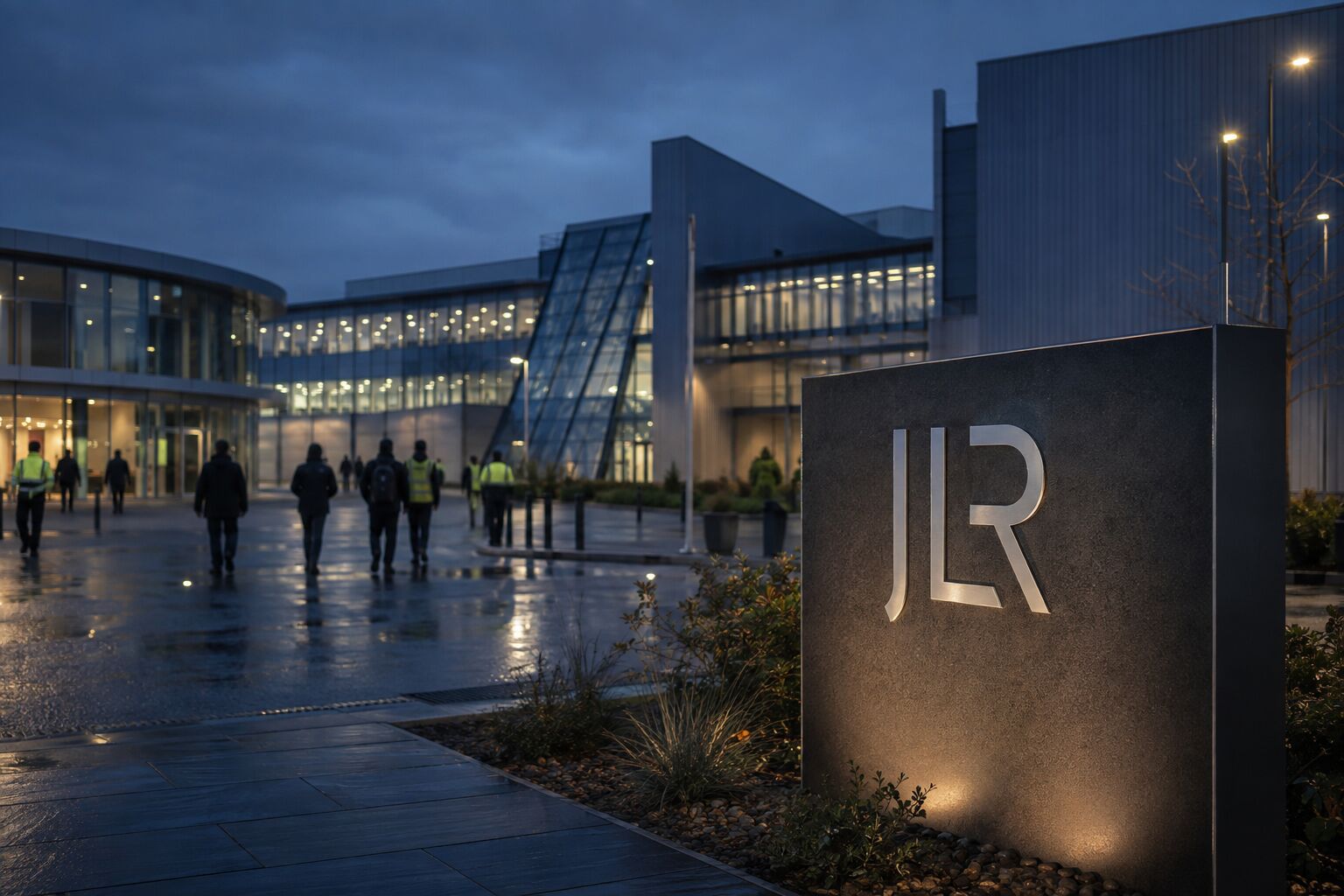

GAYDON, England, September 6, 2026, 10:21 a.m. BST — Jaguar Land Rover’s last full-year wholesale volume finished only 7,915 vehicles above the cost base it now wants. That 2.6% cushion frames weekend reports that as many as 4,000 jobs could go. The financial exposure sits inside Tata Motors Passenger Vehicles Ltd. NSE:TMPV.
JLR confirmed a voluntary redundancy programme for salaried and management staff. It did not confirm the reported headcount, making 4,000 a preliminary figure.
The carmaker reiterated a £1.7 billion savings target and a 300,000-vehicle breakeven goal. Its statement said JLR must “further simplify our organisation, improve efficiency, and build greater resilience.” For shareholders, execution matters more than the headline.
One programme, two levels of certainty
The savings and breakeven objectives are company targets. The workforce number remains a media report.
Programme details: JLR statement reported by Sky News. Workforce: JLR annual report.
Monday will deliver the first share-price verdict because Indian exchanges were closed when the news broke. TMPV finished Friday at ₹311.50, down 0.2% in the session.
The stock has already discounted setbacks. It has fallen 10.6% since August 4 and 10.9% since JLR’s August 13 results.
The earnings-day bounce did not hold
TMPV daily closing prices over the latest 24 NSE sessions.
Last regular trade at . Closing-price record: Yahoo Finance market data. Change calculations by TS2.
Price weakness makes the fresh plan more than a labour story. JLR contributes about 80% of its Indian parent’s revenue, according to Reuters reporting from its June investor day.
The £1.7 billion programme spans material, warranty and fixed costs. Redundancies are one component, so dividing the target by the reported job number would create false precision.
The 300,000-unit goal gives investors a cleaner yardstick. JLR wholesaled 307,915 vehicles in fiscal 2026. The gap was thin.
Fiscal 2026 volume barely cleared the new floor
The breakeven target is not a sales forecast. It shows how little room last year’s volume left above the desired cost threshold.
Reported volume: JLR FY25/26 annual report. Current quarter: JLR investor-relations results. Calculations by TS2.
The first quarter tells the same story. Wholesales of 79,288 annualize to 317,152, a run rate rather than a forecast. That is only 5.7% above the desired threshold.
A lower breakeven point could protect cash in a downturn. It cannot create demand or pricing power.
JLR’s first-quarter revenue fell 9.6% to £5.973 billion. Pretax profit before exceptional items dropped 68.9% to £109 million. Free cash outflow reached £998 million.
Adjusted EBIT margin was 2.8%, down from 4.0%. Variable marketing expense rose to 7.1% from 4.1%, exposing a sales-support cost that headcount cuts cannot remove.
Savings cannot come at the cost of the product cycle
The restructuring sits beside large cash demands and a crowded launch plan.
Strategy target: JLR’s June investor update. Cash and liquidity: Q1 FY27 release.
Capital spending complicates the trade-off. JLR still plans five launches over two years, while the wider £18 billion programme runs through fiscal 2029. Cutting launch capacity could defend costs now and weaken future mix.
That mix is carrying current results. Range Rover, Range Rover Sport and Defender supplied 80.8% of Q1 wholesales, up from 77.2%. China volume fell 26.2%, however, while North America was flat.
Analysts disagree on what recovery is worth. Motilal Oswal retained a Sell rating and ₹310 target after Q1, citing marketing expense and rising automotive debt. Current published targets range from Axis Capital’s ₹290 to Nuvama’s ₹450.
The risks run both ways. Faster savings and clean launches could lift margins. Deeper China weakness, tariffs, severance cash costs or delayed models could absorb the benefit.
The NSE is scheduled to reopen Monday at 9:15 a.m. IST. Investors will first test the reported scale against the share price. They will then need acceptance numbers and a cost bridge in JLR’s next results.