NEW YORK, July 30, 2026, 18:00 EDT — Wall Street trading is closed for the day; after-market moves continue.
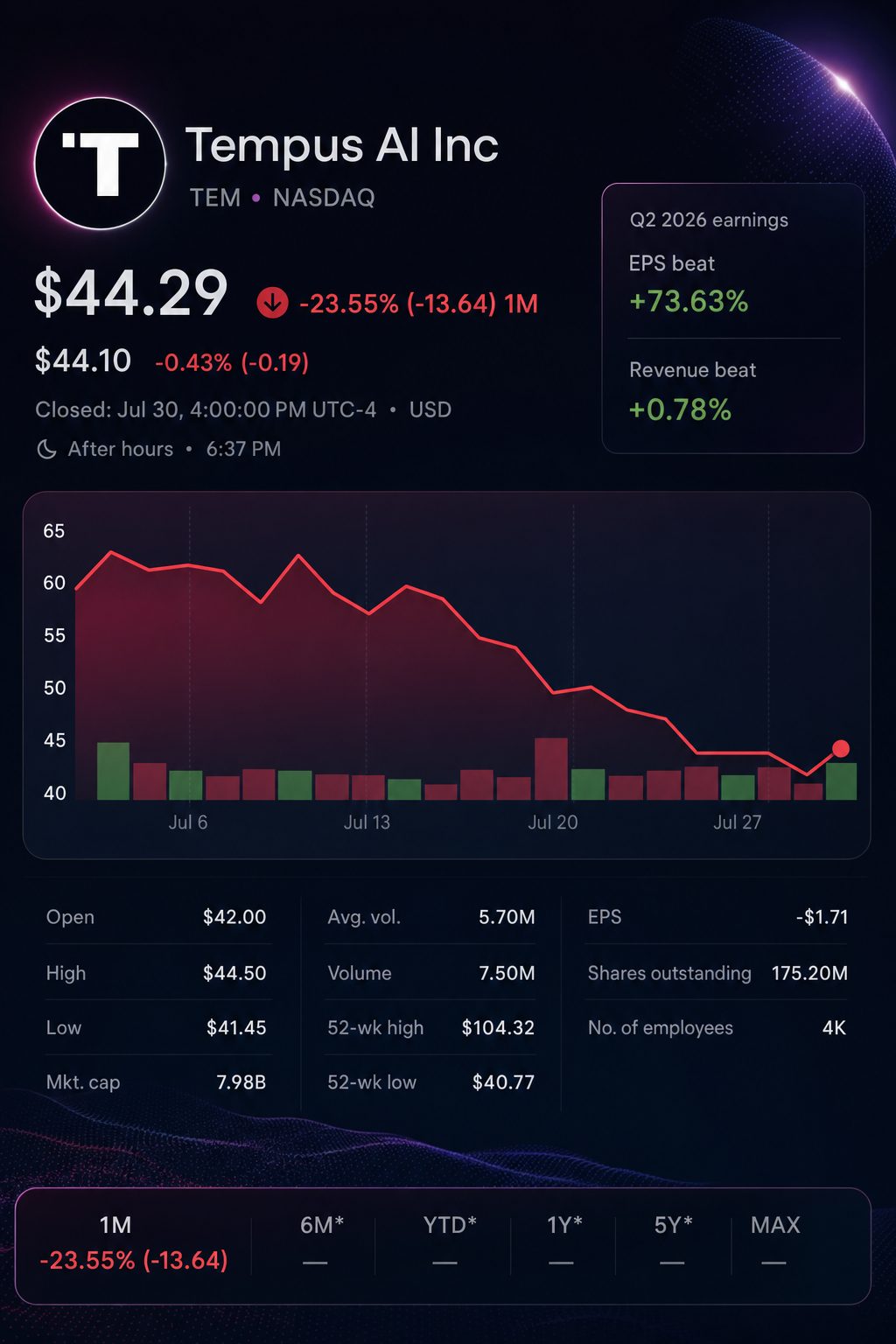
Tempus ended the session up 6.6% at $44.29 before slipping 2.6% in after-hours trading.
Revenue increased by 22% to $382.5 million, slightly surpassing analyst expectations.
An initial assessment indicates a sharp increase in adjusted EBITDA for the second half.
Tempus AI NASDAQ:TEM dropped 2.6% to $43.15 in after-hours trading on Thursday, following a slight beat for its second quarter and raised full-year revenue outlook. Shares finished regular trade up 6.6% at $44.29 prior to the report.
The timing shifts the perspective. Thursday’s rise at the close was unrelated to earnings. The drop after hours was a response to results.
Tempus faces scrutiny as investors examine its profit bridge for the second half. The company must generate nearly $60 million in adjusted EBITDA to meet its full-year guidance, having reported just $5.2 million in the first half. Management’s outlook remains unchanged.
The quarter outperformed a consensus compiled by MarketBeat. Revenue surpassed expectations by under 1%, and the adjusted loss came in 10 cents lower than projected.
GAAP net profit appeared higher than the company’s core performance. Net income was $5.6 million, boosted by $98.5 million in unrealized securities gains. Operating loss increased by 23%.
The business mix provided a more positive indication. Diagnostics saw increases in both scale and margin. Data and Applications experienced quicker growth, but its gross margin decreased.
Chief Executive Eric Lefkofsky stated, “Our strategy is working.” Oncology testing volumes climbed 31%. Revenue from data licensing and modeling was up 36%, and new Data and Applications bookings neared $200 million. Business Wire
Tempus has increased its projected 2026 revenue range to between $1.595 billion and $1.605 billion, while keeping its adjusted EBITDA forecast close to $65 million. Based on the midpoint estimates, this implies $869.4 million in revenue and $59.8 million in adjusted EBITDA are expected in the second half.
The figures below are initial estimates and do not represent official company guidance.
Second-half bridge
Q2 actual
Average for second half, implied quarterly
Needed change
Revenue
$382.5 million
$434.7 million
+13.7%
Adjusted EBITDA
$8.0 million
$29.9 million
3.7 times Q2
Adjusted EBITDA margin
2.1%
6.9%
+4.8 percentage points
The revenue target appears attainable given the company’s recent growth. However, the margin target is more challenging. Tempus needs to generate higher earnings from additional sales while maintaining its investment in testing and AI.
Thursday’s regular session saw gains extend beyond Tempus. Two publicly traded diagnostic-testing rivals rose by comparable margins, as technology shares propelled Wall Street upward.
Molecular residual disease testing, designed to detect cancer remnants post-therapy, completed 9,000 tests, up 38% from the prior quarter. Tempus announced on July 20 that it would purchase Personalis NASDAQ:PSNL, a company focused on MRD, in a deal valued at roughly $1.5 billion.
Lefkofsky indicated expansion will remain cautious until testing economics strengthen. “You’re just burning money” by conducting far more tests at a loss, he said. MarketBeat
The deal introduces an additional challenge for capital allocation. Tempus can finance up to 50% of the payment in cash and is seeking debt to limit share dilution. Guggenheim analyst Subbu Nambi associated the early drop in share price with the structure’s reliance on equity.
Management projected that adjusted pricing for its FDA-approved tumor-only xT assay might generate roughly $85 million in additional annual revenue starting in 2027. Tempus has also supplied its initial oncology foundation model to AstraZeneca NASDAQ:AZN. These developments are expected to provide future upside, but have not yet impacted current cash flow.
Risks: Tempus consumed $80.8 million in operating cash over the first half. Quarterly GAAP profitability depended on gains from securities. The Personalis financing might result in increased debt, dilution, or a mix of both, and the current outlook does not factor in this deal.
The regular session on Friday will offer clearer results. The key issue is if Tempus can convert its rapid expansion into an adjusted EBITDA margin nearing 7% in the second half.
On which exchange is TEM listed, and how did the market respond to its Q2 results?
TEM finished regular trading on July 30 at $44.29, advancing 6.6%. Earnings were announced following the session, meaning that rise came ahead of the results. MarketBeat The most recent confirmed after-hours price was $43.42, representing a decline of roughly 2.0%. Investing.com Market capitalization stood at $7.93 billion at the close. Shares are still trading 57.5% under the $104.32 peak for the year, and 8.6% above the $40.77 annual low.
Did Tempus surpass forecasts for the second quarter?
Revenue for the second quarter was $382.5 million, up 22% year-on-year. Stock Titan MarketBeat’s consensus forecast was $379.7 million, indicating a $2.8 million beat. Non-GAAP earnings per share were negative $0.04, compared with the negative $0.14 consensus. MarketBeat Public.com had forecast a negative $0.20 EPS, pointing to vendor disagreement. Public Gross profit increased 26% to $246.5 million, while the GAAP gross margin strengthened to 64.4% from 62.0%.
Has Tempus actually achieved profitability?
Not on a sustainable basis. Tempus recorded $5.6 million in GAAP net income and $8.0 million in adjusted EBITDA. The company continued to report a $75.9 million operating loss. Stock Titan GAAP results reflected $98.5 million of unrealized gains from securities. Stock-based compensation and associated payroll taxes reached $55.6 million. Stock Titan Trailing earnings per share stayed at negative $1.72, which makes standard P/E analysis unworkable.
What are the primary sources of growth for the underlying business?
Diagnostics revenue reached $289.3 million, up 20% from a year earlier. Oncology testing volume expanded at a faster pace, jumping 31% for the quarter. Stock Titan Revenue in Data and Applications advanced 28% to $93.2 million. Inside this category, Insights licensing and modeling achieved 36% growth. Stock Titan MRD test volume increased from 6,500 in Q1 to about 9,000. Tempus booked roughly $200 million in new quarterly contracts.
Is Tempus able to feasibly achieve its 2026 targets?
Management lifted its revenue outlook to $1.595–$1.605 billion, pointing to 25% growth. Adjusted EBITDA guidance was maintained at approximately $65 million. The outlook does not factor in any results from the pending Personalis acquisition. Stock Titan Revenue for the first half totaled $730.6 million, with adjusted EBITDA at $5.2 million. Stock Titan Based on the midpoint of guidance, second-half revenue would need to be around $869.4 million. Adjusted EBITDA for the second half would need to near $59.8 million, reflecting a 6.9% margin. Revenue targets appear in reach, but the profit goal presents a higher risk for execution.
What is the potential size for the xT and xF catalysts?
FDA clearance for tumor-only xT CDx stands out as the most significant trigger for 2027. Company leadership anticipates the product will bring in about $200 more per average test and generate annual revenue of $85 million. MarketBeat Approval of xF is expected in the latter half of 2027. Management estimates both products may contribute around $400 million in 2028. MarketBeat The projections remain highly dependent on when approvals are granted, reimbursement rates, demand for testing, and overall execution.
Does the Personalis acquisition add shareholder value or result in dilution?
Tempus has agreed to acquire each outstanding share of Personalis for $16.25. The deal values Personalis at around $1.5 billion net of Tempus’s existing stake. Reuters Payment consists of Tempus stock, with the option to pay up to 50% in cash. To limit shareholder dilution, management intends to secure substantial debt financing. Reuters Personalis completed 10,384 clinical tests in Q2, an increase of 33% from the prior quarter. Approximately 10% of Tempus’s salesforce currently markets its MRD test. Tempus AI The SEC filing notes a potential termination right below $46; management maintains expectations for the deal to close.
Does the balance sheet have sufficient strength to support further expansion?
On June 30, cash and marketable securities stood at $820.7 million. Net convertible senior notes reached $1.173 billion, surpassing total liquidity. Stock Titan Operating cash outflow for the first half was $80.8 million, up from $61.5 million. Stock Titan Second-quarter operating cash usage dropped sharply to $7.5 million. Management projects positive free cash flow before year-end, though this remains untested. MarketBeat Personalis-related funding may increase leverage, while equity financing could dilute existing shareholders.
Is TEM considered to be fairly priced, and what are analysts' projections?
Market capitalisation stands at around 5.0 times Tempus AI’s midpoint revenue guidance for 2026. Stock Titan That still represents a premium valuation for a growth company that is not profitable on a GAAP basis. The average analyst price target on Investing.com is $66.57, indicating an estimated upside of about 50.3%. Fourteen analysts have set estimates from $35 to $100. Investing.com The wide range points to significant uncertainty regarding growth prospects, regulatory issues, reimbursement, and acquisition outcomes. Analyst price targets are projections, not guarantees.
What is the likely short-term direction for stocks?
The short-term outlook is mixed. Stronger bookings, xT pricing, and improved cash utilization underpin the bullish scenario. MarketBeat Bears point to steady EBITDA guidance and Personalis financing concerns. A sustained rise above $46 could address one cited merger risk. Stock Titan A decline under $40.77 would mark a fresh 52-week low. Investing.com TEM is likely to stay volatile until positive cash flow is achieved.
Michał Rogucki is a senior markets reporter at TS2.tech. His coverage ranges from stocks and technology to economic developments affecting global markets. He graduated from Humboldt University of Berlin and worked in investment research and market analysis before becoming a financial journalist.