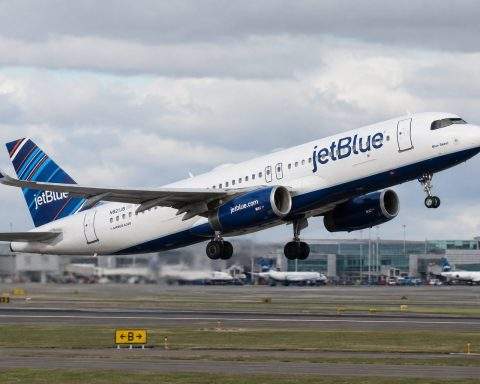

JetBlue (NASDAQ:JBLU) shares rise 6% as fares offset fuel costs, while debt load puts 2028 pressure
31 July 2026
3 mins read

JetBlue (NASDAQ:JBLU) shares rise 6% as fares offset fuel costs, while debt load puts 2028 pressure

NEW YORK, July 30, 2026, 17:54 EDT

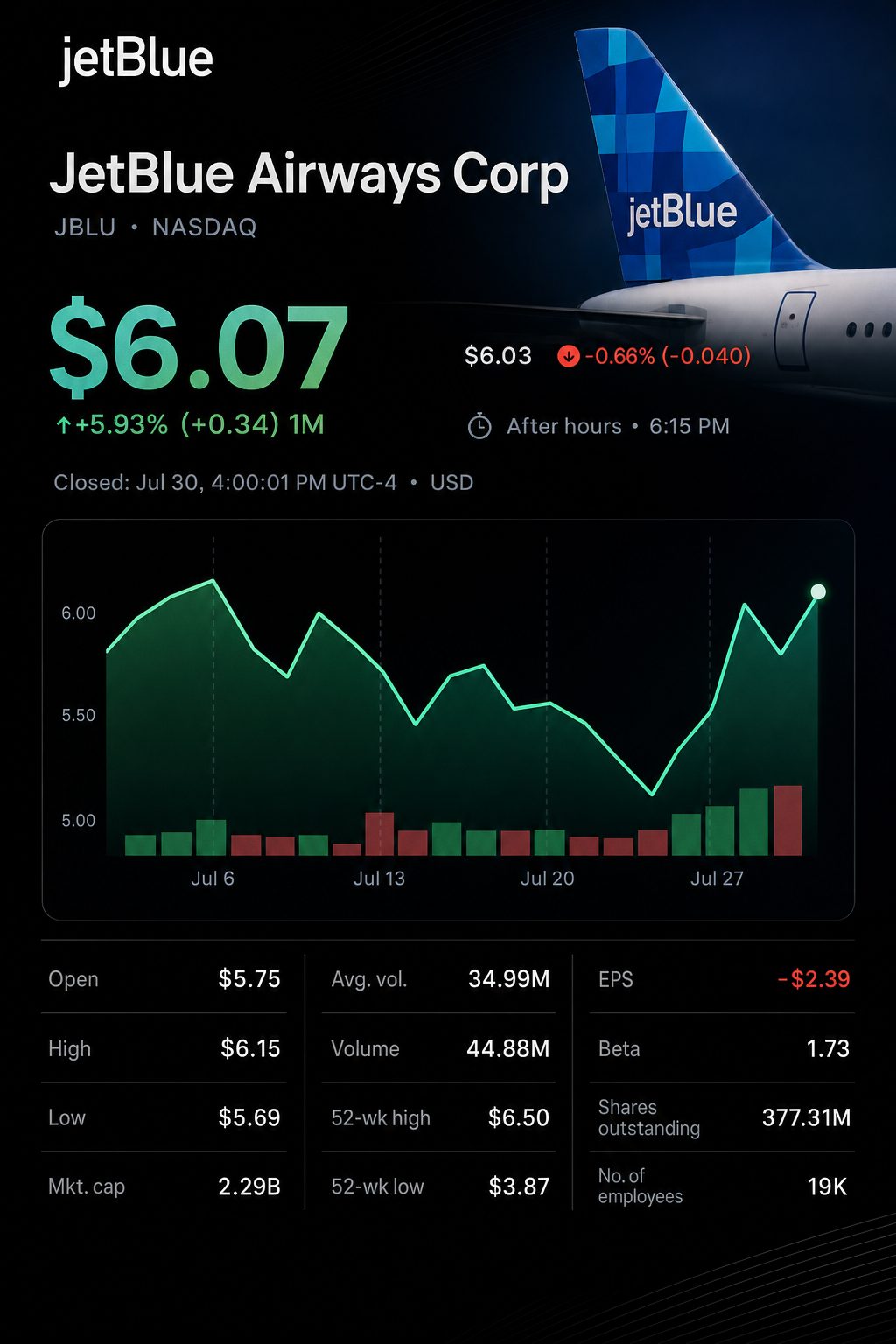
  • JetBlue shares closed at $6.07, rising 6.2% on Thursday and gaining 15.2% since July 24.
  • JetBlue reported a 14.5% increase in second-quarter revenue, while fuel costs surged 80.7%. The company posted a wider net loss of $247 million.
  • The valuation represents approximately 6.1 times the management’s minimum projected earnings for 2028. Basic net debt stands at nearly 2.8 times the company’s market capitalization.

JetBlue Airways Corporation stock finished regular U.S. trading at $6.07. Shares rose 6.2%, building on gains following its earnings release.
Stock chart for NASDAQ:JBLU

The development is significant as JetBlue increased ticket prices at a pace that exceeded its growth in capacity. The average fare climbed 8.6%, with revenue per available seat mile up 10.9%. Capacity expanded by only 3.2%.

The stock appears attractively valued. Priced at $6.07, shares trade at roughly 6.1 times the company’s projected minimum 2028 earnings. However, this outlook depends on jet fuel averaging $3 per gallon, while second-quarter fuel costs were $4.23.

Investor calculationValue
Current share price$6.07
2028 EPS goal from managementAt least $1.00
Example price-to-target-EPS multipleNo more than 6.1 times
Total reported debt$8.478 billion
Holdings in cash and investments$2.168 billion
Basic net debt$6.310 billion
Ratio: net debt to current market valueAbout 2.8 times
Fuel cost in Q2$4.23 per gallon
Fuel cost assumption for 2028 target$3.00 per gallon

The balance sheet offers another perspective. JetBlue disclosed liquidity of around $2.2 billion, in addition to an unused credit facility of $600 million. According to management, this should be adequate for no less than the next 12 months.

Fares climbed sharply. JetBlue saw a 5.1% rise in passenger traffic, and the mean ticket price hit $237.38. Overall revenue climbed $341 million.

Q2 operating measure20262025Change
Revenue$2.697 billion$2.356 billion+14.5%
Average fare$237.38$218.52+8.6%
Revenue per available seat mile15.71 cents14.17 cents+10.9%
Fuel expense$911 million$504 million+80.7%
Unit cost excluding fuel11.12 cents10.86 cents+2.4%
Operating profit/(loss)$(141) million$6 million$(147) million
Net profit/(loss)$(247) million$(74) millionLoss widened $173 million

Chief Financial Officer Ursula Hurley stated that “pricing will provide an offset if recent fuel price increases stick.” JetBlue reported an adjusted loss per share of 66 cents, which was less than the consensus estimate of a 71-cent loss. Reuters

The offset was not fully achieved. Revenue climbed by $341 million, but fuel costs grew by $407 million. Additional operating expenses contributed a further $81 million.

Reported Q2 bridgeYear-over-year effect
Revenue gain+$341 million
Increased fuel costs−$407 million
Rise in non-fuel operating costs−$81 million
Change in operating profit−$147 million
Revenue gain compared to rise in fuel costs84%
Company’s reported fuel-recapture metricNearly 50%

The 84% number comes from a basic accounting comparison. JetBlue’s separate measure, nearly 50%, factors in only pricing moves and relies on another methodology. It is calculated differently and should not be considered equivalent.

Higher-tier offerings contributed extra backing. Premium revenue per seat mile advanced by 13%. Revenue per seat mile in the main cabin was up 11%, and loyalty revenue also grew 13%. The number of new premium card sign-ups jumped almost 40%.

Raymond James Financial analyst Savanthi Syth described the 2028 goal as “ambitious.” She calculated that pretax earnings would need to rise by over $1.3 billion from 2026 levels. Reduced fuel costs account for roughly $400 million of that gap. Reuters

Management continues to expect strong pricing in the short term. The numbers shown are based on company projections, not analyst estimates.

Company outlookQ3 2026 estimateFull-year 2026 estimate
Capacity increase+3% to +6%+1.5% to +3.5%
Revenue per available seat mile+12.5% to +16.5%+10% to +12.5%
Unit cost, excluding fuel+2.5% to +4.5%+2% to +4%
Predicted fuel price$3.49 per gallon$3.49 per gallon
Adjusted operating marginNot disclosed−2% to −5%
Capital spendingRoughly $300 millionRoughly $850 million

Third-quarter unit revenue growth outpaces ex-fuel cost growth by eight percentage points at the minimum. Hurley projects a roughly 3.5-point increase in second-half operating margin compared to a year ago.

JetBlue surpassed bigger U.S. airlines on Thursday, with its 6.2% rise outperforming increases recorded by its most comparable listed rivals.

AirlineLatest priceThursday moveMarket value
JetBlue Airways Corporation $6.07up 6.2%$2.29 billion
American Airlines Group Inc. $15.43gained 3.9%$10.22 billion
United Airlines Holdings Inc. $123.56rose 3.4%$40.11 billion
Delta Air Lines Inc. $88.59added 2.7%$58.26 billion

The weekly performance has improved. JetBlue shares are up 15.2% since July 24, currently trading around 6.6% under their 52-week peak of $6.50.

The upcoming public fuel checkpoint is set for August 5, when the U.S. Energy Information Administration will release its weekly update. Gulf Coast jet-fuel spot prices declined to $3.582 per gallon on July 27, down from $3.708 on July 24. That wholesale index does not represent JetBlue’s comprehensive fuel cost.

Risks: Fuel costs could rebound sharply, and subdued demand may restrict the ability to raise fares further. JetBlue still has $5.47 billion in commitments for aircraft purchases. There is an additional $250 million in available aircraft-secured financing, while issuing new debt or equity might dilute existing shareholders.

The rally reflects anticipated advances rather than finalized outcomes. JetBlue is required to achieve its forecast for third-quarter revenue gains and keep non-fuel expenses under control. The $1 earnings objective remains a target for 2028, not an ongoing rate.

TS2 TECH • EXTENDED COVERAGE

Further analysis

What is the current trading level of JetBlue stock, and what does this valuation indicate?

JetBlue finished the July 30 session at $6.07, up around 6.2% for the day. The company’s market capitalization was close to $2.29 billion. Shares trade 6.6% below their 12-month peak of $6.50, while remaining approximately 57% higher than the $3.87 annual low. The current valuation factors in improved revenue performance, as well as significant turnaround and financing risks. The Wall Street Journal

Were JetBlue’s second-quarter results enough to support the recent rise in its share price?

Revenue climbed 14.5% to $2.697 billion, narrowly topping analyst projections. Adjusted loss came in at $0.66 per share, better than the anticipated $0.71 per share. Revenue per available seat mile grew 10.9%, while capacity edged up 3.2%. Net loss, however, deepened to $247 million from $74 million. Although the quarter surpassed market estimates, core profitability saw a marked decline. Reuters

Does passenger demand offer sufficient backing for JetBlue’s recovery?

Average ticket prices climbed 8.6%, with passenger numbers up 5.1%. The load factor gained 0.8 percentage points, reaching 82.7%. Premium revenue per seat mile was up about 13%. Revenue per seat mile in the main cabin rose 11%. JetBlue offset close to half of increased fuel expenses using pricing. Demand remains robust. It is still unclear if full cost recovery will be achieved. SEC

What do JetBlue’s revised projections for 2026 indicate regarding profitability?

JetBlue projects unit revenue will rise by 12.5% to 16.5% in the third quarter. Anticipated capacity growth is estimated at between 3% and 6%. For the full year, unit revenue is expected to increase by 10% to 12.5%. The company continues to guide for a negative adjusted operating margin, between minus 5% and minus 2%. The airline’s outlook is based on fuel costs averaging $3.49 per gallon. As a result, JetBlue is still expected to post an operating loss in 2026. JetBlue Investor Relations

What is the extent of JetBlue’s vulnerability to fluctuations in fuel prices?

JetBlue’s average fuel cost was $4.23 per gallon for the quarter, marking a 76.3% rise compared to the same period last year. Fuel costs rose by $407 million to $911 million. As of June 30, JetBlue had no open fuel hedges. A further 10% increase in fuel prices could add approximately $309 million annually to costs. This remains JetBlue’s main near-term forecasting risk. SEC

Is JetBlue’s liquidity sufficient to prevent financial trouble in the short term?

JetBlue ended June with $2.2 billion in unrestricted cash and investments, alongside access to a $600 million undrawn revolving credit line. Management expects these funds to meet obligations for no less than the next twelve months. Total debt was close to $8.48 billion. Both S&P and Fitch rated JetBlue at CCC+, reflecting elevated credit risk. The airline’s short-term liquidity is seen as sufficient, while the risk linked to longer-term refinancing remains considerable. SEC

Is JetBlue’s rate of cash burn recovering at a sufficient pace?

JetBlue reported an operating cash outflow of $35 million for the first half. Capital expenditure was $348 million, in addition to $27 million in aircraft deposits, pointing to an estimated $410 million in cash used prior to any financing. The airline forecasts capital spending of about $850 million in 2026. While improved margins in the second half could limit cash burn, achieving positive free cash flow is still uncertain. As a result, debt financing may continue to be significant. SEC

Is JetBlue’s 2028 earnings goal achievable through the JetForward program?

JetForward delivered about $470 million in cumulative incremental EBIT by June. Management aims for $850 million to $950 million annually by late 2027, with the 2028 target increasing to roughly $1.2 billion. JetBlue is also seeking earnings of no less than $1 per share in that period. At $6.07, this equates to approximately 6.1 times projected earnings. The target relies on sustained demand and fuel prices around $3 per gallon. Raymond James describes the necessary profit gains as ambitious. JetBlue Investor Relations

What do analysts identify as the current upside and downside potential for JetBlue shares?

Analyst price targets recently released extend from $4 at BofA up to $8 at Morgan Stanley. UBS maintains a $5 target, while BMO and Barclays offer projections of $6.75 and $7, respectively. This range suggests potential movement of around 34% down or 32% up relative to $6.07. Among analysts, current ratings consist of one Buy, ten Holds, and five Sells. Another analyst has issued an Underweight rating for JetBlue. The outlook for returns will largely be determined by fuel costs, margin performance, cash generation, and operational results. StockAnalysis

Shan Ahmed Khan is a senior markets reporter at TS2.tech, specializing in stocks, technology and macroeconomic trends. A graduate of the Lahore University of Management Sciences (LUMS), he previously worked in investment research and market analysis. His coverage helps readers understand the key developments influencing global financial markets and emerging industries.

LIVE • LATEST MARKET MOVES

Live updates

  1. Wood Mackenzie expects the global upstream oil and gas sector could deliver $495 billion in free cash flow by 2026, provided Brent crude maintains an average of $90 per barrel. The outlook underscores the major financial effect of continuing Middle East oil developments on the industry.
  2. Corteva, Inc. (CTVA) posted Q2 earnings of $2.3 per share, exceeding the consensus forecast of $2.24 by 2.68%. Revenue reached $6.38 billion, coming in 3.66% below estimates. The stock has risen 35% since the start of the year, outperforming the S&P 500. Corteva maintains a Zacks Rank #2 (Buy) and has seen positive revisions to earnings forecasts, ranking among the top 38% within the Agriculture - Operations sector.
  3. Camden (CPT) posted second-quarter funds from operations (FFO) of $1.71 per share, exceeding expectations by 2.40%, compared to $1.70 a year earlier. Quarterly revenue reached $387.15 million, outpacing consensus by 0.62%. Shares in Camden have advanced 11.5% year-to-date, while the company holds a current Zacks Rank #2 (Buy), pointing to possible near-term strength in the REIT and Equity Trust - Residential industry.
Australia Stock Market Today: ASX 200 Ends at Five-Week High as Banks Offset Tech Rout
Previous Story

ASX 200 Pre-Open: Tech Rally Eyes 3% July Rise—Watch for Breadth as Trading Set to Begin

Tempus AI Falls in After-Hours Despite Topping Q2 Estimates; Second-Half Outlook in Focus
Next Story

Tempus AI Falls in After-Hours Despite Topping Q2 Estimates; Second-Half Outlook in Focus