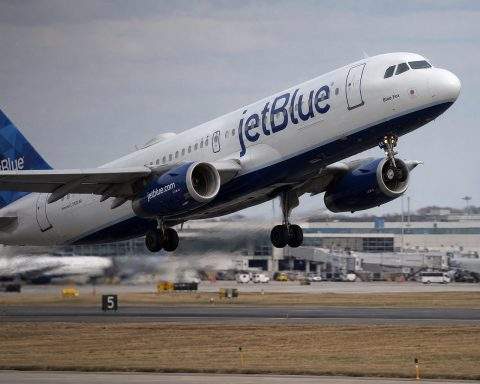
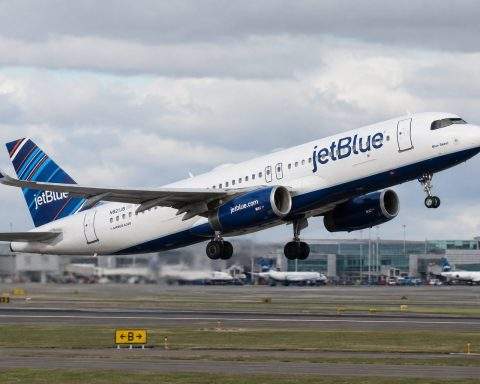
NEW YORK, July 29, 2026, 05:02 EDT JetBlue’s stock remained up 10% on Tuesday after the company raised its guidance, citing a lower fuel cost forecast that offset broader sector concerns.
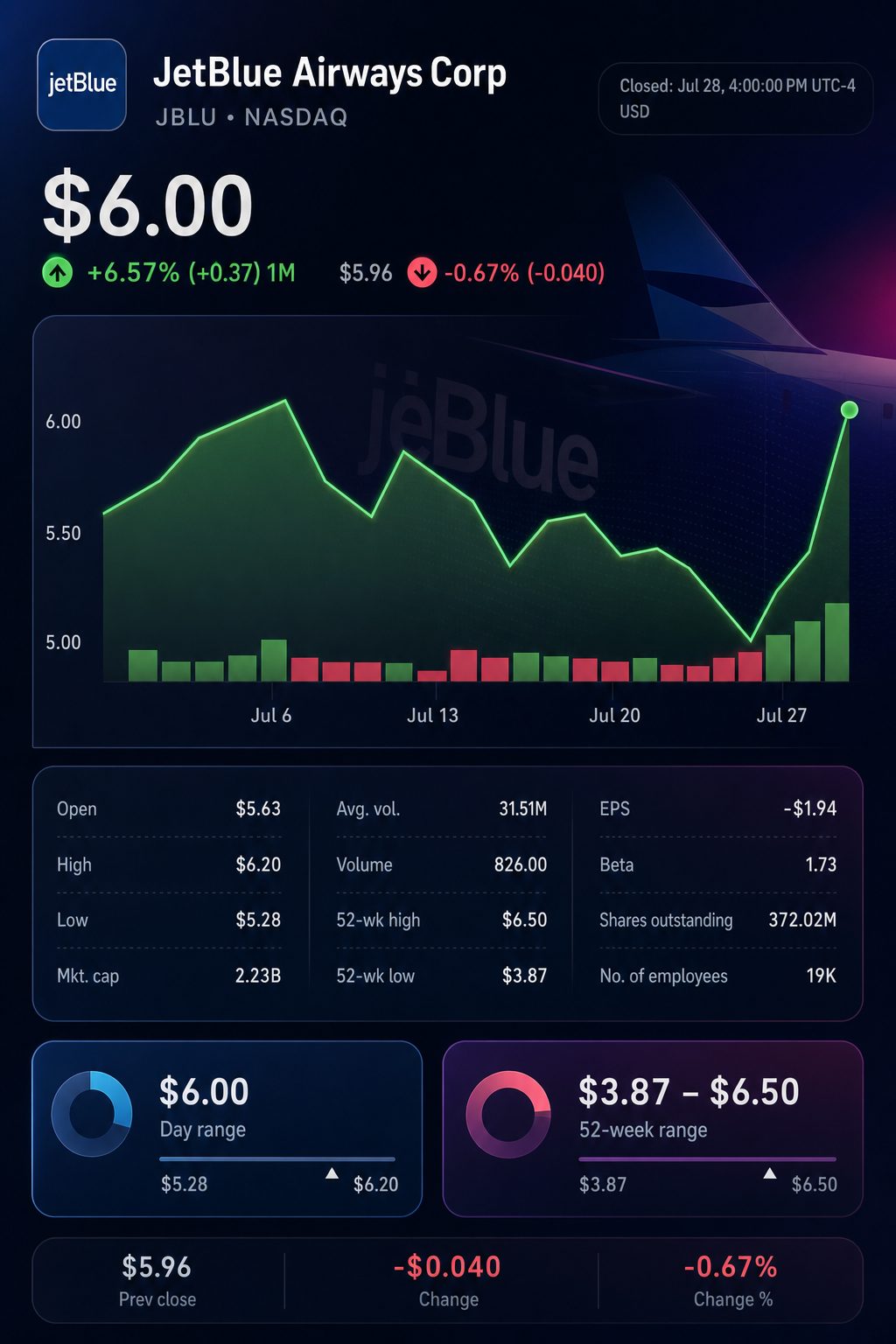
JetBlue Airways Corporation NASDAQ:JBLU last traded at $6.00 ahead of Wednesday’s market open. Shares surged 10.5% on Tuesday, supported by robust revenue performance and reinstated guidance. The main U.S. market session was shut, but premarket trading continued.
The steep shift is based on a straightforward fuel estimate. JetBlue projects third-quarter fuel costs at $3.49 per gallon, which is 74 cents less than in the previous quarter.
With second-quarter consumption at 215 million gallons, the gap amounts to roughly $159 million. This example of potential saving is greater than JetBlue’s $141 million operating loss for the quarter. The calculation is not official guidance; both fuel consumption and market prices are subject to change.
This constitutes the trade.
JetBlue’s disclosed unit economics help explain the movement in its share price. Figures for the third quarter are initial projections; midpoint figures are derived from guidance provided by the company.
Metric
Q2 2026 actual
Q3 2026 preliminary estimate
Fuel cost per gallon
$4.23
$3.49
Year-on-year RASM increase
10.9%
12.5%-16.5%
CASM excluding fuel, annual change
2.4%
2.5%-4.5%
Capacity, compared to prior year
3.2%
3.0%-6.0%
RASM growth minus ex-fuel CASM rise
8.5 points
11.0 points at midpoint
Revenue per available seat mile (RASM) increased by 10.9%. Excluding fuel, unit costs climbed 2.4%, resulting in a gap of 8.5 points.
The midpoint gap for the third quarter has increased to 11 percentage points. This could lead to quicker operating leverage if fuel trends align with the curve.
The average fare climbed 8.6% to $237.38. Capacity was up 3.2%, and load factor advanced 0.8 point to 82.7%.
JetBlue managed to offset almost 50% of increased fuel expenses, surpassing its previous projection of 30%-40%. Chief Financial Officer Ursula Hurley cited the carrier’s pricing strength. “Given strong customer demand and our ability to adjust capacity, we believe pricing will provide an offset if recent fuel price increases stick.” Reuters
Revenue rose 14.5% to $2.697 billion. Fuel costs, however, climbed by $407 million to reach $911 million. Operating expenses outside of fuel grew by an additional $103 million.
As a result, operating results shifted from a $6 million profit to a $141 million loss. The net loss increased to $247 million, compared to a $74 million loss previously.
The adjusted loss came to 66 cents per share, surpassing analyst forecasts by five cents.
Management has set a goal of at least $1 in earnings per share for 2028. This projection is based on $3 fuel prices and sustained robust demand. With shares at $6, the price represents a multiple of six times the earnings target, below typical consensus.
Raymond James Financial NYSE:RJF analyst Savanthi Syth described the target as “ambitious.” According to Syth, pretax profit would need to rise by over $1.3 billion compared to 2026, with just $400 million of that gain expected to result from reduced fuel costs. Reuters
On Tuesday, JetBlue led gains among airlines. Delta Air Lines NYSE:DAL climbed 3.12%, United Airlines Holdings NASDAQ:UAL increased 2.65%, and Southwest Airlines NYSE:LUV was up 2.05%.
Risks: The fuel projection is based on the July 10 forward curve. JetBlue reported $2.2 billion in liquidity and access to a $600 million undrawn credit facility, while total debt stood at $8.478 billion. The company posted a working-capital shortfall of $1.4 billion. Executives indicated additional aircraft financing could be required if fuel prices remain high.
Upcoming third-quarter bookings and fuel prices will provide the next key test. Should both remain in line with guidance, the loss driven by fuel could shrink swiftly. However, if either falls short, achieving the 2028 target will stay out of reach.
What led to the rise in JetBlue stock following the most recent earnings release?
JBLU ended July 28 at $6.00, advancing 10.5% after its earnings report. The increase came as the airline posted an adjusted loss that was five cents narrower than analyst estimates. Revenue slightly surpassed projections, and management restored full-year guidance. Executives also introduced a 2028 earnings-per-share goal of at least $1.00. The move drew a positive response, despite ongoing uncertainty related to fuel costs and leverage.
Has JetBlue’s business in the second quarter truly shown improvement?
Operating revenue increased by 14.5% to $2.697 billion, slightly surpassing the $2.68 billion market view. RASM climbed 10.9%, while overall system capacity grew by just 3.2%. Net loss deepened to $247 million, compared to $74 million previously. Operating margin fell to negative 5.2%, down from positive 0.3%. Adjusted loss per share was $0.66, better than analysts’ projection of $0.71.
Is JetBlue likely to sustain its pricing strength in the third quarter?
Management projects third-quarter RASM growth of 12.5% to 16.5% compared to the previous year. Capacity is expected to increase by 3% to 6%, positioning revenue expansion well ahead. For the full year, RASM is seen rising 10% to 12.5%. The second-quarter average fare rose 8.6% to $237.38, while load factor gained 0.8 points to reach 82.7%. The forecast relies on strong leisure travel demand and sustained pricing discipline.
To what extent do jet-fuel prices continue to pose a risk?
JetBlue reported an average fuel price of $4.23 per gallon for the second quarter, up 76% from a year earlier. JetBlue’s quarterly aircraft-fuel spending rose by $407 million to $911 million. Higher ticket prices recouped nearly half of the added fuel expenses, surpassing prior management expectations. Guidance for the third quarter and full year is now based on $3.49 per gallon. The company’s 2028 EPS outlook is tied to an average fuel price of $3.00 per gallon. Fuel continues to be the key variable.
Is JetBlue's liquidity sufficient to prevent the need for further capital raising?
JetBlue reported $2.2 billion in unrestricted liquidity as of June 30, alongside a fully available $600 million revolving facility with Citibank. The airline’s total debt amounted to $8.478 billion, compared with $1.587 billion in stockholders’ equity. According to management, these resources are expected to be sufficient for at least the next twelve months. JetBlue can also draw up to $250 million more through its April aircraft-backed facility, pending agreed terms. Credit ratings at CCC+ from both S&P and Fitch indicate considerable credit risk.
Is JetBlue’s goal of achieving a minimum of $1.00 EPS in 2028 believable?
Management is aiming for at least $1.00 in earnings per share by 2028, based on specific assumptions. These include ongoing demand levels and an average fuel price of about $3.00 per gallon. JetForward is projected to contribute $850 million to $950 million in additional annual EBIT by the end of 2027. For 2028, the company forecasts roughly $1.2 billion in annual incremental EBIT. By June, cumulative incremental EBIT had reached $470 million. Raymond James estimates pretax profit will need to rise by more than $1.3 billion compared to 2026, with only an estimated $400 million of that improvement resulting from lower fuel costs.
Is JetBlue making sufficient progress in reducing its controllable costs?
CASM excluding fuel increased by just 2.4% in the second quarter, outperforming the revised midpoint of guidance by 1.6 percentage points. Overall CASM advanced 17% as higher fuel expenses outweighed operational efficiency gains. Third-quarter CASM excluding fuel is projected to rise between 2.5% and 4.5%. Annual interest expense is expected to near $590 million, with capital expenditures around $850 million. Cost management is showing gains, though fixed financing commitments remain substantial.
Could Spirit's departure, along with the BlueFirst and United Blue Sky partnership, provide potential gains?
Revenue per available seat mile (RASM) in Fort Lauderdale climbed 11%, even as capacity expanded by nearly 40%. JetBlue plans to operate over 150 daily flights from the city during the winter season. The carrier has offered $58.5 million to acquire Spirit’s slots at LaGuardia, which would enable up to a dozen daily round trips. The transaction remains subject to regulatory approval and standard closing conditions. BlueFirst product sales are scheduled to launch in the fall with backing from newly structured fares. The Blue Sky arrangement already allows bookings and loyalty rewards between JetBlue and United. No individual earnings guidance was issued for either project.
Jerzy Lewandowski is a senior markets editor at TS2.tech. His coverage ranges from stocks and semiconductors to AI and the broader global markets. He studied economics at the University of Warsaw and worked in investment analysis before becoming a financial journalist. Follow Jerzy Lewandowski on Google News.
Surprising starts and permits data can impact homebuilders, mortgage-sensitive stocks, Treasury yields, and the dollar if results deviate significantly from consensus estimates.
#02
Home Depot Q2
The results and outlook provide key insights into housing turnover, renovation demand, professional customer activity, and U.S. discretionary spending.
#03
09:15 ET industrial production
A robust or disappointing factory or utilities report can shift expectations for economic growth, cyclical stocks, bond yields, and the Federal Reserve’s policy direction.