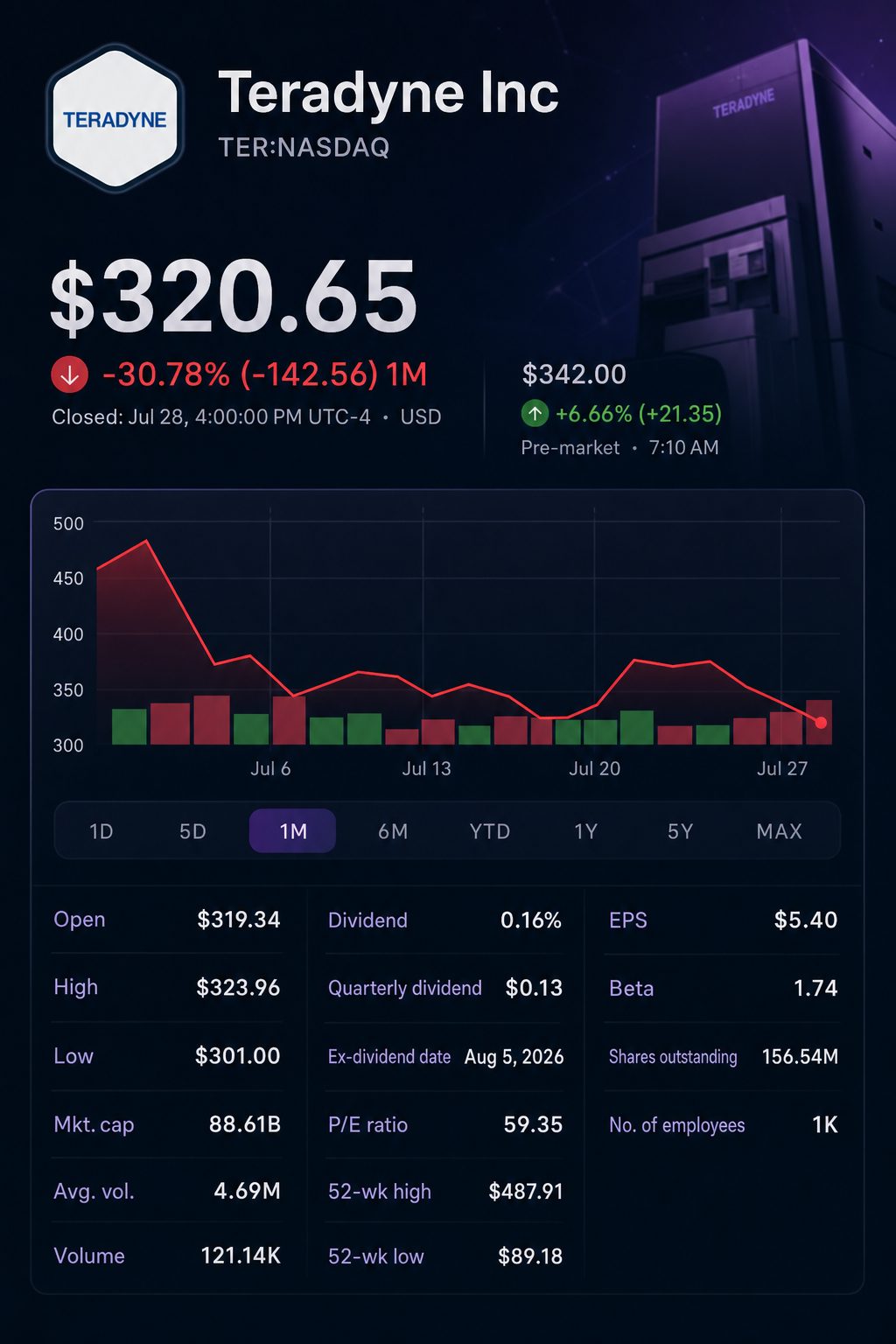
Shares of Teradyne Inc. NASDAQ:TER rose 7.0% to $343.02 ahead of Wednesday’s session open.
The midpoint for preliminary Q3 revenue was roughly 20% higher than the LSEG consensus estimate.
Adjusted operating margin in the second quarter decreased by 380 basis points from the previous quarter.
Shares of Teradyne climbed 7.0% to $343.02 during premarket trade on Wednesday after the semiconductor test equipment company posted third-quarter guidance well ahead of analysts’ expectations. Nasdaq trading opens at 9:30 a.m. ET.
There is robust demand. The upcoming challenge for investors is profit leverage.
At the middle of its initial outlook, third-quarter revenue is expected to decrease 5.9% compared with the record set in Q2. Adjusted earnings are projected to decline by 19.0%. The sharper drop suggests a less favourable mix or increased operating expenses.
Measure
Reported or preliminary midpoint
LSEG consensus
Above consensus
Q2 revenue
$1.329 billion
$1.220 billion
8.9%
Q2 adjusted EPS
$2.47
$2.09
18.2%
Q3 revenue
$1.250 billion
$1.040 billion
20.2%
Q3 adjusted EPS
$2.00
$1.53
30.7%
*Third-quarter numbers represent preliminary guidance midpoints from the company, rather than finalized results. LSEG forecasts are as reported to Reuters. Percentage changes have been calculated based on those numbers.
Revenue in the second quarter surged to $1.329 billion, more than twice the year-ago result. Adjusted earnings per share climbed to $2.47 from $0.57 in the prior-year period. Semiconductor Test contributed $1.122 billion, representing 84% of total sales.
Chief Executive Greg Smith said, “Our Q3 guidance reflects robust AI-related demand.” He attributed sustained growth ahead to increased investment in wafer-fabrication equipment. Teradyne, Inc.
Margins eased prior to the anticipated deceleration. The adjusted operating margin dropped to 33.7% from 37.5% in the previous quarter. Revenue increased by 3.6% on a sequential basis. Gross margin declined by 110 basis points to 59.8%.
Most of the additional sales during the quarter came from the smaller business units. Product Test and Robotics together accounted for $36 million out of the $47 million sequential gain, representing roughly 77%, according to company figures.
Semiconductor Test revenue increased by just $11 million sequentially but continued to be Teradyne’s primary profits driver. As a result, investors require more diversified growth that avoids further margin erosion.
On Wednesday, Advantest Corp. TYO:6857, a peer company, confirmed the demand trend. The Japanese firm reported a 38.7% year-on-year rise in fiscal first-quarter test-system sales, driven by AI processors, high-performance computing and memory-test requirements.
Advantest increased its full-year sales outlook to 1.714 trillion yen, up from a prior forecast of 1.420 trillion yen. The concurrent momentum indicates the cycle is not confined to a single supplier.
Teradyne was under scrutiny ahead of its earnings release. The stock dropped 13.2% from July 22 until Tuesday’s close. Shares declined for a third session on Tuesday, settling at $320.65.
Despite recovering in premarket trading, Teradyne was still down 7.2% from its July 22 close. The stock had earlier surged as much as 13.5% after hours.
The management earnings call is scheduled for 8:30 a.m. ET. The Federal Reserve’s decision, also set for Wednesday, could influence risk sentiment. This week’s major technology sector results will gauge market optimism regarding AI-related capital investments.
Major U.S. futures showed mixed movement ahead of the Fed’s decision. Futures on the S&P 500 and Nasdaq ticked up. Chip shares continued to show volatility.
Risks continue to be concentrated. Semiconductor Test accounted for 84% of revenue in Q2. Delays from customers, supply issues, and export restrictions may impact results at short notice. With reduced liquidity, premarket quotes are also more volatile.
The report offers some relief over short-term demand issues but leaves the margin uncertainty unresolved. Wednesday’s call will need to clarify the reasons for earnings declining at a sharper rate than sales.
What is causing Teradyne shares to fluctuate significantly ahead of Wednesday’s market open?
Teradyne ended Tuesday’s session at $320.65 after a 4.22% decline in regular hours. Early indications Wednesday showed shares in the $343–$345 range, representing a gain of about 7% over Tuesday’s close. Shares had jumped to nearly $367 post-market before relinquishing some of those gains. The move followed a major earnings beat and a much stronger outlook for the third quarter. Premarket trading volume is still light, and prices may fluctuate ahead of the opening bell.
What was the size of Teradyne’s earnings outperformance in the second quarter?
Revenue totaled $1.329 billion, a jump of 104% from $651.8 million in the year-ago period. Analysts surveyed by Wall Street had expected about $1.22 billion, making for a roughly 9% beat. Adjusted earnings per share stood at $2.47, ahead of the $2.09 consensus. GAAP net income rose to $374.5 million from $78.4 million. Scale was a key factor.
Did third-quarter guidance provide enough support for the rally?
Management projects third-quarter revenue between $1.20 billion and $1.30 billion, with the midpoint at $1.25 billion. FactSet listed a consensus estimate of $1.06 billion, so the midpoint stands roughly 18% above that figure. The company’s adjusted EPS forecast ranges from $1.85 to $2.15, compared to analysts’ $1.56 expectation. At the midpoints, revenue is set to decline 6% from the prior quarter, with adjusted EPS down 19%. Still, compared to Q3 2025, revenue at the midpoint would increase by about 63%.
What division was the main driver behind Teradyne’s growth?
Semiconductor Test posted $1.122 billion, accounting for 84% of total revenue for the quarter. The segment jumped 128% from $492 million in the same period a year earlier. Product Test increased 26% to $107 million, and Robotics climbed 33% to $100 million. All segments recorded growth. Management pointed to record Memory sales driven by DRAM and NAND final testing. Despite gains, semiconductor testing demand remains the primary driver of earnings.
Is demand for AI sufficiently widespread, or is growth focused too narrowly?
Teradyne reported that about 70% of its first-quarter revenue was driven by AI demand. The company’s second-quarter announcement did not disclose a revised AI proportion. Teradyne highlighted strong demand related to AI and record Memory revenue in both DRAM and NAND. This concentration adds potential gains but also increases exposure to risks tied to customer ramp-ups and spending patterns. Management’s outlook for 2027 partially factors in further growth in wafer-fabrication equipment spending. The company’s call is expected to provide more details on how long elevated demand may last and the range of customers involved.
Is growth in margins and cash flow matching revenue increases?
GAAP gross margin stood at 59.8%, up from 57.2% in the prior-year period but down compared to 60.9% in the previous quarter. GAAP operating margin came in at 32.9%, a sharp rise from 13.9% a year ago. Operating cash flow amounted to $469.1 million, and capital expenditures were $90.7 million, resulting in simple quarterly free cash flow of about $378.4 million. This was calculated by deducting capital expenditures from operating cash flow. Total cash and marketable securities were approximately $517 million, with no short-term debt reported.
Is the Robotics division starting to see progress?
Robotics revenue climbed to $100 million, representing a 33% increase from $75 million a year ago. Sequentially, it grew 10% from $91 million recorded in the first quarter. Robotics contributed 7.5% of total revenue for the second quarter. This signals encouraging progress, but Robotics has yet to become a significant driver of overall earnings. The company did not include Robotics margin or backlog data in the release. Such figures are notable since last year’s restructuring impacted about 150 employees.
Does Teradyne maintain a stretched valuation post-earnings beat?
Teradyne finished Tuesday with a market capitalization close to $50.5 billion. The most recent four quarters delivered approximately $7.29 in GAAP diluted EPS. This gave the closing share price a trailing GAAP price-to-earnings ratio of around 44. In premarket trade near $344, that ratio climbs to about 47. Shares remained almost 30% under their 52-week peak of $487.91. Market expectations are elevated.
What factors might influence Teradyne shares during the remainder of the week?
The initial catalyst is the July 29 call, set for 8:30 Eastern. Investors seek segment-level guidance, with a particular focus on Memory, compute, and Robotics demand trends. They are also looking for signs that third-quarter momentum can persist into 2027. Key areas to monitor include customer concentration, export controls, tariffs, and timing for program ramps. Management is expected to provide further details, which could prompt analyst estimate changes—potentially having a bigger impact than any headline earnings beat. Broader chip market swings may intensify any reaction, though the company’s guidance remains the primary focus.
Khadija Saeed is a financial markets reporter at TS2.tech. Her coverage ranges from stocks and technology to emerging industries and developments across global markets. She studied economics and finance at the London School of Economics and worked in market research before becoming a financial journalist. Follow Khadija Saeed on Google News.
Surprising starts and permits data can impact homebuilders, mortgage-sensitive stocks, Treasury yields, and the dollar if results deviate significantly from consensus estimates.
#02
Home Depot Q2
The results and outlook provide key insights into housing turnover, renovation demand, professional customer activity, and U.S. discretionary spending.
#03
09:15 ET industrial production
A robust or disappointing factory or utilities report can shift expectations for economic growth, cyclical stocks, bond yields, and the Federal Reserve’s policy direction.