
NORTH READING, Massachusetts, April 29, 2026, 12:04 EDT
- Teradyne dropped roughly 16% by midday, despite the chip-testing supplier delivering record first-quarter revenue.
- Management painted a gloomier outlook for the upcoming quarter, guiding for both revenue and adjusted earnings to come in below the numbers just posted.
- About 70% of Teradyne’s revenue came from AI-related demand, tying the company’s fortunes closely to data-center spending—and to sharp shifts in customer buying patterns.
Teradyne shares slid Wednesday, pressured by the company’s outlook for lower revenue and profit in the second quarter—even after a record-breaking first quarter, lifted by strong artificial-intelligence demand.
The stock slid to $319.10, a drop of $61.03 from Tuesday’s close, after hitting a session low of $307.31. That retreat erased some of the sharp gains shares booked in 2026 and reignited debate about just how sustainable the AI testing boom really is.
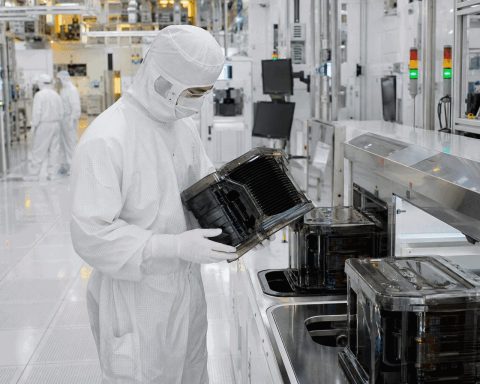
Timing is key here. Teradyne stands out as a direct listed bet on AI chip testing, a niche segment within the semiconductor supply chain that doesn’t always get attention. Its automated test equipment—ATE for short—handles the job of verifying chips before they leave the factory. As AI processors, memory, and networking chips ramp up in complexity, those machines are working overtime.
Teradyne’s first-quarter revenue clocked in at $1.282 billion, an 87% jump year-over-year. Semiconductor Test was the standout, generating $1.111 billion. Robotics contributed $91 million; Product Test, $80 million. On a GAAP basis, net income hit $398.9 million, translating to $2.53 per diluted share. Excluding certain acquisition, restructuring and tax effects, non-GAAP earnings landed at $2.56 per share.
Chief Executive Greg Smith said the quarter broke all previous records, with “approximately 70%” of revenue linked to AI demand—an outcome he attributes to Teradyne’s “wafer to AI data center strategy.” In his prepared remarks, Smith credited “durable AI demand drivers” for the new peak, but cautioned that big customer programs could still make growth “lumpy.” Teradyne, Inc.
Teradyne is projecting second-quarter revenue in the range of $1.15 billion to $1.25 billion. Adjusted earnings are expected to fall between $1.86 and $2.15 a share, down from the $2.56 posted in the first quarter. The outlook knocked shares down more than 8% in after-hours action late Tuesday, according to Reuters, with losses accelerating in Wednesday’s regular session.
Teradyne CFO Michelle Turner called the first quarter “an exceptional quarter” on the call, and pointed to the second-quarter midpoint, which still signals roughly 84% revenue growth from a year ago. For gross margins, Turner projected a range of 58% to 59%—off from the first quarter’s 60.9%—as the company expects peak volumes and certain one-off gains to level out. Investing.com
Teradyne is vying with Advantest and Cohu for a slice of AI-fueled semiconductor test demand, its latest annual filing shows. That puts extra weight on the guidance: investors want to know if AI spending will lift the entire test-equipment sector or if Teradyne’s first quarter was just a short-lived high.
Analysts hadn’t thrown in the towel on the long-term outlook just yet. Over at Seeking Alpha, UBS stuck to its Buy call on Teradyne, price target steady at $440, even as analysts chewed over how guidance and gross margin were shaping investor sentiment.
There’s a risk here. Teradyne’s growth leans harder on AI data-center expansion and a handful of massive chip projects. Should hyperscalers cut back on spending, or if supply chain hiccups push out customer timelines—or if demand swings back to the softer mobile and industrial segments—revenue could turn choppy, even with solid longer-term prospects for the market.
Teradyne is leaning on acquisitions to sharpen its test software edge. Earlier this April, it picked up TestInsight, which makes software for semiconductor test development, validation and conversion. Management touted the deal as a way to speed up time-to-market for AI and data-center chips. That’s a strategic play, but not what moved the stock Wednesday. The real driver: a solid quarter, though investors weren’t satisfied—they wanted a stronger outlook for the next.