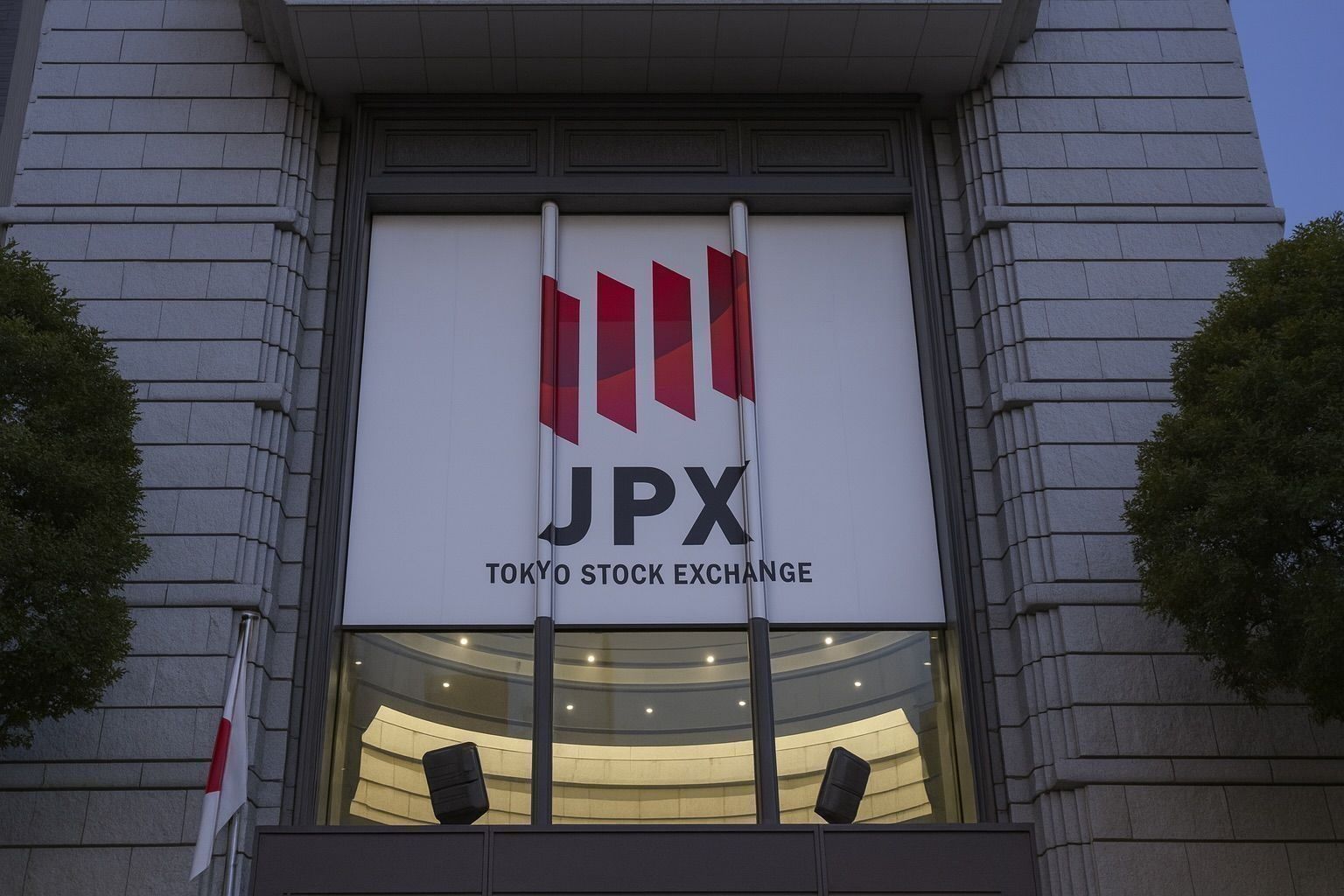
Tokyo heads into Tuesday’s session with a lot on its plate: a powerful overnight earthquake in the northeast, a deeper‑than‑expected GDP slump, growing expectations of a Bank of Japan rate hike, and global markets on edge ahead of a likely U.S. Federal Reserve cut.
Here’s what investors need to know before the Tokyo Stock Exchange opens at 9:00 a.m. local time today. StockAnalysis
1. Where Tokyo left off: Nikkei heavy near 50,600
On Monday, Japan’s Nikkei 225 finished at 50,581.94, up about 0.2%, while the broader Topix climbed roughly 0.7% to 3,384.31. The Economic Times+1
The tone, however, was more cautious than the index gains suggest:
- A rebound in real estate stocks, which jumped around 3.2%, helped offset weakness elsewhere.
- Bank shares slipped about 0.6%, as investors reassessed how far and how fast domestic rates might rise. The Economic Times
- Heavyweight SoftBank Group fell about 3.3%, trimming some 120+ points off the Nikkei’s advance, while Fast Retailing (Uniqlo’s owner) also declined and knocked dozens of points from the benchmark. The Economic Times+1
Strategists quoted in Reuters noted that the Nikkei still “feels heavy” after touching a record high above 52,600 in early November, as investors worry that AI‑related valuations have run too far and that high‑tech names remain vulnerable to further profit‑taking. The Economic Times
In short: Tokyo’s main indices are near record territory, but breadth and sentiment are more fragile than the headline level implies.
2. Overnight shock: 7.5 quake in Japan’s northeast
The biggest new factor for Tuesday’s open is a powerful 7.5‑magnitude earthquake that struck off the coast of Aomori prefecture at 11:15 p.m. local time on Monday. Reuters
Key points so far:
- Authorities initially warned of tsunami waves up to 3 meters for parts of Hokkaido, Aomori and Iwate, ordering around 90,000 people to evacuate.
- Observed tsunamis so far have been in the 20–70 cm range, and warnings have been downgraded to advisories, indicating more limited flooding risk. Reuters
- Prime Minister Sanae Takaichi said early Tuesday that only a small number of injuries had been confirmed, with no immediate reports of large‑scale damage. Reuters
- No irregularities have been reported at nuclear facilities operated by Tohoku Electric Power and Hokkaido Electric Power, though some households experienced temporary power outages. East Japan Railway suspended some services in the affected region. Reuters
The yen briefly weakened, with the dollar touching around ¥155.8 in the initial reaction, before stabilising. Reuters
Likely market impact
At the open, investors are likely to focus on:
- Insurers (e.g., Tokio Marine, MS&AD) for any early estimates of claims.
- Rail and infrastructure names, especially East Japan Railway and construction firms, as damage assessments become clearer.
- Utilities like Tohoku Electric and Hokkaido Electric, given their proximity to the affected region.
For now, the quake looks material for sentiment but not yet systemic. The bigger economic risk would come if aftershocks or new quakes trigger more serious disruption; Japan’s Meteorological Agency has warned that stronger tremors are possible in the coming days, which may keep a risk premium in domestic cyclicals. Reuters
3. Nikkei futures hint at a softer open
Early Tuesday, Nikkei 225 futures were trading around 50,325, down roughly 0.35% from the previous settlement. The overnight range has been 50,220–50,785, with an opening trade near 50,500. Nikkei Futures
That suggests:
- A modest pullback at the cash open versus Monday’s close around 50,582.
- Markets digesting both the earthquake headlines and global risk‑off cues ahead of the Fed decision.
Futures still indicate that the 50,000 level remains strong psychological support, echoing recent analysis that the Nikkei is consolidating around that round number even as yen weakness bolsters exporter earnings. Forex+1
4. Macro shock: Q3 GDP revised sharply lower
Fresh data released Monday showed that Japan’s economy shrank more than first reported in Q3:
- Annualised GDP: –2.3% (revised from –1.8%), the worst since Q3 2023.
- Quarter‑on‑quarter: –0.6%, versus an initial –0.4%. Reuters+1
Under the hood:
- Private consumption was nudged up to +0.2% q/q, helped by spending on services like dining out.
- Capital expenditure swung sharply, now showing a 0.2% decline instead of a previously‑reported 1.0% rise, reflecting weaker investment momentum.
- External demand knocked about 0.2 percentage points off growth, as exports took a hit from the new baseline 15% U.S. tariff on most Japanese imports, particularly autos. Reuters+2AP News+2
- Housing investment fell around 8% amid tougher energy‑efficiency rules, though the contraction was revised slightly smaller than initially reported. Reuters+1
Economists quoted by Reuters and AP describe the slump as uncomfortable but probably temporary, expecting a modest rebound in Q4 led by consumption. Crucially, most strategists do not think this revision is enough to derail the Bank of Japan’s path toward higher rates. Reuters+1
5. BoJ: December hike almost priced in
Markets now see the December 18–19 Bank of Japan meeting as pivotal.
According to government sources cited by Reuters, the BoJ is likely to raise its policy rate from 0.5% to 0.75% this month, and Prime Minister Takaichi’s administration is prepared to tolerate the move. Reuters
Key takeaways:
- Governor Kazuo Ueda has signalled that a December hike is firmly “on the table,” pushing the 10‑year JGB yield to around 1.93–1.96%, its highest level in roughly 18 years. Nippon+1
- Market pricing implies roughly an 80% chance of a hike this month, with investors now focused on how quickly rates could ultimately approach Japan’s estimated “neutral” level of 1–2.5%. Reuters
- Economists argue that strong wage‑growth expectations for spring 2026 give the BoJ cover to keep normalising despite the Q3 GDP setback. Reuters+1
For equity traders, this mix is tricky:
- Higher domestic yields improve bank net interest margins but pressure highly leveraged sectors and rate‑sensitive growth stocks.
- A firmer yen, if and when it materialises, would hurt exporters but could relieve political pressure over imported inflation.
Expect banks, real estate investment trusts, and domestic cyclicals to trade as a BoJ‑sensitive basket into the meeting.
6. Yen still very weak – and seen as a “ticking time bomb”
Despite the earthquake wobble and BoJ speculation, the yen remains near multi‑decade lows:
- The dollar has been trading in the ¥155–156 range in recent sessions, with the latest move up to around ¥155.8following the quake. Reuters+2Trading Economics+2
Recent analyses highlight a few themes:
- A Reuters column describes the yen’s current level as historically extreme, warning that heavy carry‑trade positioning leaves room for a sudden, violent rebound if the BoJ turns more hawkish or the Fed eases faster. Reuters
- Bloomberg reporting shows speculative positioning remains heavily short yen, even after BoJ officials began flagging a December hike; Citi’s sentiment gauges still show deeply negative yen sentiment, while major banks warn the currency could overshoot in either direction. Bloomberg
- FX strategists at multiple firms note that USD/JPY has stalled near resistance, but until the policy gap narrows, the yen is likely to stay under pressure. FXStreet+1
For the Tokyo stock market, this means:
- The weak yen continues to support exporters (autos, machinery, electronics) at today’s open.
- But the risk of a rapid yen spike later in December is a key overhang, particularly for stocks most leveraged to overseas earnings.
7. Global backdrop: Wall Street edges lower ahead of Fed cut
U.S. equities dipped on Monday, extending a mild pullback from record levels:
- The S&P 500 fell about 0.3% to around 6,846.
- The Dow Jones slipped roughly 0.4% to about 47,739.
- The Nasdaq Composite eased 0.1% to around 23,546. AP News+1
The moves were modest, but the message was clear:
- After a powerful rally, investors are locking in profits and de‑risking ahead of this week’s central‑bank storm.
- According to CME FedWatch data cited by Benzinga and Reuters, markets are pricing roughly an 87–90% chance that the Fed will cut rates by 25 bps at its December 9–10 meeting. Benzinga+1
- Economists at Nomura, J.P. Morgan and others have all shifted to call for a December cut, with some warning of a potential “hawkish cut” if Chair Jerome Powell stresses caution about further easing. Reuters+1
From Tokyo’s perspective:
- A dovish Fed would support global risk assets and could narrow the U.S.–Japan policy gap, eventually favouring a stronger yen.
- A more hawkish‑sounding cut (or any hint of delay) could keep U.S. yields elevated, prolonging yen weakness but also tightening financial conditions globally.
8. Today’s data and event calendar
Japan
- Machinery / machine‑tool orders (November)
Latest figures show machine tool orders up 16.8% year‑on‑year in November, matching October’s pace and marking a sharp acceleration from single‑digit growth earlier in the year. Investing.com+2Investing.com UK+2- This suggests solid capital‑goods demand despite the Q3 GDP slump, a positive sign for industrial names and factory automation plays.
- JGB auctions
The Ministry of Finance is scheduled to auction six‑month Treasury discount bills and a 5‑year JGB today, offering another test of investors’ appetite at higher yields. Ministry of Finance Japan
Global
- Australia: The RBA rate decision arrives during the Asian session; IC Markets notes it is widely expected to hold rates after three cuts this year. IC Markets+1
- BoJ Governor Ueda’s speech in London (later Tuesday) is flagged as a potential volatility trigger for the yen, especially if he offers more colour on the neutral rate or December hike odds. IC Markets
- U.S. data: NFIB small‑business optimism and JOLTS job‑openings numbers over the next 24 hours may influence U.S. yields and risk sentiment into the New York session. Benzinga+1
9. Stock and sector stories to watch in Tokyo
9.1. Earthquake‑sensitive names
- Insurers – Any emerging damage estimates could move shares like Tokio Marine and MS&AD, as markets gauge the size of potential claims.
- Rail & transport – East Japan Railway temporarily suspended some services in the northeast; investors will watch for disruption to operations or infrastructure. Reuters
- Utilities & construction – Tohoku Electric, Hokkaido Electric, and construction/materials firms could see two‑way flows depending on how damage and repair needs evolve.
9.2. AI and tech: SoftBank, Fast Retailing, chip names
- SoftBank Group (9984) closed Monday around ¥18,655, down roughly 3.3%, after recent AI‑related volatility and heightened scrutiny of lofty valuations. StockAnalysis+2The Economic Times+2
- The Reuters Nikkei wrap highlighted that SoftBank alone shaved over 100 points from the index, and strategists warn that high‑tech remains vulnerable to further de‑rating after the early‑November peak. The Economic Times
Look for:
- Continued rotation out of crowded AI winners into more reasonably priced cyclicals.
- Sensitivity to any new headlines around OpenAI and the broader AI ecosystem, given SoftBank’s heavy exposure.
9.3. Exporters: Autos and machinery
- Toyota Motor (7203) ended Monday around ¥3,060, up just under 1%, as investors continue to balance tariff risk in the U.S. against a still‑weak yen and solid global demand. StockAnalysis+1
- Machinery and capital‑goods producers could benefit from strong machine‑tool orders, but any sign of quake‑related supply‑chain disruption or U.S. tariff escalation would be a headwind. Investing.com+2Reuters+2
9.4. Financials and real estate
- Real estate stocks were among Monday’s best performers, rising about 3.2%, as investors reversed some of last week’s aggressive selling. Banks lagged, down about 0.6%. The Economic Times
- With JGB yields at multi‑year highs and a BoJ hike almost priced in, expect continued rotation within financials:
- Banks: benefit from steeper curves, but could suffer if quake news worsens or if rate volatility hits risk assets.
- REITs and property developers: sensitive to both rate expectations and quake‑related news about buildings, land values and demand in the northeast.
9.5. Corporate actions and listing changes
A few company‑specific events also matter ahead of the open:
- Recruit Holdings (6098)
The HR and staffing giant will conduct a ToSTNeT‑3 off‑auction share repurchase at 8:45 a.m. today, buying up to 2.5 million shares (about 0.18% of shares outstanding) at Monday’s closing price of ¥8,096. This is part of a larger programme authorising up to 38 million shares or ¥250 billion in buybacks through April 2026. Recruit Holdings- The transaction is likely to tighten the float and support sentiment in the name at the open.
- TechnoPro Holdings (6028)
Following shareholder approval of a share consolidation, TechnoPro’s common stock will be delisted as of today, December 9 under Tokyo Stock Exchange rules. テクノプロ・ホールディングス株式会社 - Tokyo Individualized Educational Institute (4745)
TSE has designated the stock as a “Security to Be Delisted” from Dec. 8 to Jan. 7; it will be excluded from collateral eligibility (margin, participant bonds, etc.) from today, with final delisting slated for Jan. 8, 2026. JPX
These micro‑events may not move the Nikkei materially, but they matter for liquidity and stock‑specific flows in the mid‑cap space.
10. Geopolitics: China–Japan tensions still simmer in the background
Beyond quakes and central banks, regional security risk remains an under‑appreciated driver:
- In recent days, Chinese fighter jets reportedly locked targeting radar twice on Japanese F‑15s near Taiwan, according to Japanese officials and market commentary, prompting strong diplomatic protests. FXStreet+1
- Earlier remarks by Prime Minister Takaichi that a Chinese attack on Taiwan could be a “survival‑threatening situation” for Japan have already drawn sharp rebukes from Beijing, which has responded with travel advisories and renewed restrictions on Japanese seafood imports. KB Valbury+1
For markets, this adds a persistent geopolitical risk premium:
- Defence, shipbuilding and cybersecurity names can benefit from rearmament themes.
- Tourism, retail and cross‑border services could face pressure if tensions escalate or if Chinese travel to Japan is further discouraged.
11. How all of this sets up Tuesday’s Tokyo session
Putting the pieces together:
- Starting point
- The Nikkei enters Tuesday near 50,600, only a few percent below record highs, but with tech and AI names already under pressure and strategists warning of overheated valuations. The Economic Times
- Near‑term drivers today
- Earthquake news and aftershock risk will dominate local headlines and could weigh on insurers, transport, utilities and regional banks, even if damage ultimately proves limited. Reuters
- Nikkei futures pointing lower suggest a soft, risk‑off open, in line with cautious global sentiment. Nikkei Futures+1
- Machine‑tool orders strength supports the view that capex hasn’t collapsed, offering some relief after the grim GDP revision. Investing.com+1
- Medium‑term themes traders will trade against
- The Fed’s likely cut this week, and how “hawkish” or “dovish” that cut sounds. Benzinga+1
- The BoJ’s probable December hike and the path for Japanese yields in 2026. Reuters+1
- The extreme weakness of the yen and the risk that the “ticking time bomb” of a crowded carry trade eventually explodes, with big implications for exporters and foreign‑asset holdings. Reuters+1
For investors and traders, the message before the Tokyo open on Tuesday, December 9, 2025 is clear:
This is not a routine session.
The combination of earthquake uncertainty, central‑bank inflection points and stretched valuationsmeans volatility could rise quickly, even if early price moves look modest.
Staying focused on liquidity, balance‑sheet quality and exposure to yen swings will be critical as Japan’s market navigates what could be one of the most consequential weeks of the year.