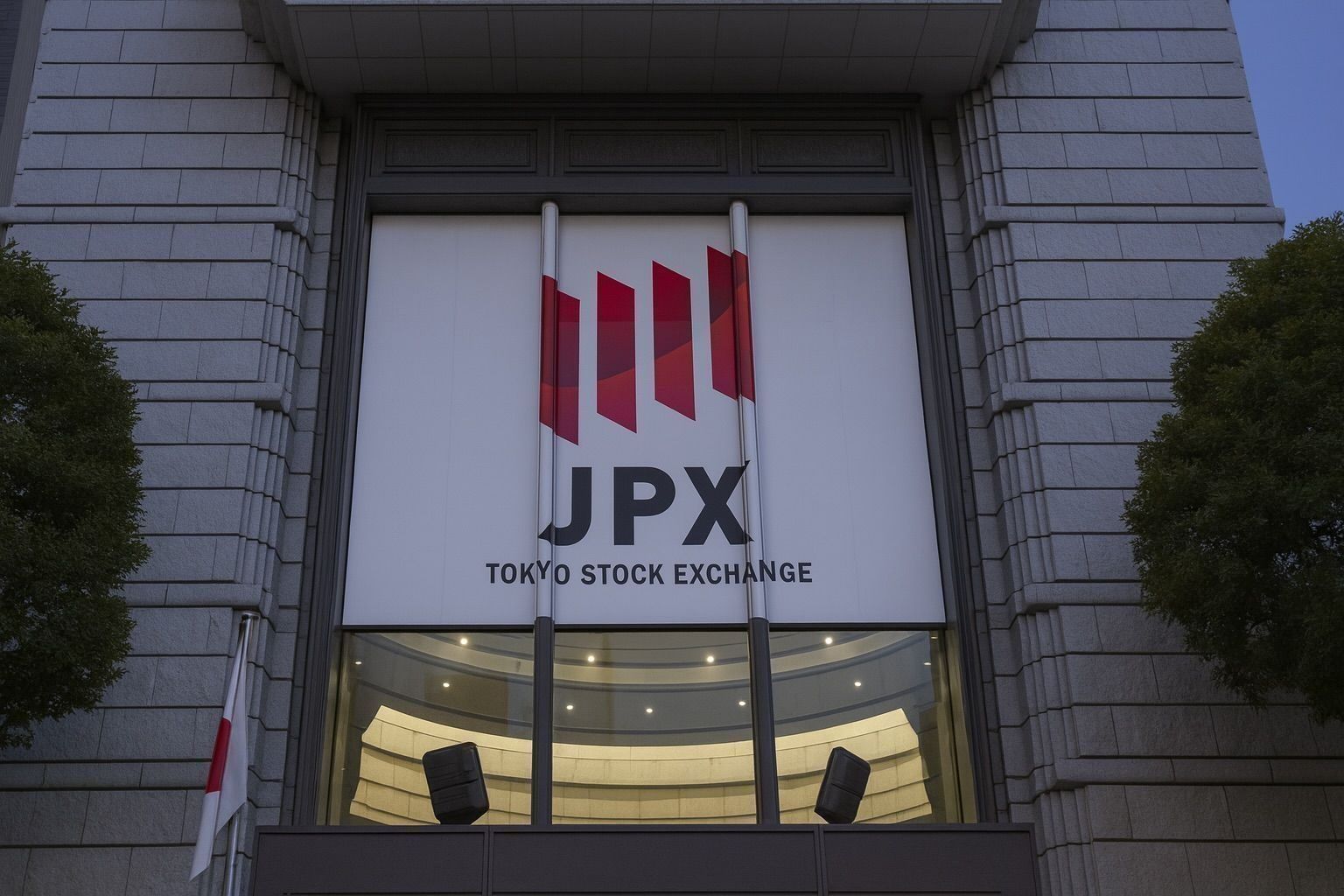
After a dramatic 950‑point plunge on Monday, Tokyo’s stock market reopened on Tuesday, December 2, 2025, with a relief bounce that quickly tested how much risk appetite is really left in Japan’s powerful 2025 equity rally.
The Nikkei 225 jumped at the open and traded firmly higher through the morning, led by banks and technology shares, as investors digested a strong Japanese government bond auction and calmer global markets. But by the closing bell the index had given back almost all of its early gains and finished essentially flat, underlining how fragile sentiment remains around the Bank of Japan’s (BoJ) next move on interest rates. finanzen.at+2CityNews Halifax+2
1. Quick snapshot: how Tokyo traded today
Monday’s shock set the stage
On Monday, December 1, the Nikkei 225 sank 950.63 points (-1.89%) to close at 49,303.28, while the broader TOPIX dropped 1.19% to 3,338.33, after BoJ Governor Kazuo Ueda signaled that a rate hike at the December 18–19 policy meeting is firmly on the table. At the same time, the 10‑year Japanese government bond (JGB) yield spiked to about 1.875%, its highest level since 2008, and the yen strengthened into the mid‑¥155 per dollar region. Nippon+2Nippon+2
That combination of hawkish BoJ hints, higher yields and a stronger yen sparked heavy selling in Japanese stocks and bonds and even helped trigger a global “risk‑off” wobble on Monday, with analysts talking about a “Japan rate chill” reverberating through world markets. Reuters+1
Tuesday’s open: relief rally above 49,450
When trading resumed in Tokyo on Tuesday:
- The Nikkei 225 opened sharply higher around 49,573, more than 250 points above Monday’s close near 49,303, according to index data from Investing.com. Nippon
- In early trade, the index climbed above the 49,450 level and reached an intraday high near 49,624, leaving it up roughly 0.3–0.6% versus Monday’s close. finanzen.at+1
- An AP Asia market wrap put the index up around 0.5% at roughly 49,534, highlighting strong buying in financial stocks as traders bet that higher interest rates would support bank earnings. CityNews Halifax
The early bounce in Tokyo mirrored a broader recovery across Asia. Regional gauges like the MSCI Asia ex‑Japan index rose as much as 0.5%, while tech‑heavy markets in South Korea and Taiwan led gains. The Times of India
2. Intraday reversal: Nikkei finishes basically unchanged
Relief at the open faded as the session wore on.
According to a Reuters/Investing.com market recap, Japan shares ended the day fractionally lower, with the:
- Nikkei 225 closing around 49,298, down just 0.01% from Monday.
- Previous close recorded near 49,303, implying barely a 5‑point loss after a volatile session that saw the index trade in a range roughly between 49,251 and 49,653. Investing.com UK+1
Breadth told a more cautious story than the near‑flat headline:
- Declining stocks outnumbered advancers by roughly 2.5 to 1 (2,535 vs 1,035), with 256 issues unchanged on the Tokyo Stock Exchange.
- The Nikkei Volatility Index jumped about 9% to around 30, signaling that options markets are pricing in a bumpier ride ahead. Investing.com UK
In other words, today was technically “flat,” but it felt like a fragile dead‑cat bounce: early bargain‑hunting met with steady profit‑taking as investors weighed the risk that the BoJ is serious about resuming rate hikes later this month.
Different data providers describe the move as anything from “slightly lower” to “fractionally higher,” but all agree that Tokyo ended the day essentially unchanged after a choppy session. Trading Economics+1
3. What drove today’s price action in Tokyo?
3.1 BoJ rate‑hike bets still front and center
Markets are still reacting to Governor Ueda’s speech in Nagoya on Monday, where he sketched a cautiously optimistic view of Japan’s economy and made clear that the BoJ is seriously considering another rate increase if inflation and wage trends hold. TS2 Tech+1
Key points shaping sentiment:
- Traders now price roughly a 60–70% chance of a BoJ rate hike at the December 19 meeting, according to AI‑curated market summaries from AInvest.
- Inflation is running around 3% year‑on‑year, with energy and food prices still elevated. TS2 Tech
- The Japan manufacturing PMI has stayed below 50 for five consecutive months, signaling ongoing contraction even as inflation remains above target. TS2 Tech
This mix of stubborn inflation and soft manufacturing makes the BoJ’s policy path unusually tricky: hiking too slowly risks letting inflation entrench, but moving too fast risks choking a still‑fragile recovery.
3.2 Bond auction relief: JGB demand calms nerves (a bit)
Tuesday’s modest stabilisation in Tokyo stocks owes a lot to the 10‑year JGB auction, which drew solid demand and pulled yields down from Monday’s spike, according to Bloomberg and other market wraps.
- Strong auction results reassured bond investors that demand for Japanese government debt remains healthy even at higher yields.
- Lower yields reduced immediate pressure on equity valuations, particularly for growth and tech names that are sensitive to discount‑rate expectations.
However, the BoJ itself has warned that Japanese stocks are showing early signs of overheating, hinting that large corrections are possible if global or domestic conditions sour. Reuters+1
3.3 Yen and global macro backdrop
The yen traded in the mid‑¥155 per dollar zone, with Investing.com data showing USD/JPY around 155.7–155.8 by Tokyo’s close. Investing.com UK+1
- A stronger yen hurts exporters’ overseas earnings but can ease imported inflation.
- Global investors are also watching the U.S. Federal Reserve, where weaker recent data has encouraged bets on a December rate cut, providing some support to risk assets across Asia even as Japanese bond yields remain elevated.
4. Sector movers: who led and who lagged on the TSE
Today’s session in Tokyo was anything but quiet under the surface.
4.1 Banks and tech stocks tried to lead the rebound
Morning reports from RTTNews and AP highlighted financials and technology as the main drivers of the early bounce: finanzen.at+1
- Megabanks such as Sumitomo Mitsui Financial Group, Mitsubishi UFJ Financial Group and Mizuho Financial all rose more than 1% in early trading as investors priced in higher net interest margins if the BoJ nudges rates up again. finanzen.at+1
- In semiconductors and equipment, names like Tokyo Electron, Screen Holdings and Advantest posted modest gains, extending this year’s AI‑ and automation‑driven rally. finanzen.at+1
- Fanuc, the industrial robot giant, was one of the stars of the day, surging more than 6% and hitting a multi‑year high by the close. Investing.com UK+1
4.2 Heavyweight SoftBank and automakers were a drag
Not everything joined the party:
- Index heavyweight SoftBank Group slipped more than 2% intraday, weighing on the Nikkei and underscoring how sensitive high‑beta growth names remain to rising yields. finanzen.at
- Among automakers, Toyota and Honda both traded lower, reflecting worries about a stronger yen and the global growth outlook. finanzen.at+1
4.3 Utilities, retail and pharma names hit hard
End‑of‑day data from Investing.com show that some domestic‑oriented and defensive sectors were hit particularly hard: Investing.com UK
- Nippon Electric Glass: +9.9% (one of the session’s biggest gainers, hitting a five‑year high).
- NGK Insulators: +7.2%, also at a five‑year high.
- Fanuc: +6.5%, at a three‑year high.
On the downside:
- Tokyo Electric Power (TEPCO) fell about 6.7%.
- Isetan Mitsukoshi Holdings dropped just over 6%.
- Sumitomo Dainippon Pharma slid roughly 5.7%.
These wide single‑day swings, coupled with elevated index volatility, underline how rotational and stock‑specific this phase of the Tokyo rally has become: investors are dumping perceived policy losers and crowding into a narrower list of winners.
5. Technical picture: bearish signals but support still holding (for now)
Short‑term technical analysis on the Nikkei 225 has turned decidedly more cautious.
An Investing.com/Forex.com column published overnight notes that:
- A bearish engulfing pattern combined with a three‑candle evening star formation has appeared on daily charts for Japan 225 futures.
- The index is hovering near a cluster of support around its 50‑day moving average and an uptrend line dating back to April’s lows.
- A clean break below this support zone could open downside targets around 48,400, with deeper risk towards 47,000, 45,170 and even the low‑40,000s if selling accelerates.
On the other hand:
- If the 50‑day average and uptrend line continue to hold, bullish scenarios point to resistance near 50,580 and 51,500, levels that saw heavy trading earlier this year. TS2 Tech
- Momentum indicators like RSI and MACD have cooled from overbought territory and are drifting towards neutral or mildly bearish, suggesting that 2025’s powerful uptrend is pausing, not yet clearly reversing. Trading Economics
Even after Monday’s plunge and today’s wobble, the Nikkei remains up roughly 30% over the past year and only around 6% below its recent record highs above 50,000, according to index data and independent forecasts. TS2 Tech
6. Big‑picture forecasts for 2026: still bullish, but with more caveats
Despite the near‑term jitters, most medium‑term forecasts for Japanese equities remain constructive.
A recent deep‑dive on Tokyo’s December sell‑off compiled several major strategist views: TS2 Tech
- Sumitomo Mitsui DS Asset Management (SMDAM) has a Nikkei 225 target around 50,300 for end‑2025 and slightly higher into March 2026, with a bullish scenario above 55,000. Its TOPIX target sits in the 3,350–3,460 range into 2026.
- UBS Global Wealth Management keeps Japan rated “Attractive,” arguing that corporate governance reforms, higher return on equity (ROE) and steady wage growth can justify further gains even as the BoJ nudges rates higher.
- J.P. Morgan Private Bank is more cautious but still recommends neutral portfolio weights for Japan, seeing mid‑single‑digit percentage upside for TOPIX over the next 12 months, with a preference for industrials, quality consumer names, financials and selective tech.
Structurally, strategists keep coming back to the same drivers:
- Corporate governance reforms: Tokyo Stock Exchange pressure on low‑ROE, low price‑to‑book companies has pushed a wave of buybacks, dividend hikes and unwinding of cross‑shareholdings. TS2 Tech
- Foreign inflows: Overseas investors have poured trillions of yen into Japanese equities this year, attracted by cheaper valuations and the “Japan reform” story. TS2 Tech
- Valuations: Japanese stocks still trade at lower P/E and P/B multiples than the U.S. market, even after the 2025 rally, leaving room for further re‑rating if earnings hold up. TS2 Tech
The catch: if the BoJ tightens more aggressively than expected or if the yen strengthens sharply, the earnings and valuation story could wobble, particularly for exporters and richly valued growth names.
7. Key risks and themes to watch after today’s Tokyo open
Putting today’s nearly flat close in context, here are the main themes investors will be watching in the coming days:
- BoJ’s December decision and guidance
- Markets now price a meaningful chance of a 25‑basis‑point hike on December 19.
- Any hint that the BoJ is comfortable with higher terminal rates could compress equity valuations, especially in duration‑sensitive growth sectors.
- JGB yields and bond market stability
- Monday’s spike to 17‑year‑high yields scared markets; Tuesday’s strong 10‑year auction provided some calm. Nippon
- If yields march higher again, expect more pressure on richly valued stocks and more rotation into banks.
- Yen volatility and export earnings
- A move from ¥155 toward the ¥140s would provide a major test for exporters and the Nikkei as a whole.
- Conversely, if the BoJ moves cautiously and the Fed cuts, the yen could weaken again, temporarily boosting exporters but potentially re‑inflaming inflation worries.
- Global risk appetite and crypto turbulence
- Monday’s BoJ shock spilled over into global risk assets and cryptocurrencies, with bitcoin sliding sharply before stabilising on Tuesday. Reuters
- A renewed global sell‑off—driven by U.S. growth concerns, tariffs or another crypto leg down—could hit Tokyo hard given how far Japanese indices have already run this year.
- Incoming data: capex, wages, PMI
- Investors will watch capital expenditure numbers, wage data and the next manufacturing PMI prints for confirmation that Japan can sustain moderate growth while normalising rates. TS2 Tech
8. What today’s Tokyo session signals for investors
Today’s open and close tell a two‑part story:
- On one side, there is still appetite to buy dips in Japanese banks, industrials and select tech names after any BoJ‑induced shock.
- On the other, breadth, volatility and technical signals all suggest that 2025’s “everything rally” in Tokyo has matured into a more selective and fragile phase.
For global investors watching via Google News or Discover, Tokyo now looks less like an unstoppable momentum trade and more like a policy‑sensitive, stock‑picker’s market:
- If the BoJ delivers a measured, well‑telegraphed rate path and inflation glides gradually toward target, the structural reform story could reassert itself and push the Nikkei back toward or above 50,000. TS2 Tech
- If policy mis‑steps or external shocks hit—whether from tariffs, global slowdown, or a sharp yen move—today’s “flat” close may end up looking like only a brief pause before a deeper correction.
Either way, December’s Tokyo sessions are shaping up to be some of the most consequential of the post‑Abenomics era, with Japan’s long‑awaited normalisation of monetary policy finally colliding with one of the strongest equity rallies in the world.