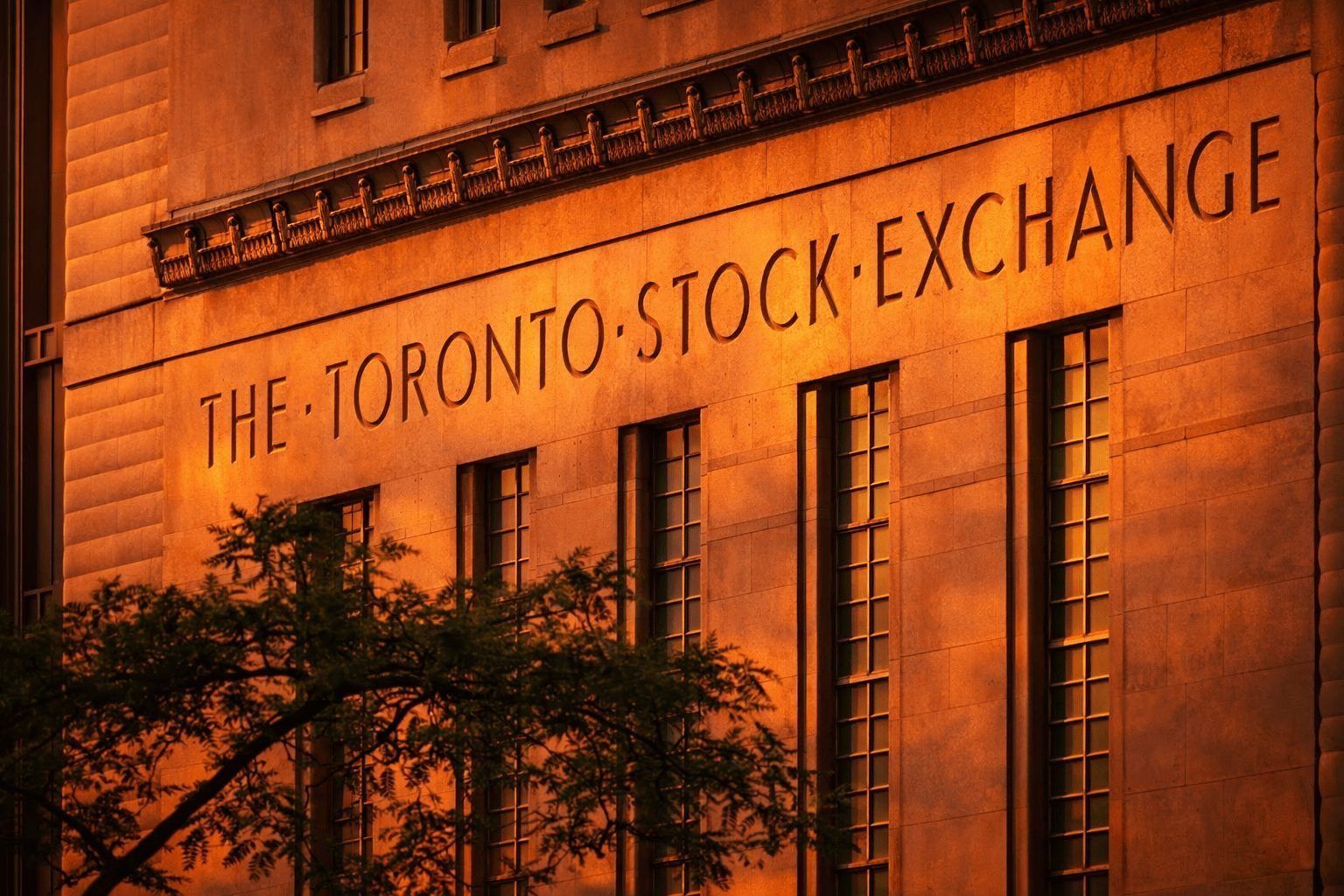
TORONTO — The Toronto Stock Exchange is heading into the final stretch of 2025 with momentum that’s hard to ignore—and harder to neatly explain with “Canada’s economy is gloomy” headlines alone.
On the last trading day before this weekend, the S&P/TSX Composite Index closed at a record 31,755.77, up 1% on the day, 0.7% on the week, and 28.4% year-to-date, putting 2025 on track for its strongest annual gain since 2009. Reuters
Because Dec. 20, 2025 falls on a Saturday, markets are closed today—meaning investors are using the weekend to digest Friday’s breakout, year-end positioning, and a flood of 2026 outlooks from strategists and economists. Reuters+1
What drove the latest Toronto Stock Exchange record
Friday’s record wasn’t a slow grind higher—it was a broad “risk-on” push led by sectors that matter disproportionately to Canada’s benchmark.
Reuters reported that the rally was driven by technology and metal mining shares in heavy volume, with materials up 2.4% and technology up 2.5% on the session. Reuters
The fundamental cocktail behind the move looked familiar:
- Lower borrowing costs (after Bank of Canada cuts)
- Fiscal stimulus expectations (Ottawa’s policy and spending agenda)
- Rising copper and gold prices, boosting the mining-heavy TSX
- A renewed wave of optimism around AI-linked equities, echoing broader U.S. market sentiment Reuters
One portfolio manager quoted by Reuters summed up the mood shift bluntly: “It feels like we’re back to a risk-on mode.” Reuters
Macro backdrop: rate cuts, stimulus, and a TSX that acts like a “commodity + banks” dashboard
The TSX is famously not a mirror of Canadian GDP. It’s more like a national dashboard dominated by financials and resources, with performance often swinging on gold, oil, copper, and bank earnings expectations.
That structure is central to why 2025 worked. BMO Economics noted that the Canadian equity market delivered one of its best years of the century—total return nearing 30%—despite downbeat macro narratives, pointing to the TSX’s heavy weighting in mining/materials, energy, and financials. BMO Economics
At the same time, the macro narrative isn’t purely doom. The Bank of Canada’s easing cycle has been a pillar of support. RBC Wealth Management wrote that the BoC’s September and October cuts brought the overnight rate to 2.25%, the bottom end of its estimated neutral range, and that the central bank has delivered 275 bps of cuts since the 2023–2024 peak, more easing than any other G7 nation. RBC Wealth Management – Asia
On the fiscal side, RBC highlighted that the 2025 federal budget proposed CA$280 billion in increased spending and capital investments over five years—and aims to catalyze CA$1 trillion in new capital investment by combining public and private funding. RBC Wealth Management – Asia
Reuters also tied the market’s latest push to the same two forces—lower borrowing costs and government stimulus—while noting Canada’s retail sales fell 0.2% in October but a preliminary estimate showed a 1.2% rebound in November. Reuters
Corporate and deal headlines that matter for the TSX right now
BlackBerry’s drop was a reminder: the rally isn’t uniform
Even in a market hitting records, stock-specific reality checks still land. Reuters pointed to BlackBerry shares falling 14.1% after quarterly results, even as the broader technology group rose. Reuters
Anglo American–Teck approval keeps the spotlight on “critical minerals” mega-deals
One of the most consequential threads for TSX investors going into 2026 is the political and capital-market push toward critical minerals.
Anglo American and Teck said they received Canadian approval under the Investment Canada Act for their “merger of equals,” positioning the combined company as a “critical minerals champion” headquartered in Canada. Investegate
Industry coverage has emphasized the scale and strategic rationale—especially copper’s importance to electrification and data-center buildouts—as well as the deal’s Canadian commitments, including a Vancouver headquarters and investment pledges that helped secure government sign-off. MINING.COM+1
For the TSX, the relevance is straightforward: materials are big, and policy is increasingly aligned with accelerating resource development, which can re-rate the sector when markets believe permitting and project timelines will actually move faster.
TMX and the Toronto Stock Exchange pipeline: IPO sentiment is thawing
It’s not just index levels. The exchange operator itself is arguing that the machinery of capital formation is improving.
In late November, Reuters reported that TMX Group, which operates the Toronto Stock Exchange, expects a pickup in listings heading into 2026, citing a robust pipeline of companies aiming to tap markets in coming months. Reuters also pointed to the C$704 million IPO of Brookfield-backed Rockpoint Gas Storage as a confidence boost after a subdued period for Canadian IPOs. Reuters
That matters for two reasons:
- New listings and secondary financings are the TSX’s lifeblood—and a stronger pipeline signals better risk appetite.
- IPO rebounds often show up when public-market valuations are supportive and investors believe liquidity will be there on day one.
2026 forecasts and strategist calls: where the TSX could go next
Year-end is when forecasts multiply like rabbits, so it helps to focus on what’s common across them—and what’s genuinely different.
Reuters poll: new highs expected, but many still see a near-term correction risk
A Reuters poll of 20 equity strategists and portfolio managers forecast the S&P/TSX Composite rising to 32,125 by end-2026 (about 5% above levels at the time of the poll), with 33,925 forecast by mid-2027. The poll’s narrative leaned on easing trade uncertainty and resource shares benefiting from AI-linked spending. Reuters
But the same poll included a big caution flag: 11 of 15 respondents said a correction was likely or very likely in the coming three months, citing stretched valuations and the possibility that the gold tailwind fades. Reuters
Raymond James: 34,000 target, with fiscal spending and “hard assets” as tailwinds
Raymond James’ Canada strategy note laid out a more aggressive index target: a 2026 TSX Composite target of 34,000, alongside an EPS forecast of $1,890, arguing that fiscal programs tied to materials, energy, and infrastructure can support both multiple expansion and earnings follow-through—though execution matters. Raymond James
RBC: valuation is richer than normal, but still less extreme than the S&P 500
RBC Wealth Management underscored the tension TSX investors are living with right now: the market isn’t cheap, but it also isn’t priced like a full-blown U.S. mega-cap mania.
RBC put the S&P/TSX at 15.9x price-to-earnings, a premium to its long-run average 14.7x, while noting the S&P 500’s valuation premium is larger versus its own history. RBC argued the TSX’s “modest premium” could offer some insulation in a broad market retracement, while recommending a focus on quality characteristics. RBC Wealth Management – Asia
RBC also framed the federal budget as a potential tailwind for the TSX in 2026, especially if infrastructure and productivity investments translate into real project flow. RBC Wealth Management – Asia
National Bank: valuations are above long-term averages, but “additional upside” remains
National Bank’s December equity monitor said the S&P/TSX total return was about 30% year-to-date (with one month remaining at the time), and argued that although valuations have moved above long-term averages, the bank still sees additional upside—with the important caveat that volatility risks remain elevated. NBC
This is a recurring 2026 theme across firms: not “the TSX is cheap,” but “the policy and commodity mix could still keep earnings expectations supported.”
The interest-rate wild card: not everyone thinks the BoC is done forever
If you want one variable that can whipsaw Canadian equities in 2026, it’s the path of rates—and not just because of mortgages.
Scotiabank Economics expects 2026 to extend the Bank of Canada’s 2.25% pause, before shifting toward 50 bps of tightening in the second half of 2026—with the possibility it comes earlier or larger than expected. Scotiabank
That’s not a trivial divergence from the more common “cuts eventually continue” baseline that many equity narratives prefer. If Scotiabank’s path is closer to reality, it could mean:
- Bank net-interest margins hold up better than feared, but
- rate-sensitive sectors (real estate, consumer discretionary, small caps) face tighter financial conditions,
- and equity valuations get less help from falling discount rates.
In other words: “rates higher for longer” doesn’t automatically kill the TSX, but it changes the leadership and raises the bar for earnings delivery.
Key risks TSX investors are watching into 2026
Even in a record-setting tape, the risk list is not decorative.
Valuations and correction risk: The Reuters poll’s correction expectation is a reminder that markets can be both bullish on the year and twitchy on the quarter. Reuters
Gold and commodity sensitivity: RBC explicitly tied 2025 TSX outperformance to all-time high gold prices and improved outlook for domestic lenders. If gold leadership weakens, TSX leadership may rotate quickly. RBC Wealth Management – Asia
AI enthusiasm versus earnings reality: BMO’s year-end commentary flagged how powerful narratives can run, especially around AI and equity concentration—useful context for investors trying to separate durable capex cycles from hype. BMO Economics
Trade policy and the USMCA review: RBC noted the USMCA provided shelter to many Canadian industries but highlighted that the agreement comes up for joint review next summer, putting trade outcomes back on the calendar as a market risk. RBC Wealth Management – Asia
Holiday trading and settlement: what TSX participants need to know next week
If you’re trading or settling Canadian equities, the calendar now matters as much as the macro narrative.
TMX operational notices confirm that TSX and TSX Venture will have an early close on Wednesday, Dec. 24, 2025, with the post-open market close at 1:00 p.m. TSX.com
They also confirm the exchanges will be closed on Dec. 25 (Christmas Day), Dec. 26 (Boxing Day), and Jan. 1 (New Year’s Day), along with a detailed holiday settlement schedule (including Dec. 24 trades settling on Dec. 29). TSX.com+1
For market behavior, the practical implication is familiar: thin liquidity, year-end rebalancing, and tax-driven flows can amplify moves—especially in smaller TSX names and TSX Venture listings.
Bottom line: the Toronto Stock Exchange enters 2026 with momentum—and meaningful cross-currents
As of Dec. 20, 2025, the Toronto Stock Exchange story is less “Canada is weak” and more “the TSX is built to rally when metals, banks, and policy tailwinds align.”
The market just printed a record close. Reuters
The IPO pipeline is showing signs of life, according to TMX leadership. Reuters
Strategists broadly see more upside in 2026—though not without correction risk and big uncertainty around rates and trade. Reuters+1