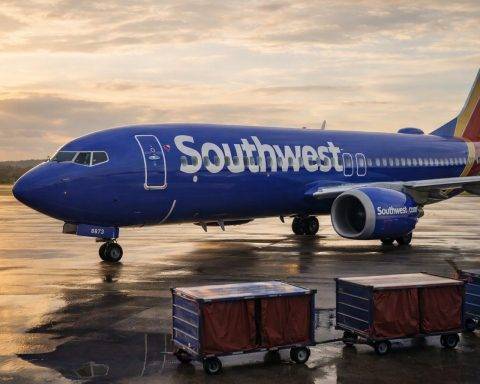
Washington, D.C. – December 7, 2025 — The Trump administration has quietly erased the final $11 million that Southwest Airlines still owed from a record federal penalty tied to its disastrous 2022 holiday travel meltdown, reigniting a fierce fight over how tough the U.S. should be on airlines that strand passengers. Reuters+1
The U.S. Department of Transportation (DOT) issued an updated order late this week granting Southwest an $11 million “credit” in place of the last installment of a $35 million cash fine, part of a broader $140 million consumer‑protection penalty first imposed under President Joe Biden in 2023. Department of Transportation+1
DOT officials under President Donald Trump say the waiver rewards Southwest for spending heavily to fix the problems that triggered the crisis. Consumer advocates and several Democratic lawmakers counter that the decision undercuts accountability and continues a broader rollback of airline passenger protections. Reuters+2Reuters+2
How the 2022 Southwest Holiday Meltdown Led to a Record Fine
Southwest’s troubles trace back to late December 2022, when a fierce winter storm collided with the carrier’s aging crew‑scheduling systems and point‑to‑point network. The airline spiraled into an operational collapse that lasted days.
- Nearly 16,900 flights were canceled, making up roughly half of Southwest’s schedule at the peak of the crisis. Department of Transportation+1
- More than two million passengers were stranded across the United States during one of the busiest travel periods of the year. Department of Transportation+1
- Southwest later told investors the meltdown cost the company around $1 billion in lost revenue and expenses. AOL+1
The Biden‑era DOT, led at the time by Transportation Secretary Pete Buttigieg, conducted an unusually expansive investigation. Regulators concluded that Southwest had violated federal consumer‑protection laws by:
- Failing to provide adequate customer service to stranded travelers
- Failing to promptly notify passengers of flight status changes
- Failing to issue timely refunds and reimbursements, including for optional fees like pet charges and upgraded boarding that customers never got to use Department of Transportation
In December 2023, the department announced a $140 million penalty, the largest consumer‑protection fine against an airline in DOT history — roughly 30 times larger than any previous such penalty. Department of Transportation+1
That enforcement package included:
- $35 million in cash payments to the U.S. Treasury, to be paid in three installments
- A $90 million fund for future travel vouchers, requiring Southwest to issue at least a $75 credit when airline‑caused problems delay a passenger’s arrival by three hours or more
- Credit for 25,000 Rapid Rewards points Southwest voluntarily granted to affected customers during the meltdown Department of Transportation+1
DOT also highlighted that, separate from the fine, the department had already forced Southwest to return more than $600 million to customers in refunds and reimbursements for the 2022 crisis. Department of Transportation+1
What Exactly Is Being Waived?
Under the original settlement, Southwest agreed to pay its $35 million Treasury penalty in three chunks: two installments of $12 million and a final $11 million payment due on January 31, 2026. ABC News+1
The updated order issued this week cancels that final $11 million payment. Instead, DOT is giving the airline an equivalent $11 million “credit” for upgrades to its operations, specifically citing more than $112.4 million invested in its Network Operations Control (NOC) and more than $1 billion spent overall to modernize operations and technology since the meltdown. ABC News+2EconoTimes+2
In practical terms:
- Southwest has already paid $24 million of the $35 million cash fine.
- The last $11 million will never go to the Treasury; it is effectively forgiven. Wall Street Journal+1
- The $90 million voucher program and consumer‑facing obligations created by the 2023 order remain intact, as do previous refunds and compensation already provided to affected passengers. Department of Transportation+1
DOT argues that letting Southwest count its investments toward the penalty “allows for the benefits of the airline’s investment to be realized by the public, rather than resulting in a government monetary penalty,” according to language in the updated order quoted by ABC News and other outlets. ABC News+1
DOT’s Rationale: Rewarding Investment Over Punishment
In both the federal order and public statements, transportation officials under President Trump frame the waiver as a carrots‑over‑sticks approach to consumer protection.
The department says Southwest’s more than $1 billion in technology and operational upgrades — including modernizing scheduling tools, adding staffing and fortifying its NOC — have meaningfully improved reliability. Reuters+2EconoTimes+2
The updated order credits Southwest specifically for:
- Improving on‑time performance and completion factor (the share of flights that operate rather than being canceled)
- Investing in systems meant to avoid a repeat of the 2022 failure
- Maintaining the voucher program that will compensate passengers even for future airline‑caused disruptions ABC News+1
DOT concludes that counting these investments against the remaining fine is “in the public interest” because it encourages airlines to plow money into resilience rather than simply writing checks to the government. Reuters+1
Southwest’s Response: “Operational Turnaround” and Political Gratitude
Southwest has warmly welcomed the move.
In a statement to ABC News, the airline said it is “grateful to Secretary Duffy and the DOT team” for recognizing “significant investments in modernizing our operations.” The carrier added that over the last two years it has completed an operational turnaround that now delivers “industry‑leading on‑time performance and percentage of completed flights without cancellations.” ABC News+2ABC News+2
The company’s public messaging has emphasized three points:
- The penalty’s consumer pieces remain in place – past refunds and future voucher obligations aren’t being clawed back. Department of Transportation+1
- The meltdown was extraordinarily costly already – Southwest has previously said the 2022 crisis produced an after‑tax hit of about $914 million and total losses of more than $1.1 billion. AOL+1
- The airline is still under pressure – just two days before the waiver surfaced, Southwest cut its 2025 earnings forecast, citing the prolonged federal government shutdown and higher fuel prices. Reuters+1
From the airline’s perspective, the waived $11 million is a relatively small slice of a much larger financial and reputational reckoning.
Critics See a “Free Pass” and a Pattern
Consumer advocates and some progressive outlets have blasted the waiver as a signal that the Trump administration is easing the pressure on airlines just as holiday travel ramps up again.
Investigative outlet The Lever framed the move as letting Southwest “off the hook” for a major portion of the cash penalty and placed it within a larger pattern of enforcement rollbacks under Transportation Secretary Sean Duffy, noting that he previously worked as a lobbyist for an airline trade association. The Lever
Critics point to several steps since Trump took office in January:
- Dropping a Biden‑era lawsuit that accused Southwest of operating “chronically delayed” flights in violation of consumer‑protection laws. Reuters+1
- Abandoning plans for automatic cash compensation when airlines cause long delays or cancellations — a rulemaking DOT under Biden had begun pursuing in 2024. Reuters+1
- Reconsidering fee‑transparency regulations that would have required airlines and ticket agents to show baggage and change fees up front. Reuters
For critics, the Southwest waiver is not just about $11 million. They argue it sends a message that the government is willing to soften record penalties once public outrage fades — potentially weakening deterrence for future meltdowns.
Democrats in Congress Push in the Opposite Direction
On Capitol Hill, the waiver has landed just as a bloc of Senate Democrats is trying to move the U.S. closer to European‑style passenger compensation.
On December 4, a group of 15 Democratic senators, led by Mark Kelly of Arizona, Ed Markey of Massachusetts and Richard Blumenthal of Connecticut, unveiled the Flight Delay and Cancellation Compensation Act. The bill would: Reuters+1
- Require airlines to pay at least $300 when a carrier‑caused delay exceeds three hours
- Mandate at least $600 for delays of six hours or more
- Oblige airlines to cover meals, hotels and ground transportation associated with disruptions, regardless of the cause
The proposal came just weeks after the Trump administration formally withdrew Biden’s plan to require airlines to provide cash compensation for long delays. Reuters+1
“Flying is already stressful and expensive. Airlines have to be accountable when they cost the American people money and travelers are left stranded,” Kelly said in promoting the bill, arguing that the Trump DOT’s reversals “only serve the airline industry.” Fox Business
The Southwest waiver is now expected to feature prominently in that debate, with Democrats likely to use it as Exhibit A in arguing that Congress — not the executive branch — should write stronger passenger‑rights rules into law.
A Broader Shift in Airline Regulation Under Trump
The Southwest decision is one chapter in a broader regulatory reset now reshaping the aviation landscape:
- Cash‑compensation rules shelved: DOT has walked away from Biden‑era plans to require airlines to pay passengers cash for qualifying delays, saying the rules would impose “unnecessary regulatory burdens.” Reuters+1
- Refund rules under review: The department has also signaled plans to revisit how “cancellations” are defined for refund eligibility, and how prominently fees must be displayed in ticket advertising. Reuters
- Industry lobbying ramps up: Airlines for America, the main trade group representing carriers including Southwest, hired politically connected firm Ballard Partners this year to lobby on aviation policy, while Southwest’s political action committee has directed most of its recent contributions to Republican candidates and committees. The Lever
Supporters of the administration’s approach say easing regulatory burdens will help keep fares lower and allow airlines to focus resources on operations instead of lawyers. Opponents argue that, without strong enforcement and automatic compensation, passengers will continue to shoulder much of the risk when airlines over‑promise and under‑deliver.
What the Waiver Means for Passengers Affected in 2022
If you were caught up in Southwest’s 2022 meltdown, the practical impact of the waiver on you is limited:
- Past refunds and reimbursements — more than $600 million across tickets, hotels, meals and other expenses — are unaffected. Department of Transportation+1
- Rapid Rewards bonus points that Southwest issued after the crisis are unchanged. Department of Transportation
- The $90 million voucher pool ordered by DOT remains in force: passengers whose Southwest‑caused delays in the future push their arrival back by at least three hours are still entitled to a transferable $75 travel credit. Department of Transportation+1
In other words, the waiver primarily affects who gets the last $11 million — the U.S. Treasury or Southwest’s balance sheet — not whether customers are compensated.
However, passenger advocates warn that decisions like this could influence how aggressively airlines weigh the cost of future meltdowns, especially if they believe record fines can later be softened through regulatory discretion.
Financial Context: A Fragile Airline Environment
The timing of the waiver also intersects with a turbulent operating environment for U.S. carriers:
- A 43‑day federal government shutdown, the longest in U.S. history, recently forced the FAA to order flight reductions at 40 major airports, hurting airline revenues. AP News+1
- Southwest this week cut its 2025 EBIT forecast to about $500 million, down from a prior range of $600–$800 million, citing shutdown‑related weakness in bookings and higher fuel costs. Reuters+1
For investors, the $11 million waiver is small compared with those headwinds. But for regulators and travelers, it looms large as a signal about how far the Trump administration is willing to go in dialing back Biden‑era enforcement, even when the underlying violations involved millions of stranded passengers.
The Bottom Line: A Symbolic $11 Million
On paper, the Trump administration’s decision changes one line item in a much bigger settlement. Southwest still faces:
- The reputational scar of the 2022 meltdown
- Ongoing obligations to compensate customers for future disruptions
- More than a billion dollars in cumulative costs tied to the crisis and its aftermath Department of Transportation+2Wikipedia+2
But symbolically, waiving the final $11 million has outsized importance.
To the administration and airline industry, it’s an example of flexible, incentive‑based regulation that rewards carriers for investing in reliability rather than simply paying fines.
To critics, it’s a warning sign that America’s toughest‑ever airline penalty is already being softened — and that without stronger laws from Congress, passengers’ leverage may fade as soon as the headlines move on.