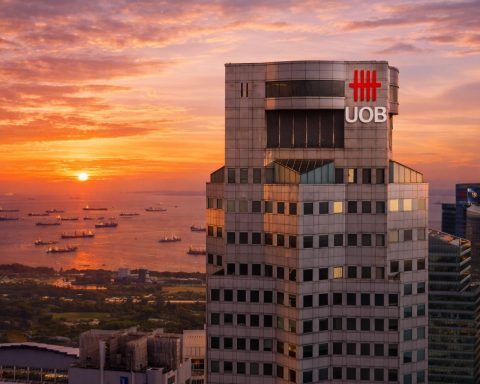

SINGAPORE (Dec 24, 2025) — United Overseas Bank Limited (UOB) shares ended the Christmas Eve session slightly higher, a small but notable outperformer among Singapore’s big three banks during thin, holiday-tilted trading. UOB (SGX: U11) rose 0.1% to S$35.03, even as the Straits Times Index (STI) slipped 0.06% ahead of the festive break.
The move was modest, but the context matters: bank investors are still pricing a tug-of-war between (1) lower interest rates that can compress margins and (2) capital strength and dividends that continue to make Singapore banks core “income” holdings. And for UOB specifically, that debate remains tightly linked to the bank’s late-2025 provisioning posture and the outlook management has set for 2026.
UOB stock on Dec 24, 2025: the numbers investors are reacting to
UOB’s Dec 24 close: S$35.03, with a session range of S$34.91–S$35.09 and volume around 942k shares, according to historical market data.
Local market coverage also highlighted UOB as the only one of the three major local banks to finish higher on the day, with DBS and OCBC closing lower.
Earlier in the morning, market reporting described subdued flows into year-end, with UOB indicated around S$34.95 shortly after the open as the STI dipped.
None of that screams “breakout.” What it does show is stability: UOB is trading like a large, mature bank stock should trade right before a holiday — incremental moves, tight ranges, and investors mostly waiting for the next real catalyst.
Why UOB stock remains under a spotlight: provisions, property risk, and the margin question
The biggest fundamental storyline still hanging over UOB is the bank’s 3Q 2025 result — not because profitability vanished, but because UOB deliberately front-loaded credit allowances.
UOB posted 3Q net profit of S$443 million, down 72% year-on-year, after setting aside S$1.36 billion in allowances for credit and other losses — including S$615 million described as pre-emptive general allowances.
Management framed the move as an effort to reinforce resilience amid macro uncertainty and sector-specific stress — with public reporting repeatedly pointing to the U.S. and Greater China commercial real estate backdrop as an area of attention.
Separately, Singapore media noted that UOB had lagged peers earlier this month as investor focus returned to Greater China property risks.
What UOB’s own disclosures suggest about risk “hotspots”
UOB’s CFO slides for 3Q 2025 include regional snapshots that underscore why the bank may have been motivated to build buffers: for the Greater China and United States portfolios shown, the slides display higher non-performing metrics than the group-wide headline investors typically quote.
Important nuance: those figures are shown by geography/portfolio, not as the bank’s overall NPL ratio.
Meanwhile, broader reporting on the 3Q result cited UOB’s overall non-performing loan ratio at 1.6% (up from 1.5% a year earlier).
In other words: UOB’s group-level asset quality headline still looks controlled, but the bank is signaling it is watching specific pockets of stress closely — and building balance-sheet “insurance” accordingly.
UOB’s 2026 outlook: lower margins, steadier credit costs, and a push to protect shareholder returns
For a bank stock, few things matter more than the net interest margin (NIM) outlook, because NIM is the “spread engine” that turns deposits + loans into recurring income.
From Reuters coverage of UOB’s 3Q release, UOB guided that 2026 full-year NIM is expected at 1.75%–1.80%, down from the bank’s projected 2025 range of 1.85%–1.90%, reflecting the impact of lower benchmark rates.
In its November 2025 investor presentation, UOB reiterated a similar message — noting NIM eased, but suggesting the pace of decline has moderated, and again flagging 2026 NIM at 1.75%–1.80%.
Just as critical: UOB paired the margin outlook with guidance that implies it expects the credit cycle to normalize after the 3Q buffer build. The bank has guided 2026 total credit costs of 25–30 basis points.
On growth, Reuters reported UOB expects low single-digit loan growth and high single- to double-digit fee income growth for 2026, essentially telling investors: “Margins may be slimmer, so we’ll lean more on volumes and fees.” Reuters
Dividends and buybacks: the “second engine” behind UOB stock
UOB’s messaging has been clear that shareholder distributions remain a priority even while it reinforces provisions.
In the same November investor deck, UOB stated its dividend payout ratio is maintained at 50%, and that the 2025 final dividend calculation excludes the pre-emptive general allowance (explicitly framed as a way to safeguard shareholder returns).
UOB also disclosed it remains committed to buybacks, with roughly 25% of a S$2 billion buyback programme completed as of September 2025.
That S$2 billion buyback programme sits within a broader capital return strategy. UOB previously announced a S$3 billion package to return surplus capital over three years, including special dividends and share buybacks.
For investors, this matters because when margins compress, capital returns can become a larger share of the total return story — especially for “bank-as-dividend-asset” portfolios.
Analyst forecasts for UOB stock: target prices cluster near current levels, but the range is wide
Across widely followed consensus pages, the main theme is moderate upside on average — but with meaningful disagreement about how optimistic investors should be.
MarketScreener’s compiled consensus shows:
- Mean rating: “OUTPERFORM”
- Analysts: 15
- Average target price:S$35.83
- High target:S$40.10
- Low target:S$30.40 MarketScreener
With the stock trading around S$35 on Dec 24, that average target implies only a small percentage upside — basically a “fairly valued, but not expensive” stance, assuming the bank executes on guidance and credit stress stays contained. MarketScreener+1
Broker commentary is also still leaning on dividends as a support pillar. DBS Vickers’ sector note this month cited forecast dividend yields for FY26 for Singapore’s major banks, with UOB’s indicated around 5.4% (alongside continued tailwinds from capital strength and broader market-development flows).
Technical and trading signals on Dec 24: a “Buy” bias, but not a momentum stampede
On the technical-analysis side, Investing.com’s summary for UOB showed a “Buy” overall stance on Dec 24, with the page listing a mix of supportive moving averages and indicators (including an RSI reading in the low 60s). Investing.com
Technical signals don’t change a bank’s fundamentals, but they can influence short-term flows — especially around quiet holiday sessions when fewer catalysts compete for attention.
Funding and market access: UOB stays active in covered bonds
Another thread worth tracking in a bank’s “risk-and-resilience” narrative is how it funds itself and diversifies market access.
In late November, UOB priced €850 million of covered bonds due 2030, with reported demand exceeding the deal size (and the bond carrying a 2.718% coupon).
Covered bonds typically signal the ability to tap longer-term funding backed by collateral pools, and they can be part of a broader liquidity strategy — a less flashy headline than earnings, but relevant in an environment where investors are hypersensitive to bank funding and real estate exposures.
What to watch next for UOB stock
As Dec 2025 wraps, UOB’s near-term stock direction is likely to hinge on a few concrete questions:
- Will margins land within guidance? Management has pointed to 2026 NIM of 1.75%–1.80%, which investors will benchmark against peers and against rate expectations.
- Does credit normalization show up in the numbers? After the 3Q provisioning surge, investors will look for credit costs to converge toward the 25–30 bps 2026 guidance.
- How persistent is commercial real estate stress in Greater China and the U.S.? UOB has explicitly referenced those areas in its buffer-building narrative, and market attention remains high.
- How quickly does capital return translate into per-share support? The buyback programme (part of the broader capital return plan) can matter most during “sideways” periods for the share price. SGX Links+1
- Relative performance vs peers. Recent market coverage has highlighted the gap between UOB and peers when property-risk concerns resurface — and that relative framing tends to shape institutional positioning in Singapore banks.
The bottom line
As of Dec 24, 2025, UOB stock is behaving like a market that is not panicking, but also not paying for blue-sky optimism: the shares are steady around S$35, analysts’ average target prices sit only slightly above spot, and the investment debate is concentrated on two variables — margin compression vs. credit normalization — with dividends and buybacks acting as the stabilizing ballast.
Related articles: SGX:U11