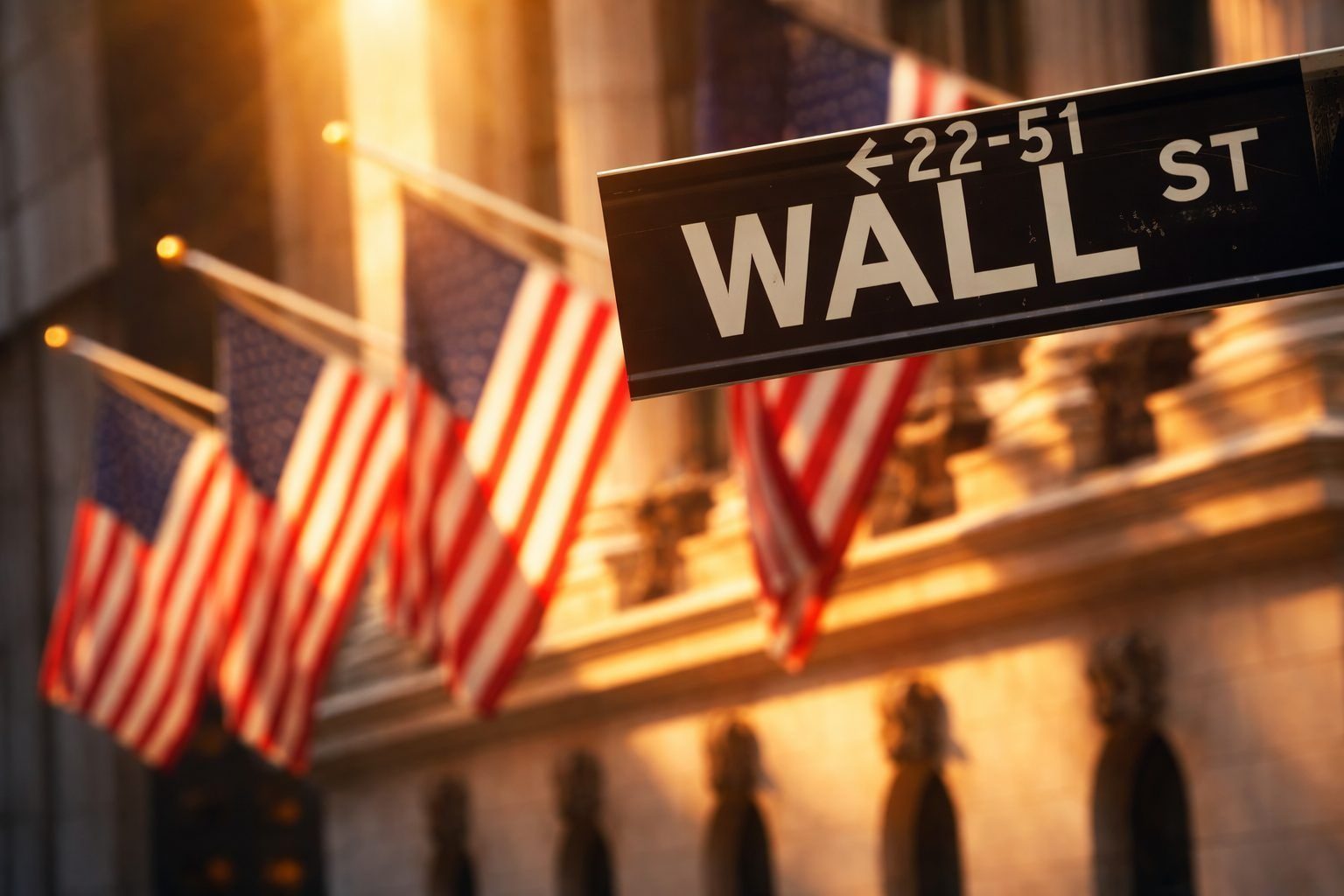

NEW YORK — December 25, 2025. Wall Street is closed for Christmas Day, but the story investors are taking into the holiday is anything but quiet: U.S. stocks left off at fresh records, the “Santa Claus rally” window has begun, and strategists are already sketching a 2026 roadmap built around three swing factors—artificial intelligence investment, corporate profit growth, and the Federal Reserve’s next moves on rates. New York Stock Exchange
The timing matters. With trading paused, markets are in “reflection mode”—digesting where prices ended the final full session before year-end positioning accelerates and before the calendar flips into a U.S. midterm-election year (a period that has historically been more uneven for equities). Reuters
Markets are closed today—here’s where Wall Street left off
U.S. stock exchanges are shut on Thursday, Dec. 25, after a shortened Christmas Eve session on Wednesday, Dec. 24, when the NYSE closed early. Trading is scheduled to resume on Friday, Dec. 26.
In that light-volume holiday session, the market still managed a milestone finish:
- Dow Jones Industrial Average:48,731.81 (record closing high)
- S&P 500:6,932.13 (record closing high)
- Nasdaq Composite:23,613.31 Reuters
That “quiet” record matters because it reinforces a bigger theme of 2025: the market’s ability to hold gains even as headlines rotate from inflation to growth, from rate cuts to election-year uncertainty, and from enthusiasm about AI to questions about whether AI spending will translate into durable profit expansion.
2025’s scorecard: a third straight year of double-digit gains—powered by a familiar engine
By Christmas week, the S&P 500 was tracking a gain of roughly 17%–18% for 2025, putting the market on course for a third consecutive year of double-digit returns.
Reuters’ year-by-year snapshot highlights how unusual this run has been:
- 2023: S&P 500 up 24%
- 2024: S&P 500 up 23%
- 2025: S&P 500 up over 17% with a few trading days left Reuters
The rally’s backbone has been consistent: optimism around AI, an easing rate environment, and an economy that continued to grow even through repeated recession fears.
The “Santa Claus rally” window is open—what it is, and why traders still watch it
Seasonality is never a guarantee, but it shapes investor psychology—especially into year-end.
Reuters notes the “Santa Claus rally” is commonly defined (via Stock Trader’s Almanac) as the last five trading days of the year and the first two trading days of January. This year, that window began Wednesday (Dec. 24) and runs through Jan. 5. Reuters
Why it matters in practice:
- Liquidity is thinner around holidays, so price moves can look “bigger” than the news flow would suggest.
- Portfolio rebalancing (and tax-related flows) often accelerates into the final week of December.
- When markets are already near highs, even small surprises—economic releases, bond-yield swings, or company headlines—can spark outsized moves.
In short: the “Santa rally” isn’t magic, but the conditions around it are real.
The macro backdrop: strong growth signals, but a labor market worth watching
A key reason stocks have held up late in the year is that the economic picture has stayed supportive—even if it’s mixed by category.
Growth came in hotter than expected
Reuters reported that U.S. gross domestic product rose at a 4.3% annualized rate in Q3, beating expectations in Reuters’ economist poll and marking the fastest pace since Q3 2023 (driven by strong consumer spending).
Labor data is sending a more nuanced message
In the Christmas Eve session recap, Reuters highlighted jobless-claims data pointing in two directions:
- Initial jobless claims dipped 4.5% (week over week)
- Continuing claims rose 2.0% to 1.923 million Reuters
That combination—fewer new claims but more ongoing claims—can be read as “less firing, but also less hiring,” which helps explain why investors keep returning to the idea that the Fed may still have room to cut.
Rates and yields are reinforcing the narrative
The same Reuters wrap noted Treasury yields eased after the claims data, with the 10-year yield around 4.136%.
The Fed’s pivot is real—and it’s still the market’s biggest macro lever
The Federal Reserve’s latest major signpost came on Dec. 10, 2025, when it cut the federal funds target range by 0.25 percentage point to 3.50%–3.75%.
The Fed’s statement also emphasized:
- Economic activity expanding at a “moderate pace”
- Job gains slowing and unemployment edging up through September
- Inflation still “somewhat elevated”
- Uncertainty “remains elevated” Federal Reserve
For markets, the takeaways are straightforward: policy is easing, but the Fed is trying to keep flexibility—and credibility—by tying “additional adjustments” to incoming data and the balance of risks. Federal Reserve
Separately, Reuters reported that Fed funds futures indicate investors expect at least two additional quarter-point rate cuts in 2026, following 175 basis points of cuts in 2024 and 2025.
That expectation—whether it proves right or not—is central to why valuations have remained firm near record highs.
2026 forecasts: the base case is bullish, but not blindly so
Strategists are not uniform in their outlook, but the consensus tone going into 2026 is notably optimistic: the bull market can continue, though the path may be bumpier.
A Reuters poll of brokerage expectations put the S&P 500 at 7,490 by end-2026, implying a gain of nearly 12% from current levels.
Reuters also reported that some forecasts reach higher—including Deutsche Bank’s 8,000 target—while others argue the next year is more likely to be “good” than “great.” Reuters
The key is the “why” behind those forecasts. Across research desks, three pillars show up repeatedly:
- Earnings growth broadens out beyond megacaps
- AI investment continues—but with clearer payoff
- The Fed stays dovish enough to support risk assets, without an economic slide into recession Reuters
AI and earnings: the market’s biggest 2026 make-or-break question
If there is a single storyline that could validate—or break—2026’s bullish forecasts, it’s this: Will AI translate into earnings power for a broader set of companies, not just the biggest tech names?
Reuters summarized the profit picture like this:
- S&P 500 earnings are projected up more than 15% in 2026, after an expected 13% rise in 2025 (per LSEG earnings research).
- The “Magnificent Seven” (including names such as Nvidia, Apple, and Amazon) posted 37% profit growth in 2024, versus 7% for the rest of the S&P 500. Reuters
- By 2026, that gap is expected to narrow: the “Mag 7” at 23% earnings growth, versus 13% for the rest. Reuters
That “broadening” is critical. When market leadership is narrow, indexes can rise fast—but they can also become fragile. When earnings growth spreads into industrials, financials, healthcare, and consumer names, rallies tend to have better internal support.
The risk: AI spending without ROI
Reuters also flagged the risk that’s been creeping into investor conversations: if companies pull back capital expenditures (or if markets lose confidence in AI returns), 2026 could look far flatter than today’s targets suggest.
This is the tension at the heart of the AI trade: the spending is visible now; the profit payoff must show up later.
Volatility is low—but that can cut both ways
One of the most striking features of late-2025 trading has been the calmness around record highs—especially into a holiday period when geopolitical and policy headlines don’t stop just because markets close.
Low volatility often reflects confidence: investors are comfortable with the soft-landing narrative, rate cuts, and earnings resilience. But it also means the market may be less “priced” for shocks—whether that shock is inflation re-accelerating, yields jumping, or policy uncertainty returning to the forefront.
The wildcards: inflation, tariffs, U.S.-China relations, and a midterm-election year
Strategists’ optimism comes with a list of explicit warnings.
Reuters noted that banks are bullish on AI momentum and rate cuts but also caution that inflation, stretched valuations, and tariff tensions could trigger corrections.
In its year-ahead framing, Reuters pointed to several additional swing factors:
- U.S.-China relations as a potential market mover in 2026 Reuters
- The market watching for the U.S. president’s expected choice of a Fed chair in 2026—and related concerns about perceived central-bank independence Reuters
- Historical performance: year four of bull markets since 1950 has averaged strong gains, but midterm election years have tended to be weaker on average Reuters
This mix is why many forecasts effectively assume continued gains, plus at least one meaningful drawdown along the way—a pattern that has been common in modern bull markets even when the year ends higher.
What investors should watch when markets reopen Friday, Dec. 26
With the market closed today, the practical question becomes: what could move prices next?
Here are the near-term catalysts implied by current reporting and positioning:
- Bond yields and rate expectations: any shift in how traders price 2026 cuts can quickly re-rate growth stocks.
- Evidence of earnings breadth: investors will keep rotating through the question of whether gains can broaden beyond the biggest tech names.
- AI capex headlines: signals that spending is accelerating (or slowing) can ripple through semiconductors, cloud infrastructure, and software.
- Holiday liquidity: fewer participants can mean sharper moves—up or down—on relatively modest news.
Bottom line: record highs into Christmas set an optimistic tone, but 2026’s rally needs “proof,” not just hope
As of Dec. 25, the U.S. stock market is sending a clear message: investors are comfortable paying up for a future in which rates drift lower, earnings rise, and AI becomes a durable engine of productivity and profit.
But the market is also moving into a phase where it needs evidence:
- Evidence that earnings growth really broadens
- Evidence that AI spending produces returns
- Evidence that the Fed can keep easing without reigniting inflation or tipping the economy into recession Reuters
If that evidence arrives, Wall Street’s 2026 targets won’t look ambitious—they’ll look like a continuation of the playbook that delivered three years of outsized gains. If it doesn’t, the market may still advance, but it’s more likely to do so through a choppier, more selective rally than the smooth climb that produced record closes into the holiday.
This article is for informational purposes only and does not constitute investment advice.
Related articles: Stock Market