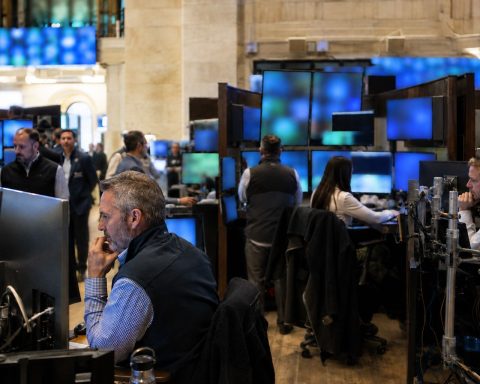

The US stock market dropped again on Tuesday, extending a November pullback driven by worries about an “AI bubble,” fading hopes for a December Fed rate cut, and a downbeat outlook from Home Depot that rattled confidence in the consumer.Reuters+1
Market snapshot: indexes slide for a fourth day
By late morning to early afternoon Eastern time, all three major US indexes were in the red for a fourth straight session:
- Dow Jones Industrial Average: down around 0.8%–1%, hovering near 46,200–46,300 after an earlier drop of roughly 458 points.
- S&P 500: off roughly 0.5%–1.1%, trading near 6,600 and on track for a fourth consecutive loss, leaving it about 3–4% below its November high.
- Nasdaq Composite: lower by about 0.8%–1.6%, as selling in large tech and AI names weighed heavily on the index.
Exchange‑traded funds that track the major indexes told a similar story. Early in the afternoon, the SPDR S&P 500 ETF (SPY) was down about 0.4%, the SPDR Dow Jones Industrial Average ETF (DIA) roughly 0.7%, and the Invesco QQQ Trust (QQQ)—a proxy for the Nasdaq 100—about 0.7%.
Tuesday’s weakness comes on top of Monday’s broad sell‑off, when the Dow fell 1.2%, the S&P 500 0.9%, and the Nasdaq 0.8%, dragged down by tech, financial, materials and energy stocks.
Despite the recent pullback, major indexes are still positive for 2025: CBS reported that the S&P 500 remains up over 12% year‑to‑date, with the Dow ahead about 8% and the Nasdaq more than 15%.
Volatility is picking up. The Cboe Volatility Index (VIX) has climbed above 23, around a one‑month high, as the S&P 500 slipped below its 50‑day moving average for the first time since late April.
AI bubble worries and Nvidia at the center of the sell‑off
The dominant narrative on Wall Street today is simple: AI hype meets valuation fatigue.
- Nvidia (NVDA)—the poster child of the AI boom—fell around 2–3% in Tuesday trading after sliding nearly 2% on Monday, leaving the stock down roughly 8–10% for November so far.
- Over the last three years, Nvidia’s market value has surged more than 1,000%, and at one point it briefly topped $5 trillion, making it one of the most influential stocks in the S&P 500.
Because Nvidia is such a large component of the index, even relatively small moves can noticeably sway the S&P 500’sdirection. Schwab estimates that Nvidia alone accounts for roughly 7% of the benchmark’s market value.
Surveys suggest professional investors are increasingly worried that AI‑linked valuations have gone too far:
- In Bank of America’s latest global fund manager survey, about 45% of respondents cited an “AI bubble” as the top low‑probability, high‑impact risk for markets—ranking it above inflation, bond market stress and trade tensions.WHEC.com+1
- Analysts note that mega‑cap tech names such as Microsoft, Amazon, Meta, Tesla and Alphabet have also been under pressure, with some of the largest declines concentrated in AI‑heavy stocks and chipmakers.
The stakes around Nvidia’s earnings report on Wednesday could hardly be higher. Investors are looking for proof that the AI spending boom—particularly on data centers and GPUs—can generate sustainable profits rather than just sky‑high capital expenditures.
A strong report and upbeat guidance could help stabilize sentiment; a disappointment might reinforce the idea that AI valuations have run ahead of fundamentals and trigger further rotation out of high‑growth tech.
Home Depot’s weak profit and guidance cut raise consumer worries
The other major story on US stock market today is Home Depot’s earnings.
The home‑improvement giant posted Q3 2025 sales of about $41.4 billion, roughly 3% higher than a year ago and slightly above Wall Street expectations. But comparable sales were essentially flat, customer transactions fell 1.6%, and adjusted EPS of $3.74 missed forecasts around $3.84—for the third straight quarter.
More importantly for the market, management cut its full‑year outlook:
- Home Depot now expects full‑year adjusted earnings per share to drop around 5%, versus a prior forecast of a 2% decline.
- It also scaled back its same‑store sales outlook from about 1% growth to “slightly positive.”Reuters
Executives cited a mix of headwinds:
- Tariff‑related uncertainty and higher costs on imported goods
- Soft housing activity, with high mortgage rates still discouraging big renovation projects
- Elevated operating expenses, including wages and logistics
- Customers prioritizing essential repairs over big‑ticket remodels like kitchens and bathroomsReuters+1
Investors took the message poorly. Home Depot shares fell about 4%, dragging the Dow lower, while rival Lowe’sslipped 1–2% ahead of its own results on Wednesday.
Because Home Depot is seen as a bellwether for both housing and discretionary consumer spending, its more cautious tone amplified worries that the US consumer—arguably the backbone of the economy—may be losing momentum heading into the holiday season.
Cloudflare outage adds to tech jitters
Tech sentiment wasn’t helped by a high‑profile Cloudflare outage that briefly broke parts of the internet.
- Around 6:30 a.m. ET, an automatically generated security configuration file at Cloudflare grew too large and crashed part of its traffic‑handling software, causing errors across several services.
- The disruption temporarily made it difficult for thousands of users to access major platforms including X (formerly Twitter), ChatGPT, Canva, Grindr and various transit and gaming services.
- Cloudflare, which routes roughly one‑fifth of global web traffic, said there was no sign of a cyberattack and that service has now been restored, though some customers experienced lingering issues as systems recovered.
Cloudflare shares traded about 2–5% lower during the morning as investors digested the incident.
For markets already anxious about the durability of the AI and cloud boom, the outage served as a reminder that even core infrastructure providers can be single points of failure.
Global risk‑off mood: Asia and Europe echo Wall Street’s slump
Tuesday’s declines were part of a broader global sell‑off.
In Asia, where many indexes are heavily weighted toward chipmakers and tech exporters:
- Japan’s Nikkei 225 sank about 3.2%, pressured by surging long‑term Japanese government bond yields and concerns over the fiscal outlook.
- South Korea’s Kospi fell roughly 3.3%, with chip giants like Samsung and SK Hynix under heavy pressure.
- Taiwan’s Taiex and other tech‑sensitive markets also dropped sharply, reflecting worries that AI‑related demand might not justify aggressive capital spending.
In Europe, stocks were similarly weak:
- France’s CAC 40 lost close to 1.9%, while the pan‑European STOXX 600 fell nearly 2% amid tech and banks selling.
- In London, the FTSE 100 dropped about 1.3%, its fourth straight decline and worst day since early April, and the FTSE 250 shed roughly 1.2%, as banks and miners led losses.
Global markets are reacting to the same themes buffeting US stocks: elevated tech valuations, skepticism about near‑term Fed rate cuts, and a sense that the AI trade has grown crowded.
Fed policy, yields and the post‑shutdown data dump
Under the surface, much of the US stock market’s repricing comes down to interest rates and uncertainty about the economic data.
A fresh Reuters analysis highlighted a deep divide inside the Federal Reserve over whether to cut rates again at the December 9–10 meeting. Some policymakers, like Governor Christopher Waller, argue that a cooling labor market justifies another cut, while others—including more hawkish regional presidents—want clearer proof that inflation is headed back to 2% before easing further.
Complicating the debate:
- The recent six‑week federal government shutdown delayed key reports on jobs, inflation, retail sales and GDP. Some September data will be released this week, but parts of the October and November series may be skipped altogether, leaving gaps in the Fed’s picture of the economy.
- Futures markets have scaled back expectations of a December rate cut, which had previously been seen as very likely.
On Tuesday, Treasury yields moved slightly lower as investors sought safety:
- The 10‑year Treasury yield slipped to around 4.1%,
- The 2‑year yield fell toward 3.56%,
- The 30‑year edged down to just under 4.73%.
Meanwhile, the Fed also released new information on enhancements to bank supervision and Governor Michael Barr delivered a speech on the case for strong, proactive oversight—moves aimed at strengthening financial stability as markets navigate higher‑for‑longer rates and rapid technological change.
Crypto, gold and oil: other markets under pressure
The risk‑off tone extended beyond equities:
- Bitcoin briefly dipped below $90,000 in morning trading before rebounding into the low $90,000s, leaving it roughly 25–30% below its recent record near $125,000 and down about 17% for the month.
- Gold—which had surged to record highs above $4,400 per ounce earlier this year—was trading around $4,050–4,100, having pulled back roughly 9% from its peak but still up sharply year‑to‑date.
- US crude oil (WTI) hovered near $60 per barrel, as traders weighed sanctions on Russian exports against expectations for a softer demand backdrop next year.
Schwab notes that semiconductor stocks are down about 8% in November, while bitcoin’s slide has pushed some investors back toward more defensive assets and even cash—helping drive US money‑market fund assets to record highs above $7.5 trillion.
What to watch for the rest of the week
For anyone following the US stock market today, the next few days are packed with potential catalysts:
- Nvidia earnings (Wednesday after the close)
- Markets will parse every detail of revenue, margins and AI data‑center demand, but forward guidance may matter most for whether the AI trade resets or rebounds.
- Fed minutes and speeches
- Minutes from the October meeting, released Wednesday, should shed more light on how deep the policy split really is and what it would take to shift the committee toward or away from further cuts.
- Delayed September jobs report (Thursday)
- This long‑awaited employment data—plus any catch‑up figures on jobless claims and wages—will be crucial signals for both the Fed and investors trying to gauge recession risks.
- Big‑box retail earnings
- Lowe’s, Target, Walmart, Gap and others report later this week, offering a clearer view of how middle‑ and lower‑income consumers are coping with tariffs, higher prices and still‑elevated borrowing costs.
- Consumer sentiment data
- The final November University of Michigan consumer sentiment reading arrives Friday and could either confirm or challenge evidence of weakening confidence seen earlier this month.
Bottom line
The US stock market today is caught between strong year‑to‑date gains and mounting doubts about how much of the AI and rate‑cut optimism is already priced in.
- Valuations in mega‑cap tech and AI plays are under renewed scrutiny.
- Earnings from bellwethers like Nvidia and Home Depot are being treated as real‑time stress tests of the AI and consumer stories.
- Fed policy remains uncertain as officials weigh incomplete data against still‑sticky inflation.
For investors, the message embedded in today’s trading is less about outright panic and more about positioning for a bumpier, data‑dependent path—with a growing preference for selectivity, diversification and risk management rather than chasing whatever has gone up the most.
This article is for information and news purposes only and is not personalized investment advice. Always consider your own financial situation and, if needed, consult a qualified advisor before making investment decisions.
Related articles: NYSE:HD