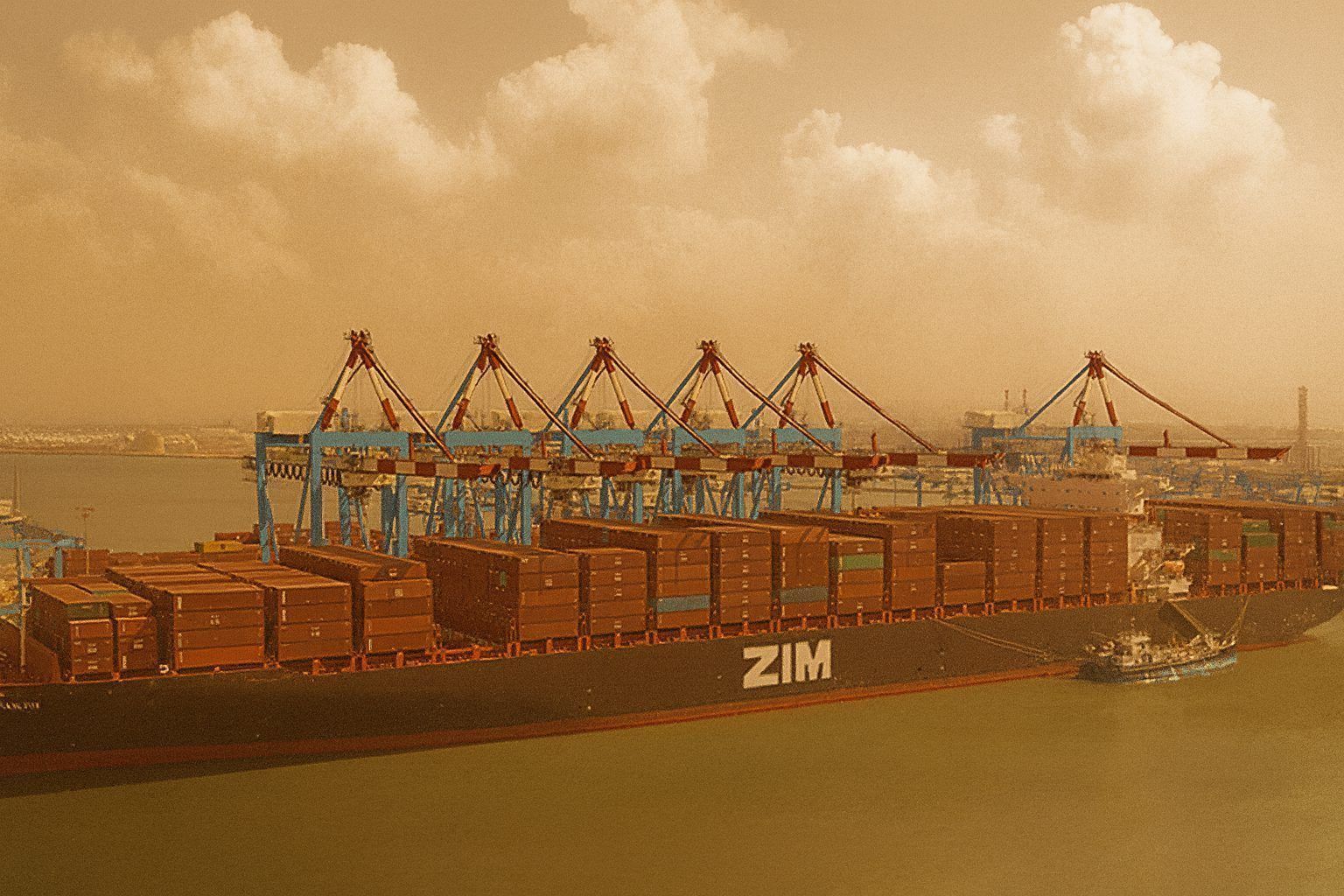
ZIM Integrated Shipping Services Ltd. stock is back in the spotlight on Dec. 15, 2025, caught at the intersection of three forces that can yank any shipping name around: freight-rate expectations, corporate control drama, and the always-contentious question of how much cash a cyclical carrier should return to shareholders.
As of the latest available trading update, ZIM shares were around $18.76, down about 5.4% from the prior close—an intraday move that underscores how headline-sensitive the stock has become as takeover speculation heats up and a high-stakes shareholder vote approaches. ZIM Investors
Why ZIM stock is moving now: M&A rumors collide with a proxy battle
The simplest way to explain ZIM’s current tape is this: the market is trying to price two very different futures at once.
One future is the familiar shipping cycle—rates up, rates down, charter costs, and earnings volatility. The other is a corporate event path—sale process, bids, board fight, and (possibly) a deal premium.
1) Strategic review is underway—and it explicitly includes a potential sale
ZIM’s board has publicly confirmed it is conducting a strategic review of alternatives, stating the process began after receiving a preliminary, non-binding proposal to acquire the company from CEO Eli Glickman and Rami Ungar. The board also disclosed it engaged Evercore as financial advisor alongside legal counsel to support the process, and said it has received indications of interest from multiple parties, including strategic interest. ZIM Investors
In other words: ZIM itself has put the word “sale” on the record, while also warning that there is no assurance any transaction will occur. ZIM Investors
2) Reported bids from MSC and Hapag-Lloyd add fuel—and raise political/regulatory questions
Israeli business outlet Calcalist reported Dec. 14 that MSC (Mediterranean Shipping Company) submitted a bid to acquire ZIM, positioning MSC as a leading contender alongside Hapag-Lloyd, which Calcalist says also submitted an offer. The same report notes investor concerns that Israeli authorities could intervene in a sale of ZIM to a foreign buyer, and cites employee opposition as part of the backdrop. ctech
Earlier reporting tied to Israeli outlet Globes also described Hapag-Lloyd as having made an acquisition offer, with additional industry players reportedly showing interest—again emphasizing that discussions were early-stage and that ZIM declined to comment on the reported offer. Investing.com
This is not just gossip-level noise for traders. In ZIM’s own investor materials, the company notes that any sale would require shareholder approval, and that Israel’s “golden share” requires governmental consent for any change of control—a structural detail that can materially affect deal certainty and timelines. s203.q4cdn.com
The proxy fight: Glass Lewis and ISS side with ZIM’s board ahead of the Dec. 26 vote
While M&A headlines grab attention, ZIM is simultaneously dealing with a proxy contest. The company has urged shareholders to back its existing slate of directors and reject dissident nominees associated with Mor Gemel & Pension Ltd., Reading Capital Ltd., and Sparta 24 Ltd. ZIM Investors
Two major proxy advisory firms have now weighed in.
- Glass Lewis recommended shareholders vote for all eight ZIM director nominees and against all three dissident nominees, according to a Dec. 14 company announcement. PR Newswire
- ISS (Institutional Shareholder Services) had previously issued a similar recommendation, also supporting the board’s slate over the dissidents. Nasdaq+1
ZIM’s messaging around these endorsements is not subtle: it argues the board is best positioned to oversee the strategic review without disruption and emphasizes that the strategic review is led by independent directors. PR Newswire+1
The timing matters because ZIM’s annual and extraordinary general meeting—where these matters come to a head—is scheduled for Dec. 26, 2025, according to an amended filing. SEC
Dividend story: big historical payouts, smaller recent checks, and a policy tied to earnings
ZIM has one of the most debated dividend profiles in U.S.-listed shipping—because it’s not a stable “utility-like” payout. It’s more like a pressure valve on profitability.
In an investor update, ZIM highlights a dividend approach that can return up to 50% of annual net income (in quarterly installments), while also stressing the need to maintain liquidity given the volatility of a charter-heavy business model. s203.q4cdn.com
That same investor deck states ZIM has returned $5.7 billion in dividends since its IPO, equating to about $47.54 per share in cumulative dividends. s203.q4cdn.com
More recently, ZIM announced a cash dividend of $0.31 per ordinary share (about $37 million), tied to shareholders of record as of Dec. 1 and paid on Dec. 8, alongside guidance on withholding tax procedures. ZIM Investors+1
For investors, the takeaway is not “ZIM pays a high dividend” as a timeless fact. The takeaway is: ZIM’s dividend is a function of earnings power, and earnings power in container shipping is a function of freight rates and capacity discipline—two variables that do not sit still.
Fundamentals check: what ZIM last reported, and what it guided for 2025
The latest detailed financial snapshot widely cited in current coverage is ZIM’s third-quarter 2025 report.
ZIM reported (among other metrics):
- Revenue: $1.78 billion
- Net income: $123 million
- Adjusted EBITDA: $593 million
- Adjusted EBIT: $260 million
ZIM also updated full-year 2025 guidance to Adjusted EBITDA of $2.0–$2.2 billion and Adjusted EBIT of $700–$900 million. PR Newswire
From a stock narrative perspective, those figures matter because they help explain why acquisition interest is even plausible: buyers (or would-be buyers) often appear when a cyclical company is throwing off cash but trading at a valuation the market is unwilling to sustain through the next downturn.
The macro backdrop: freight rates, capacity, and the “Suez question”
Shipping stocks never trade in a vacuum. They trade inside a messy machine made of spot rates, contract rates, idle capacity, newbuild deliveries, reroutings, and geopolitics.
Two widely watched benchmarks suggest freight pricing has been relatively firmer in early December than some investors feared:
- Drewry’s World Container Index was reported at $1,957 per 40-foot container, up 2% for the week of Dec. 11. Drewry
- The Freightos Baltic Index (FBX) showed a current global container price index around $1,934.40 in the latest update visible on Freightos Terminal. Freightos
Meanwhile, broader routing decisions remain a wild card. Reuters reported in early December that Hapag-Lloyd’s CEO said any industry return to the Suez Canal route would be gradual, with a transition period discussed in the 60–90 day range—illustrating how quickly effective capacity can shift if vessels stop taking longer routes. Reuters
For ZIM, this matters because changes in route length and congestion can swing effective supply and rates—and therefore earnings—without any single carrier “doing” anything.
What Wall Street is forecasting: cautious consensus, but deal optionality complicates targets
On conventional fundamentals, many analysts still treat ZIM as a classic cyclical: highly profitable in good markets, vulnerable when rates normalize, and hard to value with long-term confidence. That shows up in target dispersion.
A consensus snapshot from StockAnalysis lists:
- Consensus rating: Sell
- Average 12-month price target:$13.70
- Range:$8.70 to $20.00 StockAnalysis
The high end of that range has become more salient because it maps to the takeover chatter. Investing.com reported that Jefferies raised its price target to $20 while maintaining a Hold rating, explicitly citing “sale scenario” considerations and referencing the reported $20-per-share bid as potentially setting a floor. Investing.com
At the cautious end, the same consensus table reflects JPMorgan with a lower target (notably $8.70) and a negative rating stance. StockAnalysis
The market implication is straightforward: the “base case” may be conservative, but the “event case” is not zero. And when event probability rises, targets tend to widen rather than converge.
ZIM’s corporate structure adds a twist: Israel’s golden share
One of the more underappreciated elements in the ZIM story—especially for U.S. retail investors—is the role of Israel’s golden share. In its investor materials, ZIM states that any sale would require shareholder approval and that Israel’s golden share requires governmental consent for a change of control. s203.q4cdn.com
That single sentence can matter as much as a freight-rate chart (and yes, shipping investors love charts) because it affects:
- who can realistically buy the company,
- how long approval might take, and
- what kind of conditions might be attached.
It’s one reason why reported “bids” can move the stock but still leave investors with uncertainty: headline M&A is not the same thing as executable M&A.
Key catalysts to watch next for ZIM stock
With the story moving fast, investors are likely to focus on four near-term catalysts:
- Dec. 26 shareholder meeting outcome and what it signals about board stability and control of the strategic review process. SEC+1
- Any update on the strategic review—whether that’s confirmation of bidders, a transaction announcement, or a decision to remain standalone. ZIM Investors
- Freight-rate trend into Q1 2026, especially if route normalization changes capacity dynamics. Freightos+2Drewry+2
- Dividend decisions tied to 2025 profitability and the board’s capital allocation stance. s203.q4cdn.com+1
Bottom line
On Dec. 15, 2025, ZIM stock is no longer trading purely as a freight-rate lever. It’s trading as a hybrid: part cyclical shipping equity, part event-driven situation.
The board-run strategic review, reported interest from major global carriers, and proxy fight—with Glass Lewis and ISS siding with the incumbent slate—have combined into a rare moment where corporate governance mechanics and container-rate math are equally important to the next move.