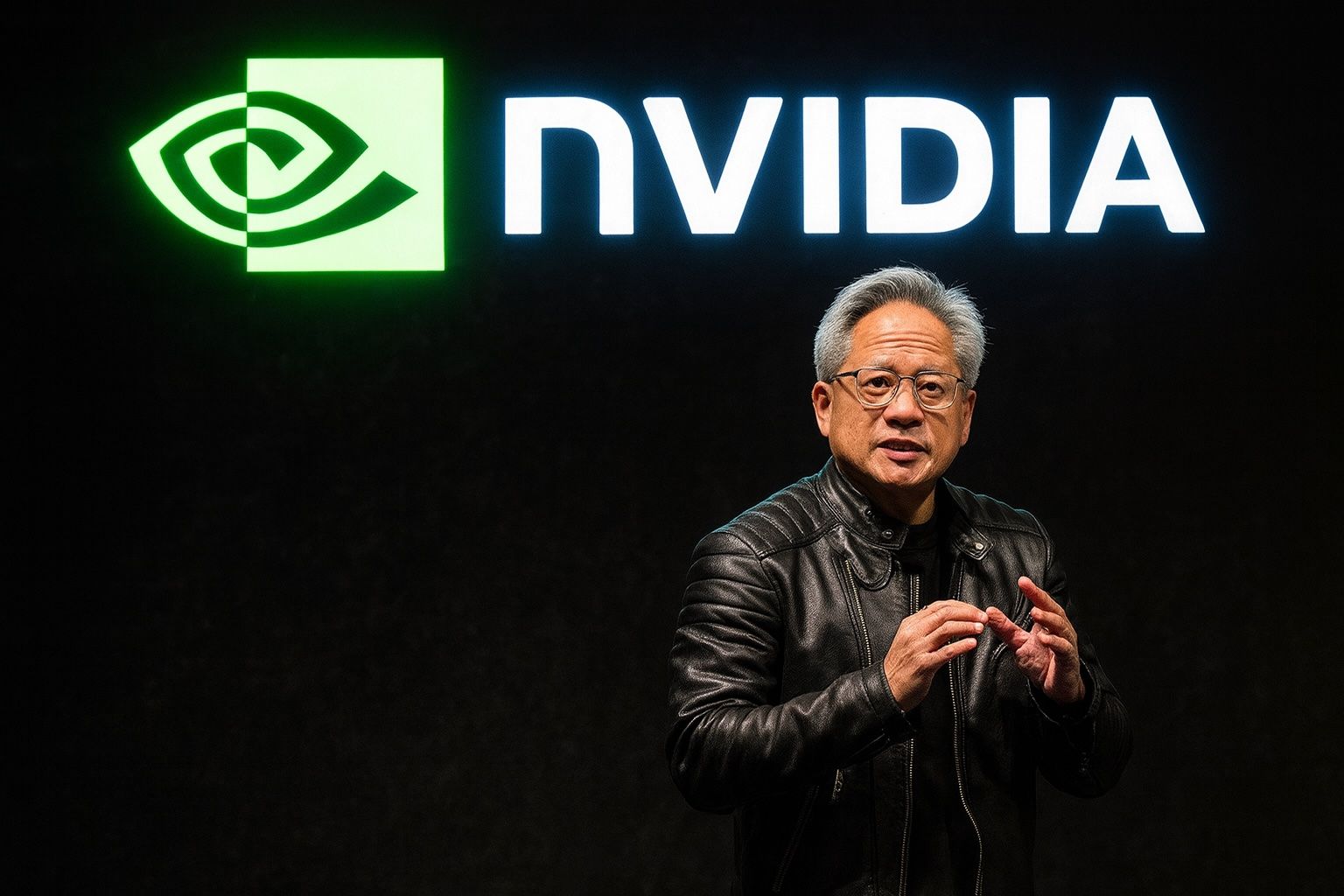

- Current Price: As of Oct 31, 2025, Nvidia NASDAQ:NVDA is trading around $202.89reuters.com, giving the company a market capitalization near $4.93 trillion. The stock is up roughly +30% year-to-date, vastly outperforming the broader marketts2.tech.
- Record Rally: In late October Nvidia briefly touched a $5 trillion valuation – the first company to do soreuters.com – driven by unprecedented demand for its AI-focused GPUs. Its market cap surpassed $4.5T in early October during a week of record gainsts2.tech.
- Blowout Earnings: Nvidia’s Q2 FY2026 (ended July 2025) results were spectacular: revenue of $46.7 billion (up 56% year-on-year) with ~88% of sales from data-center AI chipsts2.techts2.tech. Profit margins are near 72%, and the company guided for another ~54% growth next quarterts2.tech.
- AI Mega-Deals & Partnerships: Nvidia locked in blockbuster deals this month, including a $100 billion GPU supply pact with OpenAI (providing ~10 GW of GPUs)ts2.techts2.tech. It also is investing $2B in Elon Musk’s xAI for a custom supercomputerts2.tech, and even took a $5B equity stake in Intel to co-develop next-gen CPU–GPU systemsts2.tech. Additionally, Nvidia joined a $40B consortium (Microsoft, BlackRock, etc.) to buy 5 GW of AI-ready data centers.
- New Products: This autumn Nvidia rolled out new hardware, including the GeForce RTX 50-series GPUs for gaming and the “DGX Spark” mini AI supercomputerts2.tech. It also continues advancing its Blackwell AI architecture (e.g. unveiling the first US-made Blackwell wafer at TSMC’s Arizona fabreuters.com), cementing its technological lead.
- Government Policy & Trade: Nvidia remains at the center of US–China chip politics. U.S. export controls have forced sales to China down to near zero, jeopardizing 10–15% of revenuets2.techreuters.com. Chinese regulators have responded by halting Nvidia AI chip purchases and stepping up customs inspectionsreuters.comreuters.com. Meanwhile, the Biden/Trump administration has signaled it may allow some advanced chips to China, and TSMC has begun onshoring Nvidia’s Blackwell chip production to the USreuters.comreuters.com in line with the CHIPS Act.
- Analyst Views: Wall Street is broadly bullish. Over 90% of analysts rate NVDA a “Buy”ts2.tech, with average 12-month targets in the $210–$225 rangets2.tech. Some are even more optimistic: HSBC recently lifted its price target to $320 (≈+60% upside)ts2.tech. Contrarians warn that valuations (~50× forward earnings) are lofty; one bear has a $100 target, fearing a “frothy” bubblets2.tech.
- Industry Context: The AI chip market is exploding. Deloitte projects global chip sales will hit ~$697 billion in 2025 (up from $627B in 2024)deloitte.com, largely driven by generative AI. AI-specific chips alone could top $150B in 2025deloitte.com. Nvidia dominates that market share, but rivals are aggressively responding: AMD, Qualcomm, Broadcom and others are all launching AI accelerators or signing mega-deals (e.g. AMD’s 6 GW OpenAI pact)ts2.tech.
- Outlook: In the short term, analysts expect NVDA to stay strong — seasonal patterns and upcoming catalysts (Q3 earnings on Nov 19) could push it past $200ts2.techts2.tech. Consensus year-end forecasts cluster in the low-$200sts2.tech. In the long term, growth drivers include surging AI/data-center demand, new applications (robotics, automotive), and global AI infrastructure buildouts. Key risks are high valuation, supply-chain/geopolitical tensions, and emerging competitionts2.tech.
Nvidia’s Performance & Valuation
Nvidia’s stock has been on a tear in October 2025, fueled by the relentless AI boom. It briefly became the world’s most valuable company (~$4.4–$4.5T) in early Octoberts2.tech. By month-end it hit a record high around $195 per share, before a modest pullback into the low-$180s on profit-takingts2.tech. As of Oct 31, NVDA trades near $202.89reuters.com, well above its closing price of ~$184 on Oct 28. Year-to-date, the stock is up about +30%, far outstripping the S&P 500’s gain. This surge reflects “unrelenting AI spending” driving Nvidia’s revenue and cash flow prospectsreuters.comts2.tech. Veteran analyst Matt Britzman of Hargreaves Lansdown calls the $5T market cap “more than a milestone…it’s a statement” that Nvidia is now an industry creatorreuters.com.
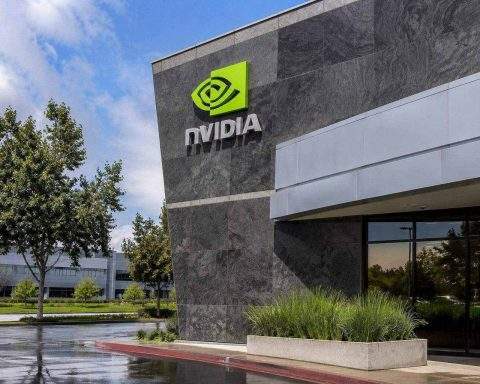
Nvidia’s Santa Clara headquarters. The company’s GPUs have become the backbone of the AI industry, driving a surge in stock price and market value.
However, some caution that expectations are high. Tuttle Capital’s Matthew Tuttle warns that if investors start demanding cash returns instead of growth, the current “AI capex” rally could stallreuters.com. Susquehanna’s Chris Rolland notes that at roughly 50× forward earnings, there’s “little room for error” and a risk of volatilityts2.techts2.tech. In short, the stock’s rise is powerful but not without risks if the AI spending boom were to cool.
Earnings and Financials
Nvidia’s recent financial results underpin the stock’s strength. In late August (Q2 FY2026), Nvidia reported $46.7 billion in quarterly revenue – a 56% jump from a year earlierts2.tech. Data-center (AI) chips drove ~88% of sales (about $41B)ts2.tech. Profit margins were exceptionally high (~72% gross margin) due to the premium pricing of its GPUsts2.tech. The company also provided huge guidance: it expects roughly $54B in revenue for Q3 (about +54% year-over-year)ts2.techts2.tech. Such blowout growth at Nvidia’s scale is almost unheard-of and has investors cheering.
For perspective, this growth is on par with the company’s post-GPU-boom era and far outstrips typical chip growth. Deloitte notes that the semiconductor industry overall grew ~19% in 2024 and forecasts about $697B in sales for 2025deloitte.com, largely driven by AI. Nvidia alone is capturing a sizable slice of that. Analysts see this continuing: consensus estimates (ahead of Q3 earnings on Nov 19) are for about $54.6 billion revenue and $1.24 adjusted EPSts2.tech, which would again handily beat past records. “Investors cheered these blowout numbers,” notes one market commentatorts2.tech.
AI Mega-Deals & Partnerships
Nvidia has aggressively converted AI hype into binding customer and partnership deals that lock in future demand. The splashiest was the OpenAI partnership announced in late September (a letter of intent): Nvidia agreed to supply at least 10 gigawatts (GW) of its top GPUs for OpenAI’s next-gen infrastructure, and even invest in OpenAI itselfts2.techts2.tech. OpenAI CEO Sam Altman encapsulated the logic: “Everything starts with compute,” meaning Nvidia’s GPUs are at the heart of AI breakthroughsts2.tech. The market cheered: Nvidia’s stock jumped ~4% on the news.
Another landmark deal was with Elon Musk’s xAI (TruthGPT). Nvidia agreed to invest about $2 billion to help build xAI’s planned $20B supercomputerts2.tech. In a twist, Nvidia even partnered with rival Intel, taking a $5B stake to co-develop new CPU–GPU chipsts2.tech. This “rival alliance” got Intel’s stock soaring and validates Nvidia’s strategy of seeding the broader ecosystem.
Beyond chips, Nvidia is securing infrastructure. In mid-October it joined a BlackRock-led consortium to acquire Aligned Data Centers for $40 billionts2.tech. This adds ~5 GW of AI-ready data-center capacity (about 80 data centers) to the market, ensuring customers have places to run all those GPUs. Japan is also in the picture: Nvidia partnered with Fujitsu to build national AI supercomputing infrastructure, under a program praised by Jensen Huang as powering the “AI industrial revolution” in Japants2.tech.
Perhaps the single biggest recent move was news on Oct 31 that South Korea will be a major new customer. Nvidia agreed to supply over 260,000 of its latest Blackwell chips to the South Korean government and companies (Samsung, SK hynix, Hyundai, Naver, Kakao)reuters.com. Each of those organizations will get tens of thousands of chips (e.g. 60k to Naver alone) to supercharge AI data centers, smart factories and infrastructurereuters.com. This deal alone underscores how Nvidia is anchoring itself as the backbone of national AI strategies — and it helped make Nvidia the first-ever $5T company on Oct 29reuters.com.
Products and Innovation
Nvidia continues pushing out new hardware. In gaming and desktops, it launched the GeForce RTX 50-series with enhanced AI graphics capabilitiests2.tech. In data centers, its Blackwell architecture (successor to Hopper) is rolling out. Notably, in mid-October Nvidia unveiled the first U.S.-made Blackwell wafer, produced at TSMC’s Arizona fabreuters.com. This is a milestone for onshoring high-end chip production under the U.S. CHIPS Act. The company also showcased the DGX Spark, a micro-AI-supercomputer (small modular box) for enterprise AI.
On the software and platform side, Nvidia is widening its ecosystem. It open-sourced robotics AI tools like the Newton physics engine and Isaac GR00T modelts2.tech. Jensen Huang even speaks of robotics as “the next frontier of physical AI.” The message: Nvidia is more than chips; it’s selling a full-stack AI solution (hardware + software). This strategy creates a “moat” around its productsts2.tech.
Competition in the Chip Race
Despite Nvidia’s lead, the AI chip market has attracted firepower from rivals. AMD scored a huge victory by getting OpenAI to agree to buy ~6 GW of AMD’s MI300 AI chips starting in 2026ts2.tech. That deal even gave OpenAI an option to take a 10% stake in AMD. It sent AMD’s stock up 34% on Oct 6. Oracle also announced it will deploy 50,000 of AMD’s upcoming MI450 GPUs in its cloudts2.tech. Meanwhile Broadcom struck an OpenAI partnership to co-develop custom AI chips (aiming for up to 10 GW by 2026)ts2.tech. Qualcomm recently unveiled its new AI200-series datacenter GPUs, specifically targeting Nvidiats2.techts2.tech. Google, Meta and Amazon are building their own internal accelerators, though those mainly reduce their reliance on Nvidia rather than competing directly yet.
However, industry analysts still say Nvidia “sells every AI chip it can make” and dominates the marketts2.tech. As one Ts2 strategist put it, these competitors validate the booming AI “pie” but so far “won’t dethrone Nvidia’s lead – for now”ts2.tech. Nvidia’s design and software ecosystem (e.g. CUDA) remain unmatched, giving it an enduring advantagets2.tech. Nonetheless, competition and innovation mean Nvidia must keep raising the bar to justify its valuation.
Geopolitical & Regulatory Factors
Nvidia’s fortunes are deeply intertwined with U.S.-China technology tensions. The U.S. has imposed strict export controls on cutting-edge AI chips, effectively banning Nvidia’s top GPUs from direct sale to Chinese customers. As a result, Nvidia’s sales in China have plummeted to near zero, costing an estimated 10–15% of revenuets2.techreuters.com. In response, Nvidia created “neutered” China-specific chips like the H20 (less powerful) and RTX 6000D, but demand for those has been weakreuters.com.
Beijing has struck back. In September, Chinese regulators ordered domestic tech companies to stop buying Nvidia’s AI chips and even cancel some existing orders, accusing the company of monopolistic tacticsreuters.com. In early October, the Financial Times (via Reuters) reported that Chinese customs officials began tightening inspections on imported Nvidia chips (targeting H20 and RTX6000D models) at major portsreuters.com. This is part of China’s effort to promote its own semiconductor industry and blunt U.S. influence. The net effect: an ongoing threat to a chunk of Nvidia’s market.
At the same time, the U.S. government has signaled it might grant exceptions. President Trump (in public comments) said he might discuss allowing Nvidia to sell “super-duper” chips in Chinareuters.comreuters.com. Nvidia’s CEO Jensen Huang was recently in talks with U.S. officials about offering a new Blackwell successor (tentatively “B30A”) to China, but emphasized that such a decision is “up to… the U.S. government”reuters.com. In July the U.S. had briefly allowed Nvidia to resume sales of the H20, even ordering 300,000 units, but China immediately flagged security concernsreuters.comreuters.com.
These geopolitical shifts keep Nvidia in a precarious balancing act (“its biggest bottleneck is… diplomacy,” one trader quippedts2.tech). On the positive side, the U.S. is heavily backing domestic chip production: under the CHIPS Act, Nvidia is bringing some chipmaking to the U.S.. As reported on Oct 17, Nvidia and TSMC produced the first US-fabricated Blackwell wafer at TSMC’s Phoenix plantreuters.com. This “bolsters the U.S. supply chain” and aligns with government goals of tech leadershipreuters.com. It also mitigates potential supply disruptions from Taiwan (Nvidia’s main fabs are in Taiwan and Korea).
Lastly, Nvidia faces a few legal matters. In Europe, a French auto parts maker (Valeo) alleges a former employee stole autonomous-driving code to bring to Nvidia; a trial is set for Novemberts2.tech. Nvidia denies wrongdoing, but any outcome could have implications for its self-driving unit.
Industry and Economic Context
Nvidia’s story cannot be separated from the broader semiconductor and AI context. The semiconductor industry is booming. Deloitte’s latest outlook projects chip sales of ~$697 billion in 2025 (an all-time high) driven by data-center buildouts and generative AIdeloitte.com. The global market is on track for $1 trillion annual sales by 2030. AI chips (CPUs, GPUs, memory, etc.) could top $150+ billion in 2025 alone, with AMD’s CEO forecasting an AI accelerator TAM of $500 billion by 2028.
Moreover, governments worldwide are prioritizing chips and AI. The U.S. CHIPS Act injects ~$52B to boost domestic fabs and R&D. Europe has its own chip acts. This supportive policy backdrop ultimately benefits companies like Nvidia, even if the trade aspects are tricky. It also fuels enterprise spending on AI: banks, retailers, healthcare and others are committing huge budgets to build AI “factories.” Nvidia, by virtue of its GPU leadership, is the primary beneficiary of this global AI investment wave. As one tech strategist noted, “all this AI capex is coming through”ts2.tech, keeping Nvidia in high demand.
At the same time, macro factors like interest rates and global growth play a role. Late October’s calmer inflation data and hints of a Federal Reserve pause helped growth stocks rally, giving Nvidia an additional liftts2.tech. Seasonally, Nvidia has historically tended to rally in late Q4 (October-November) – over the past 19 years it averaged +8.1% gains in this periodts2.tech. Combined with the near-record bullish sentiment, many observers think $200+ is likely in the short term, barring any shocks.
Short-Term and Long-Term Outlook
Short-Term (weeks to months): Nvidia’s immediate catalysts include the upcoming Q3 earnings report (Nov 19), where management has set an aggressive ~54% Y/Y revenue growth target (~$54B)ts2.tech. If Nvidia beats or confirms that, analysts expect another stock pop. Upcoming investor conferences and continuing AI news flow (like any new partnerships or customers) will keep momentum. The current environment of easing inflation, potential Fed cuts, and Sino-American détente (e.g. progress on rare-earths and soybeans) also bodes wellts2.tech. Many strategists have their one-year price targets in the $210–$225 rangets2.techts2.tech, implying modest upside but within reach.
Long-Term (years): Nvidia’s long-term growth drivers are vast: continuous AI demand, expansion of AI into new industries (auto, robotics, healthcare), the advent of new architectures (H100→Blackwell→GH200 supernodes), and more. The company’s software stack (CUDA, AI frameworks) and services (cloud GPU offerings) create recurring revenue angles. If Nvidia maintains its ~80–90% market share in high-end AI chipsts2.tech, the revenue run-rate could soar into the hundreds of billions, making even a $10 trillion market cap conceivable (some analysts are bold enough to suggest it).
However, there are challenges. Geopolitical tensions could limit growth (China’s market is huge but uncertain)ts2.techreuters.com. Supply constraints (TSMC fab capacity) might cap sales in the very short term, although Nvidia and partners are ramping new fabs. Competition may eat into margins or share if alternative chips improve faster than expected. And importantly, the stock’s valuation is already very high (~50× forward EPS), which means any slowdown in AI spending or tech stock selloff could trigger sharp corrections.
Overall, the consensus is optimistic but cautious: Nvidia’s AI leadership gives it tremendous tailwinds, but investors “should brace for a volatile ride”ts2.tech. As one Reuters analysis puts it, Nvidia’s rally “reflects investor confidence in unrelenting AI spending,” but many warn that it “bakes in” future growthreuters.comreuters.com. For now, Nvidia remains the marquee AI stock of 2025 – commanding record highs and driving market euphoria – but its next chapters (post-$5T, post-Q3 earnings) will be closely watched by bulls and bears alike.
Sources: Recent filings and Reuters reportingreuters.comreuters.comreuters.comreuters.comreuters.comreuters.comreuters.comts2.techts2.techdeloitte.comreuters.com, plus analysis from tech news outlets (ts2.tech)ts2.techts2.tech and industry reports.
Related articles: NASDAQ:NVDA