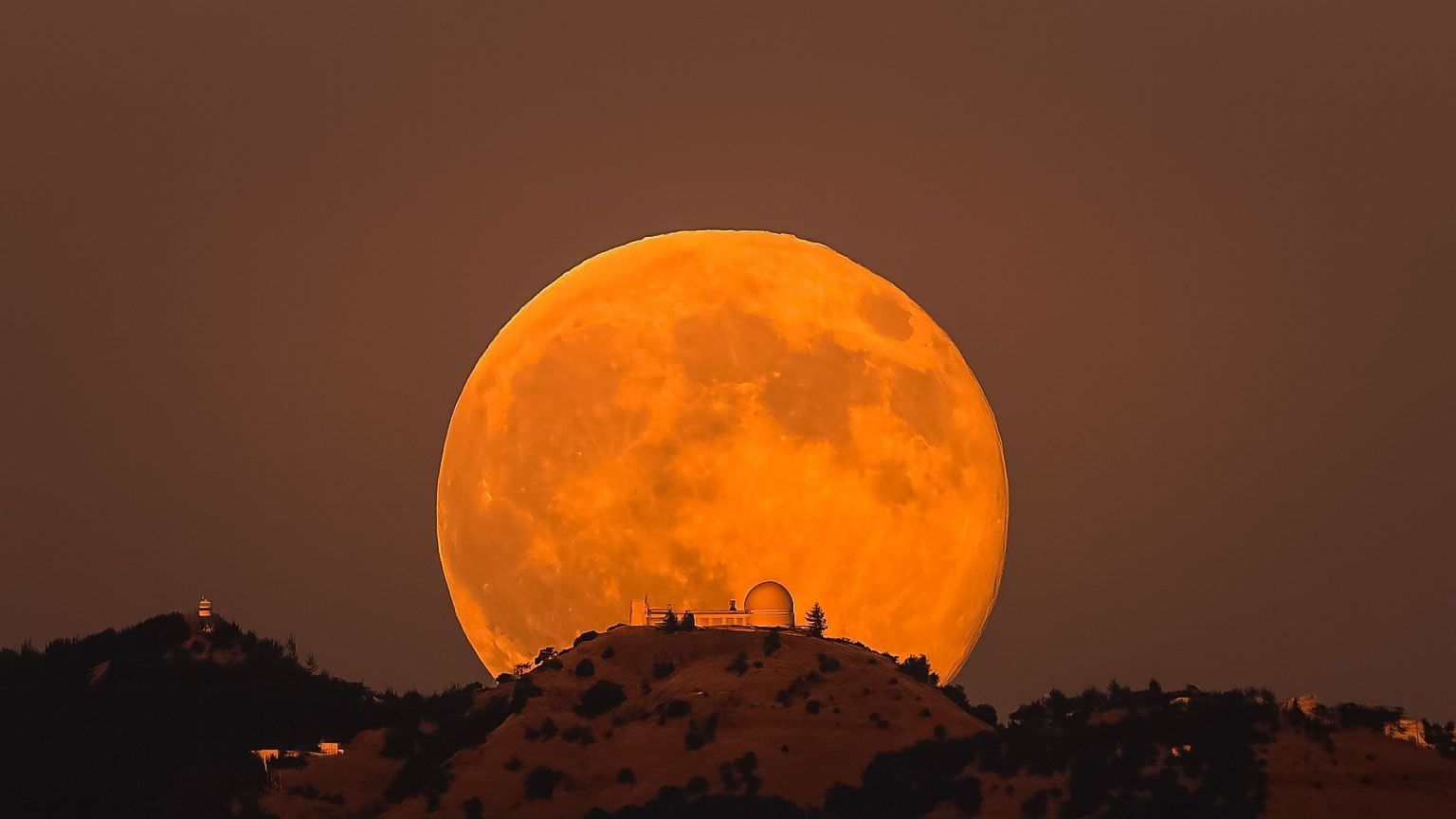

- Today’s phase:Full Moon (a supermoon) — the brightest and closest full Moon of 2025. Peak full moment: 13:19 UTC (8:19 a.m. ET).
- Closest approach (perigee): About 22:30 UTC (5:30 p.m. ET) today at ~356,833 km (221,726 mi) from Earth — the year’s nearest perigee.
- Why “super”: A supermoon happens when a full Moon occurs near perigee; at its closest, it can look ~14% larger and ~30% brighter than the faintest full Moon. NASA Science
- Largest since 2019: Multiple outlets note today’s full Moon is the closest/brightest since February 2019.
- Illumination & age:~100% illuminated; lunar age ~14.8 days in the 29.5‑day cycle.
- What it’s called: Because 2025’s Harvest Moon fell in October, many astronomers call today’s full Moon the Hunter’s Moon; it’s also widely called the Beaver Moon in North American folklore. Both names are used this year.
- Where to look: The Moon looks full all night; best “wow” views at moonrise and moonset (the moon illusion). Tomorrow (Nov 6) it appears near the Pleiades star cluster. Time and Date
- Tides: Expect perigean spring tides (a modest bump above typical spring tides); local weather and coastline shape dominate actual impacts.
- What’s next: Last Quarter Nov 12 (05:28 UTC); New Moon Nov 20 (06:47 UTC); another supermoon Dec 4.
Today’s Moon, explained
At 13:19 UTC (08:19 ET) the Moon reached the exact Full Moon moment — the point when Sun, Earth and Moon line up with Earth in the middle. Timeanddate summarizes it neatly: “Full Moon is the only phase where the Moon is up all night.” Time and Date
Later today, around 22:30 UTC, the Moon hits perigee (its closest point this month), tightening the geometry into what popular usage calls a supermoon. NASA’s definition: “A ‘supermoon’ occurs when a full Moon coincides with the Moon’s closest approach to Earth in its elliptical orbit, [perigee].” The result is a disk that can appear up to ~14% larger and ~30% brighter than a full Moon near apogee. NASA Science
Because perigee arrives only ~9 hours after the full‑phase moment, tonight’s Moon is 2025’s biggest and brightest — and the closest since 2019, according to multiple sky‑watching briefings.
How bright/big will it really look?
Perception is tricky. Space.com notes the physics says “bigger/brighter,” but Sky & Telescope editor Alan MacRobert cautions: “That’s not enough to notice unless you’re a very careful moon‑watcher.” Look near the horizon at moonrise for maximum wow — that’s the moon illusion at work, not actual size change. Space
Where it is in the sky
At the instant of full phase, the Moon sits near the Aries–Taurus boundary; by Nov 6 evening it drifts into Taurus near the Pleiades — a pretty pairing for binoculars.
Names & folklore: Hunter’s Moon vs. Beaver Moon (why both are right this year)
“Hunter’s Moon” is defined by sequence: it’s the full Moon after the Harvest Moon. Because 2025’s Harvest Moon was in October, the November full Moon becomes the Hunter’s Moon. At the same time, many lists traditionally label November’s full Moon the Beaver Moon (and also Frost/Freezing Moon), so you’ll see both names used in media today. Timeanddate explicitly flags the dual usage this year; EarthSky headlines “Super Hunter’s Moon” for Nov 5–6. Time and Date
Tides: what to expect
NOAA explains: “A perigean spring tide occurs when the moon is either new or full and closest to Earth.” That alignment can nudge high tides slightly higher and low tides slightly lower than typical spring tides. Actual flooding risk depends on your local coastline, weather, and pressure systems (stormy onshore winds matter far more than the supermoon itself). National Ocean Service
NASA adds that supermoons can “cause higher tides than usual,” but again the effect is modest by itself. If you live along flood‑prone coasts, check your local tide forecasts. NASA Science
What to look for on the Moon tonight
Even though shadows are minimal at full phase, several features pop:
- Tycho’s bright ray system splashes across the southern hemisphere — a classic full‑Moon sight in binoculars. (Sky at Night & NASA feature guides).
- Copernicus also shows a brilliant spray of rays across Oceanus Procellarum. (Sky at Night).
NASA’s general Moon viewing guide has quick pointers if you want to go beyond naked‑eye viewing.
How to see (and shoot) it best
- When: Tonight at moonrise (east) and pre‑dawn near moonset (west). It will look nearly as full tomorrow as well.
- Where: Find an unobstructed horizon (waterfronts, fields, rooftops). If you’re clouded out, tomorrow’s moonrise offers a near‑identical view.
- Photography tips NASA: Turn flash off, lower exposure so the Moon looks gray, not white; use a timer or tripod to avoid blur; treat lunar shots like daylight exposures if you want surface detail.
Related sky events in the next days
- Southern Taurids peak Nov 4–5; expect slow fireballs, but tonight’s full Moon will wash out fainter meteors. Northern Taurids peak Nov 11–12; Leonids peak Nov 16–17 under darker skies.
Expert voices (short quotes)
- NASA (definition): “A ‘supermoon’ occurs when a full Moon coincides with the Moon’s closest approach to Earth…[perigee].” NASA Science
- NOAA (tides): “A perigean spring tide occurs when the moon is either new or full and closest to Earth.” National Ocean Service
- Alan MacRobert, Sky & Telescope (perception): “That’s not enough to notice unless you’re a very careful moon‑watcher.” Space
- Noah Petro, NASA LRO (why orbits vary): “You have all of these different gravitational forces pulling and pushing on the moon…which gives us opportunities to have these close passes.” Space
- Timeanddate (visibility): “Full Moon is the only phase where the Moon is up all night.” Time and Date
Deeper details & data
- Full Moon exact time:13:19 UTC (08:19 ET). Last Quarter:Nov 12, 05:28 UTC. New Moon:Nov 20, 06:47 UTC. Next supermoon:Dec 4.
- Perigee timing & distance: ~22:30 UTC at 356,833 km (221,726 mi). (Distance at the exact full‑phase moment is slightly different; perigee is the closest.)
- Age & illumination today: ~14.8 days, ~100% illuminated.
- “Closest since 2019” context: Widely reported by astronomy outlets and general media ahead of tonight’s event. Live Science
What the news is saying (today and the last few days)
- Washington Post highlights that it’s the closest since 2019, with notes on king tides in some U.S. regions.
- TIME and The Guardian flag it as 2025’s biggest supermoon, with when/where to watch.
- LiveScience gives the distance (356,980 km) and best viewing tips; AP offers a concise explainer and visibility guidance.
Sources & further reading
- Exact phase times & naming: Timeanddate’s November 2025 Moon guide (full at 13:19 UTC, naming discussion: Hunter’s vs Beaver), plus its general Moon‑phase explainer.
- Supermoon basics & 2025 supermoon dates: NASA Moon pages on supermoons, phases, and the 2025 dates list.
- Perigee details: Space.com’s observing advisory with perigee time/distance.
- Distance at full, perceived size: LiveScience and Forbes roundups on the “closest since 2019.” Live Science
- Lunar age/illumination snapshot: TheSkyLive’s daily Moon page.
- Tides: NOAA on perigean spring tides.
- Meteor showers: American Meteor Society calendar; EarthSky on Taurids & Leonids.
- Observing features at full: BBC Sky at Night and NASA’s Tycho resources.
Bottom line: Today (Nov 5, 2025) delivers the supermoon of the year — full at 13:19 UTC, closest around 22:30 UTC. Step outside at moonrise or moonset, enjoy the glow, and watch for Tycho’s bright rays while the Hunter’s/Beaver supermoon lights up the sky.
Related articles: Night Sky