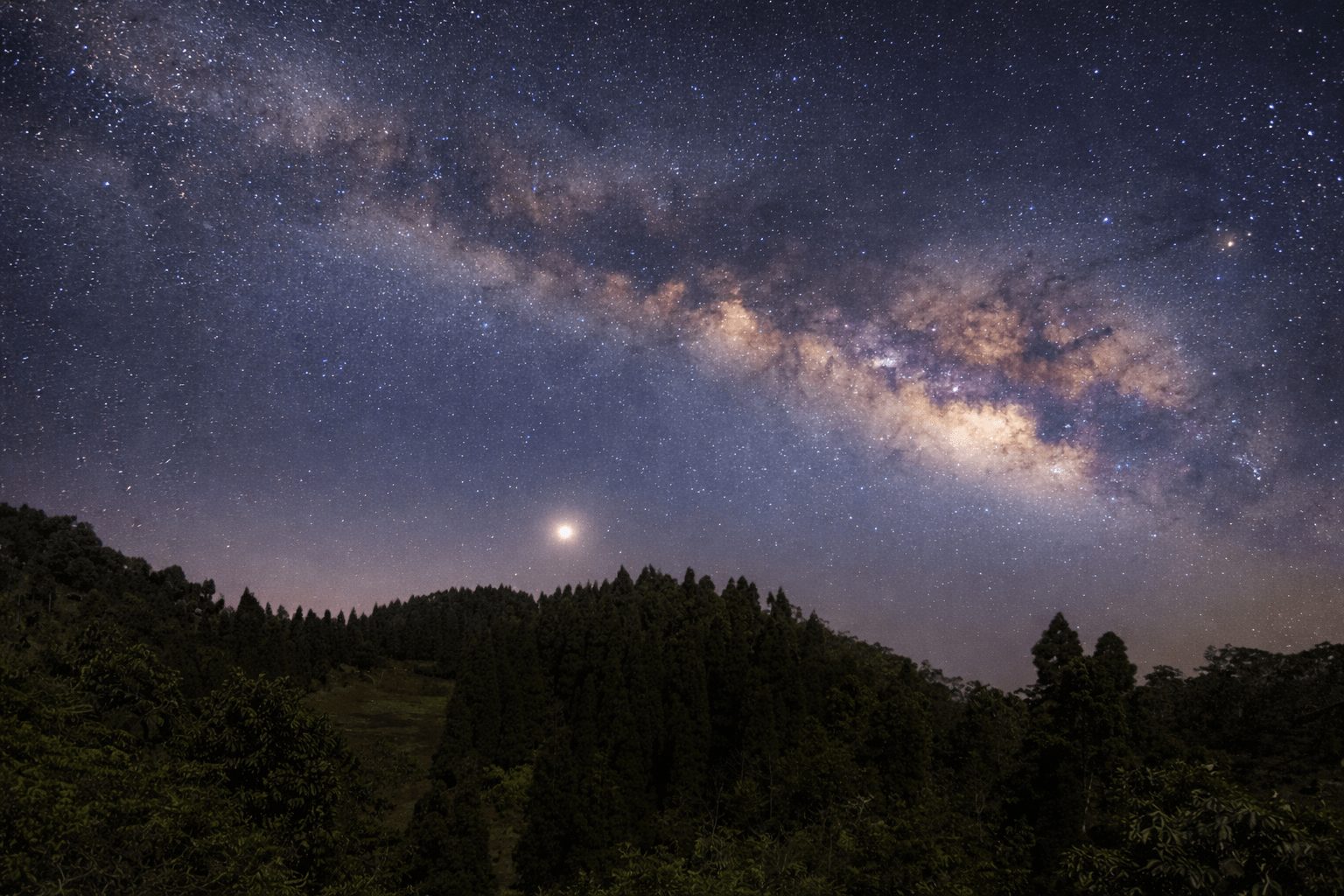

The “Night Sky Today” headline for 22.12.2025 is basically a gift-wrapped astronomy combo: the Ursid meteor shower is peaking on the darkest nights of the month, the Moon is only a slim waxing crescent (so it won’t wash out faint meteors), and bright Jupiter is dominating the late-evening sky. Add in a NOAA space-weather forecast calling for minor geomagnetic storming (the kind that can boost aurora chances), and you’ve got one of the most watchable late-December skies in years—assuming clouds don’t crash the party. NOAA SWPC+3TIME+3American Meteor Society+3
Below is a detailed, news-focused guide to what’s happening in the sky tonight and into the early hours of tomorrow—plus the next big dates to circle as we roll toward the New Year.
Night Sky Today highlights for 22.12.2025
Tonight’s biggest “look up” moments are clustered into three categories:
1) Meteor shower peak (Ursids): A modest shower, but perfectly timed for long solstice-season nights and minimal moonlight. TIME+2American Meteor Society+2
2) Aurora boost potential: NOAA’s latest 3-day outlook flags likely G1 (minor) geomagnetic storming on Dec. 22–23, which can push auroras farther from the poles than on a quiet night. NOAA SWPC+1
3) Bright planets: Jupiter is up for much of the night, while Saturn is best in the early evening. Uranus and Neptune remain binocular targets for the patient.
And in today’s broader stargazing news: the UK’s dark-sky tourism scene got a fresh spotlight with coverage of the Lake District’s Grizedale Observatory—an example of how “night sky” isn’t just a science hobby right now, it’s a travel trend with real infrastructure behind it. The Guardian
Ursid meteor shower peak: when to watch and where to look
What the Ursids are (and why they matter tonight)
The Ursids are the final notable meteor shower of 2025, caused by Earth passing through debris shed by Comet 8P/Tuttle. They’re not a “storm” shower—typical rates are roughly 5–10 meteors per hour under dark skies—but they have a reputation for occasionally surprising observers with short-lived bursts. TIME+2American Meteor Society+2
Peak timing: the practical version
Multiple skywatching reports converge on the night of Dec. 21–22 into the morning of Dec. 22, with another solid opportunity the night of Dec. 22–23, depending on your longitude and local weather.
For the “precision nerd” version, the American Meteor Society notes a predicted maximum around 10:00 UT on Dec. 22 (which is 5 a.m. EST / 2 a.m. PST), and also flags a possible earlier enhancement tied to a filament of debris. American Meteor Society
EarthSky places a predicted peak around 11 UTC on Dec. 22, 2025, essentially the same window. EarthSky
Where in the sky do the meteors come from?
Ursid meteors appear to radiate from Ursa Minor (the Little Dipper), near the star Kochab—a region that stays in the northern sky for many observers in the Northern Hemisphere. That’s why the shower is effectively a Northern Hemisphere event and is poorly placed (or not visible) far south of the equator.
The best way to actually see them (no gear required)
Meteor showers reward comfort and stubbornness more than equipment.
- Go darker than you think you need. Even modest light pollution can erase the faint streaks.
- Give your eyes 20–30 minutes to adapt to darkness (avoid phone screens; if you must use one, dim it).
- Don’t stare at the radiant. Look at a broad patch of sky, roughly halfway up, away from bright lights.
- Stay at least an hour. Meteors come in clusters and lulls; short sessions are how people convince themselves nothing is happening.
Moon phase tonight: a thin waxing crescent means darker skies
If the Moon were bright tonight, the Ursids would be a lot less fun. Fortunately, the Moon is a waxing crescent at roughly ~5% illumination on Dec. 22, 2025—small enough that it’s not the main light source in the sky, and it sets relatively early in many locations.
For context:
- The previous New Moon occurred on Dec. 19, 2025 (time varies by location).
- The next First Quarter Moon arrives around Dec. 27, 2025.
Translation: tonight is in the “sweet spot” where the sky gets properly dark for meteors and deep-sky objects—before the Moon brightens the late evening later this week. TIME+1
Planets tonight: Jupiter rules late evening, Saturn shines after sunset
Jupiter: the bright headline planet
Jupiter is the easiest planet to spot right now: bright, steady-looking, and visible for much of the night. In many mid-northern locations, it’s up from evening through dawn. (Exact rise/set times depend on where you are.
The “big news” for Jupiter is what’s coming next: it reaches opposition around Jan. 9–10, 2026 (depending on time zone), when it’s up all night and at its brightest for the year. EarthSky pins opposition at Jan. 10, 2026 (around 9 UTC), which means the “best nights” are really the entire window around those dates. EarthSky+1
If you have binoculars, you can often see Jupiter’s four Galilean moons as tiny points lined up near the planet. With a small telescope, you’ll start catching cloud bands and, on good nights, more subtle detail.
Saturn: best early, then gone by late night
Saturn is currently an early-evening object: look for it not long after sunset, lower in the sky than Jupiter for many Northern Hemisphere observers.
If you’ve never seen Saturn through a telescope, this is your seasonal reminder: it’s one of the few objects that reliably triggers an involuntary “wait… that’s real?” reaction.
The other planets: harder targets right now
Depending on your location, skywatching maps indicate Mercury, Venus, and Mars are all relatively close to the Sun right now—meaning twilight glare makes them difficult or impossible for casual viewing. Uranus and Neptune remain possible with binoculars (and easier with a telescope), but you’ll want a planetarium app or a local sky map to nail the exact patch of sky.
Aurora alert: NOAA forecasts minor geomagnetic storming on Dec. 22–23
This is a legitimately newsy add-on to tonight’s sky: NOAA’s Space Weather Prediction Center issued a 3-day forecast indicating the greatest expected Kp is 5.00 (G1/minor) for Dec. 22–24, and explicitly notes that G1 geomagnetic storms are likely on Dec. 22–23 due to coronal hole high-speed stream influences.
What that means in human terms:
- Auroras become more likely and more widespread than on a quiet night—especially across higher latitudes.
- Visibility still depends on cloud cover, light pollution, and timing (aurora can surge and fade quickly).
- Your best move is to consult NOAA’s Aurora Viewline and related dashboard products for “how far south” the oval may dip tonight. NOAA Space Weather Prediction Center
If you’re in a region that sometimes gets aurora on active nights, tonight is the kind of forecast that justifies at least one “walk outside and check the northern horizon” moment.
Interstellar comet 3I/ATLAS: still a telescope target as it heads out
While meteors and auroras are the big naked-eye stories, December 2025’s deeper astronomy headline is still Comet 3I/ATLAS—a rare interstellar visitor and only the third confirmed interstellar object observed passing through our solar system.
Key recent updates:
- The comet made its closest approach to Earth on Dec. 19, 2025, staying a safe distance away at about 1.8 AU (~170 million miles / ~270 million km).
- NASA emphasizes it poses no threat and remains far from Earth, while astronomers continue investigating its size and properties.
- NASA’s Parker Solar Probe captured observations of the comet during a window when it was difficult to observe from Earth due to its proximity to the Sun in our sky—one example of how multiple missions and observatories have been coordinated to study it.
Can you see it tonight?
Not with the naked eye. This is firmly a telescope object, and it’s fading as it exits. But for backyard astronomers with the right setup (and a good finder chart), this week remains part of the “catch it while you can” period. AP News+1
Solstice afterglow: the longest nights are here (and people celebrated)
The winter solstice—astronomical winter’s start in the Northern Hemisphere—occurred on Dec. 21, 2025 at 15:03 UTC (timing depends on location/time zone). That matters for stargazers because it delivers maximum nighttime hours right when late-December sky events are stacking up.
It also matters culturally. Over the weekend, crowds gathered for solstice sunrise celebrations at Stonehenge, a reminder that “watching the sky” is one of humanity’s oldest recurring habits—older than writing, older than most religions, older than basically everything except boredom and wonder. AP News
Next up: the dates to mark after tonight
If you’re building a short “Night Sky Today → Night Sky This Week” plan, here are the most time-sensitive upcoming moments:
- Dec. 26, 2025: The Moon passes close to Saturn in the evening sky (a friendly naked-eye pairing, prettier with binoculars).
- Dec. 27, 2025:First Quarter Moon, meaning brighter evenings and less ideal conditions for faint meteors.
- Jan. 3, 2026: The Wolf Moon (full moon) peaks around 10:02–10:03 UTC (time varies by time zone).
- Jan. 4, 2026: The Quadrantid meteor shower is predicted to peak around 00:36 UTC, but moonlight from the just-full Moon is expected to interfere significantly.
- Jan. 9–10, 2026:Jupiter at opposition (depending on where you live), the best all-night Jupiter viewing window of the season.
Bottom line for Night Sky Today
If you step outside tonight—22.12.2025—the highest-probability “wow” is the Ursid meteor shower during the late night and pre-dawn hours, boosted by a thin crescent Moon that won’t flood the sky with glare. American Meteor Society+2TIME+2
Your bonus roll is the aurora forecast: NOAA is calling for minor storming (G1) likely on Dec. 22–23, which can make the northern lights more reachable than usual for some regions.
And if you’re more of a planet person than a meteor person, Jupiter is the bright, unmissable anchor—now—while opposition in early January is the moment when it becomes a true all-night ruler of the sky.