
NEW YORK, August 9, 2026, 18:16 EDT
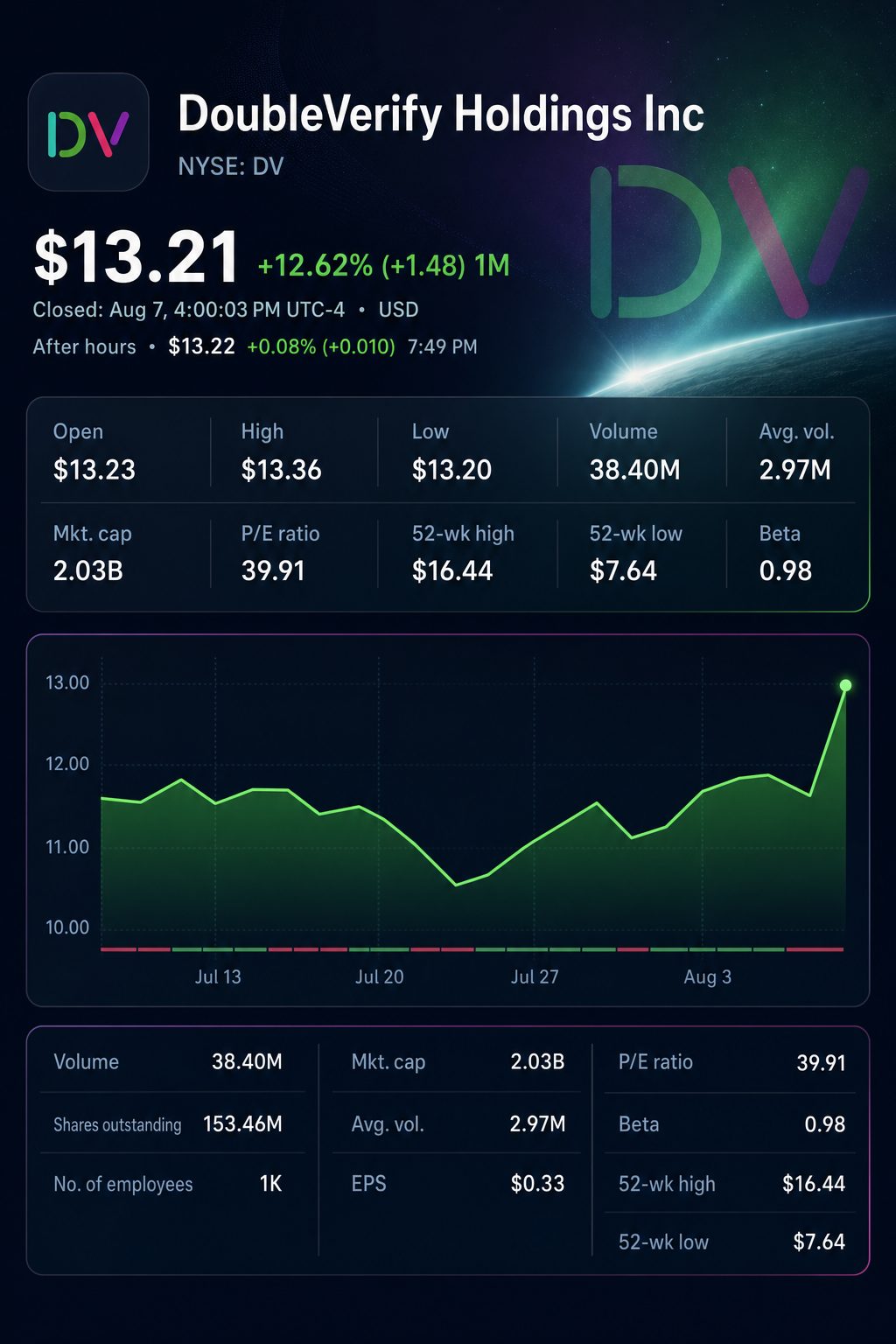
- U.S. markets did not open on Sunday. DoubleVerify closed Friday at $13.21, resulting in a 39-cent difference from Nielsen’s cash bid.
- The revised filing on Friday updated the projected closing timeframe to the first quarter of 2027, previously listed as the fourth quarter of 2026.
- The company posted a 3% increase in second-quarter revenue, but retracted its outlook and halted investor calls.
DoubleVerify Holdings NYSE:DV closed Friday trading 2.95% lower than Nielsen’s $13.60 per share cash bid. The stock surged 12.8% following announcement of the $2.15 billion deal.
The projected return now appears modest compared to the announced schedule. An initial estimate using the March 31 closing results in a 4.6% annualized return prior to fees and taxes.
That amounts to just 0.6 to 0.7 percentage point higher than Treasury-bill yields recorded on Friday. The 26-week bill closed with a coupon-equivalent yield of 3.93%. The 52-week bill posted a rate of 4.01%.
| Metric or assumption | Value | Investor implication |
|---|---|---|
| Nielsen cash offer | $13.60 | Offer is fixed |
| August 7 closing price | $13.21 | $0.39 under the offer |
| Gross spread | 2.95% | Excludes fees and taxes |
| Closing on December 31, 2026 | 7.5% annualized | Early close scenario |
| Closing on March 31, 2027 | 4.6% annualized | End-of-quarter scenario |
| 26-week Treasury bill | 3.93% | Yield as coupon equivalent |
| 52-week Treasury bill | 4.01% | Yield shown as coupon equivalent |
Returns are calculated from the closing price on August 7. The figures are based on settlement at closing without factoring in any probability adjustments. December 31 is used for illustration; according to the updated filing, the transaction is expected to close by the end of the first quarter of 2027.
The downside reference now encompasses a broader range. Falling back to Thursday’s $11.71 close would represent an 11.4% drop from Friday’s level, nearly quadrupling the potential remaining upside. This is intended as a reference point, not a prediction.
DoubleVerify rose 17.4% over the past week. Trading volume on Friday hit 38.4 million shares, almost 13 times higher than its recent average. The move indicates investors had mostly anticipated completion.
The updated timing was disclosed in an 8-K/A filed on Friday. The company’s Thursday statement previously targeted completion by end-2026. The amended document revised this to the first quarter of 2027, noting that all other aspects remained unchanged.
The deal received approval from both boards. Providence Equity Partners affiliates, which own roughly 11.8% of DoubleVerify shares, have committed to backing the transaction. It is still subject to shareholder and regulatory clearances.
Nielsen CEO Karthik Rao described the agreement as bringing together “trusted audience intelligence with verified media delivery.” DoubleVerify CEO Mark Zagorski pointed to “expanded resources to deliver new, market-leading solutions.” ADVFN Italy
The acquisition coincided with uneven quarterly earnings. Gains in measurement speed and supply-side activity helped balance a drop in activation revenue, which is DoubleVerify’s top segment.
| Second-quarter metric | Q2 2026 | Year-on-year change | Revenue share or margin |
|---|---|---|---|
| Activation revenue | $107.7 million | down 1% | 55.6% |
| Measurement revenue | $66.8 million | up 6% | 34.5% |
| Supply-side revenue | $19.3 million | rose 13% | 10.0% |
| Total revenue | $193.8 million | increased 3% | 100% |
| Adjusted EBITDA | $65.3 million | — | 34% margin |
| Cash | $210 million | — | No debt outstanding |
Data as reported by the company. Initial revenue share estimates may not add exactly due to rounding.
Cash generation saw a significant uptick for the quarter. Free cash flow increased by 64% to reach $65.7 million. However, free cash flow for the first six months decreased 16.9% to $59.4 million. That softer half-year result is notable should the acquisition not succeed.
DoubleVerify retracted all previously issued guidance and paused both earnings and investor calls during the ongoing transaction. For now, the main short-term indicators are regulatory filings, materials for voting, and the merger spread.
Analysts promptly adjusted their ratings to align with the offer price. The following moves were recorded on August 6 and August 7.
| Analyst | Firm | Recommendation change | Price-target change |
|---|---|---|---|
| Alec Brondolo | Wells Fargo Securities / Wells Fargo NYSE:WFC | Underweight raised to Equalweight | $8.00 increased to $13.60 |
| Nat Schindler | Scotiabank NYSE:BNS | Downgraded from Sector Outperform to Sector Perform | $15.00 lowered to $13.60 |
| Brian Pitz | BMO Capital Markets / Bank of Montreal NYSE:BMO | From Outperform to Market Perform | $15.00 decreased to $13.60 |
| Andrew Marok | Raymond James Financial NYSE:RJF | Downgrade: Outperform to Market Perform | Not stated |
| Matthew Swanson | RBC Capital Markets / Royal Bank of Canada NYSE:RY | From Outperform changed to Sector Perform | $14.00 revised to $13.60 |
The revisions to ratings are largely driven by the transaction cap and do not indicate an overall decline in analyst sentiment. Data from MarketScreener, based on input from 15 analysts, recorded a Hold consensus and an average price target of $13.52.
Integral Ad Science, acquired by Novacap in December 2025, represents the most comparable case in the sector. The $1.9 billion transaction came amid ongoing consolidation among independent media measurement firms.
| Target | Buyer | Cash value | Announced premium | Outcome or timetable |
|---|---|---|---|---|
| DoubleVerify | Nielsen | $2.15 billion enterprise value | 30% to 60-day VWAP | Transaction anticipated by Q1 2027 |
| Integral Ad Science | Novacap | About $1.9 billion | 22% to prior closing price | Finalised December 23, 2025 |
The premiums rely on separate reference prices, making direct comparison impossible.
As trading picks up again Monday, investors will monitor if the spread stays close to 3%. Focus will later move to the proxy filing, the timing of the special meeting, and the regulatory review process. DoubleVerify has stated it plans to submit a proxy statement but has not specified when it will file.
Risks: The deal faces potential delays, obstruction or cancellation. Shareholder and regulatory consents are still pending. A protracted timeline would lower the annualized yield, and if the agreement collapses, falling activation levels and retracted guidance could deepen losses.