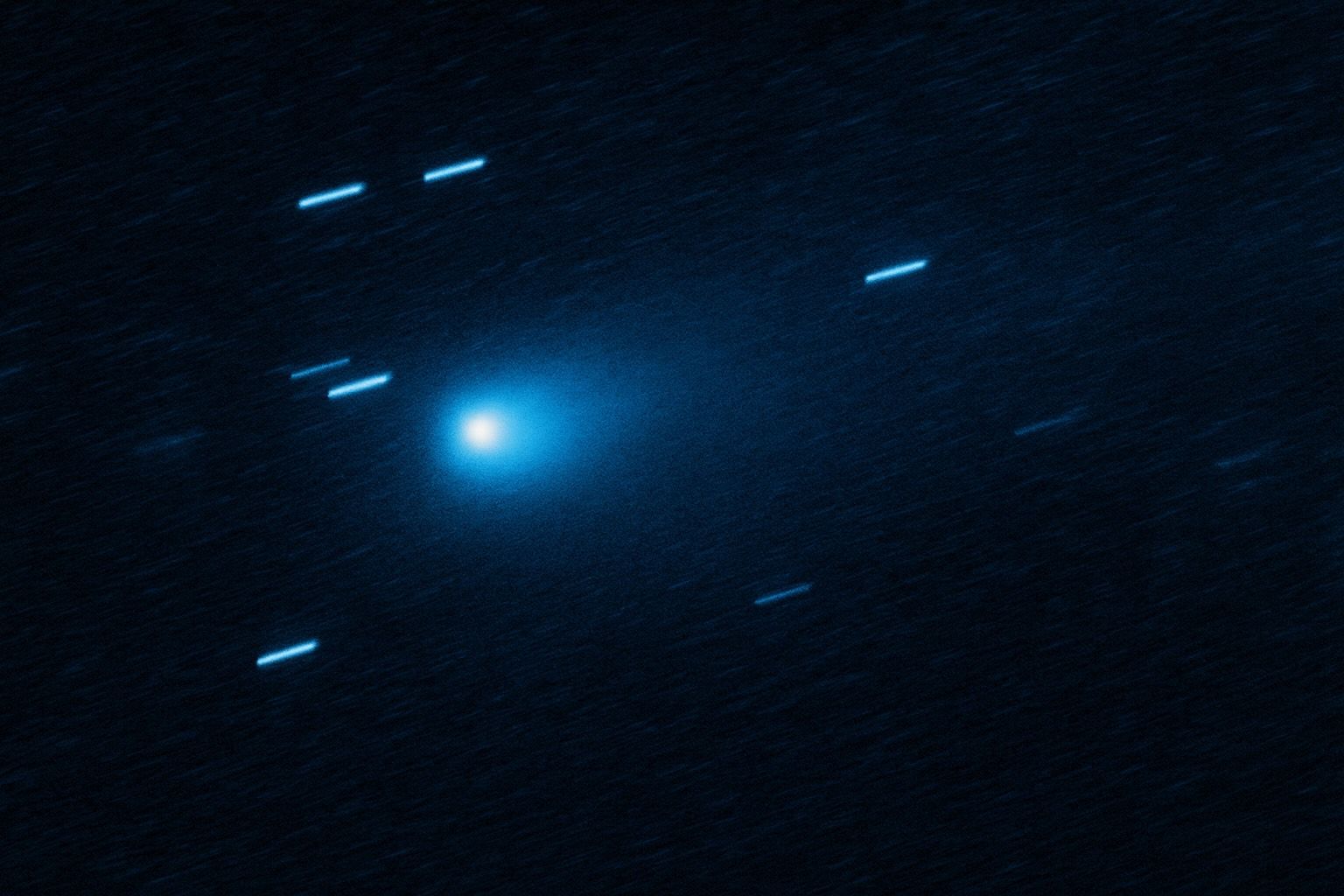

Interstellar comet 3I/ATLAS has rocketed into headlines: it’s only the third known visitor from another star system, it just swung around the Sun, it’s growing a dramatic tail, and it’s even been detected in radio waves – prompting a flurry of “is it aliens?” stories. NASA Science+2Live Science+2
But if you’re a skywatcher, the burning question is simpler:
Can I actually see comet 3I/ATLAS with my eyes, my camera, or my telescope?
Here’s the short answer, then we’ll dive into the details.
Quick answer
- Naked eye:
No. 3I/ATLAS is far too faint and will never become visible without optical aid, even from the darkest skies on Earth. - Ordinary camera (phone / DSLR on a static tripod):
Not realistically. It’s possible for experienced astrophotographers with tracking mounts and long exposures, but a casual handheld or single-exposure shot won’t capture it. - Telescope (including smart telescopes):
Yes, this is where it becomes accessible.
You’ll need at least an 8-inch (20 cm) telescope for a visual glimpse, or a smart scope / imaging setup that can stack long exposures to reveal the faint comet and its tail.
The rest of this article explains how bright 3I/ATLAS actually is, where it is in the sky right now, and what gear you realistically need to see or photograph it.
What is 3I/ATLAS, and where is it now?
3I/ATLAS (also designated C/2025 N1 (ATLAS)) is an interstellar comet discovered on 1 July 2025 by the ATLAS survey telescope in Chile. It’s on a hyperbolic orbit, meaning it came from outside our Solar System and will never return once it leaves.
Key facts:
- Origin: Its past trajectory traces back beyond the Solar System; models suggest it may have been wandering space for billions of years.
- Perihelion (closest to the Sun):
~1.36 AU (between Earth and Mars) on 29–30 October 2025. - Closest to Earth:
About 1.8 AU (~270 million km / 170 million miles) on 19 December 2025, so it stays very far away and poses no threat.
In mid‑November 2025, 3I/ATLAS has just re-emerged from behind the Sun and is now a predawn object in the constellation Virgo, around magnitude 10—bright enough for moderate telescopes and astrophotography, but hopeless for the unaided eye.
Over the coming weeks it will slide northward into Leo, passing not far from the bright star Regulus around its closest approach to Earth on 19 December 2025, before fading as it heads back into deep space.
Can you see 3I/ATLAS with the naked eye?
No – and that will not change.
Under excellent dark skies, the human eye can usually detect stars down to about magnitude 6. 3I/ATLAS:
- Was originally forecast to peak at about magnitude 11–12, already far below the naked‑eye threshold.
- Has recently been measured around magnitude 9.9, slightly brighter than expected, but still about 40 times fainterthan the dimmest stars most people can see.
Independent skywatching guides from EarthSky and BBC Sky at Night are blunt about this:
they note that 3I/ATLAS “will never be visible with the eye alone” and will remain a telescopic target only. EarthSky+1
So if you step outside and look up hoping to spot a glowing green interstellar visitor next to a bright star: you simply won’t see it. At best, even in a telescope, it appears as a tiny fuzzy patch, not a dramatic comet like the famous “great comets” of the past.
Can you photograph 3I/ATLAS with a camera?
Smartphones
- On their own: no.
Phone cameras can pick up bright comets and the Milky Way, but 3I/ATLAS is far too dim. - Through a telescope with live stacking: possibly.
If you attach a phone to a smart telescope or a tracking telescope with an app that stacks frames, you may be able to get a record shot. But the telescope is doing most of the work here.
DSLR / mirrorless astrophotography
This is where determined amateurs can really start to capture 3I/ATLAS.
Recent images from the Virtual Telescope Project in Italy used a robotic telescope and 18 separate 120‑second exposures stacked together to show a sharply defined ion tail, even with the comet low on the horizon and a bright Moon in the sky.
That gives a good sense of what’s required:
- Sky conditions
- Dark, transparent skies.
- Comet high enough above the horizon (at least 15–20° is ideal).
- Mount
- A tracking equatorial mount is strongly recommended.
- Optics
- Small refractor (e.g. 60–80 mm) or telephoto lens (135–300 mm).
- Camera settings (starting point)
- ISO 1600–3200
- Individual exposures of 30–120 seconds (depending on tracking and focal length)
- Capture at least 20–50 frames and stack them using software (e.g. DeepSkyStacker, Siril, PixInsight).
Because the comet is diffuse, total integration time matters more than any single exposure. Think in terms of tens of minutes of total exposure to reveal the tail.
Smart telescopes
The Wikipedia observability notes and several observing reports mention that 3I/ATLAS has already been captured by plate‑solving smart telescopes with apertures of about 3–4.5 inches (7.6–11.4 cm) that automatically stack images.
These “point‑and‑shoot telescopes” (such as Seestar or Dwarf‑class devices) are arguably the easiest way for most non‑experts to “see” 3I/ATLAS in 2025:
- You select the comet from an app.
- The scope slews, plate‑solves and tracks it.
- The software stacks dozens or hundreds of short exposures.
- Over a few minutes, the comet gradually appears on your screen with a faint coma and tail.
Can you see 3I/ATLAS in a telescope?
Visual observing (through an eyepiece)
Here the verdict is more encouraging – if you have enough aperture and dark skies.
- EarthSky stresses that you’ll need at least an 8‑inch (20 cm) telescope to have a realistic chance of seeing 3I/ATLAS visually.
- The observability estimates compiled on Wikipedia similarly indicate that, given its diffuse nature, a 300 mm (12‑inch) telescope may be required for comfortable visual detection at fainter magnitudes.
What you can expect at the eyepiece:
- A small, slightly blurred “star” or soft glow, perhaps a hint of a stubby tail in very good conditions.
- It will not look like the dramatic, long‑tailed images from big observatories or online — those are usually the result of long exposures on large telescopes.
Tips for visual observing:
- Dark skies matter more than magnification.
Start with a wide‑field eyepiece (low power) to locate the comet, then gently increase magnification. - Use averted vision (looking slightly to the side of the comet) to tease out its faint glow.
- Observe when it’s highest in the sky from your location to minimize atmospheric extinction.
Electronic‑assisted observing
If you attach a camera to your telescope and use live stacking (often called EAA – Electronically Assisted Astronomy):
- Even a smaller telescope (e.g. 4–6 inches) can show the comet quite nicely on a laptop or tablet screen after a few minutes of stacking.
- This is very similar in spirit to what the Virtual Telescope Project did, just on a smaller scale.
In short:
- Big Dobsonian / SCT (8–12″) under dark skies: faint visual smudge is realistic.
- Small imaging setup with stacking: much better experience, with tail structure starting to appear.
When and where to look (late 2025)
Because 3I/ATLAS moves quickly across the sky and its visibility window is limited, the exact position will depend on your date and location. But current guidance from BBC Sky at Night, EarthSky and the latest orbit data gives a good general picture.
Mid–late November 2025
- Constellation: Virgo
- Time: Pre‑dawn, rising in the east before sunrise.
- Brightness: Around magnitude 10–12, appearing like a tiny, out‑of‑focus star in most amateur telescopes.
EarthSky notes that the best chance for visual observers will likely be late November, when 3I/ATLAS has pulled far enough away from the Sun’s glare to be comfortably visible in the morning sky, but before it fades too much.
December 2025: closest to Earth
- Around 19 December 2025, the comet makes its closest approach to Earth at 1.8 AU.
- Location: drifting from Virgo into Leo; guides highlight that it will lie not far from Regulus, the brightest star in Leo, which makes star‑hopping easier.
- Visibility: It will rise around late evening and climb higher overnight for northern observers, remaining purely a telescopic target that will require long exposures to photograph.
How to get precise coordinates
Rather than relying on printed charts, it’s best to use live tools, because 3I/ATLAS is moving quickly:
- NASA “Eyes on the Solar System” – lets you visualize the comet in 3D and track its position relative to Earth and the constellations. EarthSky+1
- Planetarium apps such as Stellarium, SkySafari, or similar – search for “3I/ATLAS” or “C/2025 N1” and set the date/time for your location.
Remember that even if your app shows the comet above the horizon, you still need:
- A dark sky,
- Enough aperture,
- And suitable imaging or visual technique
to have any chance of detecting it.
Don’t confuse 3I/ATLAS with “the other comet ATLAS”
If you search “comet ATLAS” right now, you’ll see stories about two different objects:
- 3I/ATLAS (C/2025 N1) – the interstellar comet we’re talking about here: faint, distant, never naked‑eye.
- C/2024 G3 (ATLAS) – a different comet, which became a spectacular sun‑skirting comet in January 2025, reaching about magnitude –4 and showing a tail visible to the unaided eye for southern observers before breaking apart.
Recent articles have even called C/2024 G3 the “other comet ATLAS”, highlighting that its bright, golden tail and breakup are unrelated to the faint interstellar visitor currently in Virgo and Leo. Live Science+2Live Science+2
So if you see news about an ATLAS comet that was visible in daylight or is dramatically breaking up near Earth, that’s not 3I/ATLAS.
What’s new in the science of 3I/ATLAS?
Even though it’s visually unimpressive, 3I/ATLAS is a scientific gold mine.
Recent headlines include:
- First radio detection from an interstellar comet
South Africa’s MeerKAT radio telescope has detected radio absorption linked to hydroxyl (OH) moleculesproduced when solar UV light breaks apart water escaping from the comet’s surface. This confirms strong water outgassing and classic cometary behavior. - Non‑gravitational acceleration explained without aliens
A new study shows that subtle deviations from a purely gravitational trajectory – previously hyped as possible signs of “propulsion” – can be explained by jets of gas and dust pushing on the nucleus, just as with many ordinary comets. IFLScience+1 - Tail growing and changing rapidly
Fresh images reveal a long, structured ion tail, captured with long exposures by robotic telescopes such as the Virtual Telescope Project, and amateur imagers around the world. - “Not an alien death probe”
A widely shared analysis in ScienceAlert reviews composition data (including unusual amounts of nickel and carbon dioxide) and concludes that every measurement so far is consistent with a weird but natural comet, and not any kind of spacecraft. ScienceAlert+2IFLScience+2
Meanwhile NASA and ESA have lined up a small fleet of spacecraft – from Hubble and Webb to Mars orbiters and the JUICE Jupiter mission – to observe 3I/ATLAS from multiple vantage points across the Solar System, especially around its perihelion and outbound leg.
So even if you only ever see it as a faint speck in your telescope (or not at all), 3I/ATLAS is giving astronomers an unprecedented look at comet chemistry from another star system.
FAQ: Comet 3I/ATLAS visibility
Will 3I/ATLAS ever become bright enough to see with the naked eye?
No. Its distance from both the Sun and Earth means it peaks around magnitude 10–11, far below naked‑eye limits. This assessment is consistent across NASA, ESA, and independent skywatching guides.
Can I see it with binoculars?
Standard binoculars (e.g. 10×50) reach roughly magnitude 9–10 under dark skies for stellar points, but 3I/ATLAS is a diffuse comet. Current data suggest it’s too faint and spread‑out to be a practical binocular target.
What’s the minimum telescope size to see it?
- Visual: at least 8 inches (20 cm) aperture recommended, and even then it will be a faint smudge.
- Imaging / smart scopes: effective detection is possible with 3–4.5 inch smart telescopes thanks to automated stacking and processing.
Is 3I/ATLAS an alien spaceship?
No. The latest radio observations, composition studies and dynamical modeling all point to a natural comet whose odd behavior can be explained by its unusual chemistry and outgassing, not technology.
If you have access to a telescope or a smart imaging setup, 3I/ATLAS is a challenging but historic target: a tiny wisp of light that has travelled for billions of years from another star system, passing through our skies for just a few months before vanishing forever.