
November 20, 2025
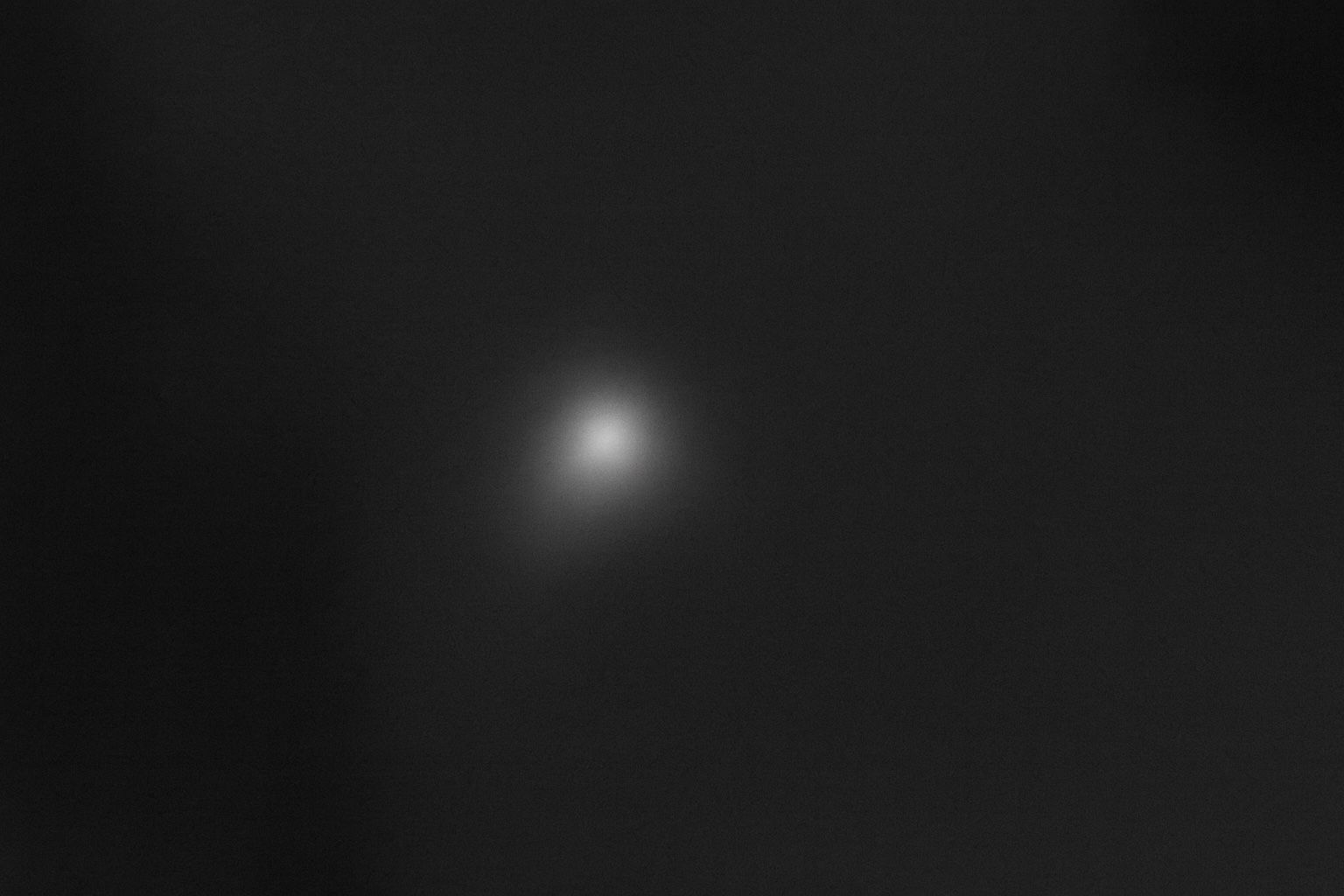
NASA has unveiled a spectacular new collection of images and data of interstellar comet 3I/ATLAS, the third known visitor from beyond our solar system, while firmly dismissing online speculation that the object might be an alien spacecraft. The release pulls together observations from an unprecedented network of spacecraft around Mars, near the Sun, and deep in space, along with some of the world’s most powerful telescopes.
What is Comet 3I/ATLAS and Why Is It Special?
Comet 3I/ATLAS (also designated C/2025 N1 ATLAS) is only the third confirmed interstellar object ever observed passing through our solar system, following 1I/ʻOumuamua in 2017 and 2I/Borisov in 2019.
Key facts from NASA’s latest “Facts and FAQs” summary:
- Origin: Its extremely fast, open-ended (hyperbolic) trajectory shows it is not gravitationally bound to the Sun, meaning it’s just passing through from another star system.
- Size: Hubble observations suggest a nucleus at least about 440 meters (1,400 feet) across and at most about 5.6 kilometers (3.5 miles) wide.
- Speed: When first discovered, it was traveling about 137,000 mph (221,000 km/h); near its closest approach to the Sun, its speed climbed to roughly 153,000 mph (246,000 km/h).
- No threat: The comet will come no closer than roughly 170 million miles (270 million km), or about 1.8 AU, from Earth—almost twice the Earth–Sun distance—so there is no danger to our planet.
NASA-funded ATLAS survey telescopes in Chile first spotted the comet on July 1, 2025, as a fast-moving, faint object entering the inner solar system. Follow‑up observations soon confirmed it was an active comet on an interstellar trajectory rather than an asteroid.
A Solar System–Wide Photo Shoot: Mars, the Sun and Deep Space
The new campaign of images released this week showcases 3I/ATLAS as seen from almost every vantage point we currently have in the solar system. NASA’s “multiple lenses” feature gathers together views from Mars orbiters and rovers, heliophysics spacecraft, deep‑space asteroid missions, and flagship observatories. NASA Science
Front‑row seat at Mars
Because 3I/ATLAS passed just outside the orbit of Mars in early October, NASA spacecraft at the Red Planet had a rare, close‑up view:
- Mars Reconnaissance Orbiter (MRO): Its HiRISE camera captured the comet on Oct. 2, 2025, when 3I/ATLAS was about 0.2 AU (19 million miles / 30 million km) from the spacecraft.
- MAVEN: An ultraviolet instrument imaged the huge cloud of hydrogen surrounding the comet in late September, just days before the Mars flyby, giving clues to how much water and other volatiles are evaporating from the nucleus.
- Perseverance rover: From Jezero Crater, the rover’s Mastcam‑Z camera recorded the comet as a faint smudge in the Martian sky on Oct. 4, when it was still nearly 19 million miles away—an extraordinary interstellar visitor rising over another world.
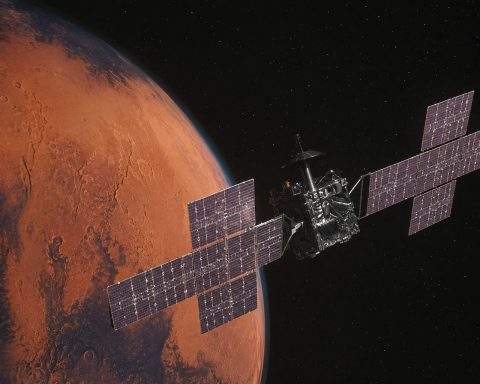
These Mars‑based observations weren’t just for pretty pictures. The European Space Agency’s ExoMars Trace Gas Orbiter (TGO) also tracked the comet from Mars orbit between Oct. 1–7, coming within about 29 million km of 3I/ATLAS. Combining TGO data with Earth‑based observations improved the comet’s predicted path by a factor of ten, a major win for future planetary‑defense techniques.
Sun‑watching spacecraft track the comet behind the star
As 3I/ATLAS slipped behind the Sun from Earth’s perspective in October, ground‑based telescopes temporarily lost direct sight of it. NASA’s solar observatories stepped in: NASA Science+2NASA Science+2
- STEREO-A captured the comet as a faint, fuzzy orb from Sept. 11–25, stacking multiple exposures from its HI1 camera to reveal the glowing coma and short tail as the comet sped through space at more than 130,000 mph.
- The joint NASA/ESA SOHO mission recorded 3I/ATLAS between Oct. 15–26, where it appears as a subtle point of light in coronagraph images, just barely brighter than the background.
- NASA’s new PUNCH mission combined observations from Sept. 20–Oct. 3, showing the comet as a bright point with a short, right‑ward tail against star trails—evidence of the dusty material streaming off the nucleus.
British magazine BBC Sky at Night highlighted how this “Sun‑side” monitoring allowed astronomers to keep following the comet even while it was hidden from Earth, filling in a critical gap in the object’s timeline. Sky at Night Magazine
Deep‑space spacecraft join the chase
Farther afield, asteroid missions Psyche and Lucy took advantage of their outbound trajectories to grab snapshots of the visitor: NASA Science+1
- Psyche observed 3I/ATLAS on Sept. 8–9, 2025, from about 33 million miles (53 million km) away. Its images are helping scientists refine the comet’s path and study the faint glow of the coma.
- Lucy photographed the comet on Sept. 16, from 240 million miles (386 million km) away, with its L’LORRI camera clearly capturing the bright nucleus, surrounding coma and a short tail.
Meanwhile, ESA’s Juice mission, now en route to Jupiter, has been observing 3I/ATLAS from early November as the comet recedes from the Sun in a highly active state. Data from Juice are not expected until February 2026, but scientists say it will provide another unique angle on the evolving tail and coma.
What the New Images Reveal About an Interstellar Comet
The flood of images and spectra from NASA, ESA and ground‑based observatories is starting to turn 3I/ATLAS from a mysterious outsider into a well‑characterized object.
Size, speed and composition
NASA’s latest fact sheet estimates that the solid icy nucleus of 3I/ATLAS falls somewhere between a few hundred meters and a few kilometers across—comparable to many “ordinary” comets born in our own solar system. NASA Science+1
Spectroscopic results from facilities including the James Webb Space Telescope and the Very Large Telescope indicate that the comet is rich in carbon dioxide, with smaller amounts of water ice, water vapor, carbon monoxide, carbonyl sulfide, cyanide gas and nickel vapor.
A scientist quoted by Reuters notes that this mix is surprisingly familiar: lots of CO₂, some water and CO, plus cyanide and nickel at levels similar to certain solar‑system comets. That suggests that, chemically, 3I/ATLAS is not wildly exotic compared with the icy bodies that haunt our own Oort Cloud—though there are some intriguing differences in the exact ratios of these ingredients.
Some orbital analyses indicate that if the comet came from the Milky Way’s thick disk rather than the thin disk, it could be older than our solar system itself, possibly more than 7 billion years old.
A laboratory for planetary defense and interstellar science
ESA’s trajectory‑refinement work with ExoMars TGO is being hailed as a rehearsal for planetary defense: by triangulating an object’s position using a spacecraft at Mars as well as observatories on Earth, agencies can drastically shrink the uncertainty in its future path—crucial if a similar object were ever on a collision course.
At the same time, every photon of light from 3I/ATLAS is a clue to how other planetary systems form and evolve. Comparing its composition and activity with comets like 2I/Borisov gives astronomers a window into ice chemistry in other star systems, and whether our solar system’s building blocks are typical or unusual.
Is Comet 3I/ATLAS an Alien Spacecraft? NASA Says No.
Since its discovery, 3I/ATLAS has fueled a wave of online speculation, including claims that its unusual path and behavior might indicate advanced alien technology. One researcher even publicly floated the idea that the object could be some kind of probe, amplifying debate on social media.
At a press briefing in Greenbelt, Maryland, on Wednesday, senior NASA officials addressed those rumors head‑on. According to reporting from Reuters, NASA’s science leaders stressed that all available data show 3I/ATLAS behaving exactly like a natural comet: it has an icy nucleus, a coma of gas and dust, and a tail driven by sunlight—nothing more exotic.
One official emphasized that the agency is actively searching for signs of life and technology elsewhere in the universe but that no “technosignatures” of any kind have been seen from this object. Astronomers interviewed in the same report were even more blunt, likening the alien‑spacecraft speculation to arguing that “the Moon is made of cheese.” Reuters+1
Indian coverage of the event notes that the release of the new images had been delayed during a lengthy U.S. government shutdown, during which NASA’s normal communications were frozen. That gap appears to have given conspiracy theories extra time to spread before scientists could show the data in public.
Now, with images and measurements from more than a dozen missions on the table, NASA is clearly aiming to reset the narrative: 3I/ATLAS is extraordinary because it is interstellar, not because it is artificial.
How to See Comet 3I/ATLAS From Earth (If You Can)
Despite the dramatic headlines, don’t expect a bright streak across your local night sky.
Astronomy site EarthSky and other observers stress that 3I/ATLAS is too faint to see with the naked eye and even too dim for small backyard binoculars. To glimpse it visually, skywatchers need roughly an 8‑inch (20 cm) telescope or larger, dark skies, and good star charts.
- The comet reached its closest approach to the Sun around late October 2025, just outside Mars’ orbit.
- It is currently climbing back out of the inner solar system and will make its closest approach to Earth around Dec. 19, 2025, still at a very safe distance of about 1.8 AU.
- By late November, it remains a plausible target for serious amateur astrophotographers, especially in the morning sky, but will never become a bright showpiece comet.
Professional observatories and spacecraft will keep following it into early 2026 as it passes the orbit of Jupiter and disappears back into interstellar space, never to return.
What Happens Next for 3I/ATLAS – and for Future Interstellar Visitors?
Over the coming months, several important threads will play out:
- Data deluge: Scientists will continue analyzing images and spectra from Hubble, Webb, ground‑based telescopes, Mars missions, solar observatories, Psyche, Lucy and Juice. Some of the most detailed compositional results and tail‑interaction measurements won’t arrive until 2026.
- Comparisons with 1I/ʻOumuamua and 2I/Borisov: By comparing brightness changes, gas production and chemical fingerprints, researchers hope to understand whether interstellar comets are broadly similar or whether each reflects a very different planetary system of origin.
- Planetary‑defense rehearsals: ESA’s work with ExoMars TGO is already being treated as a test bed for more advanced warning systems. Future missions like NEOMIR (to spot objects coming from the Sun’s direction) and Comet Interceptor (designed to rapidly fly to a newly discovered comet—possibly an interstellar one) will build on lessons from 3I/ATLAS.
If anything, 3I/ATLAS shows how quickly the world’s space agencies can pivot to study a once‑in‑a‑lifetime visitor. Within months of discovery, an entire fleet of spacecraft—from a Mars rover to a Jupiter‑bound probe—turned their cameras and sensors toward this tiny point of light from another star.
Key Takeaways at a Glance
- Third interstellar object: 3I/ATLAS is only the third known visitor from outside our solar system, after 1I/ʻOumuamua and 2I/Borisov.
- New images released: On Nov. 19–20, 2025, NASA and partners showcased images from Mars orbiters and rovers, solar missions, deep‑space probes and major telescopes.
- No threat to Earth: The comet will never come closer than ~170 million miles (1.8 AU), posing no impact risk.
- Natural, not artificial: NASA officials and independent astronomers say there is zero evidence that 3I/ATLAS is anything other than a normal—if interstellar—comet.
- Scientific bonanza: The object offers a rare chance to directly sample the chemistry and behavior of material formed around another star, while testing new planetary‑defense techniques using spacecraft far from Earth.
As 3I/ATLAS races back into the dark between the stars, it leaves behind something invaluable: a treasure trove of data that will help scientists understand both our own solar system and the wider galaxy it inhabits.
Related articles: Space Exploration