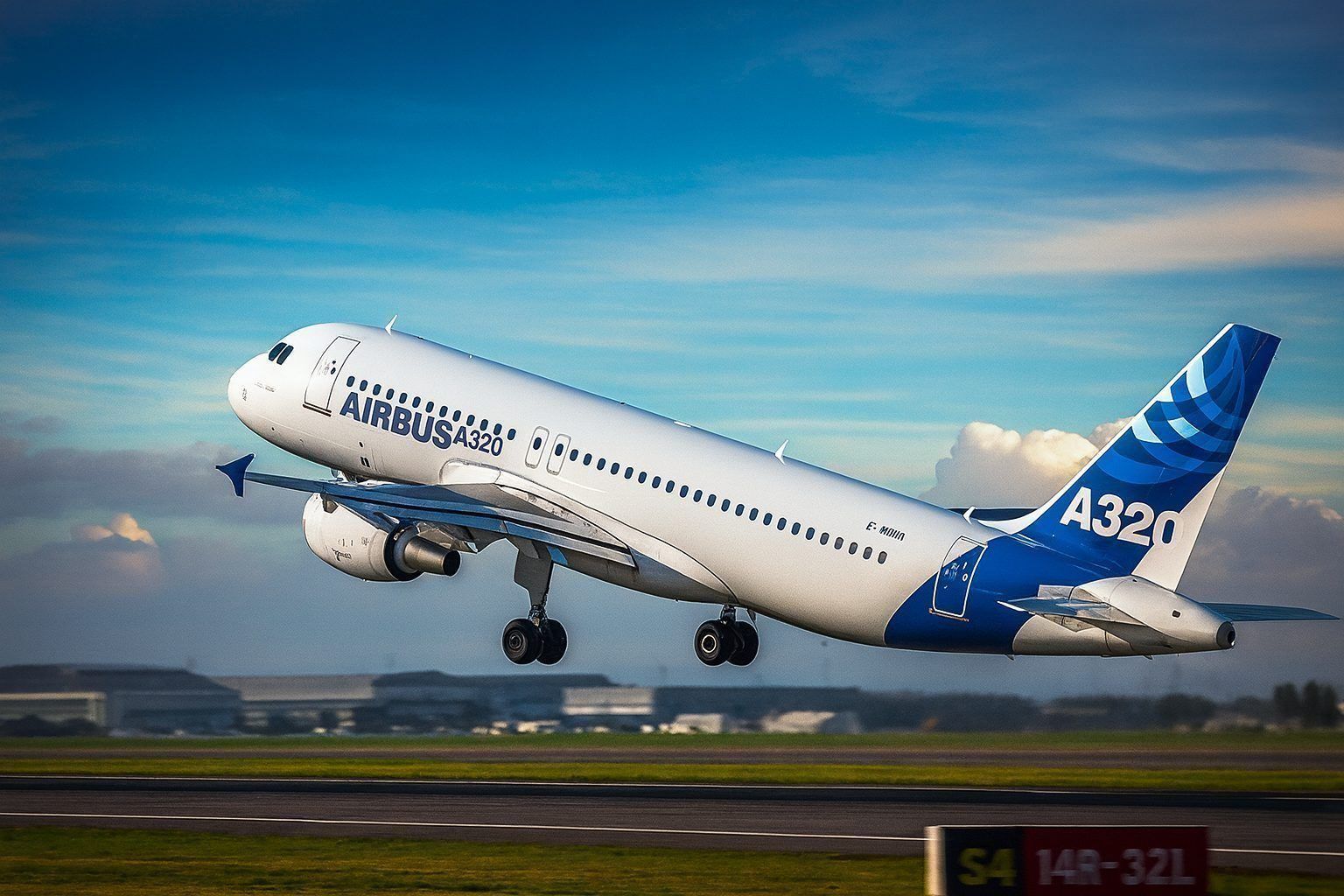

Airbus says it has almost closed the book on one of the largest safety actions in its history. As of December 1, 2025, the planemaker reports that the “vast majority” of roughly 6,000 Airbus A320-family jets affected by a critical flight‑control software bug have now been modified, with fewer than 100 aircraft still awaiting the fix and remaining on the ground. Airbus
At the same time, a separate development is adding pressure: Airbus has also discovered an industrial quality issue in fuselage panels on several dozen A320-family aircraft, delaying some deliveries, though there is currently no indication that the flaw affects aircraft already in service.
What Airbus Confirmed on December 1
In a new press release dated Toulouse, France, December 1, 2025, Airbus said that following a precautionary alert issued on November 28, the global rollout of A320-family fixes is almost complete. Out of about 6,000 potentially affected aircraft, the “vast majority have now received the necessary modifications,” and the company is working with airlines to finish updates on fewer than 100 remaining jets so they can return to service. Airbus+1
An Associated Press summary of the same update notes that airlines worldwide rushed to apply the software change just as the U.S. entered its busiest Thanksgiving travel period, causing minor but noticeable disruption before schedules began to normalize.
Airbus again apologised for delays and challenges faced by airlines and passengers, while stressing that the decision to ground and modify aircraft was driven by its “safety above all” policy. Airbus
The JetBlue Mid‑Air Scare That Started It All
The recall traces back to a frightening incident on October 30, 2025 involving a JetBlue Airbus A320 operating flight 1230 from Cancún to Newark.
During cruise, the aircraft suddenly pitched down without pilot input, causing a rapid loss of altitude. The crew diverted to Tampa, Florida, where the flight landed safely, but at least 15 people were injured and taken to local hospitals.
Subsequent technical assessments linked the event to a malfunction in the Elevator Aileron Computer (ELAC) — a key part of the A320’s fly‑by‑wire system which controls pitch (nose up/down) and roll (banking).
This single incident triggered a worldwide re‑examination of the software running on ELAC units installed across the A320-family, which includes the A319, A320 and A321 in both “ceo” (classic engine) and “neo” (new engine) versions. EASA Safety Publications Tool+1
A Rare Solar-Radiation Software Bug, Explained
In a November 28 statement, Airbus said that analysis of the JetBlue event showed “intense solar radiation” could corrupt data critical to flight-control functions on certain A320-family aircraft. Airbus+1
European safety regulators echoed that finding. The European Union Aviation Safety Agency (EASA) issued an Emergency Airworthiness Directive (EAD 2025‑0268‑E) on November 28, warning that a malfunction in the ELAC could cause uncommanded elevator movement, potentially exceeding the aircraft’s structural limits if not corrected.
Investigations and technical reporting describe the issue as a form of “single event upset”:
- High‑energy particles from solar activity or cosmic rays strike electronic components.
- In extremely rare circumstances, this can flip bits in memory or logic circuits.
- The latest ELAC software version apparently had a logic path that did not fully guard against such corrupted data, allowing an incorrect control command to propagate.
Aviation engineers have long designed flight‑control systems with triple redundancy, cross‑checks and error‑correction precisely to cope with such radiation effects. The JetBlue incident exposed a corner‑case vulnerability in the newest software load — serious enough that regulators demanded a fix before the next flight for all affected aircraft.
Emergency Orders: EASA Leads, FAA Follows
EASA’s Emergency AD 2025‑0268‑E, effective November 29, applies to an extensive list of A319, A320 and A321 variants, covering both classic and neo models. It mandates corrective action before further flight, referencing Airbus Alert Operators Transmission A27N022‑25 as the primary compliance document.
Key points from the regulatory response:
- All affected aircraft must be modified before carrying passengers again.
- The standard remedy is to revert the ELAC to a previous, stable software version.
- A subset of airframes requires hardware changes — replacement of the ELAC unit itself — because their computers cannot safely run the older software image.
The U.S. Federal Aviation Administration (FAA) moved in parallel, preparing a matching directive for the U.S. A320-family fleet after the JetBlue event, which occurred in U.S. airspace.
How Airlines Rolled Out the Fix – and What Passengers Saw
The scale of the recall was unprecedented for Airbus: around 6,000 A320-family jets in service globally — more than half of all A320-family aircraft flying — were told to undergo an urgent software rollback or remain grounded.
Disruptions by region
- In Australia, low‑cost carrier Jetstar said 34 of its 85 A320s were affected, leading to about 90 flight cancellations and delays for thousands of passengers across major cities.
- In the UK and Europe, airlines including Air France, Wizz Air, easyJet and Air New Zealand temporarily grounded parts of their fleets. Air France cancelled more than 50 A320-family flights to and from Paris CDG; Air New Zealand grounded its entire A320 fleet for part of a day before resuming service.
- In Latin America, Colombian carrier Avianca said roughly 70% of its fleet was impacted and warned of “significant disruptions” over several days, temporarily halting new ticket sales up to December 8 to prioritise rebooking. The Independent+1
- In the U.S., JetBlue took dozens of jets out of service, cancelling around 20 flights on Monday as it raced to restore 137 of 150 affected aircraft.
The good news: many airlines were able to perform the software rollback in two to three hours per aircraft, often overnight, meaning disruptions, while headline‑grabbing, were short‑lived and geographically uneven.
Inside the Fix: Software Rollback and Hardware Bottlenecks
Reporting from industry sources and regulators paints the following picture of the remedy:
- For most jets, the fix was a software rollback to a previous ELAC version that had millions of safe flight hours.
- Engineers used a portable “data loader” device connected in the cockpit to reload the older software image. Reuters+1
- A smaller group of, generally older, A320-family aircraft require new ELAC computers, because their existing hardware cannot support the safe configuration demanded by regulators. These jets may stay grounded longer due to global chip and avionics supply constraints.
Aviation outlets note that this episode underscores how modern fleet management now includes “fleet-wide rollback” as a safety tool, mirroring best practices in the software industry but on a much higher‑stakes stage. Flight Global+2Flight Global+2
Where Things Stand Today: Fewer Than 100 Jets Still Grounded
As of December 1, 2025:
- Airbus says “most” of its 6,000 A320-family passenger jets have been updated. MarketScreener
- The company and multiple news wires report that fewer than 100 aircraft remain grounded pending modification.
- Airlines in Europe, Asia, the Middle East and the Americas are largely back to normal schedules, with only isolated delays linked directly to the recall.
In short, the acute phase of the crisis — mass groundings and widespread cancellations — appears to be over, even though the technical and regulatory investigations will continue for months.
New Twist: Fuselage Panel Quality Issue on Dozens of A320s
Just as Airbus moved to close the software chapter, another issue surfaced on December 1.
According to Reuters and related market reports, Airbus has identified an industrial quality problem affecting fuselage panels on “several dozen” A320-family aircraft on the production line. Reuters+2SRN News+2
Key details:
- The defect relates to fuselage panels on jets still in the delivery pipeline.
- Some aircraft deliveries are being delayed while Airbus and suppliers investigate the root cause and decide on corrective measures.
- At this stage, there is no indication that the flaw affects aircraft already in service, and regulators have not issued any separate operational safety warnings related to the panel issue.
Financially, the latest quality problem and the recent recall have weighed on investor sentiment. Airbus shares fell sharply on December 1 as markets digested both the recall fallout and this new manufacturing headache.
Is It Safe to Fly on an Airbus A320 Now?
From a regulatory standpoint, yes — provided the aircraft has been modified or was not affected by the problematic software.
A few important points:
- EASA’s emergency directive and equivalent actions worldwide require that affected aircraft remain grounded until the ELAC software/hardware is corrected.
- Airbus and AP both stress that the vast majority of impacted jets now meet the updated requirements, and airlines are working through the final handful.
- The A320 family has a long, strong safety record over decades of service and millions of flight hours; the current measures are designed to keep that record intact by removing a very specific, newly identified risk.
Investigations are still underway into the precise failure path during the JetBlue incident, and some experts have publicly questioned whether solar radiation alone fully explains the event — highlighting how complex highly automated systems have become.
For passengers, the most practical reassurance is this: if an A320-family aircraft is operating your flight, regulators have signed off on its configuration under the new rules. Any jet that is not yet compliant is not allowed to fly passengers.
What Travellers Should Do If They’re Booked on an A320
Most travellers will notice little to no disruption from today onward, but it’s still wise to take some basic precautions:
- Check your flight status early and often
- Use your airline’s app or website on the day of travel.
- Some carriers may still be cycling individual aircraft through maintenance, leading to last‑minute swaps or small delays.
- Allow extra time for connections
- Where possible, avoid razor‑thin connections over the next few days in heavily affected hubs such as Paris CDG, London‑area airports, or large A320 bases in Australia, India and Latin America.
- Know your passenger rights
- In regions like the EU and UK, existing compensation rules may apply if your flight is significantly delayed or cancelled due to aircraft availability, even when the cause is a safety directive. Travel columns and consumer advocates are already publishing guidance on how these rules interact with the Airbus A320 grounding.
- Don’t panic about the aircraft type
- If your booking shows “A319,” “A320” or “A321,” that doesn’t mean your flight is unsafe — it simply identifies the aircraft family at the centre of this story.
- The entire point of the recall was to fix the rare scenario before it could cause a catastrophic outcome.
Why This Matters Beyond Airbus
The A320 situation is being closely watched across the aviation and tech industries for several reasons:
- It shows how a single software regression in a mature, widely used platform can cascade into a global grounding within days, much like well‑known examples in other sectors but with far higher safety stakes.
- Regulators and airlines appear to have reacted faster and more transparently than during the early days of the Boeing 737 MAX crisis — something analysts explicitly link to lessons learned from that earlier saga.
- For Airbus, the successful, rapid rollout of fixes may limit long‑term reputational damage, but the combination of software recall and new fuselage quality issues will intensify scrutiny of its supply chain and digital validation processes.
For travellers and crews, the story is ultimately about how aggressively the industry is willing to act on low‑probability but high‑impact risks. A rare cosmic‑ray‑induced software glitch made headlines, but the robust response — emergency directives, global software rollbacks and candid public updates — is a reminder of how modern aviation safety works in practice.
Related articles: EPA:AIR