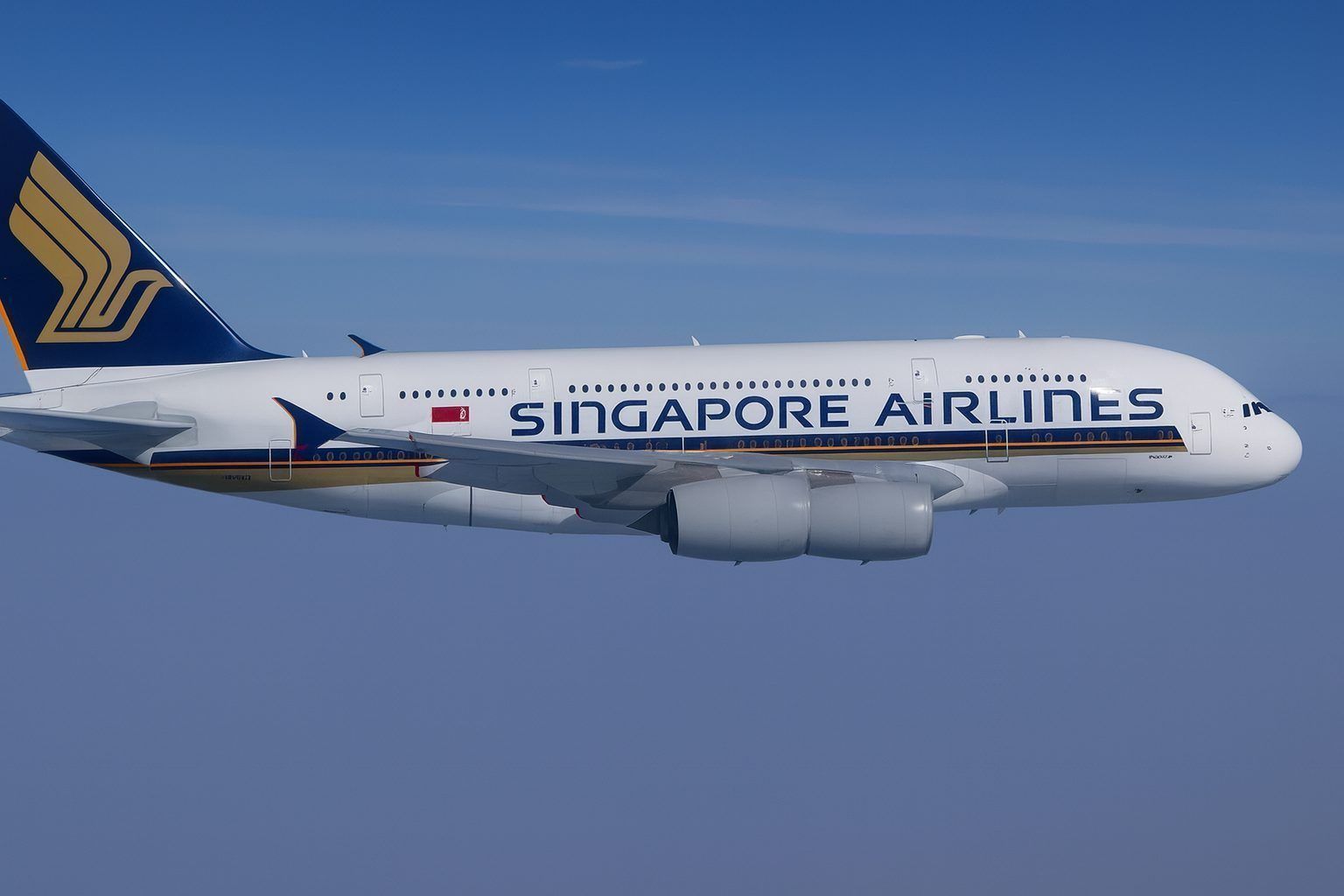
Singapore Airlines Limited (SIA, SGX:C6L) enters December 2025 as a classic “good airline, messy earnings story” stock.
On 2 December 2025, the flagship carrier is trading around S$6.50 per share, valuing the group at roughly S$20.3 billion.SG Investors+2Beansprout+2 The share price sits in the middle of its 52‑week range of S$5.90–S$7.63, after peaking in late July and easing as investors digested weaker profit numbers and rising exposure to India.
At the same time, SIA offers a high trailing dividend yield of about 5.8% and trades at roughly 8–9x trailing earnings and about 1.3x book value, cheaper than many global peers.
The tension between strong underlying demand, generous dividends and volatile earnings driven by Air India and normalising fares is exactly what makes Singapore Airlines one of the more closely watched stocks on the Singapore Exchange today.
Current Share Price and Valuation Snapshot (2 December 2025)
As of the morning session on 2 December 2025, Singapore Airlines shares trade around S$6.49–S$6.50 on the SGX.
Key valuation markers:
- Market capitalisation: ~S$20.3–20.4 billion.
- Trailing P/E: around 7.5–9.1x, depending on data provider and exact earnings base.
- Price‑to‑book:~1.27–1.31x, using both market data sites and the company’s reported net asset value per share (S$4.97 as at 30 September 2025).
- Trailing dividend yield: about 5.85%, based on the last 12 months of dividends and the current share price.
Independent comparables platforms note that Singapore Airlines’ P/E multiple is well below a peer average near 18–19x among major global airlines, implying the stock trades at a discount on conventional earnings metrics.Simply Wall St However, that discount comes with baggage: earnings are unusually distorted by one‑off gains from the Air India–Vistara merger in FY2024/25 and heavy Air India losses in the current year.
Simply Wall St also highlights that over the past year SIA has underperformed both the Singapore market and the local airline sector – returning only about 2.8% versus roughly 21.6% for the broader market – despite its solid fundamentals and relatively low volatility.
From Record Profit to Profit Slump: What Changed in 2025?
FY2024/25: Record headline profit, weaker core profitability
For the financial year ended 31 March 2025, Singapore Airlines reported record net profit of S$2.78 billion, marginally above the prior year and ahead of analyst expectations, largely thanks to a one‑off gain of about S$1.1 billion from the merger of its 49%-owned Vistara into Air India.
Under the surface, though, the earnings mix was less flattering:
- Operating profit fell 37% year‑on‑year to S$1.71 billion, as passenger yields (a proxy for average fares) declined 5.5% amid intense competition and increased capacity worldwide.
- SIA carried a record number of passengers and saw cargo revenue rise about 4.4%, aided by e‑commerce and shipping rerouting, but freight yields fell around 7–8% as more belly cargo capacity returned to the skies.
- The airline warned that U.S.-led tariffs and geopolitical uncertainty could dampen both passenger and cargo demand.
The board declared a final dividend of S$0.30 per share, lower than the previous year’s S$0.38, signalling management’s awareness that the bumper gain from the Vistara transaction was non‑recurring.
H1 FY2025/26: demand resilient, but earnings hit by Air India
Fast forward to the first half of FY2025/26 (six months to 30 September 2025) and the earnings picture has flipped:
- Revenue: S$9.68 billion, a 1.9% increase year‑on‑year and a first‑half record.
- Operating profit: S$802.9 million, up 0.9%, indicating the core airline is still generating healthy operating margins.
- Net profit: S$238.5 million, down about 68% from S$742 million a year earlier and well below consensus expectations of roughly S$342 million.
The culprit is not collapsing demand – far from it:
- Group passenger numbers rose 8.0% to 20.8 million in the half, with passenger load factor climbing 1.3 percentage points to 87.7%, a historically high level.
- Passenger yields, however, fell 2.9%, reflecting continued normalisation of post‑pandemic fares and fierce competition on key routes.
- Cargo volume grew modestly, but cargo yields fell 4.1% and cargo load factor slipped slightly, keeping that business under pressure.
On the cost side:
- Total expenditure increased 2.0%, with non‑fuel costs up 5.9% due to inflation, wage increases and network growth.
- Net fuel expense actually fell 6.7%, thanks to lower oil prices and efficient hedging, but this was not enough to offset higher non‑fuel costs.
The real swing factor was non‑operating items, particularly SIA’s share of losses from associates, driven by its stake in Air India.
Air India: Strategic Bet or Earnings Black Hole?
Singapore Airlines now owns 25.1% of Air India, after exchanging its 49% stake in Vistara for a minority stake in the combined Air India group in 2024.
In FY2024/25, that deal delivered the S$1.1 billion one‑off gain mentioned above. But in FY2025/26, Air India has turned into a material drag:
- For the half year to September 2025, SIA’s share of results from associated companies swung down by about S$417 million, largely due to Air India’s sizeable losses.
- Indian media report that Air India lost roughly ₹95.7 billion (about S$1.7 billion) in its FY2025 financial year, helping to explain the hit to SIA’s bottom line.
A recent Reuters report notes that Air India is seeking at least ₹100 billion (US$1.14 billion) in additional financial support from its shareholders Tata Sons and Singapore Airlines, heightening the risk that SIA may have to commit more capital over time to support the turnaround.
Despite these losses and the high‑profile Air India crash in June 2025, which triggered fleet safety checks and investigations, Singapore Airlines management has repeatedly stated it remains committed to the Air India investment and its multi‑hub strategy with India.
From a stock perspective, this means:
- Upside: If Air India’s restructuring succeeds over the next 3–5 years, SIA gains leveraged exposure to one of the fastest‑growing aviation markets in the world without having to fully fund a new airline.
- Downside: In the near term, Air India is depressing reported earnings and may require more equity injections or reduced dividends if losses persist.
This is a core reason many analysts caution that headline EPS is a poor guide to SIA’s underlying profitability right now, and why valuation tools that extrapolate current earnings can look either too cheap or too expensive depending on how they treat these one‑offs.
Balance Sheet, Debt and Convertible Bonds
Notwithstanding the earnings volatility, Singapore Airlines’ balance sheet remains relatively strong:
- Equity attributable to shareholders: S$15.53 billion as at 30 September 2025.
- Total assets: S$40.66 billion; total debt: S$10.87 billion.
- Debt‑to‑equity ratio: improved to 0.70x, from 0.82x at the end of March 2025.
- Cash and bank balances: S$6.45 billion, plus about S$2.06 billion of longer‑dated fixed deposits and S$3.3 billion of undrawn committed credit lines.
The company also has convertible bonds maturing in December 2025. By 30 September, about S$714 million of these had already been converted into roughly 150 million new shares, with only S$136 million outstanding.singaporeair.com This modestly dilutes EPS but also reduces leverage.
From an equity holder’s standpoint, SIA has:
- Enough liquidity to withstand cyclical downturns.
- Reasonably conservative gearing for a capital‑intensive industry.
- The flexibility to keep paying dividends even when reported earnings are under pressure – at least for now.
Dividends and Capital Returns: A Central Part of the Investment Case
SIA has been increasingly positioning itself as a dividend and capital‑return story as the post‑pandemic recovery matures.
Recent and upcoming payouts include:
- FY2024/25 final dividend: S$0.30 per share.
- H1 FY2025/26:
- Interim dividend: S$0.05 per share.
- Interim special dividend: S$0.03 per share.
- Both payable on 23 December 2025.
More importantly, SIA has committed to a three‑year special dividend plan totalling about S$900 million, under which it intends to pay S$0.10 per share in special dividends each year from FY2025/26 to FY2027/28, subject to conditions.
When you combine the ongoing ordinary dividends with this multi‑year special plan, you get a stock that – at current prices – is anchored by a mid‑single‑digit to potentially high‑single‑digit cash yield, assuming earnings and cash flows hold up.
That dividend narrative is one reason SIA is frequently cited by local brokers as a core income holding in the Singapore blue‑chip universe, alongside the big banks and telcos.
Fleet, Boeing 777‑9 Delays and Capacity Strategy
As of 30 September 2025, the SIA Group operated a fleet of 208 aircraft, comprising:
- 145 passenger aircraft and 7 freighters at Singapore Airlines.
- 56 passenger aircraft at low‑cost subsidiary Scoot.
- A combined order book of 67 aircraft to refresh and expand the fleet.
The group’s strategy is to push premium long‑haul and regional traffic through SIA, while Scoot focuses on price‑sensitive leisure and regional markets. This has become even more important after Jetstar Asia, a Singapore‑based low‑cost rival, ceased operations on 31 July 2025 due to rising costs and intense competition.ETInfra.com+1 Scoot has already moved to pick up some of the vacated routes, strengthening SIA’s ecosystem in Southeast Asia.
One potential concern for investors has been Boeing’s 777‑9 (777X) programme, a key part of SIA’s future wide‑body fleet:
- Boeing has pushed the first 777X deliveries to 2027, citing certification delays and booking a significant charge in Q3 2025.
- SIA’s CEO, Goh Choon Phong, has publicly stated that the airline does not expect a major impact from this delay because it has built flexibility into its fleet plan.
In practice, the delay extends the life of some existing wide‑bodies but also prolongs tight long‑haul capacity, which can support premium yields as long as demand remains solid.
Industry Backdrop: Asia-Pacific Still the Growth Engine
From a macro perspective, SIA is operating in an industry that is profitable again but far from carefree.
The International Air Transport Association (IATA) projects that:
- Global airlines will earn about US$36 billion in net profit in 2025, with an industry‑wide net margin of roughly 3.7% – one of the best years ever for the sector, but still only about half the average margin of all global industries.
- Overall passenger demand (in revenue passenger kilometres, or RPKs) is expected to grow 5.8% in 2025, with Asia‑Pacific the fastest‑growing region at around 9%, contributing more than half of global RPK growth.
More current traffic data show that in October 2025, Asia‑Pacific airlines posted double‑digit passenger growth and high load factors as international travel in the region continued to normalise.
However, IATA also flags several headwinds that are very relevant to SIA:
- Tariffs and protectionism that can dampen trade and cargo demand.
- Supply chain constraints in aircraft manufacturing, which keep capacity tight and complicate fleet planning.
- Inflationary costs and wage pressures across the industry.
SIA’s own outlook commentary echoes this: demand into Q3 remains “resilient”, but management is acutely aware of geopolitical risks, macro headwinds and ongoing pressure on cargo yields, even as cargo volumes grow.singaporeair.com+1
What Analysts and Models Are Saying About SIA Stock
Across broker research platforms and retail‑oriented analysis sites, the message on Singapore Airlines is broadly neutral to mildly cautious.
Consensus price targets
Different aggregators paint a fairly consistent picture:
- Growbeansprout / SGX consensus: average 12‑month target of about S$5.997, implying ~7.7% downside from S$6.50 as of 2 December 2025.
- Investing.com, TradingView and similar platforms: average target around S$6.17–6.18, with a range roughly S$5.25–S$7.00. Some classify the consensus stance as “Sell” or “Underperform”, with a heavy concentration of Hold recommendations among local brokers.www.alphaspread.com+3TradingView+3Investin…
- ValueInvesting.io (Peter Lynch‑style model): estimates a “fair value” near S$4.44, suggesting the stock might be overvalued by about 30% versus that particular metric.ValueInvesting
Local broker targets compiled by Beansprout show most major houses rating SIA as Hold, with price targets clustered between S$6.00 and S$6.85, broadly bracketing the current price.
Fundamental commentary
Qualitative analyst and platform commentary tends to converge on a few themes:
- Earnings quality: Several research notes and Simply Wall St articles argue that SIA’s headline earnings are currently a poor guide to long‑term profitability, given large one‑offs (Vistara gain) and the volatile contribution from Air India.
- Relative value: On traditional metrics like P/E and P/B, SIA screens as cheaper than many global peers, especially U.S. carriers, supporting the idea that some downside is already priced in.
- Share price performance: Despite resilient operations, SIA’s share price has lagged the Singapore market and airline sector over the last 12 months, partly because investors anticipate normalising fares and cargo yields and worry about Air India‑related risks.
In short, the market seems to be saying: “Great airline, but the easy money after the post‑COVID boom and Vistara gain has already been made.”
Key Bull and Bear Drivers for Singapore Airlines Stock
Bullish factors
- Structural travel demand in Asia-Pacific
Asia‑Pacific remains the fastest‑growing aviation region, with IATA projecting around 9% RPK growth in 2025 and the region contributing more than half of global traffic growth.IATA SIA, with its premium brand and Changi hub, is well placed to capture this. - Solid balance sheet and liquidity
A 0.70x debt‑to‑equity ratio, multi‑billion‑dollar cash pile and ample credit lines provide resilience against shocks and allow continued fleet renewal and dividends. - Attractive dividend profile
Between ordinary payouts and the three‑year special dividend plan, total shareholder yield could remain appealing even if the share price moves sideways. - Scoot’s strengthening position after Jetstar Asia’s exit
The closure of Jetstar Asia in mid‑2025 removes a long‑time low‑cost competitor based at Changi. Scoot’s move to take over routes and expand strengthens SIA’s grip on regional leisure traffic. - Singapore market backdrop
Singapore equities as a whole screen as high‑yield and relatively inexpensive, and JP Morgan’s upgrade of the Singapore market to “overweight” in February 2025 cited exactly those features plus policy support to revive the stock market.Reuters+1
Bearish factors
- Air India losses and potential capital needs
Heavy Air India losses have already wiped hundreds of millions of dollars off SIA’s half‑year profit, and the Indian carrier is reportedly lobbying for more than US$1.1 billion in support from its shareholders.Reuters+3singaporeair.com+3Reuters+3 That overhang is likely to persist for years. - Normalising yields and intense competition
Passenger yields are now falling in both SIA and Scoot, even as load factors hit record levels. The days of post‑pandemic super‑fares are clearly over, and competition from Middle Eastern, Chinese and regional carriers remains intense. - Cargo uncertainty and tariffs
Cargo yields remain under pressure even as volumes inch up, and both SIA and IATA have warned that tariffs and trade frictions could hurt air freight demand. - Boeing 777‑9 delays and supply chain risks
While SIA says the 777‑9 delay to 2027 will not materially harm its plans, the broader supply chain constraints in aircraft manufacturing keep the sector vulnerable to shocks and limit flexibility. - Earnings volatility vs. “defensive” dividend image
As more investors treat SIA like a quasi‑defensive income stock, any future cut or pause in dividends – for example to support Air India – could trigger outsized share price reactions.
Outlook for Singapore Airlines Stock into 2026
Looking into 2026, the broad market and analyst consensus leans towards a sideways to mildly negative price outlook, cushioned by dividends:
- Most price targets cluster between S$6.00 and S$6.50, not far from the current price, with some downside‑skewed models pointing towards the S$4.50–S$6.00 range if earnings disappoint and valuations compress towards book value.
- On the upside, if Air India’s losses narrow faster than expected, yield declines stabilise and global travel stays resilient, SIA could rerate back towards the upper end of recent trading ranges (around S$7.00–S$7.50), particularly if investors lean into its dividend and balance sheet strength.
In practical terms, that makes Singapore Airlines today:
- A yield‑and‑quality play on Asia‑Pacific air travel, for investors comfortable with cyclical earnings and geopolitical risk.
- Less obviously a deep value trade, because the discount vs global peers is partly explained by Air India and cyclically high margins that may trend down.
Monitoring points for 2026 will include:
- Quarterly updates on Air India’s performance and any capital support.
- The trajectory of passenger yields and load factors, especially if global growth slows.
- SIA’s dividend decisions beyond the already‑announced special plan.
As with all airline stocks, the story is dynamic: a couple of strong quarters or a nasty external shock can shift sentiment quickly. For now, though, Singapore Airlines sits in that familiar aviation sweet‑spot – operationally excellent, strategically ambitious, and financially solid – but navigating a noisy, politically entangled world.