As of 5 December 2025, Transport for London’s (TfL) bid to take over the Great Northern “inners” route from Moorgate has moved from long‑running aspiration to a concrete proposal – complete with an outline business case, newly released FOI documents and a clear list of stations that could end up with London Overground‑style services by the end of 2027. ianVisits+1
If approved, the plans would reshape rail travel from the City of London into north London and Hertfordshire, tie directly into a proposed 21,000‑home “new town” at Crews Hill, and slot into the wider national shift to public ownership and Great British Railways. Enfield Council+2The Standard+2
What exactly is TfL proposing on the Moorgate mainline?
The bid centres on what TfL and the Department for Transport (DfT) call the Great Northern “Inners” – the suburban routes currently run by Govia Thameslink Railway (GTR) under the Great Northern brand. ianVisits+1
In headline terms, TfL wants to:
- Take over services from Moorgate through the Northern City line tunnels to Finsbury Park, then
- Run all‑stopping suburban services:
- Moorgate – Welwyn Garden City, and
- Moorgate – Hertford North / Stevenage via the Hertford Loop.
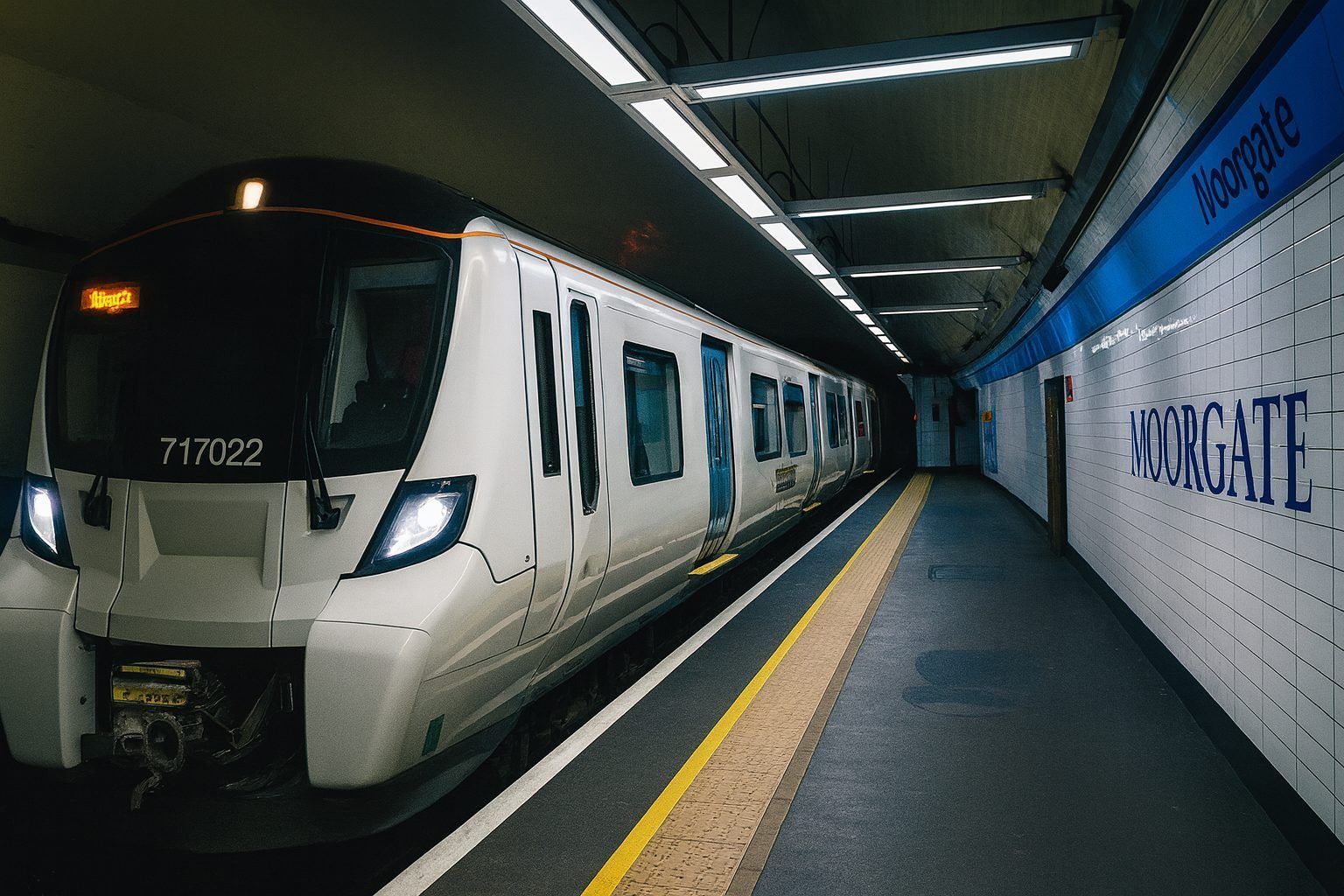
Today these trains are operated by GTR using dual‑voltage Class 717 units. TfL’s business case proposes taking over those same trains, rather than buying new rolling stock, and operating them under a London Overground‑style concession, with TfL specifying frequencies, stopping patterns and standards.
More frequent trains – especially to Hertford North
According to details in the outline business case reported via a Freedom of Information (FOI) release and analysed by independent transport site ianVisits, TfL says it could:
- Double the off‑peak frequency on both the Welwyn Garden City and Hertford North branches
- From 2 trains per hour (tph) today
- To 4 tph off‑peak.
- Increase the Hertford North line further to 6 tph in the long term – effectively a train every 10 minutes, which TfL regards as “turn up and go” territory.
- Work towards 12 tph into Moorgate in the peaks, with the ability to push this up to 14 tph for the busiest hour, subject to detailed timetable and signalling work on the East Coast Main Line.
At the same time, GTR has its own plan – agreed with DfT – to restore pre‑Covid frequencies of 12 tph peak and 4 tph off‑peak by December 2026, whether or not devolution to TfL happens. TfL’s argument is that, under its control, a higher all‑day frequency and more consistent stopping pattern could be delivered and sustained.
Station upgrades and “TfL‑isation”
TfL’s business case also sketches out an initial package of station improvements to bring Great Northern stops up to Overground standards:
- New or improved shelters and seating
- Additional ticket machines and departure screens
- Staff facilities at currently unstaffed stations
- A first wave of accessibility works, with more extensive step‑free access likely funded later by developers and other partners
The estimated cost is around £47 million for basic “TfL‑isation” of the stations, rising towards £70 million if Crews Hill receives a major rebuild to serve the proposed new town. ianVisits+1
Timeline: when could TfL actually take over?
Key dates in the story so far:
- 30 September 2025 – TfL submits its Great Northern Inners outline business case to the DfT under the government’s new “right to request” devolution process. railmagazine.com+1
- 15 October 2025 – RAIL magazine confirms the submission and reports that TfL expects to run a more intense service than GTR.
- 2 December 2025 – TfL releases a redacted version of the business case following FOI requests, confirming the proposed routes and that the decision now rests with the Secretary of State for Transport.
- 4 December 2025 – ianVisits publishes a detailed summary of the business case, including service levels, station upgrades and costs.
TfL’s ambition is to secure approval in principle from the Transport Secretary by the end of 2025, allowing a formal transfer in autumn 2027, followed by around two years of service and station upgrades – meaning noticeable improvements by late 2029 if all goes to plan.
Full list of places that could get a London Overground‑style service
The MyLondon coverage – now echoed widely on social media – has focused on the “full list of places that could get London Overground service by the end of 2027” if TfL’s bid succeeds. While the final geography depends on DfT’s decision, TfL’s business case and current timetables make the core candidate list fairly clear. ianVisits+2Moovit+2
1. Northern City Line: Moorgate tunnels (inner London)
These are the six tunnel stations between the City and Finsbury Park, currently branded as Great Northern but historically part of the Underground’s Northern line:
- Moorgate
- Old Street
- Essex Road
- Highbury & Islington
- Drayton Park
- Finsbury Park
Under TfL, these would almost certainly appear on the Tube/Overground map with a new Overground sub‑line name, alongside existing Overground routes that already serve Highbury & Islington.
Although most trains would still terminate at Moorgate, a handful of peak services each day are currently diverted to King’s Cross. The business case suggests these would also fall under TfL’s control, so King’s Cross mainline could see occasional Overground‑contracted services as well.
2. Welwyn Garden City branch – north London and Hertfordshire
Current stopping services from Moorgate to Welwyn Garden City serve 19 stations, all of which sit inside the proposed TfL takeover geography:
- Moorgate
- Old Street
- Essex Road
- Highbury & Islington
- Drayton Park
- Finsbury Park
- Harringay
- Hornsey
- Alexandra Palace
- New Southgate
- Oakleigh Park
- New Barnet
- Hadley Wood
- Potters Bar
- Brookmans Park
- Welham Green
- Hatfield
- Welwyn Garden City
For residents in places like Harringay, Hornsey, Alexandra Palace and Potters Bar, the headline change would be more frequent trains branded and specified by TfL, potentially TfL fares and capping, and higher‑quality station facilities.
3. Hertford Loop to Hertford North – Enfield, north London and beyond
On the Hertford Loop, the all‑stopping service from Moorgate to Hertford North calls at 20 stations:
- Moorgate
- Old Street
- Essex Road
- Highbury & Islington
- Drayton Park
- Finsbury Park
- Harringay
- Hornsey
- Alexandra Palace
- Bowes Park
- Palmers Green
- Winchmore Hill
- Grange Park
- Enfield Chase
- Gordon Hill
- Crews Hill
- Cuffley
- Bayford
- Hertford North
Some trains go beyond Hertford North to Watton‑at‑Stone and Stevenage; IanVisits reports that TfL’s business case envisages the line “splitting to the line to Welwyn Garden City and to Stevenage via Hertford North”, though capacity constraints mean the core all‑day upgrade focuses on Hertford North as the outer Turn‑Up‑And‑Go terminus. ianVisits+1
These are the places MyLondon refers to when it talks about towns that could get London Overground services by the end of 2027, should the bid succeed and the transfer timetable hold.
What would change for commuters?
Frequency and reliability
Today, off‑peak services on both branches typically run at 2 tph, with a more complex pattern in the peaks. TfL and GTR agree the line can sustain 4 tph off‑peak, and GTR is already planning to reach that by December 2026 under the existing contract.
TfL’s business case goes further by:
- Embedding 4 tph as a minimum all‑day standard on both branches
- Aiming for 6 tph to Hertford North, smoothing out the current pattern where extra trains appear only in the peak hour
- Using simpler stopping patterns to boost reliability and make the service feel more like a Tube or Elizabeth line branch.
In practice, that would mean:
- Waiting no more than 15 minutes for a train off‑peak, and possibly 10 minutes on the Hertford Loop
- Less need to juggle between Piccadilly or Victoria line Tube services and Great Northern trains – good news for overcrowded stations like Manor House, Wood Green and Bounds Green, which commentators already see as potential beneficiaries if passengers switch to improved National Rail options.
Fares and integration
The exact fares structure is not set out in the redacted business case, but past TfL takeovers (for example of Liverpool Street – Enfield/Chingford services) have seen:
- TfL fare capping and contactless integration
- Simpler zonal pricing and clearer interchange rules
- Harmonised concessionary and discount schemes.
Campaigners and local passengers have repeatedly highlighted the current mismatch between TfL Tube fares and National Rail prices on stations like Harringay, where travelling into Zone 1 by Great Northern can cost significantly more than nearby Piccadilly line alternatives. Bringing the line under TfL control is seen by many as a way to tackle these anomalies.
Stations and accessibility
Initial upgrades would focus on:
- Better lighting, shelter and seating
- More consistent customer information and signage
- Staff presence at stations currently left unstaffed for long periods
More ambitious accessibility schemes – lifts, step‑free access and rebuilt interchanges – are likely to be tied to developer contributions around growth hotspots such as Crews Hill, Enfield Chase and Hatfield.
Why housing at Crews Hill is central to the case
If you want to understand why the Moorgate line has suddenly leapt up the political agenda, look at Crews Hill.
- The government’s New Towns Taskforce and Enfield Council have identified Crews Hill and Chase Park as a potential new town of up to 21,000 homes, with a target of 50% affordable housing.
- The site is explicitly justified in government and council documents on the basis that rail services can be significantly enhanced, including “more trains at Crews Hill station”. Enfield Council+1
At present, Crews Hill is served by just two trains an hour, and critics have attacked the claim that it is “well connected” as “smoke and mirrors” given the area’s reliance on cars and distance from the Underground. The Standard
TfL’s business case leans into this housing agenda:
- It presents the Moorgate–Hertford Loop as the spine for new homes at Crews Hill and other infill development along the corridor, suggesting an extra 12,000 homes could be unlocked beyond the new town itself.
- It argues that high‑frequency, TfL‑branded rail services make it easier to get housing schemes approved and sold, echoing how the Elizabeth line has boosted development in east and west London.
Opponents, including local Green Belt campaigners and CPRE London, argue that building on open land is unnecessary while hundreds of thousands of consented homes across London remain unbuilt, and that relying on car‑dependent greenfield development undermines climate goals.
Either way, by 5 December 2025, the Crews Hill proposal and the TfL takeover bid are now politically intertwined: better trains are being used to justify more homes, and more homes are being used to justify devolving the railway.
National context: devolution meets renationalisation
The Moorgate bid is unfolding against the backdrop of a wholesale “railways reset” in Britain.
- The government is bringing most English rail operators under public ownership via DfT Operator Limited and the forthcoming Great British Railways (GBR).
- Govia Thameslink Railway, which runs Thameslink, Southern, Great Northern and Gatwick Express, will transfer into public ownership on 31 May 2026.
At the same time, the government’s “Railway Fit for Britain’s Future” proposals give mayors like Sadiq Khan a formal “right to request” devolution of specific services, while stressing that GBR must protect the overall integrity of the network and avoid “carving off” profitable bits. OnLondon+1
TfL’s Great Northern Inners business case is one of the first big tests of how those two agendas fit together:
- On one side, TfL and City Hall argue they have a proven track record running London Overground and the Elizabeth line, boosting ridership, reliability and local growth.
- On the other, ministers and GBR planners must decide whether transferring this corridor – including busy nodes like Finsbury Park, Potters Bar and Hatfield – makes operational sense just as GTR is being folded into a new, unified national structure.
Support, scepticism and what we still don’t know
Political backing
The London Assembly Transport Committee has already thrown its weight behind a TfL takeover of the Moorgate–Hertfordshire route, citing potential benefits in reliability, simplicity and integration with the rest of the capital’s network.
The Mayor of London has repeatedly highlighted Great Northern devolution as one of his top rail priorities, alongside suburban routes in south and south‑east London.
According to coverage based on DfT briefings, the Transport Secretary has acknowledged the bid and is “considering” the proposal, but there has been no public commitment yet to approve it. londonhotelsnearme.com+1
Passenger and campaign group reactions
Reactions among rail and passenger groups are more mixed:
- Some passenger advocates and local campaigners see the plan as a logical extension of the successful Overground model, pointing to overcrowded Piccadilly line stations and the underused potential of the Moorgate routes.
- Others, notably Railfuture, have warned in earlier submissions that the Great Northern Inners are tightly interwoven with the wider East Coast Main Line, and that devolution could introduce new operational complexities for relatively modest gains unless handled very carefully.
There are also unresolved questions:
- How far will TfL fares and concessions apply into Hertfordshire?
- Will Watton‑at‑Stone and Stevenage see any TfL‑specified services, or will the core “metro” operation stop at Hertford North?
- Can the line’s capacity bottlenecks, particularly around Welwyn North, be managed well enough to sustain higher frequencies without knock‑on delays elsewhere on the East Coast Main Line?
The redacted business case offers clues but not full answers; commercial, operational and financial detail is still being kept confidential while DfT and TfL work through the options.
What happens next – and what to watch
As of 5 December 2025, the Moorgate‑Great Northern story sits at a hinge point:
- DfT must decide whether to grant at least “approval in principle” before GTR transfers into public ownership in May 2026. GOV.UK+1
- TfL will need to negotiate funding for station upgrades and potential fare changes at a time when its wider budget is still tight.
- Local councils and residents along the Hertford Loop will be weighing up new homes, Green Belt concerns and the promise (or pressure) that comes with better rail links.
For commuters, the key milestones to keep an eye on are:
- DfT’s formal response to the Great Northern Inners business case
- Any consultation on rail devolution and station changes along the route
- Detailed timetable proposals for December 2026 and beyond – both from GTR/GBR and, if the bid is approved, from TfL.
If the takeover gets the green light, passengers from Moorgate to Welwyn Garden City, Hertford North and the intermediate stations listed above could be boarding orange‑branded, TfL‑specified services from late 2027 – with the line becoming one of the clearest test cases of how Britain’s new public‑ownership rail era and London’s devolution ambitions can work together in practice.