
Published: December 5, 2025
Key takeaways
- A new Nature study led by NASA scientists predicts that planned satellite “megaconstellations” could contaminate almost all images from several upcoming space telescopes and roughly 40% of Hubble’s images. Nature+1
- The forecast assumes up to 560,000 satellites in low‑Earth orbit (LEO) by the late 2030s, driven by networks such as Starlink, Guowang and Amazon’s Kuiper.
- Three missions – SPHEREx NASA, ARRAKIHS (ESA) and Xuntian (China) – are projected to have more than 96% of their exposures affected by satellite trails, in some cases with dozens of streaks per single image.
- News outlets worldwide, from The Verge and Heise Online to Reuters, the Financial Times and ScienceAlert, are highlighting the threat to space science, planetary defense and dark skies as of December 5, 2025.
- Astronomers and international bodies such as the International Astronomical Union (IAU) and the UN Committee on the Peaceful Uses of Outer Space (COPUOS) are intensifying calls for regulation to keep LEO usable as a scientific “global commons.” European Southern Observatory+3cps.iau.org+3cps.iau.org+3
What’s new: a landmark Nature study raises the alarm
On December 3, 2025, Nature published a peer‑reviewed paper titled “Satellite megaconstellations will threaten space‑based astronomy,” authored by NASA researchers Alejandro S. Borlaff, Pamela M. Marcum and Steve B. Howell. Nature
Their work tackles a question that, until now, had mainly worried ground‑based observatories: what happens to space telescopes when low‑Earth orbit fills up with hundreds of thousands of bright satellites?
Using filings to regulators such as the US Federal Communications Commission (FCC) and the International Telecommunication Union (ITU), the team modeled a future in which LEO hosts around half a million satellites by the late 2030s if all current megaconstellation plans are realized.
They then simulated how those satellites would streak through the fields of view of four key space telescopes:
- Hubble Space Telescope (NASA/ESA, in LEO)
- SPHEREx (NASA, launched in 2025) heise online
- ARRAKIHS (ESA’s planned halo‑survey mission) Nature+1
- Xuntian (China’s planned wide‑field space telescope) Nature
The headline result is stark:
- Roughly 39–40% of Hubble images would contain at least one satellite trail.
- For SPHEREx, ARRAKIHS and Xuntian, more than 96% of exposures would be affected, with average trail counts per exposure of about 5.6, 69 and 92 respectively.
In other words, under realistic “business as planned” scenarios for satellite internet and other constellations, clean space images become the rare exception rather than the rule.
Hubble is already being photobombed – and it’s accelerating
This isn’t a far‑off, hypothetical problem. The Nature study builds on earlier work showing that between 2018 and 2021, 4.3% of all Hubble images already contained satellite trails, at a time when the satellite population was much smaller.
Since then, the growth has been explosive:
- In 2019, low‑Earth orbit hosted only a few thousand active satellites.
- By 2025, that number has surged to around 15,000–15,800, depending on the catalog used.
- If current projects go ahead, up to ~560,000 satellites could be orbiting Earth by the end of the 2030s.
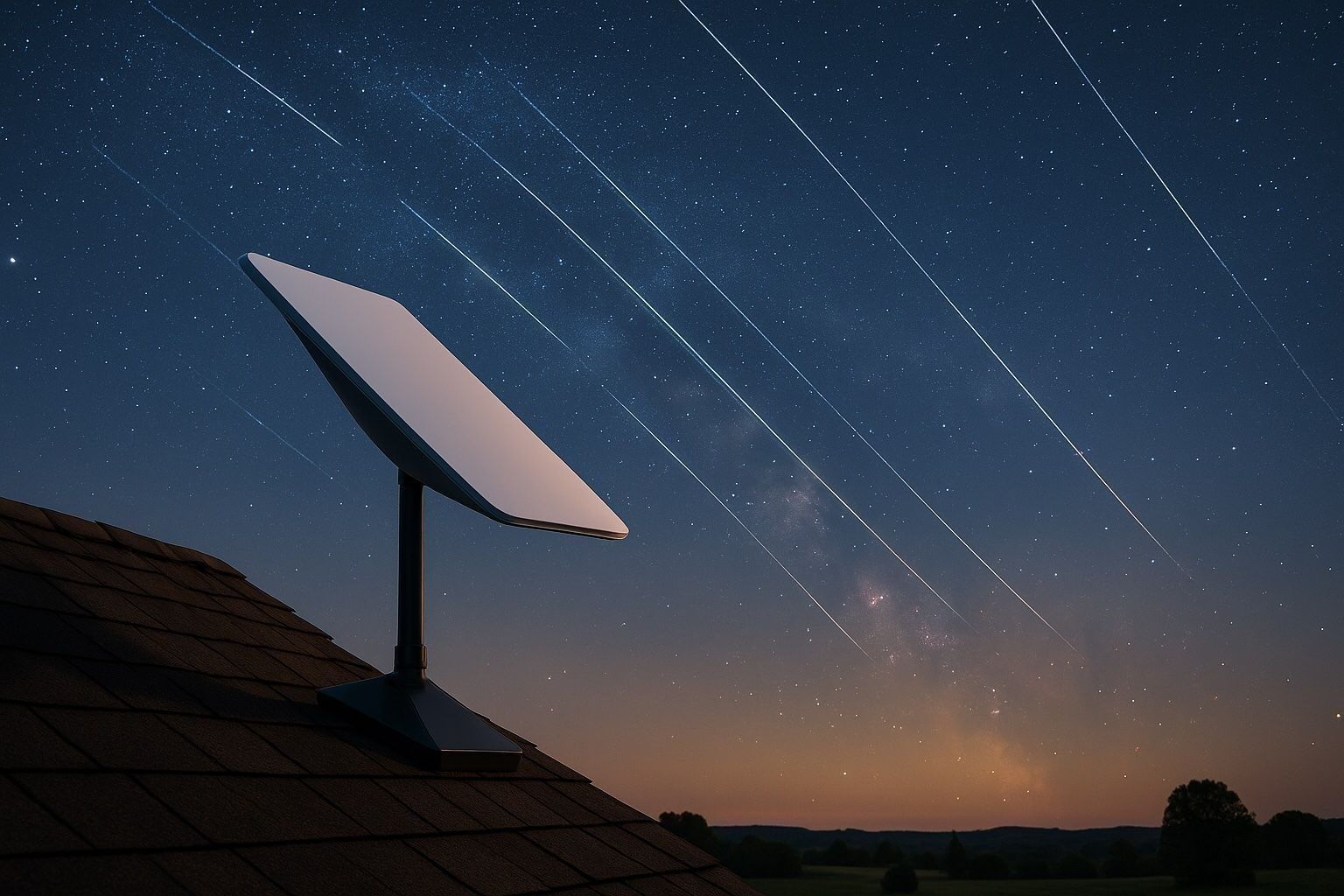
Reporting in The Verge describes how Hubble, which relies on long, sensitive exposures to catch faint galaxies and exoplanet signatures, increasingly finds its images “photobombed” by bright satellite streaks. The Verge
These trails don’t just draw white lines across otherwise beautiful astronomy pictures. As the Nature paper explains, they:
- Saturate pixels, leaving overexposed streaks that can’t simply be subtracted.
- Create scattered light and background gradients, making it harder to detect faint structures and subtle changes in brightness.
- Increase photon noise, degrading the scientific precision of measurements.
For some kinds of work – like searching for small, fast‑moving near‑Earth asteroids or tiny brightness dips that betray exoplanets, a single streak at the wrong place and time can effectively erase the data.
Future missions: SPHEREx, ARRAKIHS and Xuntian could be hit hardest
While Hubble gets much of the attention, the new analysis suggests that some upcoming missions are even more vulnerable.
SPHEREx
- SPHEREx (Spectro‑Photometer for the History of the Universe, Epoch of Reionization and Ices Explorer) is a NASA mission designed to map the entire sky in infrared, probing everything from galaxy evolution to the distribution of water and organic molecules. It launched in spring 2025 into low‑Earth orbit.
- Because it surveys wide areas repeatedly, SPHEREx provides many opportunities for satellites to cross its field of view.
- The Nature simulations predict more than 96% of its images will contain at least one trail, with an average of about 5–6 satellite streaks per exposure in a full‑constellation scenario.
ARRAKIHS
- ARRAKIHS (Analysis of Resolved Remnants of Accreted galaxies as a Key Instrument for Halo Surveys) is a planned ESA telescope that will study faint stellar halos and tidal streams around galaxies.
- It is particularly sensitive to low‑surface‑brightness features – exactly the kind of subtle structures that bright streaks and background gradients can obscure.
- The Nature team estimates about 69 satellite trails per exposure in the worst case, with more than 96% of its images affected.
Xuntian
- China’s Xuntian (“Surveying the Heavens”) space telescope will share an orbit with the Chinese space station and aims to conduct ultra‑wide‑field surveys of the cosmos. Nature
- In the megaconstellation scenario, Xuntian is by far the most impacted, with simulations showing an average of around 92 satellite trails per single exposure and again >96% of images contaminated.
European and Spanish‑language coverage, including Heise Online and El País, has emphasized how these numbers could undermine ambitious plans to map dark matter, galaxy halos and the large‑scale structure of the Universe.
The satellite boom: from Starlink to a crowded orbital marketplace
Part of what makes this story so urgent is the sheer rate of change in orbit.
The Nature study and follow‑up news reports outline a trajectory like this: Financial Times+3Nature+3ScienceAlert+3
- 2019: Around 2,000–5,000 satellites in orbit, depending on counting method.
- 2025: Roughly 15,000+ active satellites, with a large majority in low‑Earth orbit.
- Late 2030s (projected): Up to 560,000 satellites, if all current filings and proposals are approved and launched.
Today, nearly three‑quarters of active satellites belong to SpaceX’s Starlink internet constellation, according to AFP reporting carried by ScienceAlert.
But that dominance is expected to fade as rival networks from China’s Guowang system, Amazon’s Kuiper, OneWeb and others deploy tens of thousands of spacecraft of their own.
The satellites themselves are also changing:
- Early Starlink designs were already bright, but new “direct‑to‑cell” platforms and planned AI‑oriented data satellites can reach hundreds to thousands of square metres in area, making them appear as bright as the brightest stars – or even planet‑like – to the human eye. Nature+1
- Many constellations operate in the 340–8,000 km altitude range, overlapping the orbits of most current and planned space telescopes.
With each launch, the probability that any given long exposure includes a satellite trail creeps closer to 100%.
What’s really at risk: from exoplanets to asteroid defense
Across global coverage – from The Verge and Heise to Reuters, AFP/ScienceAlert, Phys.org, NDTV and the Financial Times – scientists stress that this isn’t just a cosmetic issue.
Key risks include:
- Missed near‑Earth objects (NEOs):
Many asteroid surveys rely on twilight observations, exactly when low‑altitude satellites are brightest and most numerous. Trails can mimic or mask the signatures of potentially hazardous asteroids. - Exoplanet detections:
Planet‑hunting often depends on tiny, periodic dimmings in starlight. Added noise or a streak during a crucial transit can erase that signal, making some planets effectively invisible to our instruments. - Faint galaxy and dark‑matter studies:
Missions like ARRAKIHS and Xuntian are designed to pick out extremely faint structures in galaxy halos and the cosmic web. Background gradients and lost pixels from trails eat directly into this science. - Operational costs and delays:
Each ruined frame can mean hours of wasted observing time, follow‑up re‑observations, and more complex data‑reduction pipelines, driving up mission costs across agencies.
The irony, noted in multiple articles, is that space telescopes were meant to escape Earth’s atmosphere and light pollution – yet now risk being blinded by human activity even in orbit.
Mitigation: darker satellites, smarter scheduling – and their limits
The Nature study and the recent wave of news coverage also explore what can be done – and why none of the current ideas fully solve the problem.
1. Darkening satellites
Several companies, working with the IAU Centre for the Protection of the Dark and Quiet Sky from Satellite Constellation Interference (CPS), have experimented with darker coatings, sunshades and different attitudes to make satellites dimmer.
But the Nature paper finds that:
- These measures have only modestly reduced optical brightness, often by about a magnitude or so – not enough for most professional telescopes.
- Darker surfaces can heat up, causing satellites to emit more infrared radiation, which creates new problems for missions observing in those wavelengths.
2. Observing at different times
Ground‑based observatories already try to avoid imaging during twilight, when low‑altitude satellites are sunlit and brightest. Some of those tactics carry over to space telescopes.
However:
- Many NEO searches and time‑critical observations must be done at twilight, exactly when satellites are most visible.
- Higher‑altitude constellations can remain sunlit throughout the night, meaning even midnight images can be contaminated.
3. Putting telescopes farther away
Telescopes placed at the Sun–Earth L2 Lagrange point, such as the James Webb Space Telescope (JWST) and ESA’s Euclid mission, sit roughly 1.5 million kilometres away and are effectively above the satellite clutter.
This strategy works – but it’s not a cure‑all:
- L2 missions are more complex and expensive, and can’t simply replace every kind of LEO telescope.
- Some science, especially all‑sky monitoring and rapid‑response targets, benefits from low‑Earth orbits that allow fast data downlinks and frequent revisits.
4. Flying satellites below telescopes
A mitigation option highlighted in the Nature paper and repeated in Reuters coverage is to keep large constellations below the orbits of key telescopes, so they don’t cross the field of view.
But there’s a catch:
When thousands of satellites are flown at very low altitudes, they re‑enter more quickly, potentially increasing aluminum and other debris in the upper atmosphere, which some scientists worry could damage the ozone layer as they burn up.
In short, every technical fix has trade‑offs – and none can fully compensate for an unchecked explosion in satellite numbers.
The policy front: from IAU and UN workshops to a push for rules
Because technical mitigation alone can’t solve the problem, astronomers are increasingly turning to policy and governance.
Key developments referenced in the recent coverage and associated documents include:
- The IAU CPS, launched in 2022, coordinates global efforts on science, industry engagement and policy, and has repeatedly warned that many existing constellations exceed the brightness limits considered acceptable for professional astronomy.
- In 2024 and 2025, the UN Committee on the Peaceful Uses of Outer Space (COPUOS) agreed to place “dark and quiet skies” and megaconstellations on its agenda, with conference papers outlining suggested actions for member states. skao.int+2European Southern Observatory+2
- Workshops co‑organized by UN OOSA and the Square Kilometre Array Observatory (SKAO) in 2025 have focused specifically on the impact of constellations on both optical and radio astronomy, and on shared mitigation strategies with satellite operators.
The new Nature study provides fresh, quantitative backing for those diplomatic efforts, and media coverage from outlets like the Financial Times has framed low‑Earth orbit as a threatened “global commons” in need of stronger international rules. Financial Times+1
As of December 5, 2025: where the debate stands
By today, December 5, 2025, the Nature paper has triggered a wave of global reporting:
- The Verge spotlighted Hubble “photobombing” and the risk to asteroid and exoplanet science. The Verge+1
- Heise Online stressed that Starlink and rival constellations could contaminate “almost all images” from future space telescopes, calling the results “really frightening” according to independent astronomers. heise online
- Reuters focused on NASA’s modeling and the jump from a few thousand satellites to tens of thousands today and potentially hundreds of thousands within a decade.
- The Financial Times, ScienceAlert, Phys.org, NDTV and others amplified the warning that almost all images from some missions could be compromised, while pointing to the growing discussions at the UN and within the IAU.
The emerging consensus is that time is running out to design a sustainable balance between global connectivity from space and our ability to study the Universe from orbit.
The study’s lead author, Alejandro Borlaff, and many colleagues are not arguing against satellites outright. Instead, they’re pushing for:
- Better coordination between space agencies, astronomers and operators.
- Transparent data on satellite orbits, brightness and orientations.
- Regulatory frameworks that treat LEO as shared infrastructure rather than an unlimited dumping ground for hardware.
Whether that happens will determine if the next generation of space telescopes can truly deliver on their promise – or spend much of their observing time cleaning up after the bright, busy web we’re spinning around our planet.
Related articles: NASDAQ:AMZN